Shanghai, as the leader of further opening up and attracting foreign investment in China, promulgated the revised Regulations of Shanghai Municipality on Encouraging Multinational Corporations to Establish Regional Headquarters (“2017 Regulations”) on February 14, 2017, which further optimizes the investment, economic development and governmental service environments, in order to spur multinational corporations (“MNC”) to consider Shanghai as their first choice for establishing regional headquarters.
In 2002, Shanghai promulgated the first interim regulations in China to encourage multinationals to establish regional headquarters (“Regional Headquarters”) [1] . These regulations were revised twice in 2008 and 2011 [2] , and implemented as the Regulations of Shanghai Municipality on Encouraging Multinational Corporations to Establish Regional Headquarters (Hu Fu Fa [2011] No. 98) (“2011 Regulations”). Under these regulations, Shanghai developed a basic set of preferential policies to promote MNC to move their regional headquarters to Shanghai, including financial support and awards, convenience in managing funds and centralized management of foreign exchange, convenience in exit-entry formalities and employment permits, and other preferential policies such as talent introduction and more convenient customs clearances and so on.
The 2017 Regulations mainly concentrate on revising the following:
Broadening the scope of Regional Headquarters
1. Introducing Quasi-Headquarters Entities
One of the highlights of the current revision is the official introduction of “Quasi-Headquarters Entities”. Quasi-Headquarters Entities refer to wholly foreign-owned enterprises (including branches) that, despite not meeting the standards for a multinational corporate regional headquarters, effectively provide multiple support service functions, including management decision-making, fund management, procurement, sales, logistics, settlement, research and development, and training, for the Multinationals in a region that includes more than one country. By introducing Quasi-Headquarters Entities, Shanghai has expanded the scope of enterprises entitled to preferential incentives granted to the Regional Headquarters of MNC. If the Shanghai Municipal Commission of Commerce (“SMCC”) recognizes a wholly foreign-owned enterprise as a Quasi-Headquarters Entity, the enterprise will enjoy the same advantages as a Regional Headquarters.
The standards and preferential policies for Quasi-Headquarters Entities were first seen in the Supplementary Provisions on the Implementing Opinions on the "Provisions of Shanghai Municipality on Encouraging the Establishment of Regional Headquarters by Multinational Companies," which was jointly promulgated in 2014 by 4 local Shanghai authorities, including the SMCC. The 2017 Regulations integrate the regulations in these supplementary provisions with respect to Quasi-Headquarters Entities. Meanwhile, the 2017 Regulations further adjust the recognition requirements for Quasi-Headquarters Entities (described in the following paragraph), so that the recognition of such entities and preferential policies will be implemented consistently.
2. Cancelling enterprise type and business scope requirements for Regional Headquarters
Before this revision, an enterprise recognized as a Regional Headquarters could only be established as either an investment company or a management company. The 2017 Regulations remove this limitation and allow a wholly foreign-owned enterprise that satisfies all of the requirements to be recognized as a Regional Headquarters, regardless of entity type (the identification requirements are described in the following paragraph). Furthermore, the limitation on business scope description is excluded from the 2017 Regulations, thereby allowing enterprises to enjoy more discretion with respect to business scope.
3. Adjustment of recognition requirements
Investment companies and management companies were previously subject to different standards in order to be recognized as Regional Headquarters. Investment companies could be directly recognized by SMCC as Regional Headquarters and thereafter enjoy policy benefits regardless of the assets of its parent company and the capital contributions of its parent company that had been paid in China. By contrast, management companies were required to satisfy certain requirements before applying to SMCC for recognition. The 2017 Regulations explicitly set out that certain requirements which must be satisfied for both investment companies and management companies (Article 5 of the 2017 Regulations).
The recognition standards specified in the former regulations and in 2017 Regulations are set out below: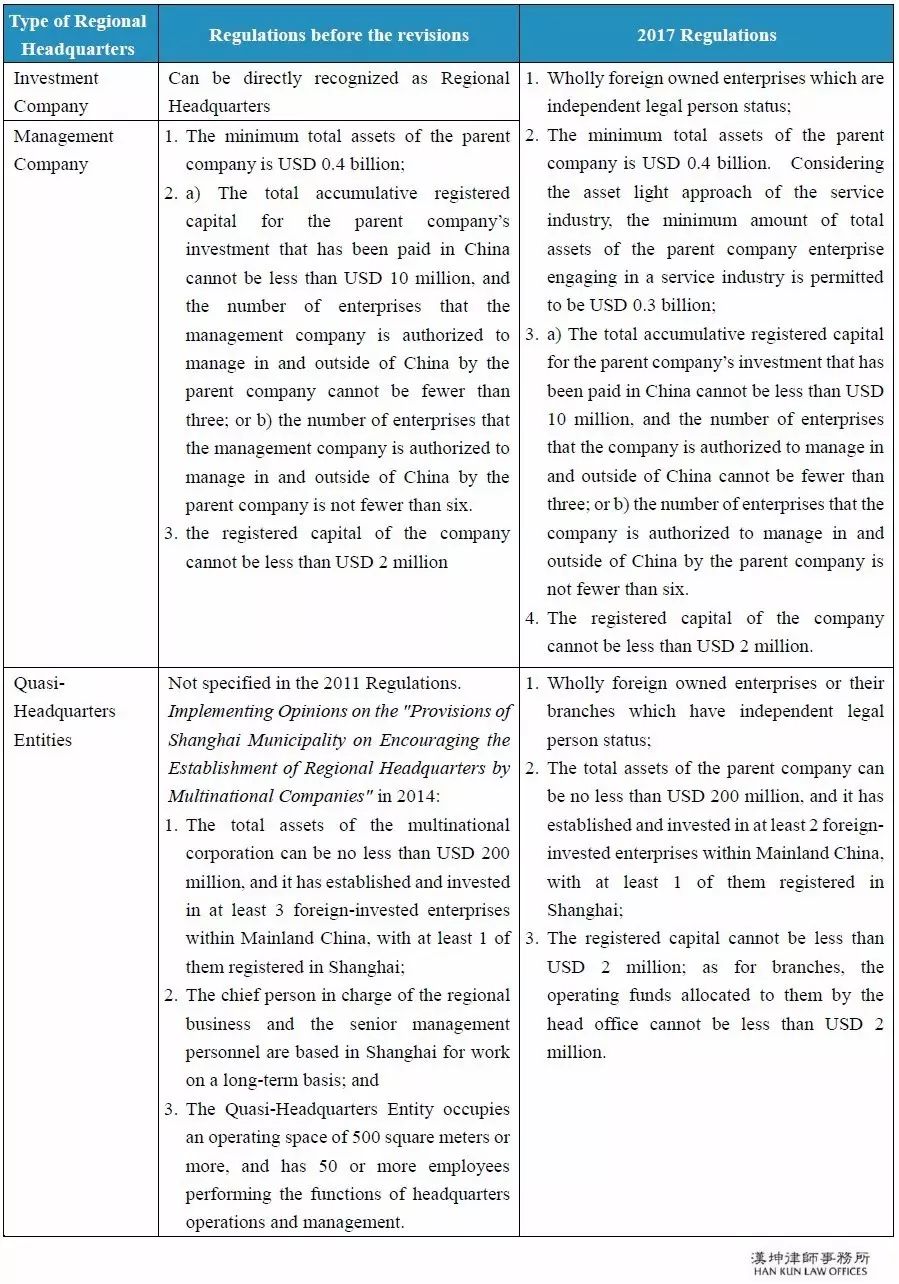
4. Adjustments to application document requirements
The revisions delete the requirements for capital verification reports and authorization documents, as well as the personal identification of the legal representative of the Regional Headquarters. The revisions now require an auditor’s report for the parent company for the preceding year. This adjustment keeps the required documents consistent with the conditions for recognition, and also coincides with the reforms of the registered capital subscription system. Further, the involvement of the parent company’s audit report reflects the SMCC’s practical attitude towards the recognition of Regional Headquarters, and shows that the authority is more concerned about the overall condition of the multinational corporation.
More policy conveniences
1. Shortening of time to receive recognition
After the revisions, the statutory time limit for the SMCC to recognize a Regional Headquarters will be shortened from 10 business days to 8 business days.
2. Clarifying the scope of fund management business that Regional Headquarters can participate in
The 2017 Regulations specify that Regional Headquarters and Quasi-Headquarters Entities can participate in the centralized management of foreign exchange funds as prescribed in the Regulations on the Centralized Operation and Management of Foreign Exchange Fund of Multinational Corporations, and encourage Regional Headquarters and Quasi-Headquarters Entities to participate in cross-border RMB business. Regional Headquarters and Quasi-Headquarters Entities based in the Shanghai Free Trade Zone can also open free trade accounts. These changes further simplify the procedures for foreign exchange fund management and cross-border payments within multinational corporations, and improve the efficiency of fund utilization.
Follow-on support policies from district governments
This Revision authorizes and encourages district governments in Shanghai to develop their respective implementing policies that fit in their practical conditions to establish a favorable environment for the development of Regional Headquarters. This will act to further refine the provisions of 2017 Regulations.
Conclusion
Compared to the policies of other cities, the revised 2017 Regulations relax the recognition requirements, simplify documentation requirements, shorten the approval time, and further specify the preferential policies that include fund management, exit-entry formalities and talent introduction, which undoubtedly will increase Shanghai’s competitiveness as the first choice for multinationals to establish Regional Headquarters. Moreover, given the revision repeals the Implementation Opinions of Shanghai Municipality on Encouraging Multinational Corporations to Establish Regional Headquarters (Hu Fu Ban Fa [2012] No. 52), including the financial support and reward policies found in the implementing opinions, we expect new implementing provisions to be issued soon to address these financial support and reward policies, and we expect more detailed policies to be promulgated by the SMCC and district governments in this area.
[1] Interim Regulations on Encouraging Multinational Corporations to Establish Regional Headquarters (Hu Fu Fa [2002] No. 24), which promulgated on July 20, 2002.
[2] The regulations were revised successively on July 7, 2008 and December 19, 2011, and the immediate predecessor to this revision is Regulations of Shanghai Municipality on Encouraging Multinational Corporations to Establish Regional Headquarters (Hu Fu Fa [2011] No. 98).
Shanghai Enhances Policies for MNC Regional Headquarters
作者:DavidTang JunLi SerinaWei来源:汉坤律师事务所

Shanghai, as the leader of further opening up and attracting foreign investment in China, promulgate