
Executive Summary
On July 25, 2016, China Food and Drug Administration (“CFDA”) published the latest "Measures for the Administration of Drug Registration (revised draft)” (“Latest Revised Draft”) for public comments[1]. Compared with the existing version effective since 2007 (“Existing Measures”), the Latest Revised Draft cancels certain time limitation rules dedicated to the protection of patent rights in the existing patent linkage mechanism and indicates that CFDA is minimizing its involvement in patent disputes related to the drug registration application. Specifically, with respect to those drug registration applications which are about drugs covered by existing patents, the Latest Revised Draft cancels the limitations about when certificates can be issued or effective, and keeps the previous revision of cancelling the limitations about when drug registration applications can be filed. In the meantime, according to previous explanation of CFDA as well as relevant content in the Latest Revised Draft, the dispute resolution mechanism newly introduced in the Latest Revised Draft is not likely to be available to patent disputes.
On July 25, 2016, CFDA published the latest "Measures for the Administration of Drug Registration (revised) for public comments on its official website. The public can send their comments on the Latest Revised Draft to the CFDA through emails before August 26, 2016.
Compared with the Existing Measures, the Latest Revised Draft specifies more detailed and explicit rules regarding drug examination, wherein the changes in the patent linkage mechanism are worth noting. The changes indicate that CDFA does not want to be too much involved in patent protection but hopes the new patent linkage mechanism, including applicants’ ownership statements of patents related to the drug registration application and non-infringement declaration about other parties’ domestic patents, can balance the legitimate interests of parties concerned. It seems that the intention of CFDA is to leave patent infringement disputes totally to judicial or other administrative proceedings. The major changes related to the patent linkage mechanism in the Latest Revised Draft are as follows:
1、No Limitation About When Drug Certificates Can Be Issued or Become Effective
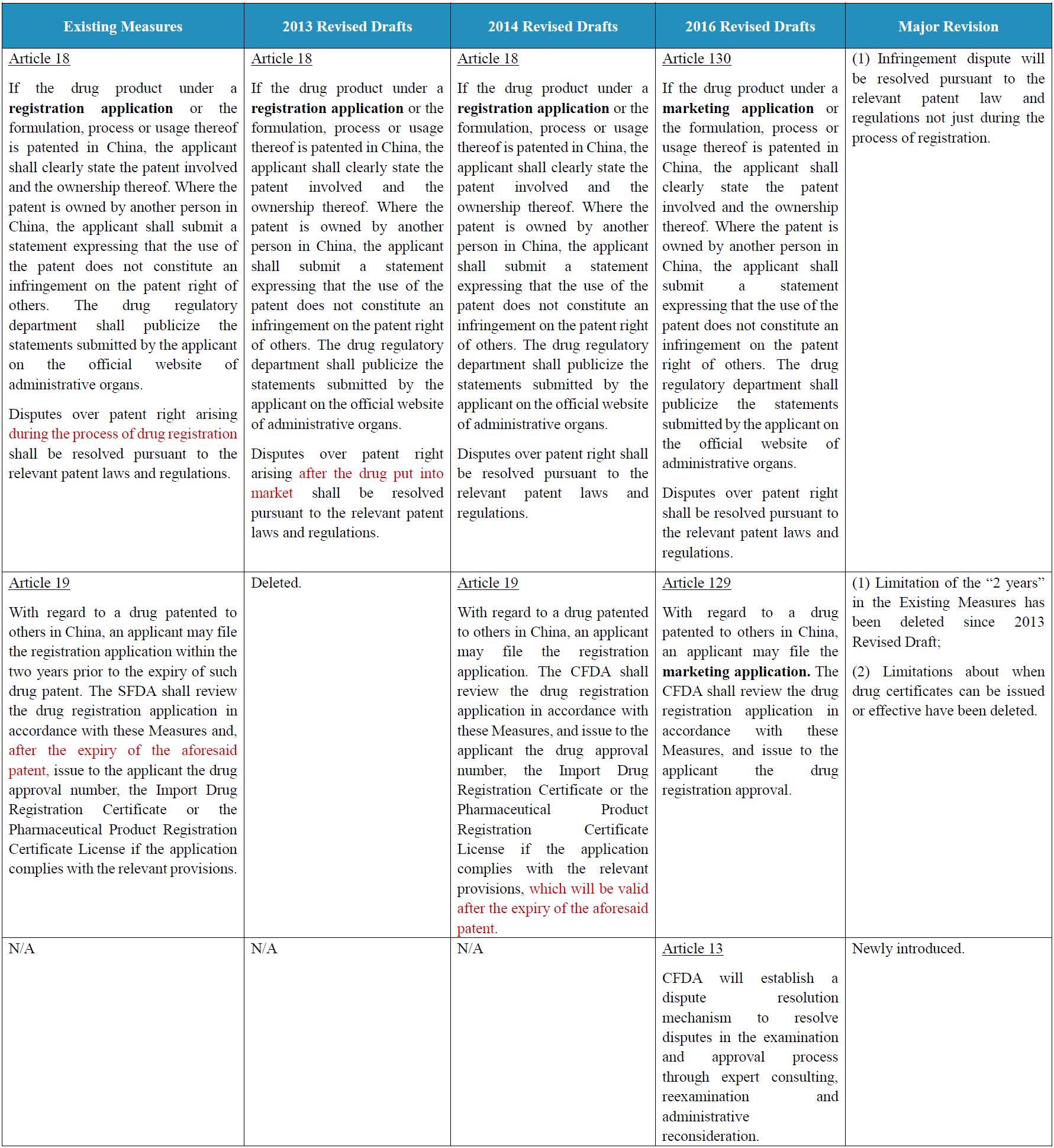
According to the Existing Measures, CFDA issues drug certificates only after expiration of related patents. In the previous revised draft published in 2014 (“2014 Revised Draft”), drug certificates can be issued before expiration dates but will not become effective until patents expire. While the revisions in the 2014 Revised Draft do not make substantive differences from the perspective of patentees, the cancellation about when drug certificates are issued or effective in the Latest Revised Draft suggests that drug certificates are not related to terms of patent any more. According to the Latest Revised Draft, drug certificates will become effective immediately after its issuance, while patent disputes will not be judged by CFDA. Due to the above changes, patentees will not be able to prevent generic drugs being granted effective certificates by raising patent claims against the applications before CFDA. And patent infringement disputes can only be resolved through the judicial and/or other administrative proceedings. The revisions will inevitably enhance difficulty of patent protection for patentees. And, more and more generic drugs, which are covered by existing patents, may enter into the market, probably resulting in increased number of related legal disputes.
2、Keep the Previous Revision of Cancelling Limitation About When Drug Registration Applications Can Be Filed
According to the Existing Measures, if there are patents of the others covering drugs in applications, applicants cannot file the drug application until the last two years of the term(s) of patent(s). However, the process from filing applications to obtaining certificates generally takes more than 2 years in practice, which means a lot of drugs covered by certain patents will not be able to enter into the market quickly even after the expiration of the patents. And the consequence is a de facto extension of term of a patent, which has been the most criticized part in the existing patent linkage mechanism by the industry. While CFDA has cancelled “two-year” rule in the revised draft published in 2013 (“2013 Revised Draft”), CFDA maintains its position in the 2014 Revised Draft and the Latest Revised Draft. As the cancellation of the “two year” rule has been throughout three versions of revised drafts, it is highly likely that the “two year” rule will be cancelled in the final version.
3、The Dispute Resolution Mechanism Newly Introduced In The Latest Revised Draft Is Not Likely To Be Available To The Patent Disputes
It is noted that CFDA has introduced “a dispute resolution mechanism to resolve disputes in the examination and approval process through expert consulting, reexamination and administrative reconsideration.” Based on the literal meaning of the expression, it is reasonable to assume that patent disputes should also fall into the broad scope of “disputes” prescribed in the mechanism. In other words, patentees can require CFDA to resolve patent disputes in the examination and approval process. If so, it would be significantly different from the “finding-infringement-then-seeking-judicial-reliefs” mechanism as of now. If disputes can be resolved by administrative proceedings in the drug registration application process, patentees can protect their patent right in a more effective and cost efficient way, by eliminating the possibility of infringement during the drug registration application process.
However, based on the previous explanation of CFDA as well as relevant contents in the Latest Revised Draft, we can see that the real objective of CFDA about introducing the dispute resolution mechanism is to resolve the disputes only related to examination of the three major drug approval issues, i.e. safety, efficacy and quality control, but not related to patents. Such intention can be inferred from the following reasons:
(1) In the official explanation about the 2013 Revised Draft, CFDA opined that there was no patent infringement in the drug registration process, pursuant to the sections about certain situations where there is no patent infringement in the Patent Law revised in 2008. And, the 2013 Revised Draft changed the term “during the drug registration process” into “after drugs enter into the market.” Therefore, it can be inferred that CFDA believes, as a matter of law, there is no patent infringement disputes during the drug registration process.
(2) Pursuant to Article 124 published in the Latest Revised Draft, applicants can file reexamination requests if they have any objection to the negative opinions issued by the examination institute, but the content of the reexamination shall be limited only to the original application items and the original application materials. Therefore, materials submitted by patentee about patent infringement are excluded from the scope of reexaminations. In other words, the infringement dispute is not an eligible subject in reexaminations.
Attachment: Comparison Chart
[1] See the official website: http://www.sda.gov.cn/WS01/CL0778/160300.html.
On July 25, 2016, China Food and Drug Administration (“CFDA”) published the latest "Measures for the Administration of Drug Registration (revised draft)” (“Latest Revised Draft”) for public comments[1]. Compared with the existing version effective since 2007 (“Existing Measures”), the Latest Revised Draft cancels certain time limitation rules dedicated to the protection of patent rights in the existing patent linkage mechanism and indicates that CFDA is minimizing its involvement in patent disputes related to the drug registration application. Specifically, with respect to those drug registration applications which are about drugs covered by existing patents, the Latest Revised Draft cancels the limitations about when certificates can be issued or effective, and keeps the previous revision of cancelling the limitations about when drug registration applications can be filed. In the meantime, according to previous explanation of CFDA as well as relevant content in the Latest Revised Draft, the dispute resolution mechanism newly introduced in the Latest Revised Draft is not likely to be available to patent disputes.
On July 25, 2016, CFDA published the latest "Measures for the Administration of Drug Registration (revised) for public comments on its official website. The public can send their comments on the Latest Revised Draft to the CFDA through emails before August 26, 2016.
Compared with the Existing Measures, the Latest Revised Draft specifies more detailed and explicit rules regarding drug examination, wherein the changes in the patent linkage mechanism are worth noting. The changes indicate that CDFA does not want to be too much involved in patent protection but hopes the new patent linkage mechanism, including applicants’ ownership statements of patents related to the drug registration application and non-infringement declaration about other parties’ domestic patents, can balance the legitimate interests of parties concerned. It seems that the intention of CFDA is to leave patent infringement disputes totally to judicial or other administrative proceedings. The major changes related to the patent linkage mechanism in the Latest Revised Draft are as follows:
1、No Limitation About When Drug Certificates Can Be Issued or Become Effective
According to the Existing Measures, CFDA issues drug certificates only after expiration of related patents. In the previous revised draft published in 2014 (“2014 Revised Draft”), drug certificates can be issued before expiration dates but will not become effective until patents expire. While the revisions in the 2014 Revised Draft do not make substantive differences from the perspective of patentees, the cancellation about when drug certificates are issued or effective in the Latest Revised Draft suggests that drug certificates are not related to terms of patent any more. According to the Latest Revised Draft, drug certificates will become effective immediately after its issuance, while patent disputes will not be judged by CFDA. Due to the above changes, patentees will not be able to prevent generic drugs being granted effective certificates by raising patent claims against the applications before CFDA. And patent infringement disputes can only be resolved through the judicial and/or other administrative proceedings. The revisions will inevitably enhance difficulty of patent protection for patentees. And, more and more generic drugs, which are covered by existing patents, may enter into the market, probably resulting in increased number of related legal disputes.
2、Keep the Previous Revision of Cancelling Limitation About When Drug Registration Applications Can Be Filed
According to the Existing Measures, if there are patents of the others covering drugs in applications, applicants cannot file the drug application until the last two years of the term(s) of patent(s). However, the process from filing applications to obtaining certificates generally takes more than 2 years in practice, which means a lot of drugs covered by certain patents will not be able to enter into the market quickly even after the expiration of the patents. And the consequence is a de facto extension of term of a patent, which has been the most criticized part in the existing patent linkage mechanism by the industry. While CFDA has cancelled “two-year” rule in the revised draft published in 2013 (“2013 Revised Draft”), CFDA maintains its position in the 2014 Revised Draft and the Latest Revised Draft. As the cancellation of the “two year” rule has been throughout three versions of revised drafts, it is highly likely that the “two year” rule will be cancelled in the final version.
3、The Dispute Resolution Mechanism Newly Introduced In The Latest Revised Draft Is Not Likely To Be Available To The Patent Disputes
It is noted that CFDA has introduced “a dispute resolution mechanism to resolve disputes in the examination and approval process through expert consulting, reexamination and administrative reconsideration.” Based on the literal meaning of the expression, it is reasonable to assume that patent disputes should also fall into the broad scope of “disputes” prescribed in the mechanism. In other words, patentees can require CFDA to resolve patent disputes in the examination and approval process. If so, it would be significantly different from the “finding-infringement-then-seeking-judicial-reliefs” mechanism as of now. If disputes can be resolved by administrative proceedings in the drug registration application process, patentees can protect their patent right in a more effective and cost efficient way, by eliminating the possibility of infringement during the drug registration application process.
However, based on the previous explanation of CFDA as well as relevant contents in the Latest Revised Draft, we can see that the real objective of CFDA about introducing the dispute resolution mechanism is to resolve the disputes only related to examination of the three major drug approval issues, i.e. safety, efficacy and quality control, but not related to patents. Such intention can be inferred from the following reasons:
(1) In the official explanation about the 2013 Revised Draft, CFDA opined that there was no patent infringement in the drug registration process, pursuant to the sections about certain situations where there is no patent infringement in the Patent Law revised in 2008. And, the 2013 Revised Draft changed the term “during the drug registration process” into “after drugs enter into the market.” Therefore, it can be inferred that CFDA believes, as a matter of law, there is no patent infringement disputes during the drug registration process.
(2) Pursuant to Article 124 published in the Latest Revised Draft, applicants can file reexamination requests if they have any objection to the negative opinions issued by the examination institute, but the content of the reexamination shall be limited only to the original application items and the original application materials. Therefore, materials submitted by patentee about patent infringement are excluded from the scope of reexaminations. In other words, the infringement dispute is not an eligible subject in reexaminations.
Attachment: Comparison Chart
[1] See the official website: http://www.sda.gov.cn/WS01/CL0778/160300.html.