On September 19, 2020, with the approval of the State Council, the Ministry of Commerce (“MOFCOM”) promulgated the Provisions on the Unreliable Entity List (the “Provisions”), which came into effect on the date of promulgation. More than a year after MOFCOM’s announcing at the end of May last year that China would establish an Unreliable Entity List (“UEL”) system, the final Provisions have refined the system and made some adjustments in terms of specific content, reflecting the supervision department’s thinking on the legislative purpose, the actual operation details, and the connection with other departmental laws. Together with the recently revised technology import and export management system as well as the current drafts of the Export Control Law and Data Security Law, the Provisions also reflect the urgency with which China is improving the relevant legislation due to geopolitical changes, and provide an effective means for ensuring China’s national sovereignty, public interests, and the legal rights and interests of companies in the context of a complex international environment.
It should be noted that the Provisions continue China’s consistent policy consideration of maintaining fair and reasonable international economic and trade rules, and do not impose differential treatment based on country status, nor do they contain preset timetables or issue specific lists simultaneously. Unlike the countermeasures of “an eye for an eye, a tooth for a tooth”, the Provisions, together with other related systems mentioned above, provide institutional guarantees for China to adhere to multilateralism and to broadly open up.
In terms of specific contents, compared with previous MOFCOM interpretations, the Provisions highlight the protection of “national interests” and “interests of Chinese enterprises, other organizations or individuals”. Whether or not the above interests are damaged and the extent of damage will be taken as the key basis for judging whether the relevant foreign entities should be included in the UEL. The Provisions also add and refine the requirements for delisting relevant entities when appropriate conditions are met. In terms of procedures, the Provisions focus on the protection of legitimacy, increased transparency, and granting foreign entities procedural statement and defense rights during investigations.
I. The Provisions continue China’s consistent policy consideration of maintaining fair and reasonable international economic and trade rules and do not implement differential treatment based on “country”, nor do they have a preset timetable or issue the specific lists simultaneously
Article 3 Provisions stipulates that “The Chinese Government pursues an independent foreign policy, adheres to the basic principles of international relations, including mutual respect for sovereignty, non-interference in each other’s internal affairs, and equality and mutual benefit, opposes unilateralism and protectionism, resolutely safeguards the core national interests, safeguards the multilateral trading system, and promotes an open world economy”. This article indicates that the main goal and functional orientation of establishing the system are to safeguard national core interests, safeguard international economic and trade rules, and promote the construction of an open world economy.
As MOFCOM explained shortly after the UEL was announced, China’s establishment of the UEL mainly aims to achieve the following goals: firstly, to safeguard China’s national security, including economic security, science and technology security, information security, resource security, etc.; secondly, to protect the social and public interests, safeguard the legitimate rights and interests of enterprises, and prevent Chinese entities from suffering risks such as supply interruptions and blockade in international economic and trade activities; and thirdly, to maintain fair and reasonable international economic and trade rules and the multilateral trade system based on rules, and to maintain the security and stability of global industrial chains
[1]. It is worth stressing that the Provisions do not follow the similar system in the United States or classify countries into different risk levels. From the institutional level, China’s UEL system will not implement differential treatment for enterprises in different countries. Previous press conferences held by MOFCOM also make it clear that the ultimate purpose of establishing the system is to maintain the order of fair and competitive markets and not to target the enterprises, organizations or individuals of any country
[2]. On September 20, 2020, the head of the Treaty and Law Department of MOFCOM also further emphasized when answering reporters’ questions about the Provisions
[3]: “First, the Chinese government’s position of firmly safeguarding multilateralism will not change. ... Second, the Chinese government’s position of further deepening reform and opening wider to the outside world will not change. ... Third, the Chinese government’s position of resolutely protecting the legal rights and interests of various market players will not change. The Provisions only target a very small number of foreign entities that violate market rules and Chinese laws. Foreign entities that are honest and law-abiding need not be concerned.”
In addition, the head of the Treaty and Law Department of MOFCOM also stated that the list does not have a preset timetable or a company list. If a foreign entity commits an illegal act listed in the Provisions, the working mechanism will strictly follow the Provisions, comprehensively consider various factors, and seriously and prudently decide whether to include the entity into the UEL and whether to take corresponding measures.
II. In terms of content, the Provisions highlight the protection of “national interests” and “interests of Chinese enterprises, other organizations or individuals”. The identification standard emphasizes objective factors and weakens subjective factors
As for concerns regarding which entities may be included in the UEL, Article 2 the Provisions divides the targeted acts into two categories: firstly, acts which endanger national sovereignty, security or development interests of China; secondly, acts of suspending normal transactions with an enterprise, other organization, or individual of China or applying discriminatory measures against an enterprise, other organization, or individual of China, which violate normal market transaction principles and cause serious damage to the legitimate rights and interests of the enterprise, other organization, or individual of China. This Article also provides that any foreign enterprise, other organization, or individual may be included in the UEL if they carry out the above-mentioned acts.
On this basis, Article 7 the Provisions further puts forward the result requirements. When the relevant departments judge whether to include a foreign entity in the UEL, the factors to be considered will include to what degree the national sovereignty, security or development interests of China are endangered; to what degree the legitimate rights and interests of enterprises, other organizations, or individuals of China are damaged; and whether the acts comply with internationally accepted economic and trade rules. In terms of specific application, the head of the Treaty and Law Department of the MOFCOM also said when answering reporters’ questions that the scope of application of the Provisions is strictly limited—only for a very small number of foreign entities in violation—and that this scope will not be expanded arbitrarily.
In fact, MOFCOM also responded to this issue last year, explaining that factors to be considered for listing decisions should include: firstly, whether the entity has implemented a block, supply interruption or other discriminatory acts against Chinese entities; secondly, whether entity’s behavior is based on non-commercial purposes and violates the rules and contracts of the market economy; thirdly, whether the entity has caused serious damage to Chinese enterprises and related industries; and finally, whether the behavior of the entity poses a threat or potential threat to national security
[4]. Compared with the explanations, the final Provisions provide “the national sovereignty, security and development interests” as a separate paragraph, which emphasizes and declares China’s determination to safeguard its national interests. This point is also echoed in the purpose of systems regarding national security and data sovereignty, such as those under the Data Security Law (Draft), Global Data Security Initiative.
At the same time, the Provisions no longer emphasize “non-commercial purpose” activities, but mainly focus on acts that “violate market transaction principles”, downplaying political goals and reflecting the institutional starting point of “maintaining international economic and trade rules.” In addition, deleting subjective elements such as “non-commercial purposes” and emphasizing objective factors such as actual influence will help increase predictability in implementing the system.
III. In terms of procedures, the Provisions focus on the protection of legitimacy, increased transparency, and granting foreign entities procedural statement and defense rights during investigations
In addition to the substantive clauses, the Provisions also stipulate procedures. Article 4 specifies that China will establish a working mechanism to take charge of organizing and implementing the UEL system. The office of the working mechanism is located within the competent department of commerce of the State Council and will also be composed of relevant departments[5].
Specifically, including a foreign entity in the UEL will generally require investigatory activities under the working mechanism. However, Article 8 also stipulates that where the facts about the actions taken by a foreign entity are clear, the working mechanism may directly make a decision on whether to include the foreign entity in the UEL and make an announcement. The main provisions for these investigatory activities are summarized as follows:
Initiation Conditions: Article 5 stipulates that the working mechanism can determine whether to investigate the behavior of the foreign entity ex officio or based on suggestions and reports from the relevant parties.
Investigation Method: Article 6 stipulates that the working mechanism may question relevant parties, search or copy relevant documents and materials, or investigate by other necessary means.
Entity rights: Article 6 also grants the entity under investigation with corresponding procedural statement and defense rights.
Consequences of an Investigation: Article 6 stipulates that, according to the results of the investigation and by taking into consideration the listing factories, the working mechanism will make a determination on whether to include the entity in the UEL and make a public announcement.
In view of this, we believe that foreign entities should guard against malicious complaints from competitors in their daily business activities. Once they are investigated, foreign entities should actively cooperate with the investigation and fully exercise their statement and defense rights.
IV. Import, export, investment and other activities of UEL-listed foreign entities will be subject to greater restrictions or prohibitions, but the Provisions also set out procedures and conditions for removing foreign entities from the list
The legal consequences of being listed have attracted much attention from outsiders. Article 9 and Article 10 of the Provisions provide for two types of legal consequences.
According to Article 9 of the Provisions, the working mechanism will issue an alert about the risks of conducting transactions with the listed foreign entity and may also specify a time limit for the listed foreign entity to rectify its actions. Combined with Article 11 of the Provisions, the measures in Article 10 will not be implemented during this time limit.
According to Article 10 of the Provisions, the working mechanism may, based on actual circumstances, decide to take one or several of the following measures with respect to a listed foreign entity:
restricting or prohibiting the foreign entity from engaging in China-related import or export activities;
restricting or prohibiting the foreign entity from investing in China;
restricting or prohibiting the foreign entity’s relevant personnel or means of transportation from entering into China;
restricting or revoking the relevant personnel’s work permit, status of stay or residence in China;
imposing a fine of the corresponding amount according to the severity of the circumstances; and
other necessary measures.
According to Article 1 of the Provisions and the relevant explanations of a MOFCOM spokesperson, the Provisions are mainly formulated in accordance with the Foreign Trade Law and the National Security Law. Compared with the legislative basis put forward during MOFCOM’s press conference last year, Article 1 the Provisions does not explicitly list the Anti-Monopoly Law. This may be due to the complexity and uncertainty of the determination of market dominance and justification for the application of the Anti-Monopoly Law. If an interruption of transactions or discriminatory behavior by foreign entities constitutes abuse of market dominance as stipulated in the Anti-Monopoly Law, it would be investigated and punished by the anti-monopoly law enforcement agency.
Chinese companies need to pay attention to Article 12 of the Provisions which stipulates that, in principle, Chinese companies, other organizations or individuals should not conduct transactions with foreign entities that are restricted or prohibited from engaging in China-related import or export activities, and Chinese companies should submit an application to the working mechanism and obtain prior permission under special circumstances if it is indeed necessary to conduct transactions with the foreign entity. However, the Provisions do not provide legal consequences for Chinese entities that engage in transactions with listed foreign entities in violation of the Provisions. According to Article 37 of the Export Control Law (Second Review Draft), once an export operator violates the provisions and engages in transactions with importers and end users included in the control list, the entity may be warned, ordered to stop illegal activities, have its illegal gains confiscated, and be fined up to 20 times the illegal operating amount. In serious circumstances, the entity will also be ordered to suspend business for rectification or even face revocation of its export business qualifications. Once the Export Control Law is officially promulgated and implemented, it may provide a corresponding legal basis for export controls under the UEL system.
Finally, it is worth noting that Article 13 of the Provisions also specifies a delisting mechanism. The working mechanism will enter a decision to delist a foreign entity from the UEL where the entity rectifies its actions with the time limit specified and takes measures to eliminate the consequences of its actions, in accordance with Article 13.1. In addition, a foreign entity may also apply for its removal from the UEL in accordance with Article 13.2 of the Provisions. In such case, the working mechanism will decide whether to delist it based on “actual circumstances”.
V. Compared with the United States, China’s UEL system awaits further improvement and implementing rules
In the current international environment, China’s UEL system is often compared with similar systems in Europe and the United States. Take the United States for example, the "Entity List" concept was proposed as early as 1990, and at that time was only to control the export of items that could be used to make nuclear weapons. In February 1997, the U.S. Department of Commerce issued the "Entity List" for the first time. After decades of practice, the U.S. "Entity List" system has relatively complete review standards and supporting measures and has gradually become an important means for the United States to safeguard its national security interests.
The U.S. export control system comprises a total of eight “lists” established for different situations, the Entity List being one of them. The Entity List is managed and executed by the Bureau of Industry and Security (“BIS”) of the U.S. Department of Commerce. The U.S. government may include in the Entity List any individual or company it deems to have participated or suspects of participating in activities that violate U.S. national security or endanger the interests of U.S. foreign policy. The End-user Review Committee (“ERC”) determines whether to include an entity in the Entity List. The ERC will implement licensing requirements for all dual-use items governed by the Export Administration Regulations (“EAR”) on the basis of considering the country of the listed entity and will update and modify the Entity List from time to time.
Compared with the U.S. Entity List system, China’s UEL system started relatively late and currently only has higher-level regulations. The supporting measures have not yet been introduced and the implementation of specific systems will require cooperation among legislative, administrative, and law enforcement departments.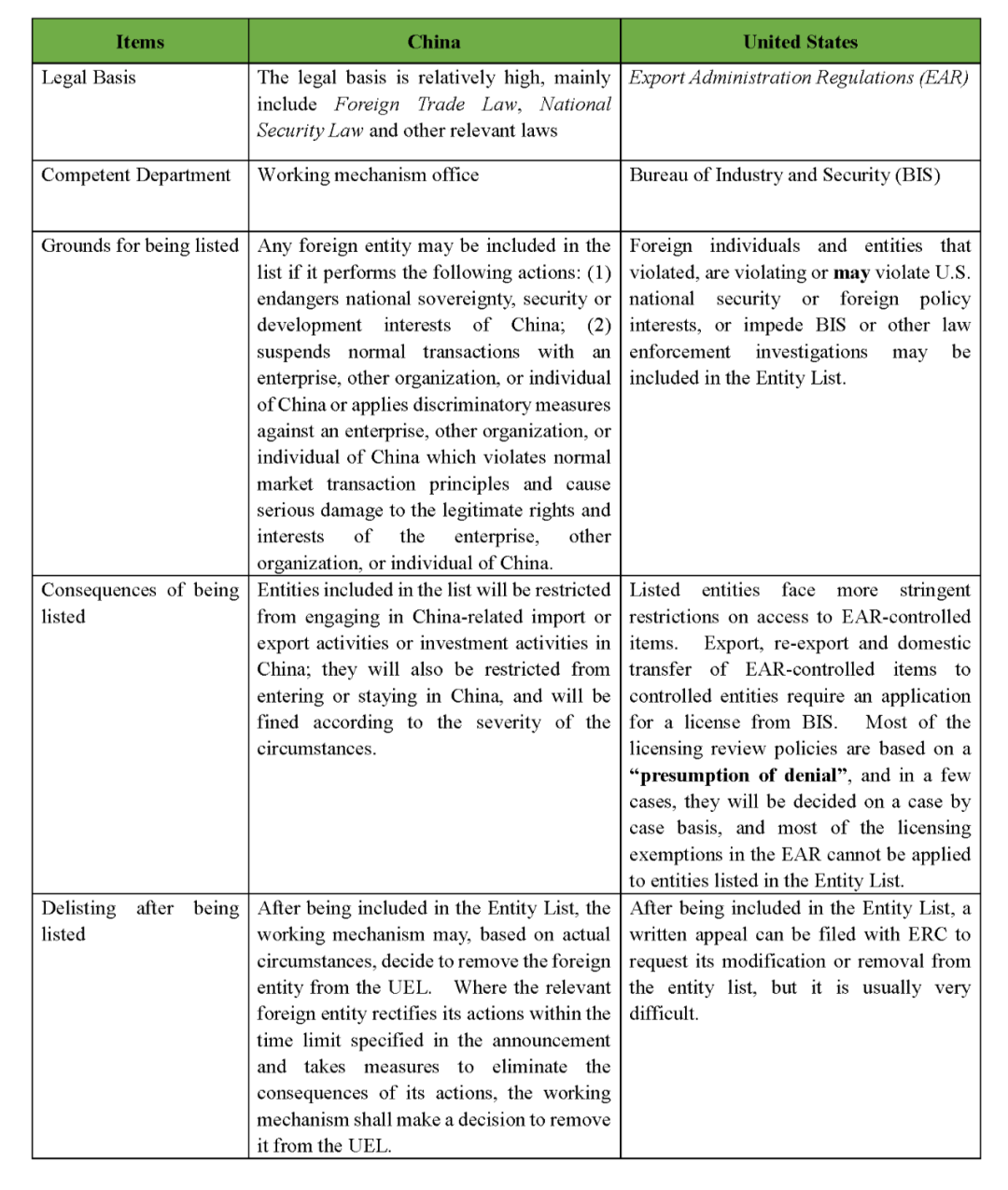
VI. Summary
Overall, the purpose of issuing the UEL is not to impose sanctions or restrictions, but to safeguard international economic and trade rules and China’s national interests. It also aims to protect entities which strictly abide by the market rules and the spirit of contracts. Same with the export control, data security and exit systems, the UEL is not a countermeasure against a specific country or a specific subject, but aims to improve China’s foreign economic and trade system from the legislative level, as well as to provide safeguards in a complex international environment for the maintenance of the international economic and trade order and the market competition environment.
In terms of subsequent implementation, the standards of the Provisions still need to be refined and clarified, including connecting with other departmental laws, related regulations and systems. As for foreign entities directly affected, of greater concern is how to address conflicting laws and regulations among countries in the context of international trade, and the resolution of such conflicts plainly requires the wisdom and flexibility of lawmakers, related administrative bodies, relevant entities, etc. We will continue to monitor for further developments regarding the UEL and international trade matters.
[1] Why introduce the system of Unreliable Entities List? Here is the interpretation of MOFCOM. http://coi.mofcom.gov.cn/article/y/gnxw/201906/20190602869699.shtml
[2] MOFCOM held a press conference on September 26,2019
http://nz.mofcom.gov.cn/article/jmxw/201910/20191002902948.shtml
[3] Head of the Treaty and Law Department of MOFCOM answered the reporters’ questions about the Provisions on the Unreliable Entity List.
http://www.mofcom.gov.cn/article/news/202009/20200903002631.shtml
[4] Why introduce the system of Unreliable Entities List? Here is the interpretation of MOFCOM. http://coi.mofcom.gov.cn/article/y/gnxw/201906/20190602869699.shtml
[5] According to the provisions of Article 6 of the Regulations of the People's Republic of China on the Administration of Technology Import and Export, the State Council and provincial authorities in charge of foreign economic relations and trade (i.e. the current competent department of commerce) are also responsible for the supervision of technology import and export.
Sword of Damocles: Provisions on Unreliable Entity List Issued
作者:KevinDuan XuezhenLu YadongLiu MinzheHu来源:汉坤律师事务所

On September 19, 2020, with the approval of the State Council, the Ministry of Commerce (“MOFCOM”) p