
During the process of patent granting and patent invalidation procedures, patent applicants and patentees typically focus on how to obtain a granted patent or how to maintain patent validity. For this purpose, the applicant or patentee will often amend claims or descriptions or submit observations to explain or clarify the scope of protection. Under the principle of estoppel, such amendments and observations will in fact have an impact on the future enforcement of patent rights and, more seriously, may directly lead a court to conclude non-infringement. Here, this article will briefly discuss possible impacts of amendments and observations submitted during the patent prosecution or patent invalidation procedures on the future enforcement of patent rights and put forward some suggestions, in combination with the 2018 second-instance final judgment of an actual case[1]. The first-instance judgment[2] in the case was also named one of the top ten typical cases of 2017 of the Guangzhou Intellectual Property Court.
I. Principle of Estoppel in the Patent System
The principle of estoppel applies in cases where a patentee restricts the scope of patent protection in order to obtain a granted patent or maintain the validity of a patent in the process of patent prosecution. Indicating that certain content is excluded from the scope of protection during patent prosecution or patent invalidation procedures precludes the applicant or patentee from re-incorporating such content into the scope of protection in a subsequent patent infringement lawsuit.
The Supreme People's Court officially sets out the principle of estoppel in Article 6 of the Interpretation on Several Issues Concerning the Application of Laws to the Trial of Patent Infringement Disputes I, “Where the patent applicant or patentee has abandoned a technical solution through amendments to claims and/or specification or observations during the prosecution or invalidation process, if the patentee asserts in a patent infringement lawsuit that the extent of protection of the patent right should include the technical solution, the People’s Court shall not allow such an assertion.”
With regard to the abandonment of technical solutions, the Supreme People’s Court added a “clearly rejected” exception to the estoppel principle in Article 13 of the Interpretation on Several Issues Concerning the Application of Laws in the Trial of Patent Infringement Disputes II. Under this exception, only where an examiner has “clearly rejected” amendments or observations which are intended to narrow the protection scope of claims will relevant technical solutions not be considered abandoned and not give rise to the principle of estoppel[3].
This exception will be further discussed in conjunction with a recent legal case.
II. Brief Introduction of the Case
Company A is the patentee of the invention patent “shielding film for printed wiring boards and printed wiring boards”. Company A believed that eight shielding film products manufactured and sold by Company B infringed on its invention patent right. Company A thus sued Company B, requesting Company B to bear civil liabilities, such as suspending infringement, compensating for economic losses and reasonable expenses for rights protection, totaling 92.72 million RMB.
During the court trial, one of the main focuses of the dispute between the two parties was how to interpret the technical feature of “the first metal layer is formed in a waveform structure along the one surface of the insulating layer” in claim 8 of the patent.
Company A’s examination dossier in the patent prosecution stage indicated that Company A filed the original patent application documents to the State Intellectual Property Office (now renamed as the China National Intellectual Property Administration) on February 3, 2010 and amended the claims in accordance with Article 28/41 of the Patent Cooperation Treaty. The original claim 1 was amended as claim 8, and the feature “the first metal layer is formed in a waveform structure along the one surface of the insulating layer” was amended to “both sides of the first metal layer are formed along one surface of the insulating layer”. The State Intellectual Property Office issued a first Office Action on June 27, 2011, indicating that the amendments to claim 8 went beyond the scope of the original specification and claims, as the original application document only recited two embodiments of the first metal layer, the first metal layer in the waveform structure and the first metal layer of a substantially planar structure, and did not recite that the first metal layer could be formed in any other kind of structure, such as in a zigzag or continuous concavo or convex shape. In response to this Office Action, the Applicant amended claim 8 back to the technical solution as claimed in the original claim 1. Based on this, the State Intellectual Property Office issued a Second Office Action, which only pointed out clarity problems in the claims caused due to the use of parentheses. The applicant responded thereto, and then the patent was granted.
In this regard, both the first-instance and second-instance courts held that the amendments to the claims by Company A in accordance with the first Office Action constituted a basis for applying the principle of estoppel.
Specifically, the second-instance court held that, During the prosecution of the subject patent, the examiner indicated in the first Office Action that the original application document only recited two embodiments, namely, the first metal layer in the waveform structure (see the figure below, i.e. Figure 1 of the subject patent as shown in Annex I of the judgment) and the first metal layer of the substantially planar structure, without providing for any other structures of the first metal layer (such as zigzag or continuous concavo-convex shape); the applicant had agreed with the examiner’s opinions and amended the claims accordingly.
Annex I (drawings for the specification of the subject patent)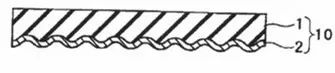
Fig. 1
In this regard, if the applicant did not accept the examiner’s relevant opinions, he should have responded accordingly in the prosecution process or, alternately, clearly and reasonably defined or explained the relevant technical features in further amendments. Therefore, the court held that the so-called “waveform structure” of the subject patent should be at least a relatively regular, relatively distinct, relatively smooth, continuous high and low undulating wave structure, which excludes a substantially flat, a zigzag, or a continuous concave or convex structure without high curvature.
On the other hand, the shape of the metal layer of the subject product is characterized by irregular and random undulations, including sections with relatively faint undulations or even flat, as well as sections with sudden changes in curvature (see the figure below, i.e. the graphical SEM results of the partial cross sections of the identified product in Annex III of the judgment).
Annex III (Graphical SEM results of 149 cross sections of the identified product shown in annex 3 of the expert opinions)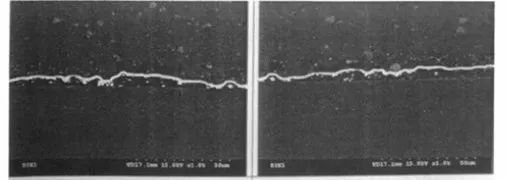
| Fig. 2 SEM result (1) of copper wire | Fig. 3 SEM result (2) of copper wire |
In combination with the aforementioned understanding of the “waveform structure”, this apparently does not conform to the “waveform structure” described in the patent. Based at least on this, the second-instance court held that the alleged infringing product did not fall within the scope of protection of the subject patent[1].
III. Insights from the Case
The main purpose of the principle of estoppel is to prevent the patentee from violating the principle of good faith, to “have it both ways” in the patent prosecution/invalidation process and infringement proceedings, resulting in harm to the public interest. In the course of the above case, the court used the previous patent examination dossier to explain the controversial technical features in the claims, in addition to the description, drawings, and the related claims in the claims of the subject patent. As can be seen, the work during the patent prosecution and patent invalidation procedures is also crucial for future rights protection.
The trial process of this case has many implications for patent applicants and intellectual property practitioners. During patent application, prosecution and patent invalidation procedures, we should keep estoppel in mind so as to avoid unnecessary troubles in the future enforcement of patent rights. Specifically, in order to avoid the impact of estoppel, applicants should pay more attention to the following aspects during patent prosecution.
Reasonably determine the scope of protection of independent claims and sufficiently lay out dependent claims before filing an application.
Fully provide the patent attorney with the background arts and innovative features of the invention so that the patent attorney can clarify the boundaries between the invention and the prior art, and thus the scope of protection of independent claims can be reasonably determined for the new, innovative features of the invention and dependent claims can be sufficiently and effectively laid out. The claims should be laid out in a manner from high-level to moderate generalizations and then to specific embodiments, so that all the technical solutions to be protected can be fully covered by the claims.
Carefully draft written communications with the State Intellectual Property Office in the patent prosecution and patent invalidation procedures.
During patent prosecution and patent invalidation procedures, it is prudent to draft written amendments and observations to be submitted, and to avoid carelessly interpreting invention technical solutions or amending claims in attempt to obtain a granted patent or maintain the validity of patent rights. In particular, when emphasizing that the technical solution of the invention differs from the cited references, or when amending the claim from a broader scope of protection to a narrower scope of protection, careful consideration should be given to whether such observations or amendments would lead to an abandonment of technical solutions which are actually desired to be contained in the scope of protection. In the patent prosecution process, for observations that may limit the scope of protection of the claims, you may consider contacting the examiner to verbally state the opinions in order to leave as little documentary evidence as possible while convincing the examiner.
Proactively clarify different opinions in the patent prosecution and patent invalidation procedures.
In the patent prosecution and patent invalidation procedures, if the patent applicant or patentee disagrees with the examiner's opinions, he should respond and explain in a positive manner, or alternatively, clearly and reasonably define or explain the relevant technical features in a desirable way in further amendments.
In summary, during patent prosecution and patent invalidation procedures, any amendments to the claims or description and any observations should be carefully considered to avoid unnecessary losses caused by the principle of estoppel.
[1] Guangdong Provincial Higher People's Court, Civil Judgment (2017) Yue Min Zhong No. 2363, China Judgement Online.
[2] Guangzhou Intellectual Property Court, Civil Judgment (2017) Yue 73 Min Chu No. 26, China Judgement Online.
[3] Song Jian, Zhang Xiaoyang, “Several questions about the application of the principle of estoppel in patent infringement litigation”, Journal of Law Application, Vol. 8, 2018.