On April 23, 2019, a decision amending the Trademark Law of the People’s Republic of China (the “Trademark Law”) was adopted at the Tenth Meeting of the Standing Committee of the Thirteenth National People’s Congress. Amended provisions of the Trademark Law will come into effect on November 1, 2019. This is the fourth time the Trademark Law has been amended, following amendments in 1993, 2001 and 2013.
This amendment primarily involves three aspects and revisions to six articles. Overall, the amendment tends to strengthen intellectual property protections, combat malicious registration of trademarks not for real use, improve the remedy system for malicious registration and malicious litigation, and increases the amount of compensation for trademark infringement, especially malicious infringement of trademark rights. The costs of violating the law are clearly increased, which will act to deter malicious registration, malicious litigation and malicious infringement. This article briefly introduces the key details of the amendment for your reference.
I. Combating malicious trademark registrations
A prominent problem currently existing in practice is that substantial trademark squatting and hoarding activities which lack real uses have made it difficult to protect domestic emerging enterprise brands and present obstacles for the entry of foreign brands into China. For these reasons, rights holders have had to spend substantial sums to buy the brands created by themselves from trademark squatters.
In most previous cases, such circumstances have been governed in accordance with Article 44 of the Trademark Law, which provides that dispute procedures to invalidate trademarks can be initiated only once a trademark has been approved for registration. In case trials, there are relatively high requirements for the number of trademarks squatters have registered and for the public profiles in China of rights holders’ trademarks. These factors greatly increase the cost and risk for brand rights holders to protect their rights, and are also not conducive to effectively curbing the malicious registration of trademarks.
In recent years, the courts and the Trademark Office of the State Intellectual Property Office have begun to explore pre-examinations of such circumstances, that is, at the preliminary examination stage, to directly refuse “large quantities of trademark registration applications that have no actual intended use and are for illegitimate purposes.” This amendment to the Trademark Law provides a clear legal basis for combating malicious registrations in four aspects: the initial examination process, trademark agency process, and in trademark application opposition and invalidation procedures. It is good news for reputable business operators that legal protections are now provided in full aspects, from applications and regulating agents to authorization and dispute resolution.
Specifically, the amended Article 4 of the Trademark Law adds that “malicious applications to register trademarks not intended for use shall be refused,” which gives examiners the right to voluntarily refuse applications at the preliminary examination stage. Article 19, para. 3 increases the obligations of trademark agents to review applications, and stipulates that agents may not accept malicious applications to register trademarks not intended for use. Articles 33 and 44 together provide for this circumstance as a reason for filing an opposition or invalidation. The amended Trademark Law can be seen as establishing a comprehensive system to combat malicious squatting and hoarding of trademarks, and this system can be described as interlocking with multiple levels of supervision.
Naturally, application of the amended Article 4 of the Trademark Law and the applicable procedures and circumstances will be further clarified in relevant supporting laws and regulations, judicial interpretations or examination guidelines. In general, we believe that “malicious applications to register trademarks not intended for use” should at least include: applying for the same or similar trademarks as the trademarks of different entities which have a certain familiarity with the public or relatively strong distinctiveness, and the application involves large quantities of trademarks or involves other serious circumstances; applying for the same or similar trademarks as the same entity’s trademarks which have a certain familiarity with the public or relatively strong distinctiveness, and the application involves large quantities of trademarks or involves other serious circumstances;; and applying to register the same or similar trademarks as others which have certain influence in the categories that are far beyond the applicant’s business scope.
II. Punishing malicious registration and malicious litigation
The amendment not only stipulates strict examination procedures during the trademark rights confirmation process, it also stipulates punishment during rights confirmation and litigation procedures.
The amended Trademark Law stipulates punishments for trademark agents who violate the amended Article 4 in Article 68, para. 1, clause 3, and also adds punishment provisions in Article 68, para. 1, clause 4. The first half of paragraph 4 stipulates that the competent authorities will impose “administrative penalties such as warnings and fines … according to the circumstances” for malicious applications for registration, and the latter half stipulates “the People's Court shall impose a penalty” for malicious trademark litigation.
The Supreme People’s Court has previously found that maliciously obtaining and using trademark rights to seek illegitimate gains was not protected under the law, in trademark infringement dispute case Zui Gao Fa Min Zai [2018] No. 396 (one of the 2018 top ten intellectual property rights cases in China). It can thus be seen that the new amendment to Trademark Law and this guiding case are of great significance in establishing sound and orderly trademark system, purifying the market environment, and curbing the use of unfairly obtained trademark rights in malicious litigation.
III. Increased compensation for trademark infringement
Another highlight of the new amendment is the increase in compensation for trademark infringement. Article 63 of the amended Trademark Law amends the method for calculating compensation in cases of malicious infringement of trademark rights from “more than one and less than three times” to “more than one and less than five times”. The maximum amount of statutory compensation has been raised from the original RMB “three million” to RMB “five million”. The amendments to these clauses reflect further increases in punitive damages for intellectual property infringement.
In recent years, the courts, the State Intellectual Property Office and other departments and leaders at all levels have been implementing and emphasizing punitive damage systems for intellectual property rights to effectively curb intellectual property rights infringement. It is foreseeable that the cost of intellectual property rights infringement will continue to increase in the future. Malicious trademark infringers may find themselves “ruined with nowhere to go”. This is more good news for reputable business operators. Now more than ever, it is increasingly meaningful for business operators in China to actively design and establish their own intellectual property systems, timely and effectively discover infringement and vigorously take action to defend their rights.
Annex: Comparison Table of Provisions before and after the revision of PRC Trademark Law[1]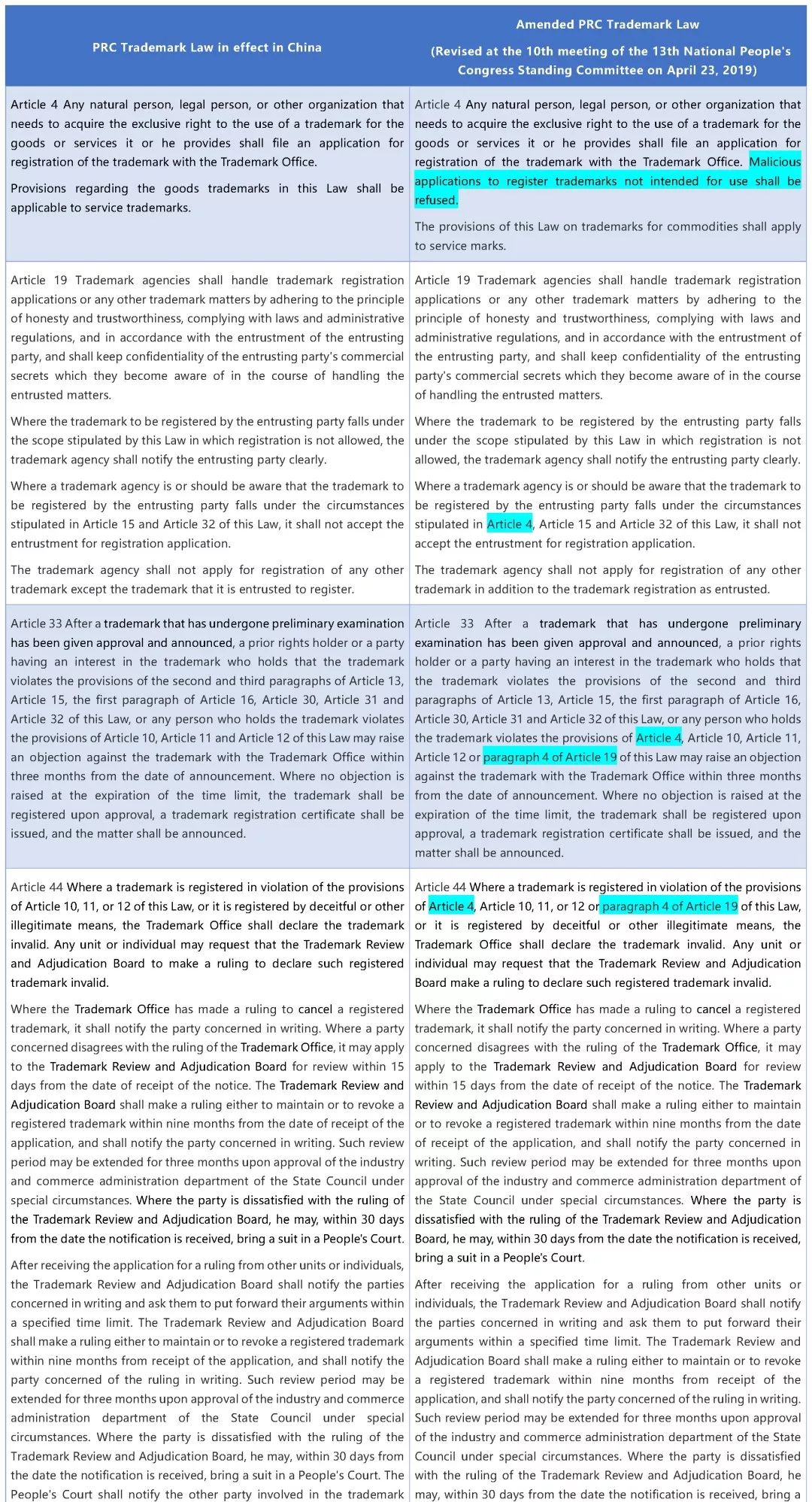
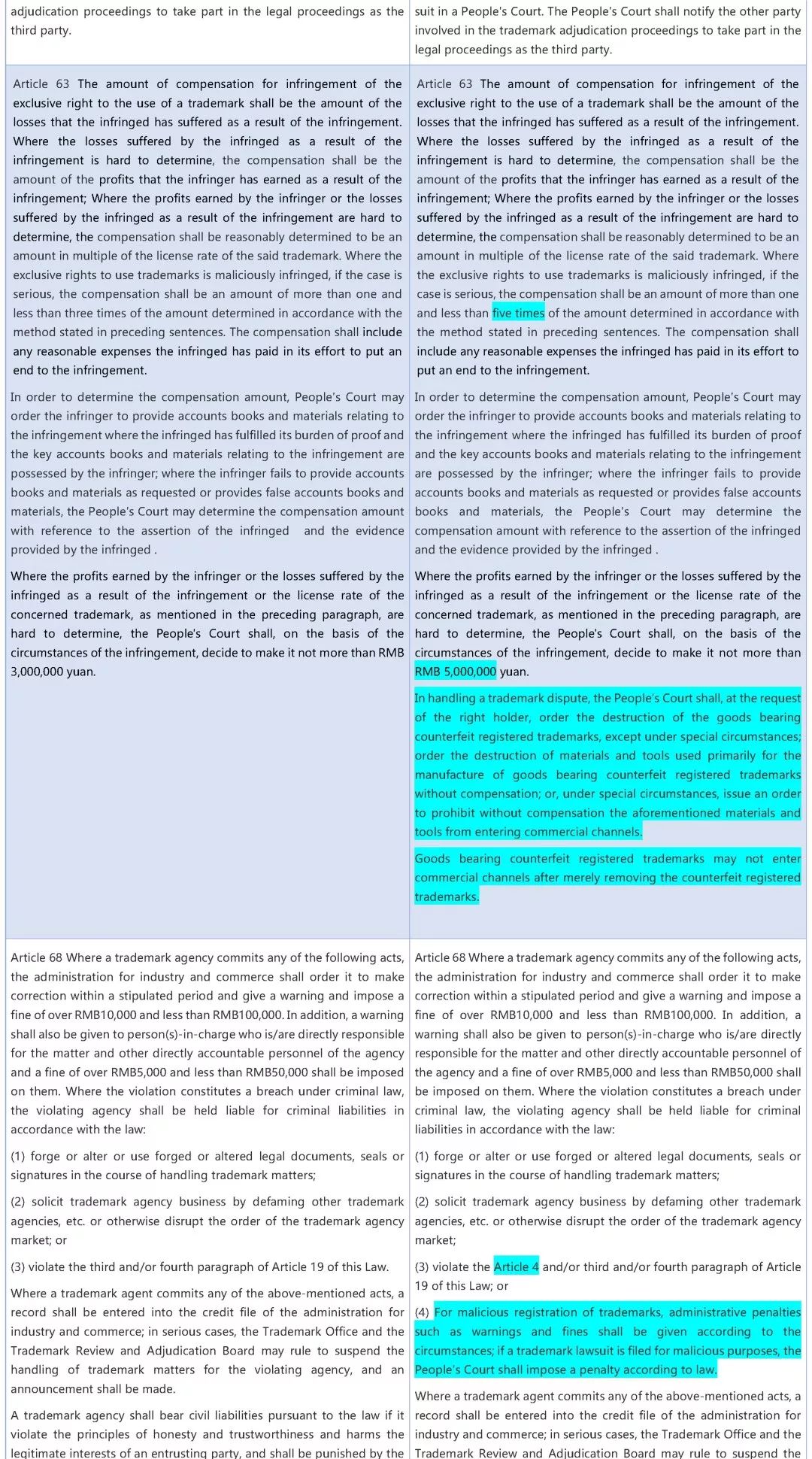

[1] http://www.npc.gov.cn/npc/xinwen/2019-04/23/content_2086193.htm
Amended Trademark Law: Combat Misconduct, Increase Compensation
作者:EstellaChen AliceLi来源:汉坤律师事务所

On April 23, 2019, a decision amending the Trademark Law of the People’s Republic of China (the “Tra