It has been less than two years since the last revisions in 2017 to the Law of the People’s Republic of China Against Unfair Competition (the “Anti-Unfair Competition Law”), but Chinese legislators have adopted on April 23, 2019 a decision again revising the Anti-Unfair Competition Law[1]. The revisions to the Anti-Unfair Competition Law took effect from the date of adoption.
These revisions only involve content related to trade secrets, and show China’s ambition to strengthen protections and provide legal safeguards for innovators. The following is a brief introduction to the revisions.
I. Adding means considered as trade secrets infringement and expansion of persons subject to infringement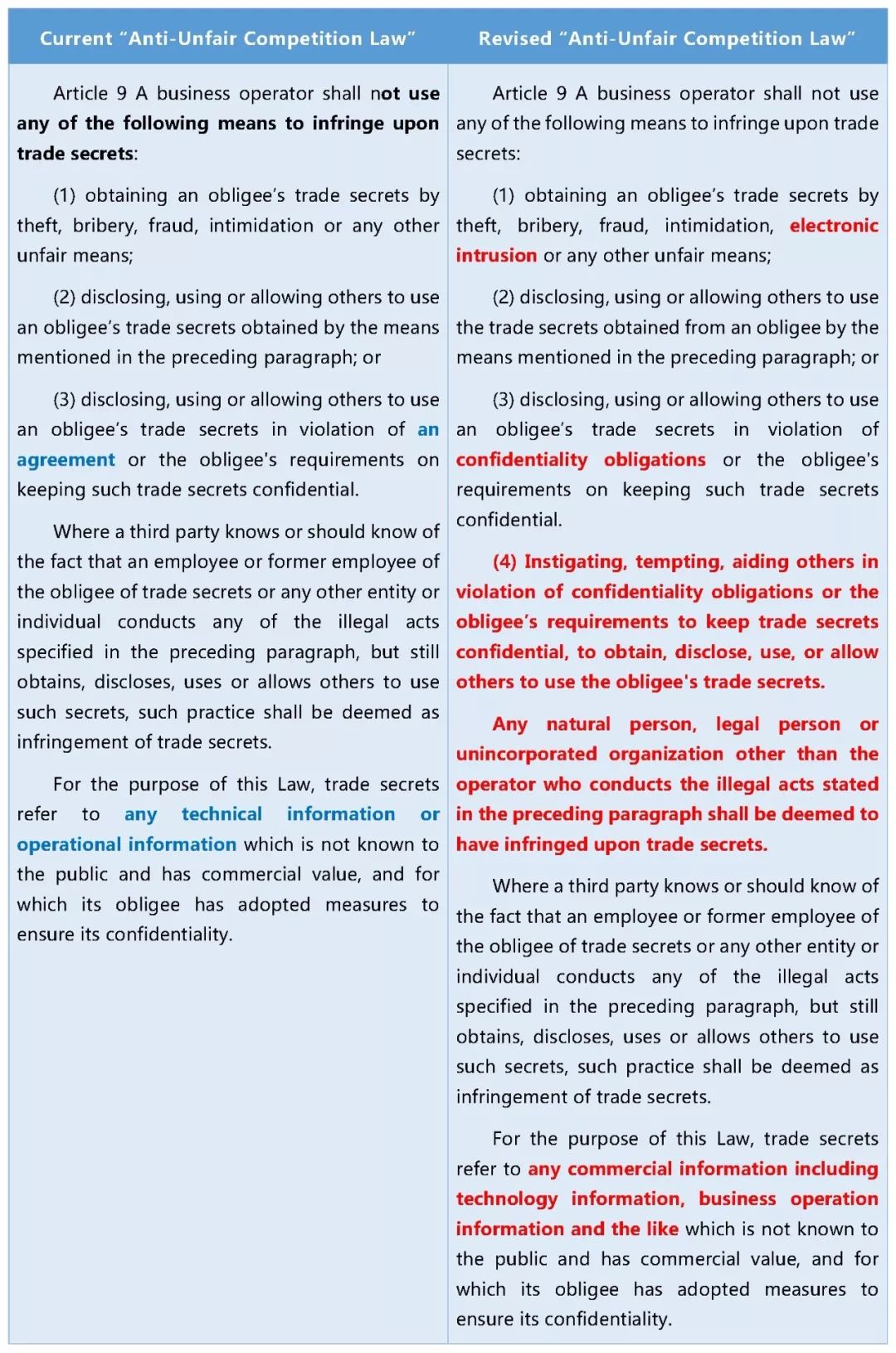
A. New means considered as trade secrets infringement
According to Article 9, the act of obtaining trade secrets of the obligee by means of electronic intrusion is regarded as trade secrets infringement. Also, instigating, inducing, or help others to obtain, disclose, use or allow others to use trade secrets by means of the above is considered infringement.
The above revisions clarify that, based on current technological developments, obtaining information illegitimately by electronic means is considered infringement of trade secrets, and they further provide a clear legal basis for enterprises to exercise their rights.
B. Expansion of persons subject to infringement
According to Article 9, persons subject to infringement is also expanded from only business operators to natural, legal persons or unincorporated organizations other than business operators.
This expansion of persons subject to infringement also directly combats a sore spot in modern trade secrets infringement—there is now a clear legal basis for determining eligible defendants, especially where trade secrets disputes arise due to employee departures.
II. Supplementing punitive damage provisions, increasing administrative penalties
A. Supplementing punitive damage provisions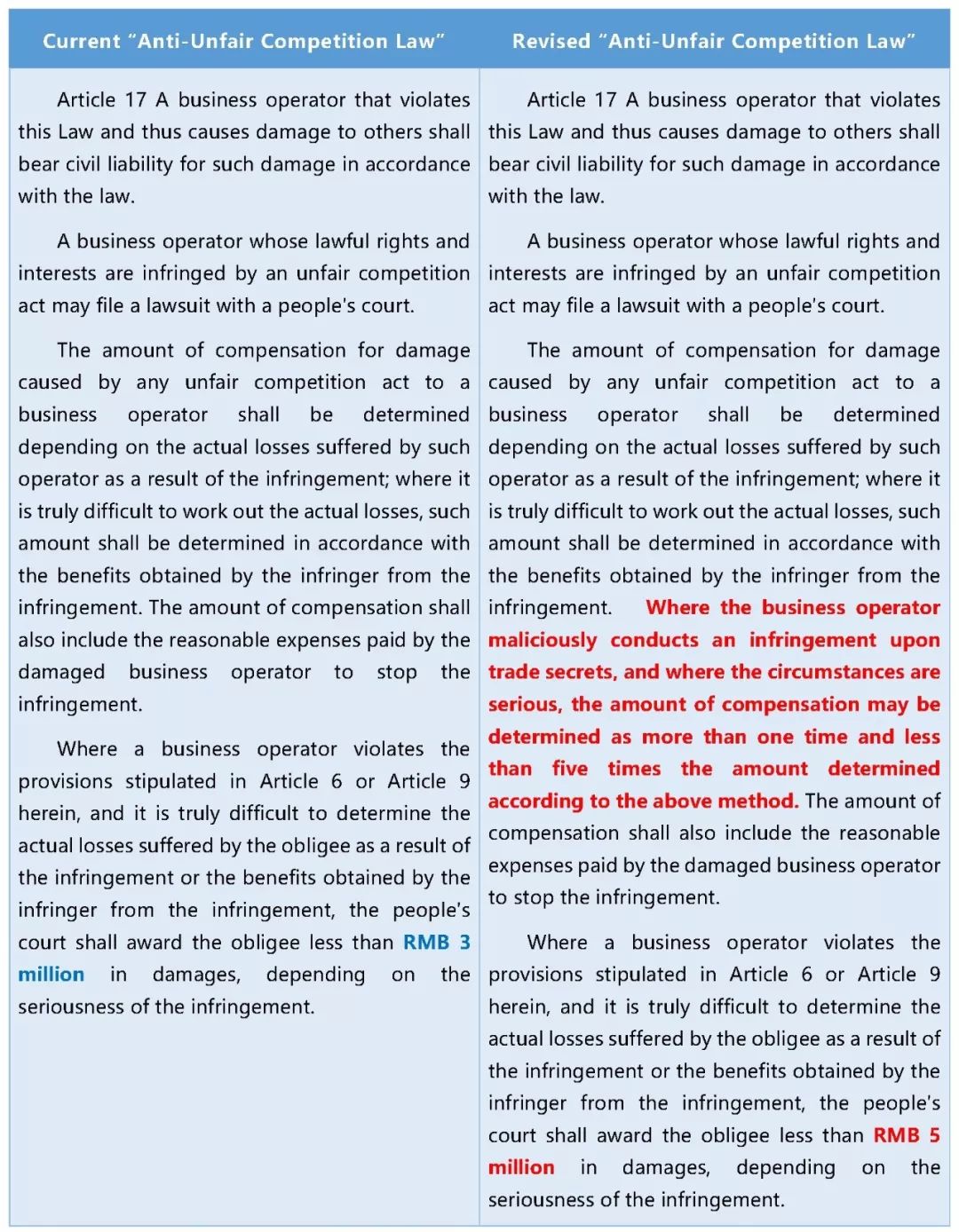
In the past, the amount of compensation for trade secrets infringement was determined based on the actual loss to the infringed party or the benefit to the infringer. Now, if a business operator is found to have committed serious malicious infringement, the amount of compensation may be determined to be more than one time but less than five times the amount mentioned above. Further, in the past, if the loss to the infringed party was difficult to determine, the court could decide to award the infringed party less than RMB 3 million in damages. This discretionary amount has now been increased from RMB 3 million to 5 million.
Following the 2017 revision to the Anti-Unfair Competition Law, which increased the maximum amount of compensation for trade secrets infringement to RMB 3 million from an amount which may be determined by referring to provisions on patent infringement (the maximum amount of compensation for patent infringement is RMB 1 million), the statutory maximum amount of compensation for trade secrets infringement is now raised again to RMB 5 million, which greatly strengthens the protection of trade secrets.
B. Increasing administrative penalties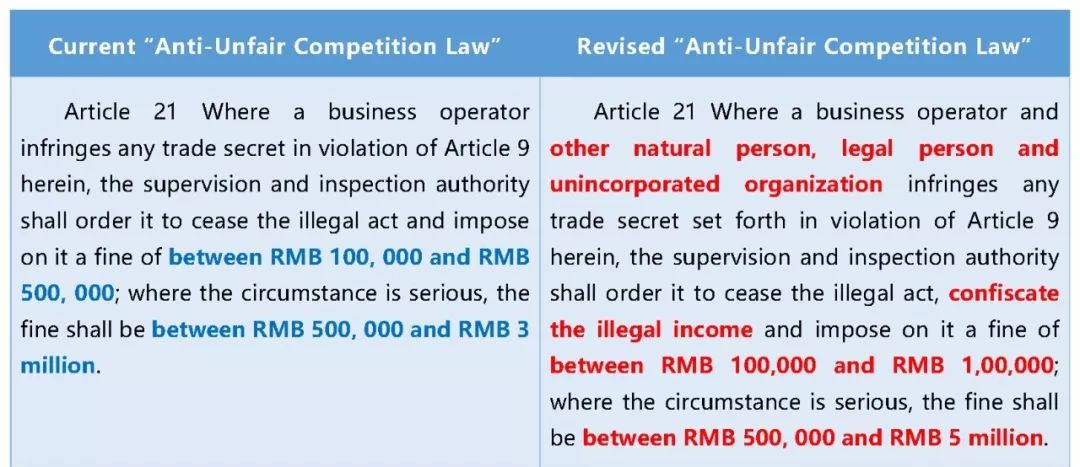
First, for trade secrets infringement, persons subject to penalties has been expanded from “business operator[s]” to “business operator[s] and other natural person[s], legal person[s] and unincorporated organization[s]”.
Second, the amount of penalties has been increased. Confiscation of illegal gains has been added as a penalty for trade secrets infringement. Fines have been increased from between RMB 100,000 and RMB 500,000 to between RMB 100,000 and RMB 1 million. For serious circumstances, the fines have been increased from between RMB 500,000 and RMB 3 million to between RMB 100,000 and RMB 5 million. Punishments have been greatly increased.
III. Relaxing the burden of proof of obligees and shifting the burden of proof to defendants after the initial production of evidence.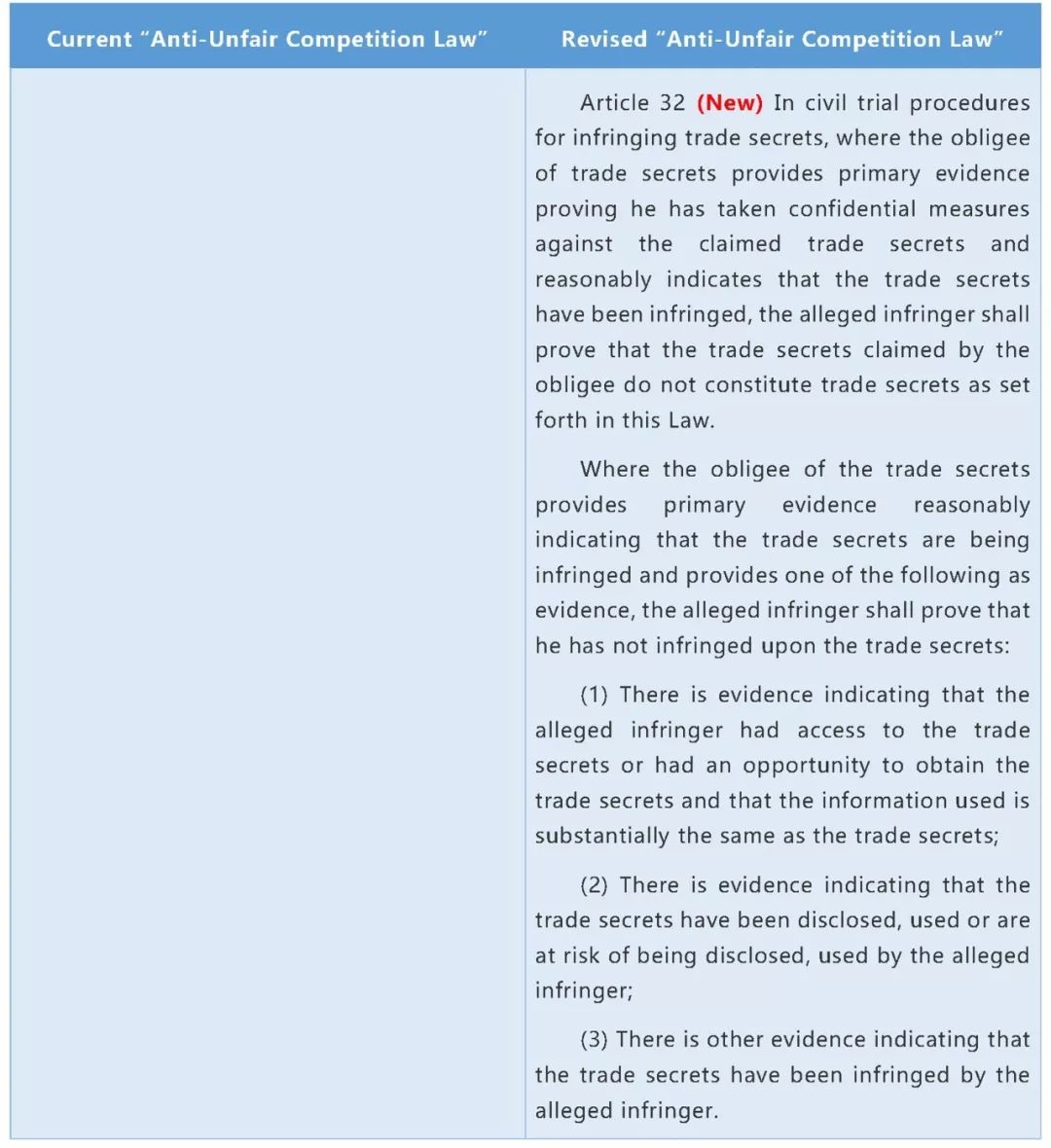
A. Trade secrets constitute a shifting of the burden of proof
According to the new Article 32, where the trade secrets obligee initially proves that the claimed trade secrets are confidential and reasonably indicates that the trade secrets have been infringed, the alleged infringer must prove that the trade secrets claimed by the obligee do not constitute trade secrets under the Anti-Unfair Competition Law.
B. Trade secrets infringement shifts the burden of proof
According to the new Article 32, under certain circumstances, as long as the obligee provides primary evidence that his trade secrets have been infringed, the alleged infringer must prove that he has not infringed the trade secrets.
The production of evidence has long been a barrier and difficulty for trade secrets obligees to safeguard their legitimate rights and interests. In past cases of trade secrets infringement, obligees have borne the full burden of proof. Obligees had to prove that the information was secret, valuable, and confidential, and constituted trade secrets in a legal sense, and that the obligee was the owner of the trade secrets. The obligee also had to prove that the alleged infringer met the conditions for and used illegitimate means to obtain the trade secrets, and finally the obligee had to prove the losses caused by the disclosure of the trade secrets.
According to this new article, after an initial production of evidence by the trade secrets obligee, the burden of proof can be partially shifted to the alleged infringer. Thus, the burden of proof of the obligee can be greatly reduced. This will help obligees to effectively protect their legitimate rights and interests.
In summary, the foregoing revisions to the Anti-Unfair Competition Law increase punishments for trade secrets infringement, while also alleviating the burden on obligees to prove their claims. These are positive developments for the protection of trade secrets, which reflect the ambition and intensity of the government to strengthen the intellectual property rights protections for innovators.
[1] 《全国人民代表大会常务委员会关于修改<中华人民共和国建筑法>等八部法律的决定》[Decision of the Standing Committee of the National People's Congress on Revising the Construction Law of the People's Republic of China and Eight Other Laws] (adopted by Standing Comm. Nat’l People’s Cong. on April 23, 2019).
Introducing the Revisions to the Anti-Unfair Competition Law
作者:LiliWu FayeWang来源:汉坤律师事务所

It has been less than two years since the last revisions in 2017 to the Law of the People’s Republic