On June 11, 2014, the Supreme People’s Court of the PRC (the “Supreme Court”) held an open hearing of a case between SINO-ENVIRONMENT TECHNOLOGY GROUP LIMITED (“Sino-Env”) and Thumb Env-Tech Group (Fujian) Co., Ltd. (“Thumb Fujian”) concerning their dispute over shareholder’s capital contribution (the “Case”) (Case No.: (2014) Min Si Zhong Zi No. 20) and rendered a ruling (the “Ruling”) with respect to the Case at the end of the hearing. By rendering the Ruling, the Supreme Court has for the first time officially recognized the influence of the overseas receiver of a non-PRC company over its PRC affiliate(s) in the form of a judgment, which would offer important guidance for the determination and handling of the disputes between the overseas receivers of non-PRC companies and their PRC affiliates that have arisen more and more frequently in the recent years (and for the purposes of this Bulletin, the term “PRC” or “China” does not include Hong Kong, Macau and Taiwan).
I. Overview of the Case
Sino-Env was incorporated inthe High Court of the Republic of Singapore issued a court order, ordering that Sino-Env should be placed under judicial management and appointing Mr. Seshadri Rajagopalan and Ms. Ee Meng Yen Angela from an accounting firm as judicial managers. In March 2012, the High Court of the Republic of Singapore issued another court order, replacing the initial judicial managers with Mr. Hamish Alexander Christie as the new judicial manager.
Thumb Fujian is a wholly foreign-owned enterprise (WFOE) incorporated in the PRC on June 30, 2000 and wholly owned by Sino-Env. On January 20, 2011 and March 24, 2011, Sino-Env adopted written resolutions under the management of the judicial managers, removing Tian Yuan, Chen Bin and Pan Chengtu from their offices of director of Thumb Fujian and appointing three new directors of Thumb Fujian and one of the new directors as the legal representative of Thumb Fujian. On March 30, 2012, Sino-Env issued another written resolution appointing Mr. Cosimo Borrelli (“Mr. CB”), Ms. Jocelyn Chi and Mr. Song Kuan as the directors of Thumb Fujian and Mr. CB as the legal representative of Thumb Fujian. However, the changes resulting from such resolutions were not registered with the competent authority of administration for industry and commerce (AIC) in China. To the contrary, based on the AIC files of Thumb Fujian, the legal representative of Thumb Fujian was Tian Yuan on May 25, 2009 and was changed to Hong Zhen on December 18, 2012.
Since Sino-Env did not fully contribute to the increase in the registered capital of Thumb Fujian, Thumb Fujian sued Sino-Env in Fujian Higher People’s Court (“Fujian Higher Court”) (Case No.: (2013) Min Min Chu Zi No. 43), requesting Fujian Higher Court to order Sino-Env to perform its capital contribution obligation as shareholder by paying RMB 45 million yuan as its contribution to the capital increase of Thumb Fujian. In response to the suit commenced by Thumb Fujian, Mr. CB applied to Fujian Higher Court for withdrawal of the suit in his capacity as the legal representative of Thumb Fujian, arguing that the bill of complaint and power of attorney from Thumb Fujian were issued by unauthorized personnel with theseal of Thumb Fujian improperly used by them, without the consent of the legitimate legal representative of Thumb Fujian, and thus could not represent the “true intent” of Thumb Fujian.
Fujian Higher Court held that pursuant to the PRC law, full faith and credit should be given to the AIC registration information and the legal representative of Thumb Fujian should be that registered with the competent AIC authority, and the application for withdrawal made by Mr. CB on behalf of Thumb Fujian as a declaration of intent should have no legal force and effect in the absence of the evidence proving that he had been registered as the legal representative of Thumb Fujian. Therefore, in the judgment of first instance, Fujian Higher Court ordered Sino-Env to make a capital contribution of RMB 45 million yuan to Thumb Fujian within 10 days after the judgment becoming effective.
II. Ruling of the Supreme Court
Dissatisfied with the judgment rendered by Fujian Higher Court, Sino-Env appealed to the Supreme Court, and the Supreme Court heard the Case and rendered the Ruling on June 11, 2014.
In the hearing of the Case, the Supreme Court determined that “whether the commencement of the suit by Thumb Fujian in the Case was a declaration of true intent” should be a key issue under the Case. The Supreme Court held that pursuant to the PRC Company Law and the PRC Law on Wholly Foreign-owned Enterprises, the shareholder of a one-person company should have the right to appoint the director(s) and legal representative of the company. In the Case, since the sole shareholder of Thumb Fujian was Sino-Env (in the process of winding-up), the Supreme Court held that the resolutions of its judicial managers appointing the legal representative of Thumb Fujian should be valid. Although the legal representative of Thumb Fujian registered with the competent AIC authority was different from that appointed by Sino-Env, the Supreme Court held that externally, the legal representative of a company should be that registered with the competent AIC authority, but internally, the legal representative of the company should be determined pursuant to the appointment/removal decision in its shareholder resolution, and thus the commencement of the suit by Thumb Fujian in the Case could not constitute a declaration of the true intent of Thumb Fujian and the litigation claims made by Thumb Fujian in the Case should be rejected.Therefore, the Supreme Court rendered the Ruling, cancelling the judgment of first instance rendered by Fujian Higher Court and rejecting the suit of Thumb Fujian.
III. Comments on the Ruling of the Supreme Court
The Ruling rendered by the Supreme Court with respect to the Case, which was final, indicates that the influence and control of the overseas judicial receivers / judicial managers / liquidators of non-PRC companies over their PRC affiliates have gradually become clear and strong.
1. Concept of Judicial Receivership
Courts in common law countries are granted with certain substantial powers and could intervene in a very wide variety of corporate disputes. For instance, (i) the General Corporation Law of the State of Delaware has created the mechanism of judicial custodian that will apply in case of deadlocks of a corporation; (ii) the Companies Act (Chapter 50) of Singapore has introduced a mechanism of judicial receivership for companies in financial difficulties; (iii) the High Court Ordinance (Chapter 4) of Hong Kong provides that the Court of First Instance may by order appoint a receiver in all cases in which it appears to the Court of First Instance to be just or convenient to do so; (iv) sections 223 through 227 of the Companies Law of Cayman Islands contain detailed provisions on the applications for and administration and discharge of receivership orders; and (v) the laws of British Virgin Islands, which are similar to the common law system of England, provide that an injunction may be granted “in all cases in which it appears to the Court to be just or convenient” (such as freezing of property and disclosure of information) and a receiver of property of a company be appointed. In addition, in case of winding-up of a company, a liquidator will be appointed in respect of the company, for example, both the Companies Act (Chapter 50) ofSingaporeand the Companies (Winding Up and Miscellaneous Provisions) Ordinance (Chapter 32) of Hong Kong contain such provisions.
Different terms are used in the laws of different countries to describe the third party taking the company into his custody or under his control, and for the purpose of convenience, each of such third parties is called a “receiver” herein. Receivership is a judicial remedy granted by a court for the primary purpose of denying the right of a debtor to control, manage and dispose of its relevant assets and business and transferring such right to the receiver in order to control the sources of debt repayments and ensure the repayment of debts. Usually, a non-PRC court would issue an order appointing a receiver in respect of a company, and in this Case, the judicial managers were appointed in respect of Sino-Env by a Singapore court.
2. Influence of Judicial Receivership on PRC Companies
More and more PRC companies have set up offshore companies in other jurisdictions, some do so for the purpose of preparing for listing in another jurisdiction or for the purpose of making investments through such offshore companies, and some do so for the purpose of conducting capital operations through an offshore holding company, or for the purpose of legitimate tax avoidance, etc. For example, under the red chip listing model, which is a way of listing in a jurisdiction other than the PRC, a PRC company will register or buy an offshore shell company, the offshore company would gain the control over the PRC company and its assets by way of acquisition or equity exchange or otherwise, and the shell company would be listed in an offshore securities market for financing purposes. The following chart shows the customary structure: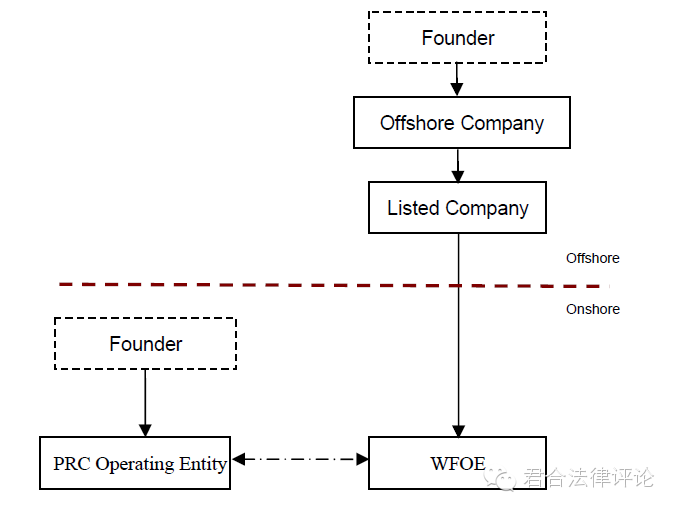
As shown in the above chart, if the offshore company or listed company is sued in a jurisdiction other than China, the relevant court in such jurisdiction could issue an order appointing a receiver in respect of the offshore company or listed company. Generally speaking, the PRC affiliates of the offshore company or listed company would certainly be subject to the influence of the receiver since they are invested by the offshore company or listed company directly or indirectly through one or more intermediaries.
3. Attitude of the PRC Courts towards Judicial Receivership
(1) The PRC courts do not recognize the force and effect within the PRC territory of the orders of appointment of receiver issued by courts in the other jurisdictions.
Pursuant to Article 281 of the Civil Procedure Law of the PRC, the judgments and rulings rendered by the courts in another country that may be recognized by the PRC courts must have become legally effective, and there must exist relevant international treaty between the two countries or the principle of reciprocity shall apply as between the two countries. Therefore, the recognition and enforcement in China of an order of appointment of receiver issued by a court in another jurisdiction would encounter the following barriers: (i) the order grants authorizations to the receiver in a general way, and whether any matter is explicitly and directly judged therein is still to be examined; (ii) based on the relevant treaties between the PRC and other countries/regions, generally speaking, the judgments and rulings that may be recognized must be final and enforceable; and (iii) the PRC and the countries in which the judgments and rulings are rendered must have concluded relevant treaties or the principle of reciprocity should apply as between them.
In practice, the above provisions of law have been strictly complied with and reflected in the judgments made by the PRC courts.
One precedent is a case in which the Supreme Court determined that the relevant winding-up order issued by a Hong Kong court had no force and effect within the PRC territory (the “Precedent”). On September 28, 2011, in its Reply to Request for Instructions with respect to the Case in which Norstar Automobile Industrial Holding Limited Applied for Recognition of Order Issued by Court of Hong Kong Special Administrative Region (numbered (2011) Min Si Ta Zi No. 19), the Supreme Court determined that a winding-up order issued by The High Court of Hong Kong Special Administrative Region was not an “enforceable final judgment requiring payment of money made in a civil or commercial case under a written jurisdiction agreement” under the Arrangement of the Supreme People’s Court on the Reciprocal Recognition and Enforcement by the Courts of the Mainland and of the Hong Kong Special Administrative Region of the Judgments in Civil and Commercial Cases under Consensual Jurisdiction. Therefore, winding-up orders issued by courts in the other jurisdictions have no legal force and effect within the territory of China.
Obviously, based on the above provisions of law and Precedent, in China, (i) the recognition and enforcement of any judicial document issued by a court in another jurisdiction would be subject to the confirmation of the competent PRC court; and (ii) the judicial documents that may be recognized and enforced by the PRC courts should be final, and no interim or provisional judicial documents could be recognized. Therefore, the (i) interim or provisional injunctions, (ii) receivership orders and (iii) winding-up orders issued by the courts in the other jurisdictions would encounter barriers when their force and effect are being determined by the PRC courts.
(2) Determination of the PRC courts on the capacity of receiver.
Based on the above Precedent, for the purpose of protecting judicial sovereignty, the PRC courts do not directly recognize the force and effect within the PRC territory of the orders of appointment of receiver issued by the courts in the other jurisdictions. However, this does not mean that the receiver of a non-PRC company will not be able to influence and control its PRC affiliates. By issuing the Ruling, the Supreme Court confirmed the capacity of the judicial managers appointed by the relevant Singapore court and recognized the force and effect of the shareholder resolutions made by the judicial managers changing the legal representative of Thumb Fujian. The Supreme Court emphasized that in case of an internal dispute the intent of a company should be determined pursuant to its shareholder resolution.
Based on the logic of the Supreme Court reflected in the Case, once a receiver is appointed in respect of a non-PRC debtor pursuant to the ruling or order of a non-PRC court, the receiver could make relevant material resolutions on behalf of the debtor (for example, changing its board members and appointing or removing its senor officers) pursuant to the articles of association of the debtor and the laws of the jurisdiction of its incorporation and effect registrations with respect to the resulting changes, thereby actually controlling the debtor. Then the debtor under the control of the receiver may appoint, remove or replace the legal representative, directors, supervisors and senior officers of its investees (such as a PRC WFOE affiliate) by adopting relevant shareholder resolutions. In this way, the control over and management of the core operating entity in the PRC as an affiliate of the debtor may eventually be affected substantially.
4. Certain Implications of Judicial Receivership
(1) Much attention will be paid to the compatibility of legal systems.
A receiver would certainly exercise his powers by taking all actions permitted by law in order to perform and fulfill the duties assigned to him to the maximum extent possible. Since nowadays the Chinese economy has more and more influence on the other economies, the openness and compatibility of the PRC legal system would certainly be improved, and as a result, more and more unique legal mechanisms or concepts in the laws of the other jurisdictions would be linked with the Chinese legal system in a new way in the course of collision between such legal systems, and new functions and meanings would very likely be assigned to some ordinary legal mechanisms or concepts in the PRC laws in the course of such collision and linkage.
(2) The legal battles between the parties concerned would be prolonged.
For the PRC affiliates (in particular, the core operating entities) of an offshore company or a company listed in another jurisdiction, the situation that certain judicial documents issued in the other jurisdictions (especially, interlocutory orders and interlocutory rulings) are difficult to be directly recognized and enforced by the PRC courts is no longer a reliable leverage. Although the PRC courts do not recognize the force and effect within the PRC territory of the orders of appointment of receiver issued by the courts in the other jurisdictions, the receiver of a non-PRC company could control and influence its PRC affiliates indirectly through one or more intermediaries. Once those PRC affiliates are in a dangerous position of being out of control by their PRC actual controller, their PRC actual controller would very likely lose the favorable position in the legal battles taking place in the PRC and other jurisdictions and have to make substantial concessions.
However, in case of a threatened change of control over those PRC affiliates, their PRC actual controller would not be in a position where it could do nothing to fight back. Based on a few substantial disputes between the overseas receivers of non-PRC companies and their PRC affiliates (or the actual controllers thereof) successfully handled by Jun He in the past few years, the orders of appointment of receiver issued by the non-PRC courts, the governing law applied, and the Company Law and even Labor Law applicable in China may provide some means or opportunities for procedural intervention, defense and counterattack, and of course, generally speaking, the earlier such intervention and defense are made, the better position those PRC affiliates (or the actual controllers thereof) would be in.
SPC recognizes influence of overseas receiver on PRC entity(ies)
作者:LeiWu ZhenyongYe(Allan) JieZhang来源:君合律师事务所

On June 11, 2014, the Supreme People’s Court of the PRC (the “Supreme Court”) held an open hearing o