On 13 March 2018, the China State Council submitted the Institutional Reform Plan of the State Council (the “Plan”) to the ongoing first session of the 13th National People's Congress for deliberations. According to the Plan, the State Council will establish a state market regulatory administration. The anti-monopoly functions currently performed by the National Development and Reform Commission (the “NDRC”), the State Administration for Industry and Commerce (the “SAIC”), and the Ministry of Commerce (the “MOFCOM”) will be consolidated into the new market regulatory administration. The widely-anticipated reform plan of the PRC Antitrust Law enforcement agencies was ultimately unveiled.
At present, PRC Antitrust Law enforcement agencies take a “1+3+X” model (Please see below Chart 1 for details). Among them:
"1" refers to the Anti-Monopoly Committee of the State Council, which is responsible for the organization, coordination, and guidance of the PRC Antitrust Law enforcement work.
“3” refers to the three agencies that undertake the PRC Antitrust Law enforcement duties as stipulated by the State Council, among which: the Bureau of Price Supervision and Anti-Monopoly under the NDRC is responsible for handling price monopoly activities; the Anti-Monopoly & Anti-Unfair Competition Enforcement Bureau under the SAIC is responsible for handling non-price monopoly activities, such as monopoly agreements, abuse of market dominance, and abuse of administrative power to rule out or restrict competition; the Anti-Monopoly Bureau under the MOFCOM is responsible for antitrust review of concentration of business operators.
"X" refers to the industry regulators, such as the China Securities Regulatory Commission, the China Banking Regulatory Commission, the China Insurance Regulatory Commission, etc., as well as the authorized local enforcement agencies of the PRC Antitrust Law.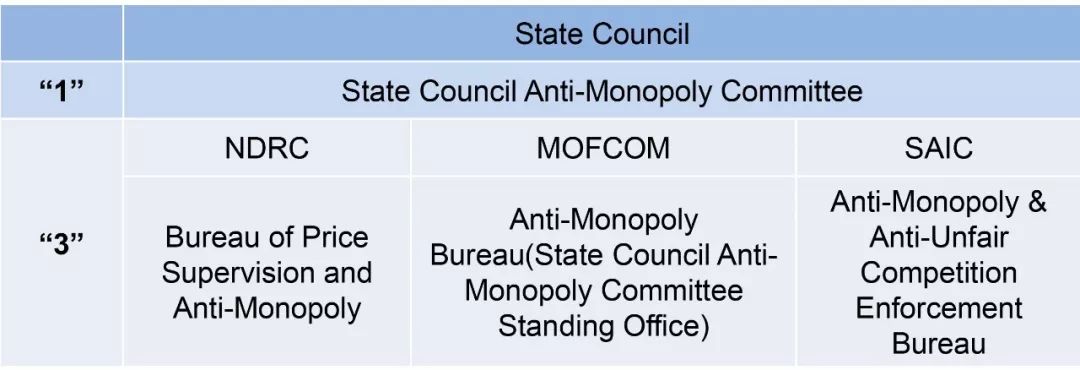
(Chart 1)
The “1+3+X” model reflected the realistic condition at the time when the PRC Antitrust Law was enacted. This model fit the actual situation of “division of specialties and powers” of law enforcement agencies at that time, and the model has played an important role in the early stage of the PRC Antitrust Law enforcement. However, this model does not conform to the new circumstances of the PRC Antitrust Law enforcement. As exposed in the past law enforcement practice, though the NDRC and the SAIC have divided their power authority and responsibility by price factors, one case often contains both price and non-price factors. Consequently, it is ambiguous to identify a competent agency to administer such case. In addition, inconsistency in legal interpretations and enforcement standards taken by multiple law enforcement agencies may also affect the efficiency and authority of the PRC Antitrust Law enforcement. It is a general trend to establish a unified, independent, authoritative, and efficient anti-monopoly law enforcement agency. As a matter of fact, a unified anti-monopoly law enforcement agency has been established in most jurisdictions in the world.
According to the Plan (Please see below Chart 2 for details), the State Council will set up a state market regulatory administration as a direct affiliate of the State Council. The work originally undertaken by the “1” Anti-Monopoly Committee of the State Council will be undertaken by the new administration, and the functions currently exercised by the “3” PRC Antitrust Law enforcement agencies will be consolidated, unified, and vested in the new administration.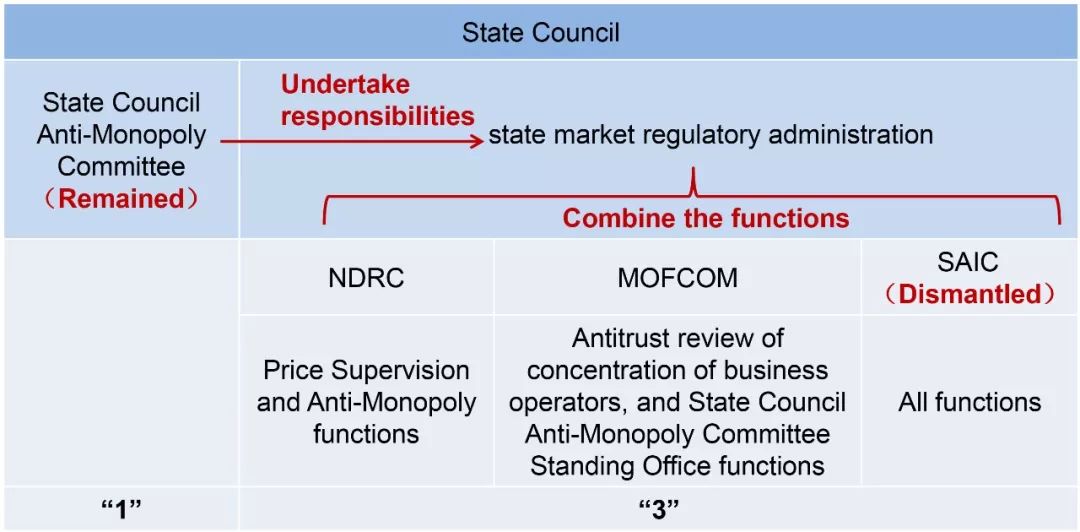
(Chart 2)
This year marks the 10th anniversary of the PRC Antitrust Law’s entry into force. The "3-in-1" reform of the PRC Antitrust Law enforcement agencies is a perfect "birthday gift" for the PRC Antitrust Law, which will certainly place a profound impact on China's anti-monopoly law enforcement practice. More independent and authoritative, a unified anti-monopoly law enforcement agency will contribute to unifying anti-monopoly law enforcement standards and methods, and to improving the transparency of law enforcement activities. The single unified agency can also help maximally integrating law enforcement experience and professionals in various agencies, and forming a more efficient anti-monopoly law enforcement team, in order to meet the professional requirements and practical needs of the anti-monopoly law enforcement. Moreover, it can avoid law enforcement conflicts, simplify law enforcement procedures and improve law enforcement efficiency.
“3 in 1” Reform of PRC Antitrust Agencies
作者:DavidPan KevinHuang IvyHong来源:通力律师

On 13 March 2018, the China State Council submitted the Institutional Reform Plan of the State Counc