
New Shanghai wage rules likely to decrease overtime pay
A change in the calculation basis of wages will likely result in lower pay in Shanghai for overtime and leave periods as a result of amended rules that will take effect on August 1, 2016. The Shanghai Measures of Shanghai Payment of Wages by Enterprises《上海市企业工资支付办法》may be a model for other provinces pending the issuance of long-awaited rules from the central government.
The amended measures clarify that the calculation of overtime and paid leave should be based on the compensation that an employee regularly receives on a monthly basis. Items that the amended measures state should be excluded from the calculation basis are irregular payments, such as overtime pay, annual bonuses, allowances for transportation, meals, and housing, and ‘special payments’, such as extra pay for night shifts or working during hot weather. Previous Shanghai rules and current national law were not clear whether these amounts should be included in the calculation basis. As a result, Shanghai arbitration and courts rulings were inconsistent on how employers should calculate overtime and leave pay.
Also under the amended measures, Shanghai employers are now permitted to withhold payments to employees pending the completion of exit procedures if agreed to by employees. As a result, employment contracts could permit employers to withhold the final month’s salary and overtime pay, as well as any accrued bonuses and compensation for unused annual leave, pending the completion of statutory and employer-mandated exit procedures.
The amended wage measures confirm that employers are not required to pay overtime for working on Women’s Day and Youth Day when the holidays fall on regular work days, and that accounting firms, law firms, and foundations are subject to the amended measures. The amended measures retained a provision granting employers the right to reduce an employee’s wages following a violation of a company’s rules.
Shenzhen considers 158-day maternity leave
Employers in Shenzhen would be required to provide employees with 158 days of maternity leave if draft family planning rules currently under consideration are approved. The rules were issued on July 15, 2016 for public comment.
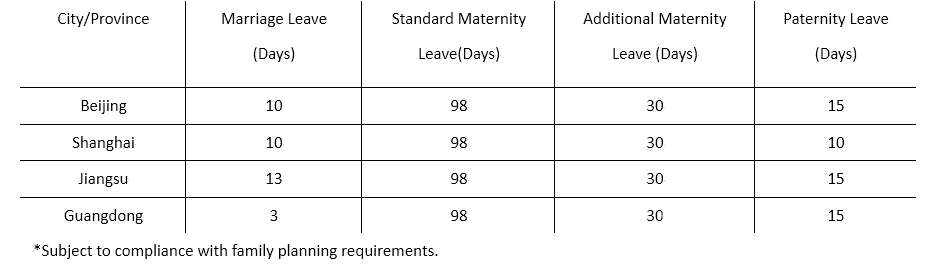
The 158-day total includes 98 days provided under national law, 30 days under Guangdong provincial rules and 30 days under the draft Shenzhen rules. Employees must comply with family planning requirements in order to enjoy the 60 days under the Guangdong and Shenzhen rules.
Local rules extending maternity leave are intended, in part, to compensate for the elimination of the ‘late birth’ maternity leave and the ‘late marriage’ leave in the December 2015 amendment of the Family Planning Law.
A sampling of current leave entitlements following recent amendments to family planning rules:
The draft Shenzhen rules require state-owned enterprises to terminate employees who violate family planning requirements. This requirement does not apply to private employers.
Reports: Shanghai monitoring local unions for overseas influence
According to local media reports in July, the Shanghai Federation of Trade Unions (SFTU) is monitoring local unions for ‘infiltration’. ‘Infiltration’ is commonly understood to be the influence of foreign organizations. Union officials are reportedly concerned that foreign organizations may take advantage of strikes and mass protests to gain influence and damage the interests of workers and domestic labor unions. Also, a SFTU representative reportedly stated in July that no independent labor unions or civil labor unions would be permitted.
Use of vocational school interns subject to increased regulation
New rules have been issued limiting the use of interns from vocational schools. The rules are intended to stop abuses in the use of vocational school interns, who may have been seen as a source of inexpensive and flexible labor with the interns receiving little training or educational benefits.
The new rules came into effect on April 11, 2016 and prevail over similar rules issued in 2007. The key points relating to interns who are expected to work independently:
A written agreement is required between the intern, the school, and the company.
The maximum term of an internship is generally six months.
Interns generally may not work overtime, on statutory holidays or on night shifts.
Interns may not exceed 10% of the company’s total workforce and 20% of specific job positions.
Interns must be paid at least 80% of the probation salary of regular employees holding the same positions.
Vocational schools and companies must provide interns with liability insurance covering injuries and accidents. The rules do not provide for administrative penalties on vocational schools or companies for failure to comply with the requirements.
Full-time university students who serve as interns are excluded from the rules.
Employer burden for social insurance programs continues to fall
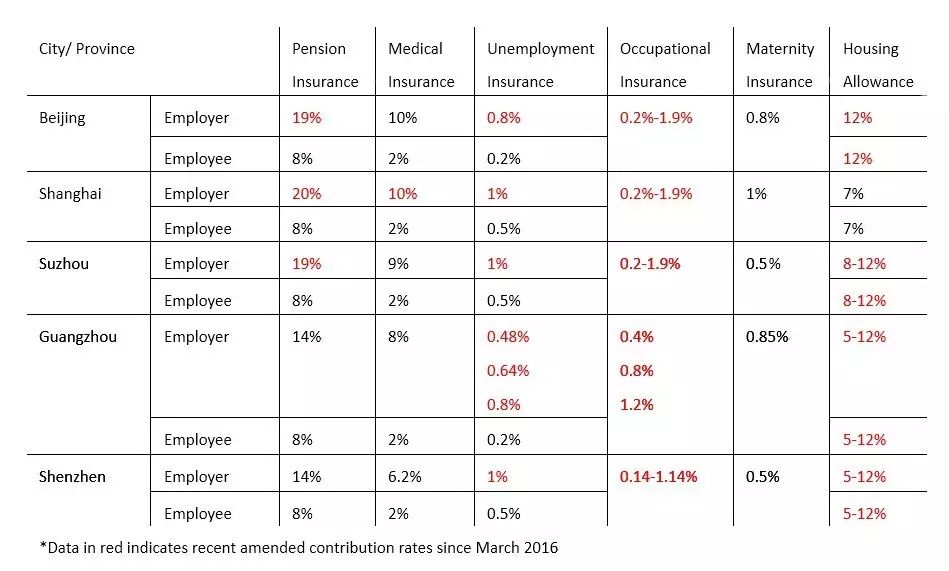
On June 1, 2016, Beijing lowered the employer contribution rate for statutory pension insurance from 20% to 19%, as cities and provinces across China continue to implement a national policy to reduce rates for social insurance and housing fund programs. The policy is a result of the central government’s effort to control labor costs with an aim of maintaining China’s economic competitiveness. Social insurance programs are composed of pension insurance, medical insurance, occupational injury insurance, unemployment insurance and maternity insurance.
The central government set a May 2018 deadline for local governments to reduce employer pension contribution rates from 21% to 20%, while the combined employer and employee contribution rates for unemployment insurance was targeted to fall from 2% to 1%-1.5% (with employee contributions capped at 0.5%).
Many jurisdictions have also been lowering occupational injury insurance and maternity insurance rates to comply with an October 1, 2015 central government requirement. The employer contribution rate for occupational injury insurance should fall from an average of 1% to 0.75%, with maternity insurance rates halved from 1% to 0.5%. Although there has not been a central government requirement to reduce medical insurance contributions, some jurisdictions, including Shanghai, have lower rates for employers. In addition, most jurisdictions have met the central government’s goal of reducing the maximum employer and employee housing fund contributions to 12%.
The current contribution rates for both employees and employers in selected cities and provinces are illustrated in the following chart:
Changes considered to simplify work permit process
Obtaining work authorization for foreign national employees may be simplified by the end of 2016 through a plan recently publicized by the Administration of Foreign Experts Affairs. Under the plan, expert permits will likely become a type of work permit with a single application process.
Under current practice, local offices of the Administration of Foreign Experts Affairs issue expert permits, while work permits are issued by Foreign Employment Administration Centers. In the future, work permit applications are expected to be reviewed jointly by the two offices to determine which type of work permit will be issued. In anticipation of these changes, Beijing and Shanghai are requiring employers to register with the local Foreign Employment Administration Centers.
Also, the central government is reportedly considering the creation of a national-level immigration agency with local branches. The agency would likely assume certain functions of the Exit-Entry Administration Bureau, the General Station of Exit and Entry Frontier Inspection, the Foreign Affairs Office and the police, and would deal with the exit, entry and stay of foreign nationals. The creation of the agency is apparently prompted by a desire to increase efficiency and service quality, as well as to better monitor the entry and stay of foreign nationals. Work permit approvals would remain with the local Foreign Employment Administration Centers.
In a related development, following similar policies implemented recently in Shanghai, Beijing and Fujian, the Ministry of Public Security issued policies effective on August 1, 2016 intended to attract foreign national employees to Guangdong. Under the new policies, foreign nationals who have graduated from colleges or universities in China are encouraged to start businesses in Guangdong, while foreign students will be allowed to take internships at companies registered in the Guangdong Pilot Free Trade Zone. In addition, highly qualified or experienced foreign professionals may be issued longer-term work and residence permits under a simplified process.
Employer duty to renew work permit selected as guiding case
In April 2016, the Guangzhou Intermediate People’s Court announced that its 2014 decision regarding the obligation of an employer to renew a work permit was selected as a guiding case. Lower courts are expected to follow guiding cases when issuing decisions.
In the 2014 decision, the intermediate court upheld a district court ruling that an employer had unlawfully terminated an employee when the employer failed to renew a work permit within the term of the employee’s employment contract. The case arose from a claim by Hsing Kuochu, a Taiwan resident, who was employed as an art consultant in Guangzhou at B.Leman Development Company. Hsing had a one-year employment contract but only a two-month work permit. Hsing sued for unlawful termination after B.Leman failed to renew his work permit.
The decision was based on a provision in rules governing the employment of Hong Kong, Taiwan, and Macao residents requiring work permits to legally work in Mainland China. The intermediate court ruled in effect that Hsing was prevented from completing the term of his contract due to B.Leman not renewing his work permit. The employer was deemed to have illegally terminated Hsing’s employment contract and ordered to pay Hsing RMB 15,939 in statutory damages.
The intermediate court further stated that any work relationship between Hsing and B.Leman after his work permit expired was only a labor service relationship, not an employment relationship. This conclusion indicates that Hsing could not have been awarded reinstatement and B.Leman would not have been required to renew his work permit.
Shanghai arbitrator upholds electronic employment contract
On July 11, 2016, a Shanghai Jiading district labor arbitrator ruled that an employment contract signed with an electronic signature on a third-party website was enforceable, based on the Electronic Signature Law.
According to the arbitration decision, an employee with a Shanghai management consulting company sued for statutory double pay because the company failed to honor the employee’s request for a written contract. The employee based his argument on a provision in the Labor Contract Law that imposes a penalty on an employer who does not enter into a written contract with an employee within one month of the employee beginning work.
The company successfully argued in arbitration that it had complied with the contract requirement because the employee and the company had signed an employment contract on a website operated by a third-party provider. The employee had used a bank card issued with an embedded electronic personal identification to log-in on the third-party platform. The employee then signed an employment contract on-line in a pdf document. The arbitrator ruled that this process created a valid signature under the Electronic Signature Law and that a legal contract was formed.
While the arbitration decision did not directly address whether the electronic contract satisfies the Labor Contract Law requirement for a ‘written contract’, the decision emphasized that the Electronic Signature Law did not include employment contracts among the types of contracts prohibited from using electronic signatures.
Fired transgender employee pursues claim in district court
In a case that has attracted widespread local and international media coverage, a fired transgender employee argued in a district court hearing in Guiyang, Guizhou on June 17, 2016 that the protections against gender discrimination in the Employment Promotion Law (EPL) should apply to him. The case is believed to the first unfair termination case in China filed by a transgender employee.
Identified in court documents as ‘Mr. C’ (who was born female but now identifies as male), the employee was fired in April 2015 from his position as a sales consultant at the Ciming Health Examination Center after only one week of work. A Guiyang arbitration tribunal ruled in May that the termination was lawful because it was based on poor performance during a probation period. The arbitration decision failed to address Mr. C’s claims that the termination was actually based on his gender identity and that EPL protections should apply.
In the district court hearing, Mr. C claimed that the employer, in anticipation of litigation, fabricated his record of poor performance, and that he was terminated merely because he identifies as male. Moreover, he claimed that the EPL’s prohibitions against gender discrimination should apply to gender identity.
A change in the calculation basis of wages will likely result in lower pay in Shanghai for overtime and leave periods as a result of amended rules that will take effect on August 1, 2016. The Shanghai Measures of Shanghai Payment of Wages by Enterprises《上海市企业工资支付办法》may be a model for other provinces pending the issuance of long-awaited rules from the central government.
The amended measures clarify that the calculation of overtime and paid leave should be based on the compensation that an employee regularly receives on a monthly basis. Items that the amended measures state should be excluded from the calculation basis are irregular payments, such as overtime pay, annual bonuses, allowances for transportation, meals, and housing, and ‘special payments’, such as extra pay for night shifts or working during hot weather. Previous Shanghai rules and current national law were not clear whether these amounts should be included in the calculation basis. As a result, Shanghai arbitration and courts rulings were inconsistent on how employers should calculate overtime and leave pay.
Also under the amended measures, Shanghai employers are now permitted to withhold payments to employees pending the completion of exit procedures if agreed to by employees. As a result, employment contracts could permit employers to withhold the final month’s salary and overtime pay, as well as any accrued bonuses and compensation for unused annual leave, pending the completion of statutory and employer-mandated exit procedures.
The amended wage measures confirm that employers are not required to pay overtime for working on Women’s Day and Youth Day when the holidays fall on regular work days, and that accounting firms, law firms, and foundations are subject to the amended measures. The amended measures retained a provision granting employers the right to reduce an employee’s wages following a violation of a company’s rules.
Shenzhen considers 158-day maternity leave
Employers in Shenzhen would be required to provide employees with 158 days of maternity leave if draft family planning rules currently under consideration are approved. The rules were issued on July 15, 2016 for public comment.
The 158-day total includes 98 days provided under national law, 30 days under Guangdong provincial rules and 30 days under the draft Shenzhen rules. Employees must comply with family planning requirements in order to enjoy the 60 days under the Guangdong and Shenzhen rules.
Local rules extending maternity leave are intended, in part, to compensate for the elimination of the ‘late birth’ maternity leave and the ‘late marriage’ leave in the December 2015 amendment of the Family Planning Law.
A sampling of current leave entitlements following recent amendments to family planning rules:
The draft Shenzhen rules require state-owned enterprises to terminate employees who violate family planning requirements. This requirement does not apply to private employers.
Reports: Shanghai monitoring local unions for overseas influence
According to local media reports in July, the Shanghai Federation of Trade Unions (SFTU) is monitoring local unions for ‘infiltration’. ‘Infiltration’ is commonly understood to be the influence of foreign organizations. Union officials are reportedly concerned that foreign organizations may take advantage of strikes and mass protests to gain influence and damage the interests of workers and domestic labor unions. Also, a SFTU representative reportedly stated in July that no independent labor unions or civil labor unions would be permitted.
Use of vocational school interns subject to increased regulation
New rules have been issued limiting the use of interns from vocational schools. The rules are intended to stop abuses in the use of vocational school interns, who may have been seen as a source of inexpensive and flexible labor with the interns receiving little training or educational benefits.
The new rules came into effect on April 11, 2016 and prevail over similar rules issued in 2007. The key points relating to interns who are expected to work independently:
A written agreement is required between the intern, the school, and the company.
The maximum term of an internship is generally six months.
Interns generally may not work overtime, on statutory holidays or on night shifts.
Interns may not exceed 10% of the company’s total workforce and 20% of specific job positions.
Interns must be paid at least 80% of the probation salary of regular employees holding the same positions.
Vocational schools and companies must provide interns with liability insurance covering injuries and accidents. The rules do not provide for administrative penalties on vocational schools or companies for failure to comply with the requirements.
Full-time university students who serve as interns are excluded from the rules.
Employer burden for social insurance programs continues to fall
On June 1, 2016, Beijing lowered the employer contribution rate for statutory pension insurance from 20% to 19%, as cities and provinces across China continue to implement a national policy to reduce rates for social insurance and housing fund programs. The policy is a result of the central government’s effort to control labor costs with an aim of maintaining China’s economic competitiveness. Social insurance programs are composed of pension insurance, medical insurance, occupational injury insurance, unemployment insurance and maternity insurance.
The central government set a May 2018 deadline for local governments to reduce employer pension contribution rates from 21% to 20%, while the combined employer and employee contribution rates for unemployment insurance was targeted to fall from 2% to 1%-1.5% (with employee contributions capped at 0.5%).
Many jurisdictions have also been lowering occupational injury insurance and maternity insurance rates to comply with an October 1, 2015 central government requirement. The employer contribution rate for occupational injury insurance should fall from an average of 1% to 0.75%, with maternity insurance rates halved from 1% to 0.5%. Although there has not been a central government requirement to reduce medical insurance contributions, some jurisdictions, including Shanghai, have lower rates for employers. In addition, most jurisdictions have met the central government’s goal of reducing the maximum employer and employee housing fund contributions to 12%.
The current contribution rates for both employees and employers in selected cities and provinces are illustrated in the following chart:
Changes considered to simplify work permit process
Obtaining work authorization for foreign national employees may be simplified by the end of 2016 through a plan recently publicized by the Administration of Foreign Experts Affairs. Under the plan, expert permits will likely become a type of work permit with a single application process.
Under current practice, local offices of the Administration of Foreign Experts Affairs issue expert permits, while work permits are issued by Foreign Employment Administration Centers. In the future, work permit applications are expected to be reviewed jointly by the two offices to determine which type of work permit will be issued. In anticipation of these changes, Beijing and Shanghai are requiring employers to register with the local Foreign Employment Administration Centers.
Also, the central government is reportedly considering the creation of a national-level immigration agency with local branches. The agency would likely assume certain functions of the Exit-Entry Administration Bureau, the General Station of Exit and Entry Frontier Inspection, the Foreign Affairs Office and the police, and would deal with the exit, entry and stay of foreign nationals. The creation of the agency is apparently prompted by a desire to increase efficiency and service quality, as well as to better monitor the entry and stay of foreign nationals. Work permit approvals would remain with the local Foreign Employment Administration Centers.
In a related development, following similar policies implemented recently in Shanghai, Beijing and Fujian, the Ministry of Public Security issued policies effective on August 1, 2016 intended to attract foreign national employees to Guangdong. Under the new policies, foreign nationals who have graduated from colleges or universities in China are encouraged to start businesses in Guangdong, while foreign students will be allowed to take internships at companies registered in the Guangdong Pilot Free Trade Zone. In addition, highly qualified or experienced foreign professionals may be issued longer-term work and residence permits under a simplified process.
Employer duty to renew work permit selected as guiding case
In April 2016, the Guangzhou Intermediate People’s Court announced that its 2014 decision regarding the obligation of an employer to renew a work permit was selected as a guiding case. Lower courts are expected to follow guiding cases when issuing decisions.
In the 2014 decision, the intermediate court upheld a district court ruling that an employer had unlawfully terminated an employee when the employer failed to renew a work permit within the term of the employee’s employment contract. The case arose from a claim by Hsing Kuochu, a Taiwan resident, who was employed as an art consultant in Guangzhou at B.Leman Development Company. Hsing had a one-year employment contract but only a two-month work permit. Hsing sued for unlawful termination after B.Leman failed to renew his work permit.
The decision was based on a provision in rules governing the employment of Hong Kong, Taiwan, and Macao residents requiring work permits to legally work in Mainland China. The intermediate court ruled in effect that Hsing was prevented from completing the term of his contract due to B.Leman not renewing his work permit. The employer was deemed to have illegally terminated Hsing’s employment contract and ordered to pay Hsing RMB 15,939 in statutory damages.
The intermediate court further stated that any work relationship between Hsing and B.Leman after his work permit expired was only a labor service relationship, not an employment relationship. This conclusion indicates that Hsing could not have been awarded reinstatement and B.Leman would not have been required to renew his work permit.
Shanghai arbitrator upholds electronic employment contract
On July 11, 2016, a Shanghai Jiading district labor arbitrator ruled that an employment contract signed with an electronic signature on a third-party website was enforceable, based on the Electronic Signature Law.
According to the arbitration decision, an employee with a Shanghai management consulting company sued for statutory double pay because the company failed to honor the employee’s request for a written contract. The employee based his argument on a provision in the Labor Contract Law that imposes a penalty on an employer who does not enter into a written contract with an employee within one month of the employee beginning work.
The company successfully argued in arbitration that it had complied with the contract requirement because the employee and the company had signed an employment contract on a website operated by a third-party provider. The employee had used a bank card issued with an embedded electronic personal identification to log-in on the third-party platform. The employee then signed an employment contract on-line in a pdf document. The arbitrator ruled that this process created a valid signature under the Electronic Signature Law and that a legal contract was formed.
While the arbitration decision did not directly address whether the electronic contract satisfies the Labor Contract Law requirement for a ‘written contract’, the decision emphasized that the Electronic Signature Law did not include employment contracts among the types of contracts prohibited from using electronic signatures.
Fired transgender employee pursues claim in district court
In a case that has attracted widespread local and international media coverage, a fired transgender employee argued in a district court hearing in Guiyang, Guizhou on June 17, 2016 that the protections against gender discrimination in the Employment Promotion Law (EPL) should apply to him. The case is believed to the first unfair termination case in China filed by a transgender employee.
Identified in court documents as ‘Mr. C’ (who was born female but now identifies as male), the employee was fired in April 2015 from his position as a sales consultant at the Ciming Health Examination Center after only one week of work. A Guiyang arbitration tribunal ruled in May that the termination was lawful because it was based on poor performance during a probation period. The arbitration decision failed to address Mr. C’s claims that the termination was actually based on his gender identity and that EPL protections should apply.
In the district court hearing, Mr. C claimed that the employer, in anticipation of litigation, fabricated his record of poor performance, and that he was terminated merely because he identifies as male. Moreover, he claimed that the EPL’s prohibitions against gender discrimination should apply to gender identity.