On 10 November 2013, the People’s Bank of China (“PBOC”) and the State Administration of Foreign Exchange (“SAFE”) issued a consultation paper to revise the Provisions on the Administration of Funds of Foreign Institutional Investors for Domestic Securities and Futures Investment (Announcement of PBOC and SAFE [2020] No. 2) (the “Consultation Paper”), aiming to further deepen the reform of foreign exchange administration of Qualified Foreign Investors (the “QFI”) and unify the regulatory rules on the administration of funds of various cross-border regimes. The Consultation Paper will seek public comments till 10 December 2023. Below we introduce the highlights of the Consultation Paper.
I、Streamline the Registration with SAFE
The Consultation Paper cancels the administrative license procedures that QFI need to conduct with SAFE under the prevailing rules.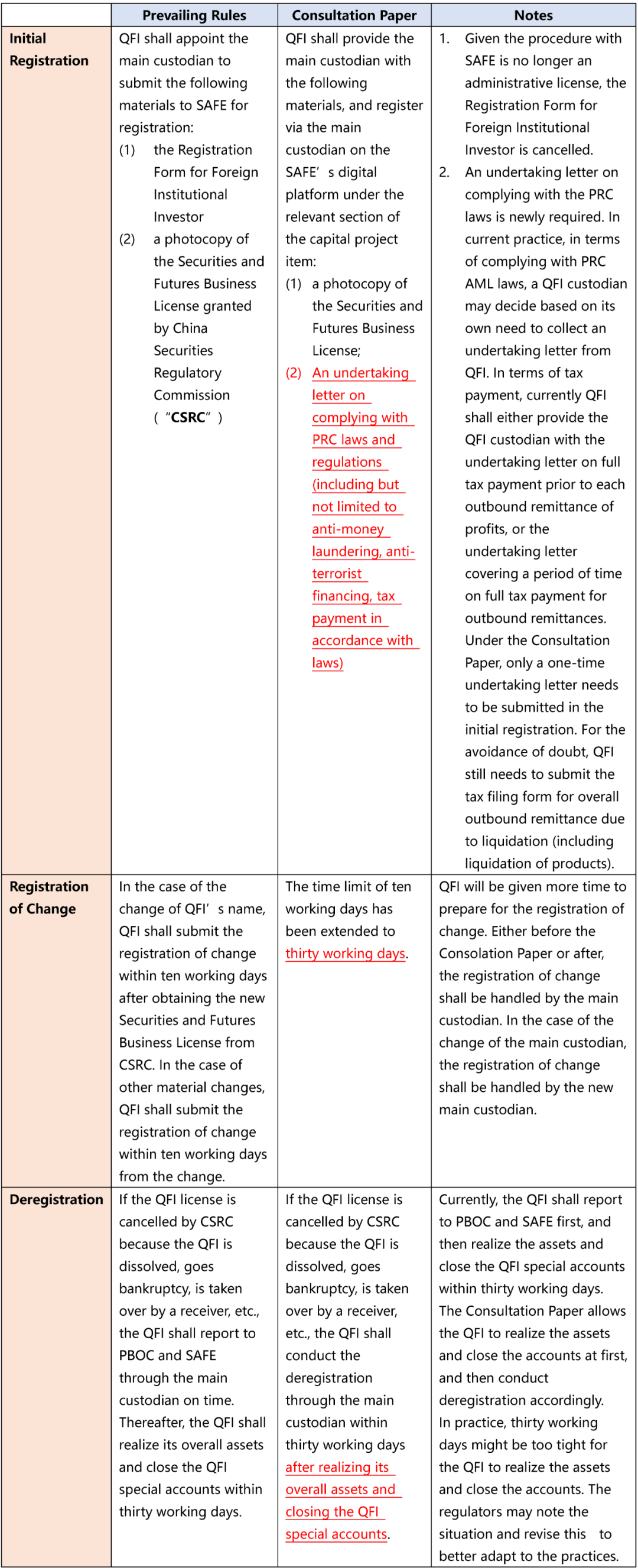
II、Expand Routes to Manage the Foreign Exchange Risks
Respecting the prevailing rules, the QFI conducting foreign exchange derivatives transactions shall still satisfy the “real demand” principle and for hedge purpose only. In the background that the regimes of investing in the China Interbank Bond Market (“CIBM”) has undergone a series of simplification of rules and infrastructure improvements to facilitate foreign investors to make investments, the Consultation Paper aims to synchronize the QFI regime with the routes to foreign exchange risks management which have been enjoyed by the foreign investors in the CIBM.
1、Under the existing rules, the QFI is only able to conduct spot purchase and sale of foreign exchange through the QFI custodian. The Consultation Paper allows the QFI to conduct spot foreign exchange purchase and sale tractions with other domestic financial institutions with this business qualification as their clients. It is worth noting that, the QFI has already been able to conduct foreign exchange derivatives business with the QFI custodian and other financial institutions which are qualified to conduct such business for clients. (Hereinafter collectively referred to as the “Client Model”).
2、The Consultation Paper gives the QFI more routes to enter into China interbank foreign exchange market. If the QFI is a banking institution, it may conduct the spot foreign exchange purchase and sale and foreign exchange derivatives business via (i) the Client Model; (ii) becoming a member of the China Foreign Exchange Trade System & National Interbank Funding Center (“CFETS”) to under prime brokerage to trade in the interbank foreign exchange market; (iii) becoming the CFETS member to directly trade in the interbank foreign exchange market. If the QFI is not a banking institution, the QFI may choose either of the aforesaid Item (i) or (ii) to conduct the spot foreign exchange purchase and sale and foreign exchange derivatives business.
3、If the QFI chooses the Client Model and conducts the foreign exchange derivatives transactions through other financial institutions other than the QFI custodian, the QFI shall file the list of such financial institutions with CFETS on its own or through the QFI custodian.
4、If the QFI chooses the Client Model to conduct the foreign exchange derivatives transactions, the domestic financial institutions (as QFI’s transaction counterparties) are obligated to daily report the transaction information to CFETS, and submit statistics and report to SAFE. If the QFI chooses either of the above 2(ii) and 2(iii) to enter into the interbank foreign exchange market, the QFI itself shall report the relevant transaction information according to the requirements of CFETS.
5、Where a domestic financial institution conducts the spot foreign exchange purchase and sale for the QFI, in the case of the Client Model, the financial institution shall perform the obligations of submit statistics and report to SAFE; in the case of the non-Client Model, the financial institution shall make statistics following the rules of the interbank foreign exchange market.
III、Improve the Account Management
The Consultation Paper also improves account management, facilitating the diversification of QFI investments and implementing the two-way non-trading transfer with CIBM.
1. No longer require separation of RMB special deposit accounts for securities transactions and futures transactions
Under the current rules, if the QFI conducts investments in both securities and futures and derivatives, the QFI shall open the RMB special deposit accounts for securities transactions and for futures and derivatives transactions separately. The Consultation Paper no longer requires such separation, which will reduce the costs of the QFI.
2. Allow the QFI to open special foreign exchange accounts with other financial institutions as needed under the Client Model
Where the QFI chooses the Client Model and conducts the spot foreign exchange purchase and sale or foreign derivatives transactions through financial institutions other than the QFI custodian, the QFI may open special foreign exchange accounts with such financial institutions. Such special foreign exchange accounts shall be used exclusively for funds settlement, profits and loss handling, margin management for the spot foreign exchange purchase and sale and foreign derivatives transactions, while the cross-border remittance of funds by the QFI shall still be handled through the special account opened with the QFI custodian.
3. Validate the domestic two-way non-trading transfers between the QFI and CIBM
From the perspective of QFI rules, the Consultation Paper validates the two-way transfer of funds in the QFI special accounts and the CIBM investment special accounts under the same name of the same foreign institutional investor. After the transfer, the transactions, the use of funds, the foreign exchange shall comply with the regulatory requirements of the later regime.
4. Allow the funds to be transferred between the QFI special accounts under the same name
For example, funds can be transferred between the RMB special deposit account opened with the depositary bank for futures margin and the RMB special deposit accounts opened with the QFI custodian under the same name.
For the avoidance of doubt, in order to prevent cross-currencies arbitrage, where the QFI remits in both RMB and foreign currencies, funds are not allowed transferred between the two types of RMB special accounts (i.e. the RMB special deposit account corresponding to the relevant foreign exchange account and the RMB special deposit account for the remitted funds directly in RMB) regardless of that they are under the same name.
IV、Improve the Foreign Exchange Administration
1. Streamline materials for outbound remittance
The Consultation Paper requires the QFI to submit the undertaking letters for complying with the PRC laws during the initial registration. Accordingly, when handling outbound remittance (except for liquidation) for the QFI, the QFI custodian will directly proceed with the procedure based on the QFI’s written orders, while the separate undertaking letter on tax payment in accordance with laws is no longer required.
2. Allow the inbound remittance in foreign currency and the outbound remittance in RMB
For the first time in the QFI regime, the Consultation Paper allows that the QFI remitting funds in foreign currencies can directly repatriate the RMB funds deposited in the corresponding RMB special deposit accounts, no longer mandatorily requiring to convert to foreign currencies for repatriation. It is worth noting that SAFE still retains the principle in the Consultation Paper that the currency of funds that the QFI remits inbound and outbound shall remain consistent basically, and the cross-currencies arbitrage between RMB and any foreign currencies is prohibited.
The Consultation Paper has brought highlights far beyond the expectation of the market. These changes will significantly improve the efficiency of funds utilization by QFI and boost foreign investors to invest in China’s capital market in a more convenient way.
Highlights of Consultation Paper of SAFE's Provisions on QFI
作者:陆三答 罗莉莉来源:通力律师事务所

On 10 November 2013, the People’s Bank of China (“PBOC”) and the State Administration of Foreign Exc