The direct overseas offering and listing by domestic entities refers to the overseas offering and listing by joint-stock companies registered and incorporated domestically in China (the “Direct Overseas Listings”), which is currently one of the main ways for domestic entities to be listed overseas. Prior to the implementation of the New Filing Rules, the Direct Overseas Listings are subject to the examination and approval by both the CSRC and the overseas securities regulatory authorities. However, under the New Filing Rules, the CSRC changes its administration from approval-based administration to filing-based administration, strengthening its supervision during and after overseas listing, and significantly modifying the original examination and approval mechanism for Direct Overseas Listings. In addition, the New Filing Rules also specify and make breakthroughs with respect to issues highly concerned by the market in the original examination and approval system, aiming to better serve the needs of the current capital market development.
As the third episode of the series of New Era of Filing-based System for Overseas Offerings and Listings[1], this article will start from the distinctions between the original examination and approval system of the CSRC and the New Filling Rules, and will summarize the procedures and requirements for Direct Overseas Listings at the stage of IPO and for the full circulation procedure which effectively supports and supplements the Direct Overseas Listings.
Changes in Procedures and Application Requirements for Direct Overseas Listings
As described above, the CSRC’s administration over Direct Overseas Listings by domestic entities has changed from the approval-based administration to the filing-based administration, and the supervision over overseas listing will be subject to a “fully unified” system after the implementation of the New Filing Rules. The specific examination and review procedures and application materials for Direct Overseas Listings are generally consistent with those of indirect overseas listings. For details, please refer to the Filing-based System for Overseas Listing (II) - Indirect Listing. However, in view of the reform in the administration system of the CSRC, the procedures and application requirements for Direct Overseas Listings are quite different from the prior procedures and requirements.
In terms of listing procedures, compared to the approval-based system, the changes in the CSRC’s procedures under the filing-based system are mainly in the following two aspects (taking a Hong Kong listing as an example):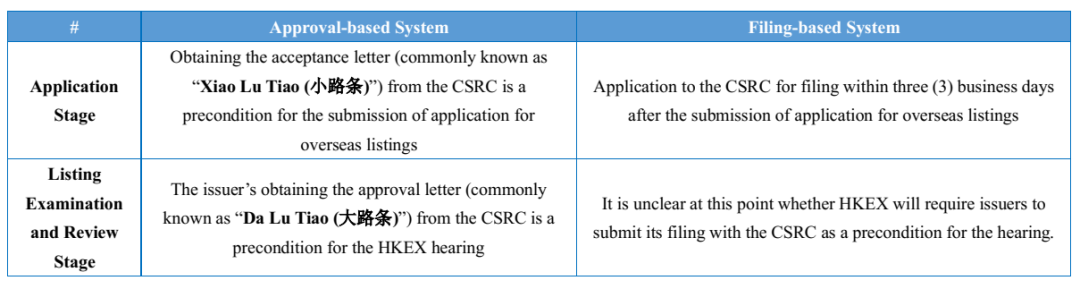
In terms of application materials, the filing materials required under the filing-based system have been refined and improved compared to the previous application materials required for examination and approval. For example, issuers are no longer required to submit permits of special industries, tax payment certificates, and the approval/filing documents for financing and investment projects, and documents such as the opinions on security assessment and review and the issuers’ complete shareholding and control structure chart are added to the required list according to the requirements of laws and regulations and regulatory experience. The detailed requirements for application materials are as follows: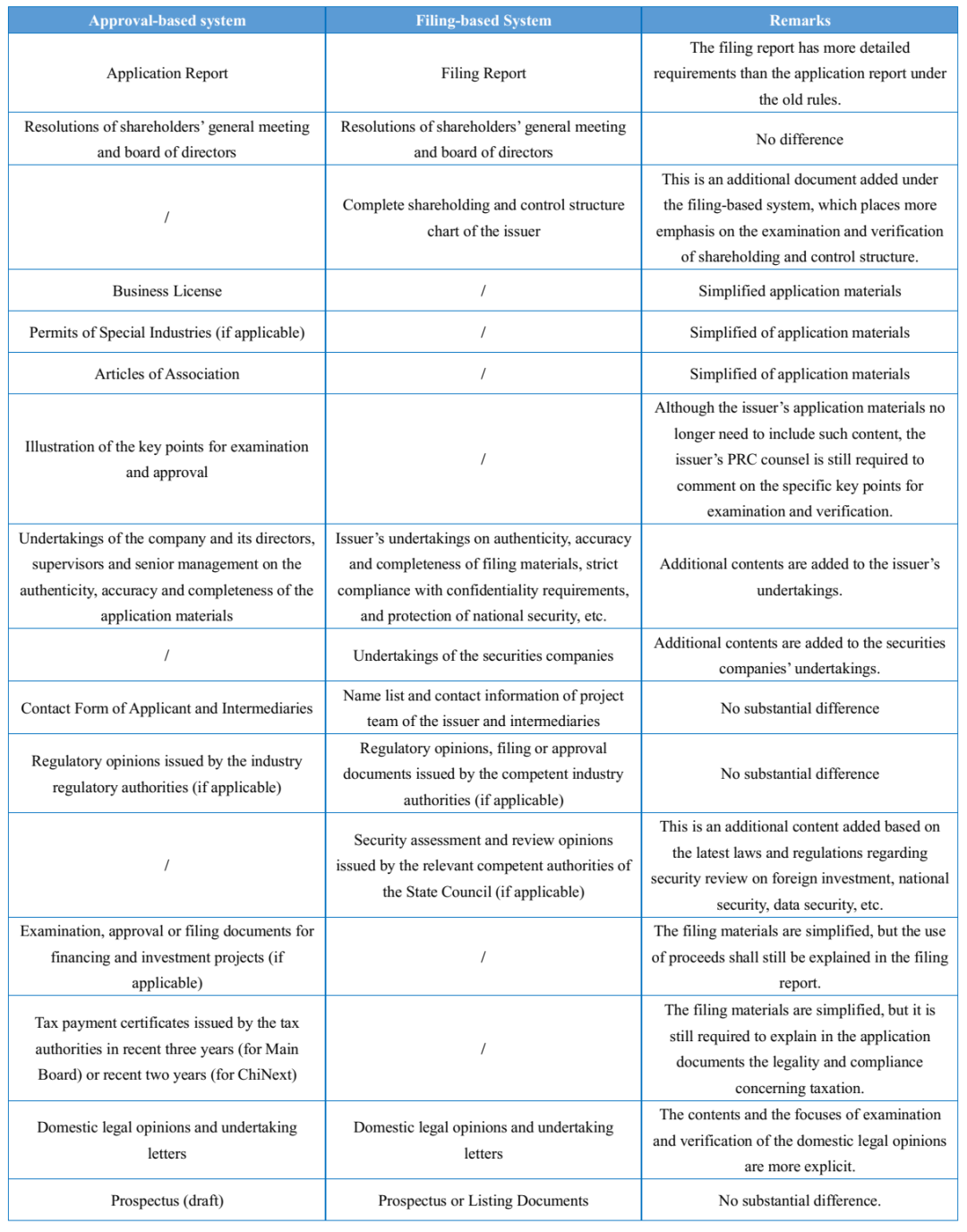
Key Points and Breakthroughs of the Filing-based System for Direct Overseas Listings
Under the New Filing Rules, in addition to complying with the Company Law of the PRC (the “Company Law”), the Securities Law of the PRC and other laws and regulations, Direct Overseas Listings are subject to more flexible arrangements compared to the original approval-based administration, as explained below:
1. Changes in Corporate Governance and Potential Adoption of Special Voting Rights for Direct Overseas Listings
Previously, domestic entities that are directly listed overseas mainly followed the Notice on the Implementation of Mandatory Provisions for the Articles of Association of Entities Listed Overseas when formulating its articles of association after the listing. Such Notice will cease to be effective by March 31, 2023. Starting from March 31, 2023, domestic entities that have listed overseas shall formulate their articles of association in accordance with the Company Law, the Accounting Law of the PRC and other laws, regulations and relevant rules as well as the guidelines of the New Filing Rules, with reference to the Guidelines for Articles of Association of Listed Companies and other CSRC rules on corporate governance.
In fact, the Mandatory Provisions for the Articles of Association of Entities Listed Overseas was a document formulated in September 1994. Although it has been revised several times, including revised by the Official Reply of the State Council on the Adjustment to the Provisions Concerning Matters Including the Notice Period of Convening General Meetings of Shareholders Applicable to Overseas Listed Entities, some of its contents no longer fit the current needs of corporate governance, including the requirements on the par value of shares to be issued (such as the par value of each share being RMB 1 and RMB-denominated requirement) as well as various procedural matters. This repeal and the explicit requirement that the formulation of articles of association shall refer to the Guidelines for Articles of Association of Listed Companies and other relevant regulations enable domestic entities to formulate their articles of association in a more flexible way.
For example, the special voting right system commonly adopted by technology innovation entities is expected to be available for domestic entities directly listed overseas after the implementation of the New Filing Rules. The current Company Law stipulates the principle of “equal rights for equal shares”. It also provides that the State Council may formulate separate regulations on the issuance of other types of shares. Considering that the original domestic laws and regulations governing the Direct Overseas Listings did not provide for the special voting right system, and the Mandatory Provisions for the Articles of Association of the Entities Listed Overseas require “equal rights for equal shares”, there is no solid legal basis for domestic entities directly listed overseas to create special voting rights. So far, there is no precedent case of a domestic entity with special voting rights which has successfully listed overseas directly. However, the New Filing Rules cover provisions on the special voting rights. For example, the Guideline No. 2 clarifies the contents required to be explained and verified where an issuer has shares with special voting rights or similar arrangements, and the Guidelines for Articles of Association of Listed Companies also specify the matters required to be stipulated in the articles of association of entities having shares with special voting rights. Therefore, we understand the adoption of special voting rights by domestic entities directly listed overseas is expected to be recognized in the filing with the CSRC, subject to the requirements for the special voting rights of the overseas jurisdiction where the issuer is listed.
2. Breakthrough in Targets of Issuance in Direct Overseas Listings
In principle, the targets of overseas offerings and listings under the New Filing Rules shall mainly be overseas investors, and qualified domestic investors complying with the laws and regulations, including:
Overseas investors and investors from Hong Kong, Macao and Taiwan
Qualified Domestic Institutional Investors (QDII)
Domestic institutional investors that have completed the Outbound Direct Investment (ODI) filings
Other domestic entities complying with the relevant national regulations on cross-border investment
The abovementioned provisions on targets of issuance do not differ significantly from those before the effectiveness of the New Filing Rules. However, the New Filing Rules make a further breakthrough by providing that domestic entities directly listed overseas may issue securities overseas to specific domestic targets for the purpose of equity incentives, and such entities are no longer required to issue domestic shares first and then apply for full circulation in order to achieve the circulation of the incentive equities in the overseas capital markets.
With respect to the scope of such specific domestic targets, the New Filing Rules specify that it includes directors, senior management, key technical personnel or key business personnel, as well as other personnel who have direct influence on the entities’ operation performance and future development. Meanwhile, the New Filing Rules also specify that the following persons cannot be the incentive targets by prohibitory provisions:
Those who have been subject to administrative penalties (including market access prohibition measures) imposed by the CSRC or its dispatched agencies due to material violation of laws and regulations within the last 12 months;
Those who are prohibited by the Company Law from acting as the directors or senior management;
Those who are prohibited by the laws, administrative regulations or relevant national rules from participating in the equity incentive plans of the entities.
Therefore, if domestic entities directly listed overseas intend to issue securities to specific domestic targets in the future, it shall pay attention to the eligibility of its incentive targets. In addition, the above listed specific domestic targets do not explicitly include supervisors or external advisors. Although such personnel may be construed as and covered in “other personnel who have direct influence on the entities’ operation performance and future development”, it remains to be clarified in practice whether such personnel can be regarded as specific domestic targets.
3. Farewell to Case-by-Case Communication for Option Incentive Plans to be Implemented after Listing
As the original Direct Overseas Listings by domestic entities subject to the approval of the CSRC, the CSRC usually requires the issuers to have clear and stable shareholding structure by referring to the examination and approval requirements for A shares. Taking the listings of H shares before the issuance of the New Filing Rules as an example, most of the incentive options would be fully exercised or the unexercised options would be cancelled before the listing, and there are only few cases where the unexercised incentive options can be retained or the incentive options can be reserved at the time of listing.
The New Filing Rules specify that domestic entities may retain the option incentive plans that are formulated prior to the filing and will be implemented after the listing, but relevant explanations and examination and verification are required to be made, which shall include the basic content of the plan, the decision-making procedures, the principles for price determination, the basic information of the incentive targets, the impact on the controlling power and whether to reserve equities and interests, etc. Therefore, if domestic entities have option incentive plans that are formulated prior to the listing and will be implemented after the listing, they no longer need to communicate with the CSRC on a case-by-case basis. Instead, such entities shall perform the examination and verification procedures in accordance with the requirements under the New Filing Rules, and shall make a comprehensive explanation to the CSRC with the concluding opinions issued by lawyers. For domestic entities proposed to list overseas directly, more flexible incentive arrangements are now available.
Changes in the Regulation Mode for Full Circulation
Since the implementation of full circulation, the projects of Direct Overseas Listings by domestic entities are on the rise. After the full implementation of the filing-based system, the regulation on the “full circulation” regarding the conversion from domestic unlisted shares to overseas listed shares is also changed from the approval-based system to the filing-based system, which brings differences in the supervision and administration with respect to the procedures, time and the submission of materials: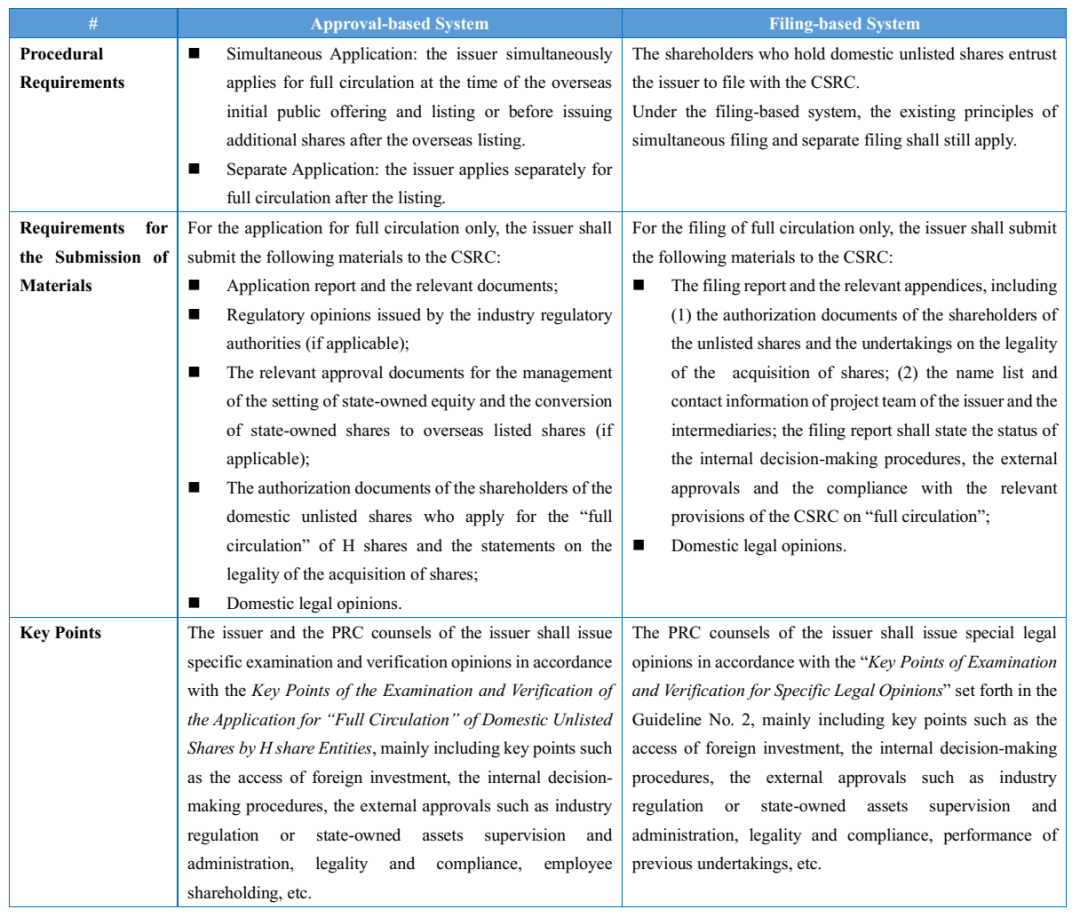
In general, compared to the approval-based system, the review of full circulation application under the filing-based system maintains the original key points, based on which, the filing materials and key points for examination and verification have been refined and improved.
Improving the disclosure contents: under the approval-based system, the contents of the application report for full circulation are almost the same as that of the initial public offering and listing or the issuance of additional shares after the listing, while the disclosure contents of the filing report under the filing-based system are more detailed. For details, please refer to the Filing-based System for Overseas Listing (II) - Indirect Listing for details.
Key points requiring further attention:
Whether the necessary internal decision-making procedures, as well as the approval, filing or verification procedures of state-owned assets management and industry regulation have been performed;
Whether the issuer continuously complies with the policies on access of foreign investment after full circulation;
Whether the shareholder applying for full circulation is a subject of serious dishonesty;
The shareholder applying for full circulation is still required to issue authorization documents and make undertakings on the legality of the acquisition of shares;
New addition: Pay attention to whether the undertakings in the previous filings have been fulfilled;
Simplification: Internal employee shareholding is no longer required to be disclosed in the specific examination and verification.
Notes
[1] Any terms or attributes used in this article but not defined herein shall have the meaning given to them in the series of New Era of Filing-based System for Overseas Offerings and Listings.
Filing-based System for Overseas Listings (III)-Direct Listings
作者:HanKunLawOfficesTransactionDepartment来源:汉坤律师事务所

The direct overseas offering and listing by domestic entities refers to the overseas offering and li