
I INTRODUCTION
In 2006, the Fédération Internationale de Basketball (“FIBA”) set-up the Basketball Arbitral Tribunal (”BAT”)[1] with the aim to establish an independent arbitral tribunal focused on basketball-related disputes, which could deliver decisions in a timely and cost-effective way. [2]
Before it was founded, “breaches of contract in international basketball often went unsanctioned and the injured party had to spend years fighting for its rights at great financial expense in an unfamiliar legal system.” [3]
However, with the establishment of the BAT, basketball stakeholders were given the chance to submit contractual disputes to a quick, inexpensive and specialized arbitration tribunal under Swiss Law, ensuring the respect of their contracts and further enforcement of the decisions through inter alia the disciplinary system of FIBA.
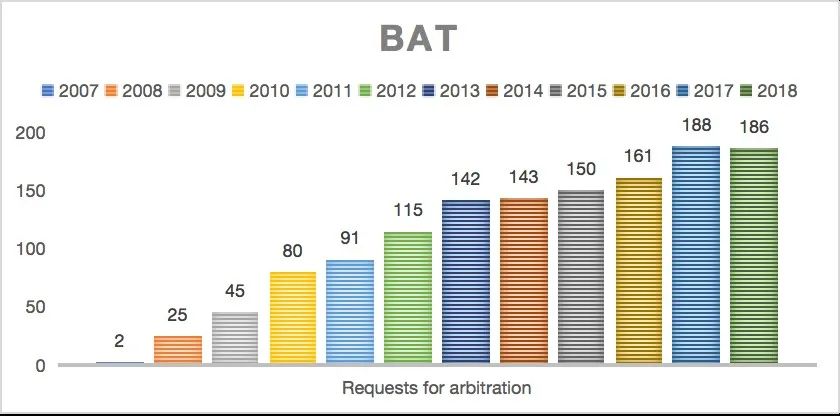
The unique characteristics of the BAT gave it great success in professional basketball, with the number of disputes resolved before this tribunal gradually increasing every year. To date, more than 1500 cases have been heard before the BAT in its 14 years activity.
Number of requests for arbitration before the BAT between 2007 and 2018 [4]
In this article, we will address some significant aspects of this arbitral tribunal, with a particular focus on the procedural issues, as well as explaining the default rule ex aequo et bono, generally applied to the merits of the cases, unless the parties agreed to a specific different applicable law.
A further contribution will then follow, in which we will go through relevant BAT jurisprudence in order to observe and understand the practical meaning of the ex aequo et bono principle in different scenarios, including recent cases concerning the pandemic of COVID-19 and its effects on contractual relations in professional basketball.
II MAIN FEATURES AND PROCEDURAL ISSUES
a) Jurisdiction
As stated above, the BAT was established by FIBA as an independent arbitral tribunal to primarily resolve contractual disputes between clubs, players and agents, provided that FIBA, its Zones or their respective divisions were not directly involved in the dispute. [5]
The reason for excluding FIBA – as well as any of its extensions or related entities - from disputes before the BAT was because in most jurisdictions, a court cannot be considered as an independent arbitral tribunal if one of the parties to the dispute has an influence on the appointment of the arbitrators. As it will be seen below, since BAT was established, FIBA kept an indirect control on several issues, including the appointment of the arbitrators.
Then, the jurisdiction of the BAT is based on a completely voluntary agreement, meaning that in order to refer a dispute to the tribunal, the parties must include in the relevant contract a standard arbitration clause in its favor. [6]
The approach of FIBA in this regard is quite unique when compared to other sports governing bodies, as they generally require their stakeholders to include mandatory arbitration clauses to refer certain matters to specific tribunals. [7]On the contrary, FIBA refrained from establishing internal dispute resolution bodies dealing with employment and financial-related matters, nor imposed any minimum requirements for employment contracts as FIFA did. In principle, FIBA only deals – by means of its own internal bodies - with disciplinary, technical or eligibility-related matters.
i. Seat and Rules
Same as other sports tribunals and institutions, the BAT has its seat in Geneva, Switzerland[8] - even if hearings (if any) are conducted in other location - with the daily work and administrative matters of its proceedings dealt by the BAT Secretariat in Munich, Germany.
The disputes resolved before this tribunal are conducted in accordance with the BAT Rules, which are designed to facilitate quick, simple and inexpensive proceedings to the parties (see Section B below)[9] and those proceedings are governed by Chapter 12 of the Swiss Private International Law Act (PILA)[10] - the piece of legislation governing international arbitration in Switzerland - “irrespective of the parties' domicile”. [11]
ii. Composition and Finance
The BAT is constituted by a President and a Vice-President, who are appointed by the FIBA Central Board for a renewable term of four (4) years. Among the functions of the BAT President, we could highlight the establishment of the list of BAT arbitrators, the appointment of the arbitrator for each proceeding, or the approval of the amendments to the BAT Rules, while the BAT Vice-President basically replaces him/her when required as per the relevant rules, such as in cases of conflict of interest.[12]
The list of arbitrators shall be formed by at least 5 members with prior legal training and experience in sports, for a renewable term of 2 years.[13]
In relation to the functioning of the BAT, it should be highlighted that although it is intended to be self-financed through the contributions of the parties to the proceedings (see below in Section B), FIBA guarantees its financing in order to secure its operations.
A. THE BAT PROCEEDINGS
In line with the above, the BAT Rules include particular features granting the parties swift and simple proceedings, while assuring a fair outcome. Among those features we could highlight the appointment of a sole arbitrator, one round of written submission per party, no hearing, application of ex aequo et bono as the standard applicable law.
i. Procedural steps in the BAT Proceedings [14]
To start the proceedings before the BAT, the first step would be for the claimant to file a request for arbitration to the Secretary of the BAT. The request shall be sent via email to the BAT Secretariat and shall include the minimum content set out in Article 9.1 BAT Rules (e.g. the parties to the dispute, statements of the facts and legal arguments, etc.)[15] , along with the payment of a non-reimbursable handling fee, which amount depends on the value of the dispute. [16]
Then, once the request is received, the BAT Secretariat will confirm that those requirements are fulfilled and, if not, the claimant will be granted a short deadline to complete the request. The request will be then forwarded to the BAT President, who will determine on a prima facie basis if the matter is arbitrable (e.g. if there is a valid arbitration agreement in the contract and the dispute is under the BAT jurisdiction rationae materiae) and if so, he will appoint the sole arbitrator from the BAT list.[17]
Upon the appointment of the arbitrator, the parties may raise a challenge against the arbitrator if the circumstances give rise to legitimate doubts regarding his/her independence within seven days after the relevant ground has become known to the pertinent party. The BAT President will finally decide about any challenge after hearing the position of the parties and the arbitrator. [18]
In the meanwhile, the file is transferred to the arbitrator and to the respondent, with the latter being provided with a short time limit to file its answer. The answer must also contain some minimum content such as the defense against the jurisdiction of the BAT, any counterclaim, or a request for examination of witnesses, among others.[19] It is important to highlight that if the defense against the jurisdiction is not brought in the answer, the respondent would be precluded to raise it afterwards according to Art. 186.2 PILA. [20]
At the same time, the BAT Secretariat fixes the advance of costs, which are normally paid equally by the parties unless a party fails to pay its share. In such a case, the unpaid share must be substituted by the other party, as otherwise the arbitration would be deemed as withdrawn if not paid within the given time limits. [21]
After, upon receipt of both submissions by the arbitrator (or the respondent fails to answer within the given time-limit), he/she may request at his/her sole discretion further written submissions if necessary. However, additional rounds of submissions are not common, due to the general rule of one submission per party. The arbitrator may also issue procedural orders requesting the production of further evidence and/or clarifications on some specific issues, which is more usual considering that - unless agreed by the arbitrator - there are no hearings for the BAT cases in general (see below). [22]
Besides that, the arbitrators are authorized to act as mediators between the parties during the proceedings, but always ensuring that the rights of the parties as well as his/her independence and impartiality are duly respected. In case of agreement, it may be incorporated in a consent award. [23]
Furthermore, arbitrators are entitled to order provisional and/or conservatory measures upon request from the parties and, in case of urgency, they can be granted inaudita altera parte. However, any request of these measures shall be brought together or after the filing of the request for arbitration as, in practice, they can only be granted by the arbitrator. [24]
As to the hearing, the BAT Rules establish that the proceedings have no hearing unless the arbitrator decides otherwise after consultation with the parties. Generally, a hearing would be held only in case the arbitrator deems crucial a testimony of witnesses to assist him/her in the understanding of the case. [25]
Finally, the arbitrator issues an award which must be in written, dated and signed by the arbitrator, as well as include reasons for the decision, unless the value of the dispute is lower than 50,000 Euro. [26]
The BAT Rules set that the arbitrators should render the awards within 6 weeks maximum after the proceedings are finished, or the outstanding advance of costs are paid, whichever comes last. Also, the awards are not confidential unless determined by the arbitrator or the BAT President.
When it comes to the final arbitration costs, they are determined by the BAT President after analyzing inter alia the value of the dispute, as well as the time spent by the arbitrator on the case. The award will determine which party bears the costs and in which proportion, which may also include a contribution towards legal fees and other expenses (e.g. costs regarding witnesses, interpreters, etc.) to the prevailing party as per the scale set in Article 17 BAT Rules. [27]
Lastly, the BAT award becomes final and binding once notified to the parties via email, fax, courier or registered letter or, if it cannot be delivered to one party, once the award is published on the FIBA website (unless appealed to the CAS and/or challenged before the SFT, as described below).
ii. The Applicable law - Ex Aequo et Bono
One of the main features of the BAT Rules is that arbitrators decide the disputes submitted to the BAT ex aequo et bono, as the standard applicable law to the merits.
This is in line with Article 187 PILA, which states that:
“1. The arbitral tribunal shall decide the case according to the rules of law chosen by the parties or, in the absence thereof, according to the rules of law with which the case has the closest connection.
2. The parties may authorize the arbitral tribunal to decide ex aequo et bono.”
It is therefore that the tribunal will decide ex aequo et bono by default, unless the parties expressly prevent the arbitrator from doing so. In case there is any express agreement on the applicable law or excluding the application of ex aequo et bono, the arbitrator will apply the national law chosen by the parties or, in absence of such choice, according to the rules he/she may deem appropriate. In both cases, the parties shall establish the content of such rules of law, as otherwise the arbitrator will apply Swiss law. [28]
To explain what does ex aequo et bono, in essence the arbitrators decide the disputes by “applying general considerations of justice and fairness without reference to any particular national or international law.” This means that the arbitrator is not bound by any legal rules, but just in accordance with principles of equity (according to the right and good), [29]with the only limitation of the international public policy as stipulated in Article 190.2 PILA.
In a nutshell, the arbitrator will analyze the terms of the contract between the parties, considering also the circumstances surrounding each concrete case (e.g. the conducts of the parties, the relationship between the parties, previous violations, etc.) and take a decision based on what he/she considers to be fair and equitable in the case at hand. The arbitrator will give significant weight to the contractual arrangements of the parties according to the legal principle of pacta sunt servanda and he/she may only depart from the contract if he/she considers that a specific term would be disproportionate, unfair or abusive. Such considerations are confirmed in the jurisprudence of the BAT:
- BAT award 1124/17: “it is not an arbitrator’s mandate to replace the parties’ express contractual arrangements by his or her own considerations of fairness and justice…the Arbitrator’s power to adjust, or even disregard, the parties’ mutual consensus should be used with extreme caution.”
- BAT award 0634/14: “Other facts may also be taken into consideration, especially if the wording is unclear or if a literal interpretation leads to a manifestly unfair and unjust result under the specific circumstances. Only in such cases, the Arbitrator is entitled under the concept of ex aequo et bono to deviate from the wording of the contract.”
Moreover, the arbitrators tend to follow previous decisions rendered by the BAT on similar cases, so as to build up a consistent jurisprudence (available at FIBA’s official website). In fact, the points raised by a particular dispute will be considered by the BAT president, and potentially by arbitrators other than the sole deciding arbitrator prior rendering the award, in order to assure that the decision taken in such case is not inconsistent with the common practice/previous jurisprudence.
The application of ex aequo et bono simplifies the resolution of disputes in international arbitration because the arbitrator does not have to apply any specific law, which in several occasions is unknown to the arbitrator. Also, considering the transnational relationships, in sports in particular, the choice of law in some circumstances becomes a challenge.
iii. The BAT Award
As mentioned above, once the arbitrator has analyzed the submissions from the parties and taken a decision on the case, according to Article 16.1 BAT Rules he/she must issue a written, dated and signed award with reasons, unless as stipulated in Article 16.2, the sum in dispute does not exceed EUR 50,000. [30]
On the other hand, the BAT President may determine at his sole discretion that the award shall be issued with reasons, if he considers that the case may have a public interest in order to develop the jurisprudence of this tribunal. [31]
The award will become final and binding upon notification to the parties and publication in the website of FIBA (unless appealed to CAS, as described below). On the other hand, it must be finally noted that BAT awards can only be challenged for annulment before the Swiss Federal Tribunal under limited and exceptional circumstances that will be explained below in more detail.
iv. Remedies against BAT Awards
Considering that the BAT is an arbitration court having the seat in Switzerland, therefore Chapter 12 PILA regulates its proceedings.[32] In particular, Article 191 PILA establishes that “the sole judicial authority to set aside is the Swiss Federal Supreme Court.” [33]
However, the parties may seek redress to the Swiss Federal Tribunal (“SFT”) to annul a BAT Award only if:
(i) they have not waived their right to do so according to Article 192.1 PILA, and;
(ii) if it is met any of the following circumstances enshrined in Article 190.2 PILA:
“2. The award may only be annulled:
a) if the sole arbitrator was not properly appointed or if the arbitral tribunal was not properly constituted;
b) if the arbitral tribunal wrongly accepted or declined jurisdiction;
c) if the arbitral tribunal's decision went beyond the claims submitted to it, or failed to decide one of the items of the claim;
d) if the principle of equal treatment of the parties or the right of the parties to be heard was violated;
e) if the award is incompatible with public policy.”
It should be noted that the time limit in order to seek the annulment of the BAT award is 30 days after the notification to the parties. Then, in case the SFT decides that one of the grounds of Article 190.2 PILA is met, it will set aside the award. If the SFT confirms the challenge of the award based on the grounds that the tribunal erroneously denied or affirmed jurisdiction (item b.), it may issue a new decision replacing the award. In all other cases, the SFT will not issue its own decision on the merits, but will refer the matter back to the BAT for reconsideration. [34]
To conclude, it is important to remark that there is no option to appeal a BAT award to the CAS, as this alternative was deleted from the BAT Rules in 2010 (unless the parties have expressly agreed in the contract – by means of an arbitration agreement - that the BAT award may be appealed to CAS).
v. Enforcement of BAT Awards
As a final step, the fact that the BAT is a real arbitration tribunal under Swiss law makes it possible to enforce BAT awards through the Convention on the Recognition and Enforcement of Foreign Arbitral Awards, commonly known as the New York Convention (“NYC”).
This feature on one hand makes it possible to enforce the BAT awards in any of the country signatories of the NYC. On the other hand, the parties to BAT proceedings may find difficulties when enforcing BAT awards through the NYC, as many jurisdictions consider employment-related disputes non-arbitrable and therefore would reject a request for recognition and enforcement of an award dealing with such matters.
Then, the main solution for parties to a dispute before the BAT is to enforce the award through the disciplinary systems of both FIBA and national basketball federations, which play an important role in this respect. FIBA establishes an internal mechanism in order to sanction those parties that do not comply with a BAT award. Among those sanctions we could highlight inter alia fines, withdrawals of FIBA licenses to agents, ban in international transfers to players, withdrawal of WABC membership to coaches, or ban on registration of new players to clubs.[35] Any decision from FIBA in this respect may be appealed to the FIBA Appeal’s Panel. Finally, according to the FIBA Rules, namely Article 345 FIBA Book 3, national basketball federations shall actively and promptly undertake the relevant measures in order to ensure that the relevant party honors the BAT award. For such purpose, it is common that national federations establish also an internal mechanism with further sanctions so as to punish the party that does not comply with inter alia the awards issued by the BAT.
Slide down to view endnote
[1] The BAT was formerly known as the FIBA Arbitral Tribunal (FAT), but it changed its name in April 2011 to remark its independence from FIBA. However, FIBA still has some influence as regards the composition, the financing and other aspects, as it will be seen below.
[2] The key components of the BAT were established in Chapter 10 of the FIBA Internal Regulations Book 3 (“FIBA Book 3”).
[3] Information available at: martens-lawyers.com/en/basketball-arbitral-tribunal-en/
[4] Information available at: http://www.fiba.basketball/documents/BATStatistics2007-2018.pdf
[5] See Article 333 of FIBA Book 3 and Article 0 of the Arbitration Rules of the Basketball Arbitral Tribunal (“BAT Rules”). It should be noted that the list of parties that may seek redress before this body is not exhaustive (e.g. coaches, technical staff, etc.). The case is different for disputes involving FIBA directly, including disputes on inter alia transfers, disciplinary and doping cases, which are dealt with by internal bodies of FIBA and final instance before the CAS.
[6] Both FIBA Book 3 and the BAT Rules – Articles 336 and 0.3 respectively - provide a standard arbitration clause for reference, for those parties interested in setting the BAT as the dispute resolution body in their contracts. Article 1 BAT Rules establish the jurisdiction of the BAT.
[7] For instance, Article 59 of the FIFA Statutes establish that “recourse to ordinary courts of law is prohibited unless specifically provided for in the FIFA regulations”. Furthermore, FIFA impose the obligation to its member associations (i.e. national federations) to insert clauses in their statutes or rules stipulating that the disputes among their members (i.e. leagues, clubs, players, etc.) cannot be taken to ordinary courts, but to an independent and duly constituted arbitration tribunal recognized under the rules of the association or confederation or to the CAS. Moreover, FIFA only authorize the parties to seek redress before civil courts in employment-related disputes (i.e. Art. 22 FIFA RSTP).
[8] For more than a century, Switzerland’s arbitration-friendly approach, political neutrality, well-developed legal system, geographically convenient location, etc. makes it a leading place for arbitrating international disputes. For instance, the ICC or the CAS are also seated in Switzerland.
[9] The current BAT Rules in force is the version issued on 1 December 2019. Available at: https://www.fiba.basketball/en/Module/c9dad82f-01af-45e0-bb85-ee4cf50235b4/9cab06c5-0ab6-4faa b338-33c706dc9dd8
[10] Link in English: https://www.swissarbitration.org/files/34/Swiss%20International%20Arbitration%20Law/IPRG_english.pdf. In essence, Chapter 12 of the PILA just includes few mandatory general rules aimed at guarantee the due process and equal treatment of the parties.
[11] See Article 2.2 of the BAT Rules and Article 331 FIBA Book 3. Switzerland has two different set of rules governing arbitration, depending on the nature of the proceedings (i.e. domestic or international). However, the BAT Rules opted for application of the PILA Chapter 12 irrespective of the parties’ domicile.
[12] See Article 334-335 FIBA Book 3 and Article 0.4 BAT Rules.
[13] As of March 2021, the list of arbitrators is composed by 8 members. Available at: https://www.fiba.basketball/bat/composition.pdf .
[14] The BAT provides a guide with the steps to be followed in its proceedings: https://www.fiba.basketball/en/Module/c9dad82f-01af-45e0-bb85-ee4cf50235b4/53eab3df-af21-4043-a4a6-5a264334ce65 .
[15] The BAT provides in its website a template with the minimum content required for the requests of arbitration at: https://www.fiba.basketball/bat/process .
[16] See Article 9.2 BAT Rules. The amount of the non-reimbursable handling fee is calculated according to the scale established in Article 17.1 BAT Rules and, without its payment, the arbitration will not proceed.
[17] See Article 11.1-11.3 BAT Rules.
[18] See Article 8 BAT Rules.
[19] See Article 11.2 BAT Rules.
[20] Article 186.2 PILA: “2. A plea of lack of jurisdiction must be raised prior to any defence on the merits.”
[21] See Article 9.3 BAT Rules. In essence, the BAT Secretariat fixes the advance of costs depending on the sum in dispute and complexity of the case.
[22] See Articles 12.1 and 12.2 BAT Rules.
[23] See Article 16.7 BAT Rules.
[24] See Article 10 BAT Rules. The right for provisional and conservatory measures is in line with Article 183.1 PILA which states that “Unless the parties have otherwise agreed, the arbitral tribunal may, on motion of one party, order provisional or conservatory measures”.
[25] See Article 13 BAT Rules. If there is hearing, the arbitrator may request additional advance of costs (from one or both parties) and/or to hold it via telephone or video-conference so as to speed up the procedure and reduce costs to the parties.
[26] See Article 16.1 and 16.2 BAT Rules. However, according to Article 16.3 BAT Rules, there are some exceptions, as the arbitrator must issue the award with reasons if:
a) A party (i) files a request for reasons since the request for arbitration is filed until 10 days after the notification of the award without reasons, and (ii) such party pays an amount of 3,000 Euro; or
b) The BAT President determines at his sole discretion to render the award with reasons.
[27] See Article 17 BAT Rules.
[28] See Article 15.2 BAT Rules.
[29] See: https://uk.practicallaw.thomsonreuters.com/6-502-6327?transitionType=Default&contextData=(sc.Default)&firstPage=true .
[30] The reason of this is in order to reduce the costs of the proceedings so as gain access to BAT Arbitration to all level of basketball stakeholders.
[31] See Article 16.1 BAT Rules.
[32] According to Article 176 PILA.
[33] As per Article 191 PILA, the procedure to set aside an award under these rules follows Art. 77 of the Swiss Federal Statute on the Swiss Federal Supreme Court of June 17, 2005.
[34] The parties have the option to waive their right to seek annulment of the BAT awards before the SFT, as per Article 192.1 PILA.
[35] See Article 344 FIBA Book 3.
In 2006, the Fédération Internationale de Basketball (“FIBA”) set-up the Basketball Arbitral Tribunal (”BAT”)[1] with the aim to establish an independent arbitral tribunal focused on basketball-related disputes, which could deliver decisions in a timely and cost-effective way. [2]
Before it was founded, “breaches of contract in international basketball often went unsanctioned and the injured party had to spend years fighting for its rights at great financial expense in an unfamiliar legal system.” [3]
However, with the establishment of the BAT, basketball stakeholders were given the chance to submit contractual disputes to a quick, inexpensive and specialized arbitration tribunal under Swiss Law, ensuring the respect of their contracts and further enforcement of the decisions through inter alia the disciplinary system of FIBA.
The unique characteristics of the BAT gave it great success in professional basketball, with the number of disputes resolved before this tribunal gradually increasing every year. To date, more than 1500 cases have been heard before the BAT in its 14 years activity.
Number of requests for arbitration before the BAT between 2007 and 2018 [4]
In this article, we will address some significant aspects of this arbitral tribunal, with a particular focus on the procedural issues, as well as explaining the default rule ex aequo et bono, generally applied to the merits of the cases, unless the parties agreed to a specific different applicable law.
A further contribution will then follow, in which we will go through relevant BAT jurisprudence in order to observe and understand the practical meaning of the ex aequo et bono principle in different scenarios, including recent cases concerning the pandemic of COVID-19 and its effects on contractual relations in professional basketball.
II MAIN FEATURES AND PROCEDURAL ISSUES
a) Jurisdiction
As stated above, the BAT was established by FIBA as an independent arbitral tribunal to primarily resolve contractual disputes between clubs, players and agents, provided that FIBA, its Zones or their respective divisions were not directly involved in the dispute. [5]
The reason for excluding FIBA – as well as any of its extensions or related entities - from disputes before the BAT was because in most jurisdictions, a court cannot be considered as an independent arbitral tribunal if one of the parties to the dispute has an influence on the appointment of the arbitrators. As it will be seen below, since BAT was established, FIBA kept an indirect control on several issues, including the appointment of the arbitrators.
Then, the jurisdiction of the BAT is based on a completely voluntary agreement, meaning that in order to refer a dispute to the tribunal, the parties must include in the relevant contract a standard arbitration clause in its favor. [6]
The approach of FIBA in this regard is quite unique when compared to other sports governing bodies, as they generally require their stakeholders to include mandatory arbitration clauses to refer certain matters to specific tribunals. [7]On the contrary, FIBA refrained from establishing internal dispute resolution bodies dealing with employment and financial-related matters, nor imposed any minimum requirements for employment contracts as FIFA did. In principle, FIBA only deals – by means of its own internal bodies - with disciplinary, technical or eligibility-related matters.
i. Seat and Rules
Same as other sports tribunals and institutions, the BAT has its seat in Geneva, Switzerland[8] - even if hearings (if any) are conducted in other location - with the daily work and administrative matters of its proceedings dealt by the BAT Secretariat in Munich, Germany.
The disputes resolved before this tribunal are conducted in accordance with the BAT Rules, which are designed to facilitate quick, simple and inexpensive proceedings to the parties (see Section B below)[9] and those proceedings are governed by Chapter 12 of the Swiss Private International Law Act (PILA)[10] - the piece of legislation governing international arbitration in Switzerland - “irrespective of the parties' domicile”. [11]
ii. Composition and Finance
The BAT is constituted by a President and a Vice-President, who are appointed by the FIBA Central Board for a renewable term of four (4) years. Among the functions of the BAT President, we could highlight the establishment of the list of BAT arbitrators, the appointment of the arbitrator for each proceeding, or the approval of the amendments to the BAT Rules, while the BAT Vice-President basically replaces him/her when required as per the relevant rules, such as in cases of conflict of interest.[12]
The list of arbitrators shall be formed by at least 5 members with prior legal training and experience in sports, for a renewable term of 2 years.[13]
In relation to the functioning of the BAT, it should be highlighted that although it is intended to be self-financed through the contributions of the parties to the proceedings (see below in Section B), FIBA guarantees its financing in order to secure its operations.
A. THE BAT PROCEEDINGS
In line with the above, the BAT Rules include particular features granting the parties swift and simple proceedings, while assuring a fair outcome. Among those features we could highlight the appointment of a sole arbitrator, one round of written submission per party, no hearing, application of ex aequo et bono as the standard applicable law.
i. Procedural steps in the BAT Proceedings [14]
To start the proceedings before the BAT, the first step would be for the claimant to file a request for arbitration to the Secretary of the BAT. The request shall be sent via email to the BAT Secretariat and shall include the minimum content set out in Article 9.1 BAT Rules (e.g. the parties to the dispute, statements of the facts and legal arguments, etc.)[15] , along with the payment of a non-reimbursable handling fee, which amount depends on the value of the dispute. [16]
Then, once the request is received, the BAT Secretariat will confirm that those requirements are fulfilled and, if not, the claimant will be granted a short deadline to complete the request. The request will be then forwarded to the BAT President, who will determine on a prima facie basis if the matter is arbitrable (e.g. if there is a valid arbitration agreement in the contract and the dispute is under the BAT jurisdiction rationae materiae) and if so, he will appoint the sole arbitrator from the BAT list.[17]
Upon the appointment of the arbitrator, the parties may raise a challenge against the arbitrator if the circumstances give rise to legitimate doubts regarding his/her independence within seven days after the relevant ground has become known to the pertinent party. The BAT President will finally decide about any challenge after hearing the position of the parties and the arbitrator. [18]
In the meanwhile, the file is transferred to the arbitrator and to the respondent, with the latter being provided with a short time limit to file its answer. The answer must also contain some minimum content such as the defense against the jurisdiction of the BAT, any counterclaim, or a request for examination of witnesses, among others.[19] It is important to highlight that if the defense against the jurisdiction is not brought in the answer, the respondent would be precluded to raise it afterwards according to Art. 186.2 PILA. [20]
At the same time, the BAT Secretariat fixes the advance of costs, which are normally paid equally by the parties unless a party fails to pay its share. In such a case, the unpaid share must be substituted by the other party, as otherwise the arbitration would be deemed as withdrawn if not paid within the given time limits. [21]
After, upon receipt of both submissions by the arbitrator (or the respondent fails to answer within the given time-limit), he/she may request at his/her sole discretion further written submissions if necessary. However, additional rounds of submissions are not common, due to the general rule of one submission per party. The arbitrator may also issue procedural orders requesting the production of further evidence and/or clarifications on some specific issues, which is more usual considering that - unless agreed by the arbitrator - there are no hearings for the BAT cases in general (see below). [22]
Besides that, the arbitrators are authorized to act as mediators between the parties during the proceedings, but always ensuring that the rights of the parties as well as his/her independence and impartiality are duly respected. In case of agreement, it may be incorporated in a consent award. [23]
Furthermore, arbitrators are entitled to order provisional and/or conservatory measures upon request from the parties and, in case of urgency, they can be granted inaudita altera parte. However, any request of these measures shall be brought together or after the filing of the request for arbitration as, in practice, they can only be granted by the arbitrator. [24]
As to the hearing, the BAT Rules establish that the proceedings have no hearing unless the arbitrator decides otherwise after consultation with the parties. Generally, a hearing would be held only in case the arbitrator deems crucial a testimony of witnesses to assist him/her in the understanding of the case. [25]
Finally, the arbitrator issues an award which must be in written, dated and signed by the arbitrator, as well as include reasons for the decision, unless the value of the dispute is lower than 50,000 Euro. [26]
The BAT Rules set that the arbitrators should render the awards within 6 weeks maximum after the proceedings are finished, or the outstanding advance of costs are paid, whichever comes last. Also, the awards are not confidential unless determined by the arbitrator or the BAT President.
When it comes to the final arbitration costs, they are determined by the BAT President after analyzing inter alia the value of the dispute, as well as the time spent by the arbitrator on the case. The award will determine which party bears the costs and in which proportion, which may also include a contribution towards legal fees and other expenses (e.g. costs regarding witnesses, interpreters, etc.) to the prevailing party as per the scale set in Article 17 BAT Rules. [27]
Lastly, the BAT award becomes final and binding once notified to the parties via email, fax, courier or registered letter or, if it cannot be delivered to one party, once the award is published on the FIBA website (unless appealed to the CAS and/or challenged before the SFT, as described below).
ii. The Applicable law - Ex Aequo et Bono
One of the main features of the BAT Rules is that arbitrators decide the disputes submitted to the BAT ex aequo et bono, as the standard applicable law to the merits.
This is in line with Article 187 PILA, which states that:
“1. The arbitral tribunal shall decide the case according to the rules of law chosen by the parties or, in the absence thereof, according to the rules of law with which the case has the closest connection.
2. The parties may authorize the arbitral tribunal to decide ex aequo et bono.”
It is therefore that the tribunal will decide ex aequo et bono by default, unless the parties expressly prevent the arbitrator from doing so. In case there is any express agreement on the applicable law or excluding the application of ex aequo et bono, the arbitrator will apply the national law chosen by the parties or, in absence of such choice, according to the rules he/she may deem appropriate. In both cases, the parties shall establish the content of such rules of law, as otherwise the arbitrator will apply Swiss law. [28]
To explain what does ex aequo et bono, in essence the arbitrators decide the disputes by “applying general considerations of justice and fairness without reference to any particular national or international law.” This means that the arbitrator is not bound by any legal rules, but just in accordance with principles of equity (according to the right and good), [29]with the only limitation of the international public policy as stipulated in Article 190.2 PILA.
In a nutshell, the arbitrator will analyze the terms of the contract between the parties, considering also the circumstances surrounding each concrete case (e.g. the conducts of the parties, the relationship between the parties, previous violations, etc.) and take a decision based on what he/she considers to be fair and equitable in the case at hand. The arbitrator will give significant weight to the contractual arrangements of the parties according to the legal principle of pacta sunt servanda and he/she may only depart from the contract if he/she considers that a specific term would be disproportionate, unfair or abusive. Such considerations are confirmed in the jurisprudence of the BAT:
- BAT award 1124/17: “it is not an arbitrator’s mandate to replace the parties’ express contractual arrangements by his or her own considerations of fairness and justice…the Arbitrator’s power to adjust, or even disregard, the parties’ mutual consensus should be used with extreme caution.”
- BAT award 0634/14: “Other facts may also be taken into consideration, especially if the wording is unclear or if a literal interpretation leads to a manifestly unfair and unjust result under the specific circumstances. Only in such cases, the Arbitrator is entitled under the concept of ex aequo et bono to deviate from the wording of the contract.”
Moreover, the arbitrators tend to follow previous decisions rendered by the BAT on similar cases, so as to build up a consistent jurisprudence (available at FIBA’s official website). In fact, the points raised by a particular dispute will be considered by the BAT president, and potentially by arbitrators other than the sole deciding arbitrator prior rendering the award, in order to assure that the decision taken in such case is not inconsistent with the common practice/previous jurisprudence.
The application of ex aequo et bono simplifies the resolution of disputes in international arbitration because the arbitrator does not have to apply any specific law, which in several occasions is unknown to the arbitrator. Also, considering the transnational relationships, in sports in particular, the choice of law in some circumstances becomes a challenge.
iii. The BAT Award
As mentioned above, once the arbitrator has analyzed the submissions from the parties and taken a decision on the case, according to Article 16.1 BAT Rules he/she must issue a written, dated and signed award with reasons, unless as stipulated in Article 16.2, the sum in dispute does not exceed EUR 50,000. [30]
On the other hand, the BAT President may determine at his sole discretion that the award shall be issued with reasons, if he considers that the case may have a public interest in order to develop the jurisprudence of this tribunal. [31]
The award will become final and binding upon notification to the parties and publication in the website of FIBA (unless appealed to CAS, as described below). On the other hand, it must be finally noted that BAT awards can only be challenged for annulment before the Swiss Federal Tribunal under limited and exceptional circumstances that will be explained below in more detail.
iv. Remedies against BAT Awards
Considering that the BAT is an arbitration court having the seat in Switzerland, therefore Chapter 12 PILA regulates its proceedings.[32] In particular, Article 191 PILA establishes that “the sole judicial authority to set aside is the Swiss Federal Supreme Court.” [33]
However, the parties may seek redress to the Swiss Federal Tribunal (“SFT”) to annul a BAT Award only if:
(i) they have not waived their right to do so according to Article 192.1 PILA, and;
(ii) if it is met any of the following circumstances enshrined in Article 190.2 PILA:
“2. The award may only be annulled:
a) if the sole arbitrator was not properly appointed or if the arbitral tribunal was not properly constituted;
b) if the arbitral tribunal wrongly accepted or declined jurisdiction;
c) if the arbitral tribunal's decision went beyond the claims submitted to it, or failed to decide one of the items of the claim;
d) if the principle of equal treatment of the parties or the right of the parties to be heard was violated;
e) if the award is incompatible with public policy.”
It should be noted that the time limit in order to seek the annulment of the BAT award is 30 days after the notification to the parties. Then, in case the SFT decides that one of the grounds of Article 190.2 PILA is met, it will set aside the award. If the SFT confirms the challenge of the award based on the grounds that the tribunal erroneously denied or affirmed jurisdiction (item b.), it may issue a new decision replacing the award. In all other cases, the SFT will not issue its own decision on the merits, but will refer the matter back to the BAT for reconsideration. [34]
To conclude, it is important to remark that there is no option to appeal a BAT award to the CAS, as this alternative was deleted from the BAT Rules in 2010 (unless the parties have expressly agreed in the contract – by means of an arbitration agreement - that the BAT award may be appealed to CAS).
v. Enforcement of BAT Awards
As a final step, the fact that the BAT is a real arbitration tribunal under Swiss law makes it possible to enforce BAT awards through the Convention on the Recognition and Enforcement of Foreign Arbitral Awards, commonly known as the New York Convention (“NYC”).
This feature on one hand makes it possible to enforce the BAT awards in any of the country signatories of the NYC. On the other hand, the parties to BAT proceedings may find difficulties when enforcing BAT awards through the NYC, as many jurisdictions consider employment-related disputes non-arbitrable and therefore would reject a request for recognition and enforcement of an award dealing with such matters.
Then, the main solution for parties to a dispute before the BAT is to enforce the award through the disciplinary systems of both FIBA and national basketball federations, which play an important role in this respect. FIBA establishes an internal mechanism in order to sanction those parties that do not comply with a BAT award. Among those sanctions we could highlight inter alia fines, withdrawals of FIBA licenses to agents, ban in international transfers to players, withdrawal of WABC membership to coaches, or ban on registration of new players to clubs.[35] Any decision from FIBA in this respect may be appealed to the FIBA Appeal’s Panel. Finally, according to the FIBA Rules, namely Article 345 FIBA Book 3, national basketball federations shall actively and promptly undertake the relevant measures in order to ensure that the relevant party honors the BAT award. For such purpose, it is common that national federations establish also an internal mechanism with further sanctions so as to punish the party that does not comply with inter alia the awards issued by the BAT.
Slide down to view endnote
[1] The BAT was formerly known as the FIBA Arbitral Tribunal (FAT), but it changed its name in April 2011 to remark its independence from FIBA. However, FIBA still has some influence as regards the composition, the financing and other aspects, as it will be seen below.
[2] The key components of the BAT were established in Chapter 10 of the FIBA Internal Regulations Book 3 (“FIBA Book 3”).
[3] Information available at: martens-lawyers.com/en/basketball-arbitral-tribunal-en/
[4] Information available at: http://www.fiba.basketball/documents/BATStatistics2007-2018.pdf
[5] See Article 333 of FIBA Book 3 and Article 0 of the Arbitration Rules of the Basketball Arbitral Tribunal (“BAT Rules”). It should be noted that the list of parties that may seek redress before this body is not exhaustive (e.g. coaches, technical staff, etc.). The case is different for disputes involving FIBA directly, including disputes on inter alia transfers, disciplinary and doping cases, which are dealt with by internal bodies of FIBA and final instance before the CAS.
[6] Both FIBA Book 3 and the BAT Rules – Articles 336 and 0.3 respectively - provide a standard arbitration clause for reference, for those parties interested in setting the BAT as the dispute resolution body in their contracts. Article 1 BAT Rules establish the jurisdiction of the BAT.
[7] For instance, Article 59 of the FIFA Statutes establish that “recourse to ordinary courts of law is prohibited unless specifically provided for in the FIFA regulations”. Furthermore, FIFA impose the obligation to its member associations (i.e. national federations) to insert clauses in their statutes or rules stipulating that the disputes among their members (i.e. leagues, clubs, players, etc.) cannot be taken to ordinary courts, but to an independent and duly constituted arbitration tribunal recognized under the rules of the association or confederation or to the CAS. Moreover, FIFA only authorize the parties to seek redress before civil courts in employment-related disputes (i.e. Art. 22 FIFA RSTP).
[8] For more than a century, Switzerland’s arbitration-friendly approach, political neutrality, well-developed legal system, geographically convenient location, etc. makes it a leading place for arbitrating international disputes. For instance, the ICC or the CAS are also seated in Switzerland.
[9] The current BAT Rules in force is the version issued on 1 December 2019. Available at: https://www.fiba.basketball/en/Module/c9dad82f-01af-45e0-bb85-ee4cf50235b4/9cab06c5-0ab6-4faa b338-33c706dc9dd8
[10] Link in English: https://www.swissarbitration.org/files/34/Swiss%20International%20Arbitration%20Law/IPRG_english.pdf. In essence, Chapter 12 of the PILA just includes few mandatory general rules aimed at guarantee the due process and equal treatment of the parties.
[11] See Article 2.2 of the BAT Rules and Article 331 FIBA Book 3. Switzerland has two different set of rules governing arbitration, depending on the nature of the proceedings (i.e. domestic or international). However, the BAT Rules opted for application of the PILA Chapter 12 irrespective of the parties’ domicile.
[12] See Article 334-335 FIBA Book 3 and Article 0.4 BAT Rules.
[13] As of March 2021, the list of arbitrators is composed by 8 members. Available at: https://www.fiba.basketball/bat/composition.pdf .
[14] The BAT provides a guide with the steps to be followed in its proceedings: https://www.fiba.basketball/en/Module/c9dad82f-01af-45e0-bb85-ee4cf50235b4/53eab3df-af21-4043-a4a6-5a264334ce65 .
[15] The BAT provides in its website a template with the minimum content required for the requests of arbitration at: https://www.fiba.basketball/bat/process .
[16] See Article 9.2 BAT Rules. The amount of the non-reimbursable handling fee is calculated according to the scale established in Article 17.1 BAT Rules and, without its payment, the arbitration will not proceed.
[17] See Article 11.1-11.3 BAT Rules.
[18] See Article 8 BAT Rules.
[19] See Article 11.2 BAT Rules.
[20] Article 186.2 PILA: “2. A plea of lack of jurisdiction must be raised prior to any defence on the merits.”
[21] See Article 9.3 BAT Rules. In essence, the BAT Secretariat fixes the advance of costs depending on the sum in dispute and complexity of the case.
[22] See Articles 12.1 and 12.2 BAT Rules.
[23] See Article 16.7 BAT Rules.
[24] See Article 10 BAT Rules. The right for provisional and conservatory measures is in line with Article 183.1 PILA which states that “Unless the parties have otherwise agreed, the arbitral tribunal may, on motion of one party, order provisional or conservatory measures”.
[25] See Article 13 BAT Rules. If there is hearing, the arbitrator may request additional advance of costs (from one or both parties) and/or to hold it via telephone or video-conference so as to speed up the procedure and reduce costs to the parties.
[26] See Article 16.1 and 16.2 BAT Rules. However, according to Article 16.3 BAT Rules, there are some exceptions, as the arbitrator must issue the award with reasons if:
a) A party (i) files a request for reasons since the request for arbitration is filed until 10 days after the notification of the award without reasons, and (ii) such party pays an amount of 3,000 Euro; or
b) The BAT President determines at his sole discretion to render the award with reasons.
[27] See Article 17 BAT Rules.
[28] See Article 15.2 BAT Rules.
[29] See: https://uk.practicallaw.thomsonreuters.com/6-502-6327?transitionType=Default&contextData=(sc.Default)&firstPage=true .
[30] The reason of this is in order to reduce the costs of the proceedings so as gain access to BAT Arbitration to all level of basketball stakeholders.
[31] See Article 16.1 BAT Rules.
[32] According to Article 176 PILA.
[33] As per Article 191 PILA, the procedure to set aside an award under these rules follows Art. 77 of the Swiss Federal Statute on the Swiss Federal Supreme Court of June 17, 2005.
[34] The parties have the option to waive their right to seek annulment of the BAT awards before the SFT, as per Article 192.1 PILA.
[35] See Article 344 FIBA Book 3.