On December 19, 2020, China’s National Development and Reform Commission (NDRC) and the Ministry of Commerce (MOFCOM) released the Foreign Investment Security Review Measures (hereinafter referred to as the “Measures”), which will take effect on January 18, 2021. According to the Measures, “foreign investments that affect or may affect national security” shall only be implemented after passing national security review. The Measures, as a supplement to the Foreign Investment Law, regulate market access and will have substantial impact on foreign investors’ investment in specific sectors in China. In this article, Llinks Corporate & Compliance Practice Group analyzes the Measures in the form of Q&A.
Q1 Is national security review a new scheme?
The Measures are not the first regulation that prescribes the foreign investment security review. China formally established the foreign investment security review system back in 2011. In February 2011, the General Office of the State Council issued the Notice on Launching the Security Review System for Mergers and Acquisitions of Domestic Enterprises by Foreign Investors (Guobanfa [2011] No. 6) (hereinafter referred to as the “Notice”), marking the establishment of the foreign investment security review system in China. In September 2011, the MOFCOM formulated the Interim Provisions on the Implementation of the Security Review System for Mergers and Acquisitions of Domestic Enterprises by Foreign Investors (MOFCOM Announcement No. 53 of 2011) (hereinafter referred to as the “Interim Provisions”).
In April 2015, the General Office of the State Council further promulgated the Trial Measures for the National Security Review of Foreign Investment in Pilot Free Trade Zones (Guobanfa [2015] No. 24) (hereinafter referred to as the “Trial Measures”), which, in conformity with the negative list regulatory scheme, stipulate implementation measures for foreign investment national security review in China (Shanghai) Pilot Free Trade Zone, China (Guangdong) Pilot Free Trade Zone, China (Tianjin) Pilot Free Trade Zone, China (Fujian) Pilot Free Trade Zone and other pilot free trade zones.
The Measures absorb security review practices in the past 10 years since the security review system was established in 2011, especially those time-tested practices in free trade zones, and make appropriate adjustments to the review authority and scope. For reference, we compare provisions in relation to the scope, subject matters, and working mechanism prescribed respectively in the Notice, the Interim Provisions, the Trial Measures and the Measures at the end of this article.
As mentioned by a representative from the Foreign Investment Security Review Working Mechanism Office in a press conference, the security review is not a unique practice in China. Other jurisdictions such as the U.S., the E.U., Australia, Germany, Japan, and the U.K. have formulated or updated their respective foreign investment security review schemes.
Q2 What is the legal basis of the Measures?
In accordance with the Foreign Investment Law and the National Security Law, with a view to achieving the overall national security and development, the Measures coordinate development and security, and place equal emphasis on openness and security.
On the one hand, the Foreign Investment Law and its implementing regulations formally establish a “pre-entry national treatment plus negative list” regulatory scheme, and put forward the principle that foreign investments that affect or may affect the national security shall be subject to security review. On the other hand, the National Security Law also raises that China establishes a national security review and supervision system and mechanism, and carries out national security review of foreign investments, specific items and critical technologies, network information technology products and services that affect or may affect national security, construction projects involving national security issues, and other material matters and activities in order to effectively prevent and resolve national security risks.
Q3 Which government authority is in charge of foreign investment security review?
A foreign investment security review working mechanism will be established to take the responsibility of organizing, coordinating, and directing foreign investment security review. The Working Mechanism Office is based in the NDRC, jointly led by the NDRC and the MOFCOM, and is in charge of foreign investment security review.
Q4 What constitutes “foreign investment”?
The Measures regulate “foreign investments that affect or may affect national security”.
According to Article 2 of the Measures, foreign investments refer to investment activities conducted by foreign investors directly or indirectly within the territory of China, including the following circumstances:
(1) Foreign investors, alone or jointly with other investors, invest in new projects or establish enterprises in China;
(2) Foreign investors acquire equity or assets of domestic enterprises through mergers and acquisitions;
(3) Foreign investors invest in China through other means.
The above definition derives from Article 2 of the Foreign Investment Law, which provides that foreign investments refer to investment activities conducted by foreign natural persons, enterprises or other organizations (“foreign investors”) directly or indirectly in China, including the following circumstances:
(1) Foreign investors, alone or jointly with other investors, establish a foreign-invested enterprise in China;
(2) Foreign investors obtain shares, equity, property shares or other similar rights and interests of China’s domestic enterprises;
(3) Foreign investors, alone or jointly with other investors, invest in new projects in China;
(4) Investment through other methods prescribed by laws, administrative regulations or regulations by the State Council.
Additionally, it is noteworthy that the Trial Measures issued in 2015 for free trade zones not only enlarge the scope of regulated transactions from using “M&A” to the broader term of “investment”, but also include other forms of investment like investment through VIE, entrusted holding, trust, reinvestment, overseas transaction, lease, and convertible bond subscription.
Q5 What types of investment are caught by foreign investment security review?
Article 4 of the Measures defines the scope of foreign investment security review, which includes two types set out in the chart below.
Type 1: security review is required for all Type 1 investments.
Type 2: security review is required if a foreign investor acquires control of the target company in a Type 2 investment.
The Measures do not provide a clear definition of “control”. We suggest that foreign investors refer to factors in determining control under the merger control regime of the Anti-Monopoly Law.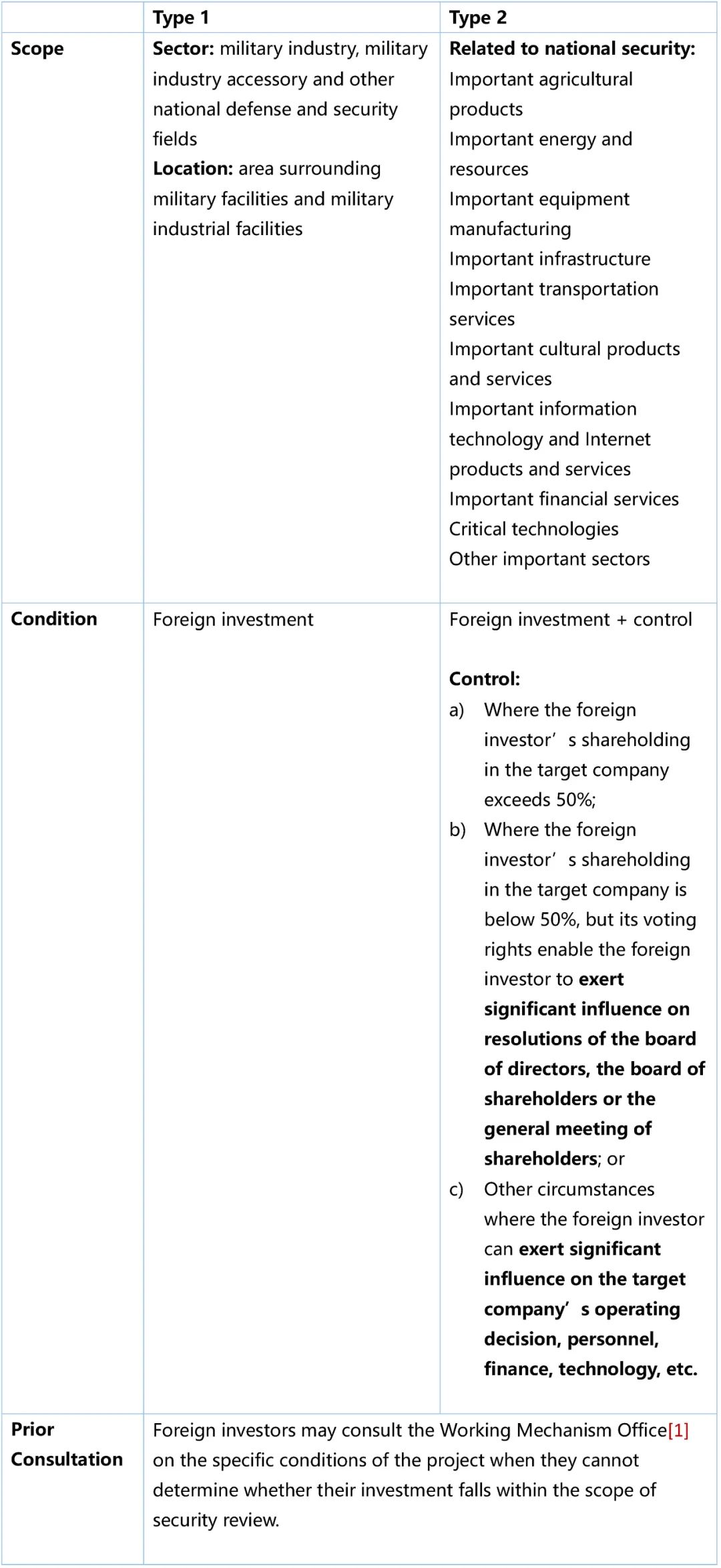
Q6 What are the application documents and review procedures for foreign investment security review?
For foreign investments that fall within the scope of security review, foreign investors or designated domestic parties (collectively referred to as “parties”) should file with the Working Mechanism Office prior to implementing the investment, and the Working Mechanism Office has the power to mandate filings if the parties fail to do so. Relevant agencies, enterprises, social organizations, and the general public may also submit review suggestions (for foreign investments that should have been reviewed but not yet reviewed) to the Working Mechanism Office. The decisions of the Working Mechanism Office include three categories: approval, conditional approval, or prohibition. Please see the chart below for more details on the notification procedures: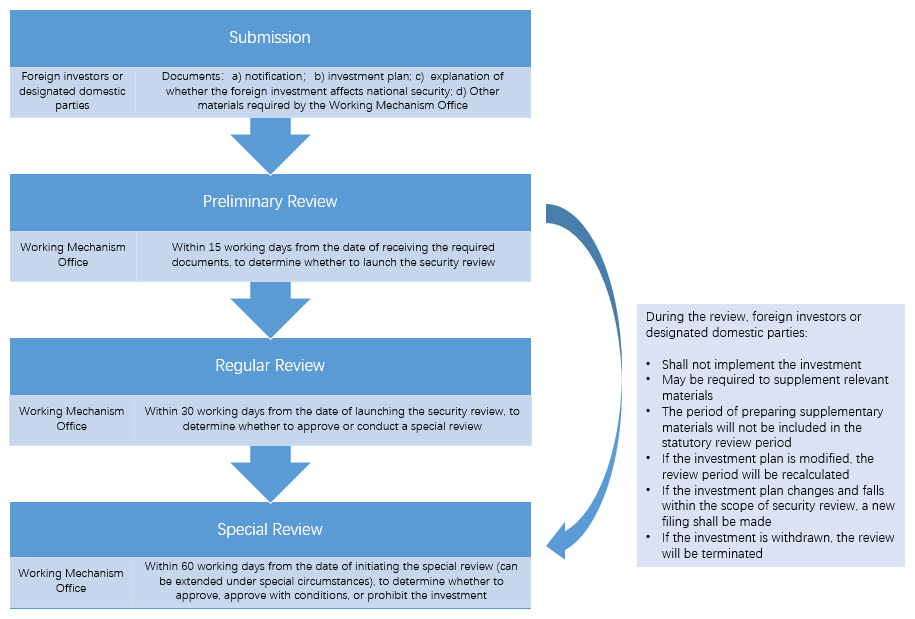
Q7 What is the supervision and punishment mechanism for foreign investment security review?
First, Article 15 of the Measures provides a means for public supervision. If relevant agencies, enterprises, social organizations, and the general public consider that a foreign investment affects or may affect national security, they may submit an opinion to the Working Mechanism Office to suggest the office to initiate security review. Second, Articles 16 to 19 of the Measures stipulate the punishments for violations such as refusal to notify, falsification, and not implementing additional conditions. The Working Mechanism Office may order the parties to dispose of equity or assets within a time limit, or downgrade the parties’ credit ratings in the national corporate social credit system, and consequently impose joint sanctions.
Q8 Whether foreign investments in securities sector fall into the scope of the Measures?
Article 22 of the Measures stipulates that with regard to foreign investors’ purchase of stocks of domestic enterprises in the stock market which affect or may affect national security, applicable security review measures will be formulated by securities regulatory authority of the State Council together with the Working Mechanism Office. Such legislation work is in progress.
“Concluding” Remarks
Notably, in its lame-duck period, the Trump administration has stepped up the suppression of Chinese enterprises during Trump’s remaining term of office. On December 18, 2020, 77 entities were added to the “Entity List” by the Bureau of Industry and Security of the U.S. Department of Commerce, most of which are Chinese enterprises, universities and individuals. On December 19, 2020, the Measures were officially promulgated. It may not necessarily be a tit-for-tat countermeasure, but the international political environment will undoubtedly influence the future implementation of the Measures. Foreign investors are advised to keep a close eye on further development.
Appendix: Comparison Table of the Notice, the Interim Provisions, the Trial Measures and the Measures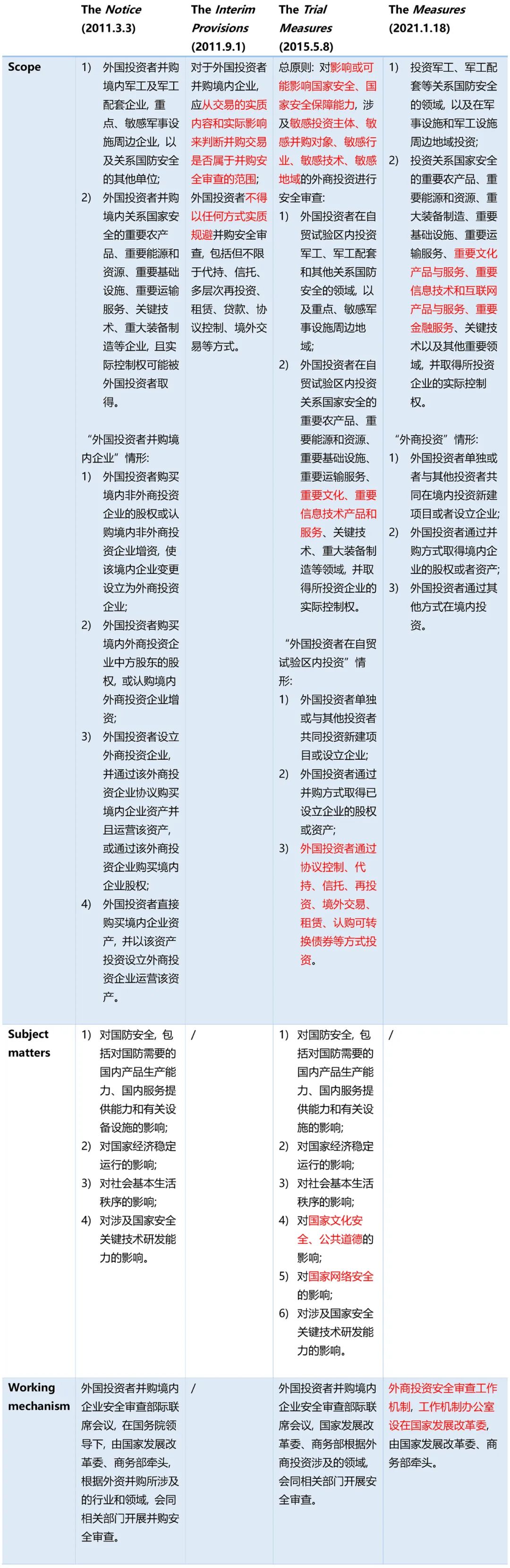
【Endnote】
[1] According to the NDRC’s No.4 Announcement in 2019, the government affairs hall of the NDRC is responsible for receiving security review filings. Address: 1st Floor, West Annex Building of National Development and Reform Commission, 5 SanLiHe South, Xicheng District, Beijing. Tel: 010-68501622, 68502979.
China’s Foreign Investment Security Review In A Nutshell
作者:通力律师来源:通力律师

On December 19, 2020, China’s National Development and Reform Commission (NDRC) and the Ministry of