
Abstract:China Securities Regulatory Commission (“CSRC”) recently released Guidance on employee stock option plan and option incentive plan of pilot enterprises (“Guidance”), which stipulates the incentive stock plan. Along with Guidance, CSRC specified Guidance by issuing measures for implementing the issuance of stock or depositary receipts by pilot creative enterprises (“measures”).
1、Scope for pilot enterprise
A. who is qualified as the pilot enterprise
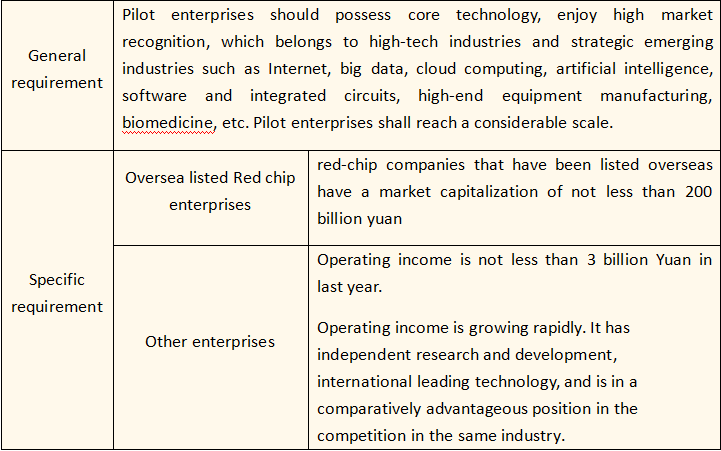
Guidance describes the pilot enterprises in general while the measure specify them, which is summarized as below:
B. selection of pilot enterprises
As shown in the above rules, the standard is set high for the pilot enterprises. However, above requirement is only the threshold for enterprises. They also have to be assessed by a consultant commission, which formed by CSRC, to determine if the enterprises is competent to be a pilot enterprises under the comprehensive consideration of factors like business model, development strategy, investment in research, ability to innovate, status in industry, and estimate market value. The CSRC would take the assessment report as the foundation to make the final decision. In the other word, even the company qualified for listed requirement of Guidance and Measures, the admission into the pilot enterprises is still subjected to the discretion of CSRC.
2、The no penetration breakthrough
No penetration immunity on the ESOP (employee stock option plan) draws a lot attention. In case of satisfy certain requirements, ESOP could qualified as one shareholder instead of the nultiple shareholders after penetrating.
According to past experience, in the process of apply for IPO, the CSRC usually pay extraction attention on employee stock option platform or ESOP, and raise the feedback questions on whether the company circumvent the requirement of shareholder shall not excess 200. In contrast with this background, the No penetration could be regard as a big breakthrough and innovation of supervising level, therefore show the determination of government to support the creative enterprises.
In addition, the companies who has plan to apply for the pilot enterprise, should pay special attention on clause on stock transfer in lock- up period. The ESOP is no valid until it has proved after the internal deciding procedure. to pass the board meeting, the ESOP shall not be vague in order to meet the no penetration requirement.
3、The form of ESOP
Guidance rule that ESOP could take form of company, partnership or asset management plan. No matter what form is taken, the ESOP shall establish the complete transfer, exit and asset management mechanism.
In common case, unlisted company setup an ESOP plan in form of company or limited partnership. Guidance pointed that the employee could hold shares indirectly by the ESOP plan. But it shall comply with the restriction of “three types shareholder.”
“Three types of shareholders” usually refers to shareholders involved in asset management products such as contractual-type private funds, asset management plans, and trust plans. According to the basic requirements of the securities law, company law and IPO rules, the stability of the equity structure and the clarity of the controlling shareholder and the actual controller are the basic auditing conditions, so enterprises that intend to be listed, and in which there are “three types of shareholders”, usually will be subject to strict and prudent supervision and verification by the regulatory authorities.
The reason why the “three types of shareholders” problem is the core issue of sustained attention from the regulatory authorities, lies in the legal construction and structural characteristics of the “three types of shareholders” itself. Under the existing legal system, there may be conflicts or challenges in terms of “equity clarity”, “equity structure stability”, and other conditions required by the listing rules, which are mainly reflected in three aspects.
First, the “three types of shareholders” are based on the construction of contracts, asset management plans or trust plans, the legal basis of which is the legal relationship of trust. They do not themselves have a “real” subject and therefore do not have the civil subject qualification and legal person qualification, and there are also problems such as the attribution of shareholders’ rights and the bearing of responsibilities.
Second, the “three types of shareholders” all have a fixed duration, and the term of such duration is usually short. In the meantime, there may be rolling issues, or transfer of shares, or the right to yields in some asset management plans or trust plans, which may cause stability as a shareholder to be questioned.
Finally, the structure of the “three types of shareholders” is complex and may involve multi-layered nesting, grading, and leveraged arrangements. In consideration of the difficulty to verify the actual holding subject or the interest subject, the “three types of shareholders” can easily become the channel for arrangements such as shareholding entrustment, benefit transfer, and connected transaction.
Nevertheless, the regulatory authorities have not completely blocked the path of listing for enterprises involving the “three types of shareholders”. Except for the above-mentioned first issue (which involves the co-ordination and architecture of more fundamental laws), the “three types of shareholders” may not be a substantial obstacle to the IPO as well as the ESOP review if the enterprise to be listed can: demonstrate the legal compliance of the establishment of the “three types of shareholders”; carry out penetration disclosure against its structure; and state that the shareholding ratio of such shareholder is low.
1、Scope for pilot enterprise
A. who is qualified as the pilot enterprise
Guidance describes the pilot enterprises in general while the measure specify them, which is summarized as below:
B. selection of pilot enterprises
As shown in the above rules, the standard is set high for the pilot enterprises. However, above requirement is only the threshold for enterprises. They also have to be assessed by a consultant commission, which formed by CSRC, to determine if the enterprises is competent to be a pilot enterprises under the comprehensive consideration of factors like business model, development strategy, investment in research, ability to innovate, status in industry, and estimate market value. The CSRC would take the assessment report as the foundation to make the final decision. In the other word, even the company qualified for listed requirement of Guidance and Measures, the admission into the pilot enterprises is still subjected to the discretion of CSRC.
2、The no penetration breakthrough
No penetration immunity on the ESOP (employee stock option plan) draws a lot attention. In case of satisfy certain requirements, ESOP could qualified as one shareholder instead of the nultiple shareholders after penetrating.
According to past experience, in the process of apply for IPO, the CSRC usually pay extraction attention on employee stock option platform or ESOP, and raise the feedback questions on whether the company circumvent the requirement of shareholder shall not excess 200. In contrast with this background, the No penetration could be regard as a big breakthrough and innovation of supervising level, therefore show the determination of government to support the creative enterprises.
In addition, the companies who has plan to apply for the pilot enterprise, should pay special attention on clause on stock transfer in lock- up period. The ESOP is no valid until it has proved after the internal deciding procedure. to pass the board meeting, the ESOP shall not be vague in order to meet the no penetration requirement.
3、The form of ESOP
Guidance rule that ESOP could take form of company, partnership or asset management plan. No matter what form is taken, the ESOP shall establish the complete transfer, exit and asset management mechanism.
In common case, unlisted company setup an ESOP plan in form of company or limited partnership. Guidance pointed that the employee could hold shares indirectly by the ESOP plan. But it shall comply with the restriction of “three types shareholder.”
“Three types of shareholders” usually refers to shareholders involved in asset management products such as contractual-type private funds, asset management plans, and trust plans. According to the basic requirements of the securities law, company law and IPO rules, the stability of the equity structure and the clarity of the controlling shareholder and the actual controller are the basic auditing conditions, so enterprises that intend to be listed, and in which there are “three types of shareholders”, usually will be subject to strict and prudent supervision and verification by the regulatory authorities.
The reason why the “three types of shareholders” problem is the core issue of sustained attention from the regulatory authorities, lies in the legal construction and structural characteristics of the “three types of shareholders” itself. Under the existing legal system, there may be conflicts or challenges in terms of “equity clarity”, “equity structure stability”, and other conditions required by the listing rules, which are mainly reflected in three aspects.
First, the “three types of shareholders” are based on the construction of contracts, asset management plans or trust plans, the legal basis of which is the legal relationship of trust. They do not themselves have a “real” subject and therefore do not have the civil subject qualification and legal person qualification, and there are also problems such as the attribution of shareholders’ rights and the bearing of responsibilities.
Second, the “three types of shareholders” all have a fixed duration, and the term of such duration is usually short. In the meantime, there may be rolling issues, or transfer of shares, or the right to yields in some asset management plans or trust plans, which may cause stability as a shareholder to be questioned.
Finally, the structure of the “three types of shareholders” is complex and may involve multi-layered nesting, grading, and leveraged arrangements. In consideration of the difficulty to verify the actual holding subject or the interest subject, the “three types of shareholders” can easily become the channel for arrangements such as shareholding entrustment, benefit transfer, and connected transaction.
Nevertheless, the regulatory authorities have not completely blocked the path of listing for enterprises involving the “three types of shareholders”. Except for the above-mentioned first issue (which involves the co-ordination and architecture of more fundamental laws), the “three types of shareholders” may not be a substantial obstacle to the IPO as well as the ESOP review if the enterprise to be listed can: demonstrate the legal compliance of the establishment of the “three types of shareholders”; carry out penetration disclosure against its structure; and state that the shareholding ratio of such shareholder is low.