From October 20, 2015 to February 24, 2016, the Hong Kong International Arbitration Center (hereinafter the “HKIAC”), the Singapore International Arbitration Centre (hereinafter the “SIAC”) and the International Chamber of Commerce (hereinafter the “ICC”) successively registered and established their Shanghai representative offices in the China (Shanghai) Pilot Free Trade Zone (hereinafter the “Shanghai Free Trade Zone”), to expand arbitration services and to seek a wider range of exchange and cooperation in mainland China.
On April 28, 2016, the Law of the People's Republic of China on the Administration of Activities of Overseas Non-Governmental Organizations within the Territory of China (hereinafter the “Overseas NGOs Law”) was adopted at the 20th Session of the Standing Committee of the 12th National People's Congress of the People's Republic of China, and promulgated on the same day for implementation on January 1, 2017.
Unlike Regulations on Foundation Administration and Interim Provisions on the Administration of Foreign Chambers of Commerce, the Overseas NGOs Law is the first law aimed at the activities of overseas Non-governmental Organizations of all forms (hereinafter the “Overseas NGOs”) in mainland China. It filled a void and might have far-reaching impacts on the activities of foreign arbitration institutions in mainland China as well.
I Main Content of the Overseas NGOs Law
1 The Scope of Application
Article 2 of the Overseas NGOs Law defines the scope for application of this law as applying to the “activities of … foundations, social groups, think-tanks and other non-profit, non-governmental social organizations legally formed abroad” “within the territory of China”.
2 The Scope of Activities by Overseas NGOs
As for the scope of activities by Overseas NGOs, the relevant provisions in the Overseas NGOs Law are listed in the following chart: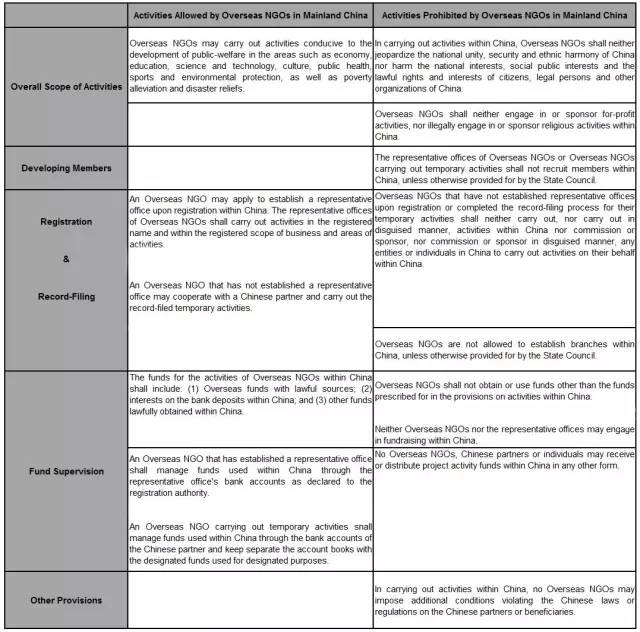
Furthermore, according to the Overseas NGOs Law, for the detailed areas of activities that the Overseas NGOs may carry out, the public security department of the State Council and the public security organs of the provincial people's governments shall, in conjunction with relevant departments, formulate the directory of areas and projects for the activities of Overseas NGOs so that the scope of activities of Overseas NGOs will be further detailed.
3 Regulatory Authorities
The Overseas NGOs Law set up a multiple administrative system consisting of the primary dual administration by relevant government departments as the competent business authorities and public security organs as the registration authorities, and the collaborative administration by other government departments:
(1) Relevant departments and organizations of the State Council and relevant departments and organizations of provincial people's governments are the competent business authorities supervising the activities carried out by the Overseas NGOs in mainland China. The public security department of the State Council and the public security organs of the provincial people's governments shall, in conjunction with relevant departments, formulate and publish the directory of competent business authorities.
The competent business authorities are mainly responsible for approving applications for Overseas NGOs seeking to establish representative offices in mainland China and for changes in registration, supervising and guiding the Overseas NGOs and their representative offices, and assisting public security departments in investigating any suspected illegal activities of the Overseas NGOs and their representative offices.
(2) The public security department of the State Council and the public security organs of the provincial people's governments are the registration authorities for the activities carried out by overseas NGOs in mainland China.
The registration authorities are mainly responsible for registration and annual review of the representative offices of Overseas NGOs, record-filing of temporary activities, and investigation and punishment of any illegal activities.
(3) Besides the aforementioned public security department of the State Council and the public security organs of the provincial people's governments as registration authorities, public security organs at all levels are also responsible for supervision and administration of Overseas NGOs, and investigation and punishment of any illegal activities.
(4) The departments for national security, foreign affairs, finance, financial supervision and administration, customs, taxation, foreign experts, etc., shall, based on their respective duties, carry out the supervision and administration of Overseas NGOs and their representative offices in accordance with the law.
(5) The anti-money laundering administrative department of the State Council shall, in accordance with the law, carry out the supervision and administration of compliance with the anti-money laundering and anti-terrorism financing laws by the representative offices of Overseas NGOs, their Chinese partners and the entities and individuals in mainland China that accept the funds from Overseas NGOs in opening and using bank accounts.
(6) Relevant departments of the people's governments at all levels shall provide necessary facilitation and services to Overseas NGOs in carrying out activities in mainland China.
In addition, the Overseas NGOs Law also stipulates that the State shall provide guidance on the activities of Overseas NGOs, the State shall establish the coordination system for the supervision and administration, so as to study, coordinate and solve major issues, and commend Overseas NGOs for outstanding contributions.
II The Impacts of the Overseas NGOs Law on the Arbitration Activities of Foreign Arbitration Institutions in Mainland China
1 Whether the Overseas NGOs Law Applies to Foreign Arbitration Institutions
As mentioned above, the Overseas NGOs Law shall apply to the non-profit, non-governmental social organizations legally formed abroad. Foreign arbitration institutions including HKIAC, SIAC and ICC are undoubtedly non-governmental social organizations. However, can they be considered non-profit social organizations?
HKIAC affirms, in an introduction to its organization, that it is a company limited by guarantee and a non-profit organization established under Hong Kong law. 1
SIAC also declares on its official website that it is an independent, not-for-profit organization. 2
ICC does not claim to be a non-profit on its official website, however, ICC is a non-governmental organization in consultative status with the Economic and Social Council of the United Nations3, given the definition of non-governmental organization as defined by the United Nations, namely “non-profit voluntary civil organizations organized at regional, national or international levels”4 and it is clearly considered a non-profit by the United Nations.
But, under Chinese law, should these foreign arbitration institutions also be identified as “non-profit” social organizations and subject to the Overseas NGOs Law? The Overseas NGOs Law does not provide a specific definition of “non-profit”.
Article 10 of the Donations for Public Welfare Law of the People's Republic of China stipulates that “the term ‘non-profit public welfare institutions’ refers to institutions of education, scientific research, medicine and public health, public culture, public sports and public welfare services, etc., which are formed in accordance with law and engaged in public welfare services with no profit-making purposes.” It can be seen that in this law the term “non-profit” is interpreted as its literal meaning, namely “with no profit-making purposes.”
Paragraph 2 of Article 2 of the Accounting System for Non-governmental Non-profit Organizations5 summarizes the characteristics of a non-governmental non-profit organization as: (1) an organization that is not for marking profit; (2) no sponsor of the organization shall have economic returns for his contribution; (3) no sponsor of the organization shall claim ownership of the organization.
We have noted that the Chinese tax laws have stricter definitions of non-profit organizations especially when it comes to the tax exempt qualifications. Specifically, the Regulation on the Implementation of the Enterprise Income Tax Law of the People's Republic of China and the Notice of the Ministry of Finance and the State Administration of Taxation on Issues concerning the Administration of Tax Exempt Qualification of Non-profit Organizations provides that the “non-profit” shall meet the following conditions: (1) the organization engages in public welfare or non-profit activities; (2) the incomes obtained are all used for public welfare or non-profit undertakings as approved in registration or stipulated in the bylaws except for the reasonable expenses relating to the organization; (3) the properties and any fruits are not to be distributed, excluding reasonable wages and salaries; (4) the residual properties of the organization after deregistration should be used for public welfare or non-profit purposes or be donated to another organization in the same nature and with the same tenets; (5) the sponsor should not reserve or enjoy any property rights to the properties contributed to the organization; (6) the expenses for the wages and fringe benefits of the employees are strictly controlled, none of the organization's properties should be distributed in any disguised form.
Although the concept of “non-profit” organization under the Overseas NGOs Law is to be further defined in relevant detailed rules, we understand the primary elements should be essentially consistent with the definitions of “non-profit” organizations under Accounting System for Non-governmental Non-profit Organizations, Donations for Public Welfare Law and tax laws aforementioned, namely, it shall meet the following requirements: (1) the organization is legally formed; (2) the organization is not for profit making; (3) the incomes of the organization should not be distributed or distributed in any disguised form, to any sponsor. In this sense, foreign arbitration institutions should be recognized as non-profit organizations under Chinese law, and the Overseas NGOs Law shall apply to their activities in mainland China.
1. See the official website of HKIAC, http://www.hkiac.org/about-us, last accessed on May 13, 2016.
2. See the official website of SIAC, http://www.siac.org.sg/2014-11-03-13-33-43/about-us, last accessed on May 13, 2016.
3. See the website of United Nations for detailed list, http://www.un.org/esa/coordination/ngo/pdf/INF_List.pdf, last accessed on May 13, 2016.
4. See the website of United Nations, http://www.un.org/chinese/aboutun/ngo/qanda.html, last accessed on May 13, 2016.
5. Stipulated by the Ministry of Finance in accordance with the Accounting Law of the People's Republic of China and other relevant laws, regulations and rules, which took effect on January 1, 2005.
Overseas NGOs Law:Impacts on Foreign Arbitration Institutions I
作者:ChristineKANG NanHU XinJIANG SizheHUANG XuanJIANG来源:君合律师事务所

From October 20, 2015 to February 24, 2016, the Hong Kong International Arbitration Center (hereinaf