
I. Legislative Background
When the Ministry of Commerce of the People’s Republic of China (the “MOFCOM”) solicited comments on the Export Control Law (Draft) in 2017, it pointed out that under the background where major countries and regions in the world have already formulated export control laws, China urgently needs a fundamental law in the field of export control to coordinate administrative regulations and rules in that field then effective. On October 17, 2020, the Export Control Law was officially promulgated and will come into effect on December 1, 2020. This article focuses on the establishment of China’s export control legal system, interprets the connection of the Export Control Law with other laws and its key clauses, and provides practical suggestions on export control compliance in enterprises.
II. Connection with Other Laws and Regulations
Before the promulgation of the Export Control Law, China has promulgated the following laws and administrative regulations in the field of export control:
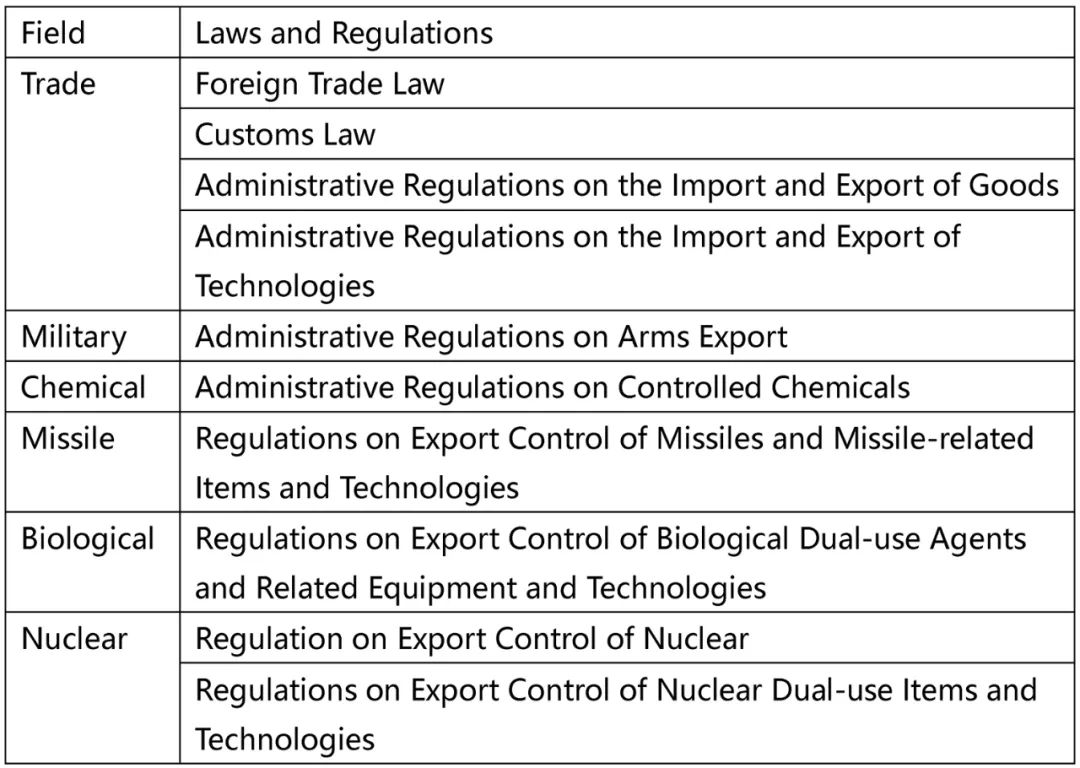
In addition to the administrative measures for controlled items, the Criminal Law of the PRC stipulates corresponding crimes for export control violations, such as the crime of smuggling goods and articles, the crime of smuggling weapons and ammunitions, and the crime of smuggling nuclear materials. After the Export Control Law comes into effect, it will not only coordinate among export control laws and regulations, but also help integrate other departmental laws into a unified legal regime of export control.
(1) The Foreign Trade Law and the Customs Law
China’s Foreign Trade Law stipulates that the state may restrict or prohibit the import or export of relevant goods and technologies based on eleven reasons[1] such as national security and social public interests, which lays a legal foundation for the implementation of China’s export control measures. Among them, quota and license management are the two most important export control measures under the Foreign Trade Law, while the Customs Law focuses on customs supervision on import and export licenses and other documents. After the promulgation of the Export Control Law, it not only further clarifies the scope and control measures of the controlled items in China at the legislative level, but also increases the administrative penalties for violating export control measures, thereby increasing the cost of violations. In terms of the amount of administrative penalties, if an operator engages in the export of relevant controlled items without obtaining the qualification for such engagement, or exports controlled items without permission or beyond the scope permitted in the license, the operator shall be fined not less than RMB 500,000 and not more than RMB 5,000,000; if the amount of illegal gains exceeds RMB 500,000, the operator shall be fined not less than five times but not more than ten times the illegal gains.
(2) The Data Security Law (Draft)
The Export Control Law clearly stipulates that the controlled items include data such as technical data related to the items, which is consistent with the provision that “the state shall implement export control on the data which belongs to controlled items and is related to fulfilling international obligations and safeguarding national security”[2] in the Data Security Law (Draft). The Data Security Law (Draft) stipulates that if any country or region imposes discriminatory prohibitions, restrictions or other similar measures against the People’s Republic of China in respect of investment and trade related to data and data development and utilization technology, China may take corresponding measures.[3] This provision is clarified in the Export Control Law, which states that China can take countermeasures against any country or region which abuse export control measures.
(3) Provisions on the Unreliable Entity List
The Provisions on the Unreliable Entity List are formulated according to the Foreign Trade Law, the National Security Law and other relevant laws. The unreliable entity list focuses on the maintenance of normal market trading rules and opposes unilateralism and protectionism. The Export Control Law includes the controlled person list and the control list. The control list relates to controlled items and includes lists, directories and catalogues. Similar to the unreliable entity list, the controlled person list relates to importers and end users and focuses on whether terrorism is involved. Although the controlled subjects and emphases of the controlled person list and the unreliable entity list are different, the legislative purposes of the two lists are consistent with respect to "safeguarding national security and interests". Therefore, if an importer endangers China’s national security and interests, the importer may be included in both the unreliable entity list and the controlled person list. Persons on both lists will be restricted or prohibited from relevant trading. In addition, the Export Control Law specifically emphasizes that Chinese exporters shall not trade with persons on the controlled person list in violation of relevant provisions.
III. Key Clauses
(1) Controlled Items
As mentioned above, before the enactment of the Export Control Law, China has formulated export control regulations covering nuclear, biological, chemical, missile, and military items at the level of administrative regulations. Nevertheless, the scope of controlled items covered by the export control legal system was limited and outdated. To make up for this deficiency, the Export Control Law includes dual-use items, arms, nuclear, and other goods, technologies, and services related to safeguarding national security and interests and fulfilling international obligations such as non-proliferation, into the scope of controlled items. It also clarifies that the controlled items include technical materials and other data related to the items. Therefore, the controlled items under the Export Control Law can be divided into three categories: commodities, technologies, and services, including data.
The Export Control Law divides the controlled items into the controlled items on the export control list, the temporarily controlled items, and other controlled items. Among them, the export control list is formulated and published by the national export control administration. At present, China has formulated several control lists such as the Export Control List of Nuclear Dual-use Items and Related Technologies, the Nuclear Export Control List, and the List of Technologies Prohibited or Limited from Export. The temporarily controlled items are commodities, technologies, and services that are not on the export control list and are temporarily controlled by the national export control administration. The implementation period of temporary controls shall not exceed two years. Temporary controls can adapt to various special situations that may arise in export control.
(2) Export Licensing System
The Export Control Law combines the control list system, the controlled person list system and the export licensing system, and stipulates that to export controlled items on the export control list and temporarily controlled items, the exporters shall apply to the national export control administration for licenses. With respect to other controlled items, if the exporters know or should have known, or are notified by the national export control administration that the relevant commodities, technologies and services may have any of the following risks, they shall apply for licenses to the national export control administration: (1) endangering national security and interests; (2) being used in the design, development, production or use of weapons of mass destruction and their means of delivery; or (3) being used for terrorist purposes.
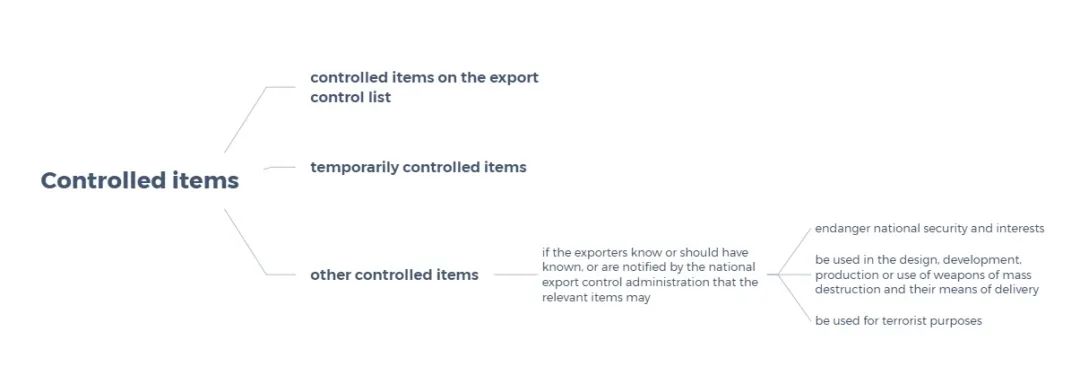
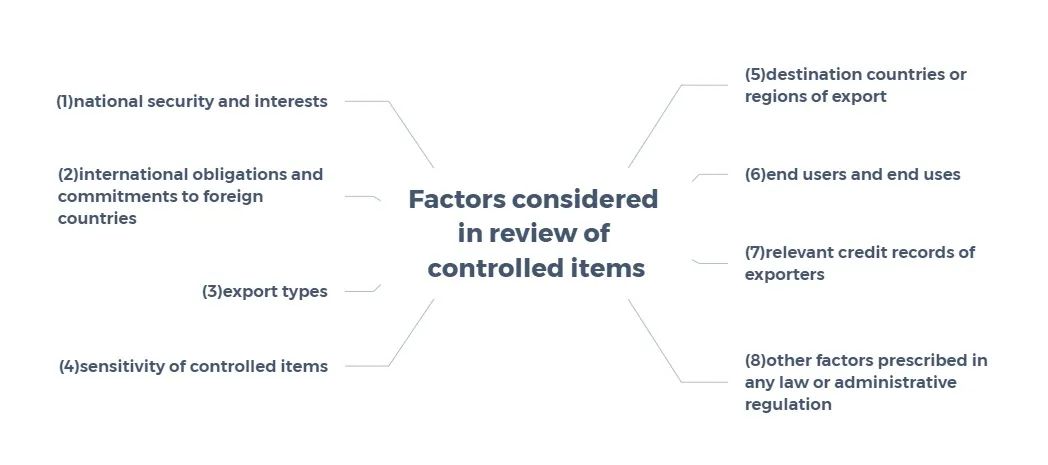
The national export control administration will take into overall consideration the following factors when reviewing the applications for export of controlled items: (1) national security and interests; (2) international obligations and commitments to foreign countries; (3) export types; (4) sensitivity of controlled items; (5) destination countries or regions of export; (6) end users and end uses; (7) relevant credit records of exporters; (8) other factors prescribed in any law or administrative regulation. Among them, (1) states the reviewing principle and reflects the nature and functions of the Export Control Law to safeguard national security and interests; (3)-(6) are export control means, and the national export control administration will review specific transactions based on the export types, controlled items, export destinations, end users and end uses involved, which basically cover all potential export control risks of all transactions; while (7) highlights the importance of establishing a sound export control internal compliance system.
(3) Controlled Person List
The Export Control Law establishes a controlled person list system. The national export control administration establishes a control list for importers and end users who violate end-user or end-use management requirements, may endanger national security and interests, or use controlled items for terrorist purposes. For importers and end users in the controlled person list, the national export control administration may prohibit or restrict the transactions related to controlled items. The controlled person list system is similar to the entity list system under the Export Administration Regulations (the “EAR”). If an entity or individual is in the entity list, unless otherwise specified, the export, re-export, or in-country transfer of specific items to the entity or individual shall not proceed before applying for licenses to the Bureau of Industry and Security, Department of Commerce of the United States (the “BIS”). In addition, “presumption of denial” applies to the licensing review for many entities and individuals on the entity list, which means that in principle the BIS will deny such applications for licenses.
In order to increase the flexibility of the controlled entity system, the Final Draft of the Export Control Law, on the basis of the Third Draft for Review, added provisions on applications for transactions with persons on the controlled person list and applications for removal from the controlled person list: where exporters do need to trade with any importer or end user on the controlled person list under special circumstances, they may file applications with the national export control administration. Where importers or end users on the controlled person list no longer falls under any of the circumstances that require controls, they may file applications with the national export control administration for removal from the controlled person list. [4]
(4) End Users and End Uses
The Export Control Law adopts control measures based on end users and end uses, and strengthens control on end users and end uses from the perspective of export business operators, end users, and national export control authorities.
From the perspective of export business operators, when applying for export of controlled items, export business operators shall submit certification documents of the end users and end uses of the controlled items. The relevant certification documents are issued by the government agencies of the countries or regions where the end users are located. For example, the MOFCOM issues the “End User and End Use Statement” to the governments of specific countries of destination, which testifies that the importers and end users have promised to the MOFCOM that the imported goods will only be used for the stated end uses, and will not be otherwise used, transferred or re-exported to other destinations. The “End User and End Use Statement” shall be jointly applied by the importers and the end users.[5]
From the perspective of end users, in accordance with the general practice of export control compliance, end users will be required to undertake in the contract signed with the export business operators or importers that they are the end users and guarantee that the end uses of the items will not be changed. The Export Control Law imposes compliance obligations on end users that end users shall promise not to change the end uses of the relevant controlled items or transfer such items to any third party without the consent of the national export control administration.
From the perspective of the national export control administration, the national export control administration establishes a risk management system based on the end users and end uses of controlled items, and evaluates and verifies the end users and end uses of the controlled items. It can be reasonably inferred that China may seek to reach bilateral or multilateral cooperation agreements with other countries with regard to extraterritorial administrative investigation and law enforcement in the future.
(5) Credit Records
According to the Export Control Law (Draft), the credit records of exporters and end users and the compliance mechanisms of enterprises are the basis for determining the license types. This provision was revised in the First Draft for Review of the Export Control Law. Since the First Draft for Review, the exporters’ credit records have become one of the examination standards for export control licensing, which is more practical.
At present, China has issued a large number of laws, regulations and policies related to corporate social credit system (the “CSCS”). Different government departments and governments at various local levels also issued their own ancillary policies. The CSCS covers almost all governing aspects of business operations of a company, such as environment protection, taxation, foreign exchange, customs, advertising, antitrust, medicine, safety production, product quality, and so on. The CSCS sets forth rating requirements that enterprises must abide by, provides clear credit rating parameters and rating methods, as well as the legal consequences corresponding to different credit ratings, and lays down a reward mechanism for compliance and punishment for violations. It is foreseeable that the export control credit records will become an important part of the social credit system of social enterprises. The national export control administration is likely to issue specific rating standards to evaluate the export control credit of enterprises and take corresponding measures in the future.
(6) Internal Compliance System for Export Control
The Export Control Law clarifies that the national export control administration will issue export control guidelines for relevant industries in a timely manner, in order to guide export business operators to establish and improve internal compliance systems for export control and regulate their operations. As early as 2007, the MOFCOM issued the Guidelines on Establishing Internal Export Control Mechanisms for Dual-use Item and Technology Trading Enterprises, which provide certain basic elements of the internal export control mechanisms of enterprises, including drafting policy statements, establishing organizational structures, formulating review procedures, preparing management manuals, carrying out education and training, and retaining documents and files. The Guidelines also point out that, in order to encourage and support enterprises to establish internal export control mechanisms, the MOFCOM will introduce supporting incentive measures to set the establishment and implementation of internal control mechanisms of enterprises as an important condition to offer licensing convenience; the MOFCOM will also provide consulting services in respect of export control regulations, the requirements on the establishment of internal export control mechanisms of enterprises, and specialized skills. The Export Control Law reiterates the above-mentioned encouragement and supporting measures, and enumerates the general license as a kind of licensing convenience.
(7) Management of Intermediary Services
In order to strengthen the management of intermediary services during the export of controlled items, the Second Draft for Review added a new clause stipulating that any organization or individual shall not provide agency, freight, delivery, customs declaration, third-party e-commerce transaction platform and financial services for export business operators with knowledge that such operators are engaged in export control violations.[6] The Final Draft of the Export Control Law has kept this newly added clause.
IV. Compliance Tips
(1) Pay Close Attention to Controlled Items
The Export Control Law adopts a comprehensive control system for controlled items, including dual-use items, arms, nuclear, and other goods, technologies, and services related to safeguarding national security and interests and fulfilling international obligations such as non-proliferation. Both the "national security and interests" in the control reason and the "services and data" in the controlled items have broadened the scope of traditional export control. Therefore, enterprises shall always pay attention to export control policies, control lists and risk levels of countries and regions with different controlled items and the policy changes of temporarily controlled items. Tangible goods, and their relevant intangible items such as technologies, services and data shall be paid equal attention. If enterprises are unable to determine whether a specific item is controlled, they should consult the national export control administration or professional lawyers before export, so as to ensure that the export activities conform to laws and regulations.
(2) Screen Controlled Person List
In addition to controlled items, export enterprises must establish a screening mechanism for end-users, pay attention to the changes in the control lists, and determine whether the importers or end-users are prohibited or restricted from trading. If the name of the importer or end user is not clear due to language and other reasons, the exporter should pay special attention to whether the receiving address of the importer is similar to that of the entity on the control lists. Export enterprises should also pay attention to abnormal signals such as the importers' unwillingness to disclose the end users and the inconsistency between the importers' business background and the imported items.
(3) Establish Export Control Compliance System
Enterprises should establish an internal compliance system for export control, pay attention to and follow the export control compliance guidelines issued by the national export control administration, which is an important condition for entitlement to licensing convenience. Meanwhile, enterprises should improve their export control behaviors according to the credit rating standards for export control, so as to obtain good corporate social credit.
In recent years, China has issued various compliance guidelines. For export enterprises, the export control compliance system must be effectively established and well implemented. Enterprise shall regard the implementation of compliance systems as an important part for the long-term development of the enterprises. Enterprises are encouraged to take measures such as ensuring the establishment of a management commitment, risk assessment of transactions, recording and auditing, compliance training, and timely communication and cooperation with export control authorities in case of doubt.
【Endnote】
[1] See Article 16 of the Foreign Trade Law.
[2] Article 23 of the Data Security Law (Draft).
[3] Article 24 of the Data Security Law (Draft).
[4] See the Report of the Constitution and Law Committee of the National People's Congress on the Opinions on Revisions to the Export Control Law of the People's Republic of China (the Third Draft for Review).
[5] See http://zzyhzm.mofcom.gov.cn/, last visited on October 21, 2020.
[6] See the Report on the Revisions of the Export Control Law of the People’s Republic of China (Draft).
When the Ministry of Commerce of the People’s Republic of China (the “MOFCOM”) solicited comments on the Export Control Law (Draft) in 2017, it pointed out that under the background where major countries and regions in the world have already formulated export control laws, China urgently needs a fundamental law in the field of export control to coordinate administrative regulations and rules in that field then effective. On October 17, 2020, the Export Control Law was officially promulgated and will come into effect on December 1, 2020. This article focuses on the establishment of China’s export control legal system, interprets the connection of the Export Control Law with other laws and its key clauses, and provides practical suggestions on export control compliance in enterprises.
II. Connection with Other Laws and Regulations
Before the promulgation of the Export Control Law, China has promulgated the following laws and administrative regulations in the field of export control:
In addition to the administrative measures for controlled items, the Criminal Law of the PRC stipulates corresponding crimes for export control violations, such as the crime of smuggling goods and articles, the crime of smuggling weapons and ammunitions, and the crime of smuggling nuclear materials. After the Export Control Law comes into effect, it will not only coordinate among export control laws and regulations, but also help integrate other departmental laws into a unified legal regime of export control.
(1) The Foreign Trade Law and the Customs Law
China’s Foreign Trade Law stipulates that the state may restrict or prohibit the import or export of relevant goods and technologies based on eleven reasons[1] such as national security and social public interests, which lays a legal foundation for the implementation of China’s export control measures. Among them, quota and license management are the two most important export control measures under the Foreign Trade Law, while the Customs Law focuses on customs supervision on import and export licenses and other documents. After the promulgation of the Export Control Law, it not only further clarifies the scope and control measures of the controlled items in China at the legislative level, but also increases the administrative penalties for violating export control measures, thereby increasing the cost of violations. In terms of the amount of administrative penalties, if an operator engages in the export of relevant controlled items without obtaining the qualification for such engagement, or exports controlled items without permission or beyond the scope permitted in the license, the operator shall be fined not less than RMB 500,000 and not more than RMB 5,000,000; if the amount of illegal gains exceeds RMB 500,000, the operator shall be fined not less than five times but not more than ten times the illegal gains.
(2) The Data Security Law (Draft)
The Export Control Law clearly stipulates that the controlled items include data such as technical data related to the items, which is consistent with the provision that “the state shall implement export control on the data which belongs to controlled items and is related to fulfilling international obligations and safeguarding national security”[2] in the Data Security Law (Draft). The Data Security Law (Draft) stipulates that if any country or region imposes discriminatory prohibitions, restrictions or other similar measures against the People’s Republic of China in respect of investment and trade related to data and data development and utilization technology, China may take corresponding measures.[3] This provision is clarified in the Export Control Law, which states that China can take countermeasures against any country or region which abuse export control measures.
(3) Provisions on the Unreliable Entity List
The Provisions on the Unreliable Entity List are formulated according to the Foreign Trade Law, the National Security Law and other relevant laws. The unreliable entity list focuses on the maintenance of normal market trading rules and opposes unilateralism and protectionism. The Export Control Law includes the controlled person list and the control list. The control list relates to controlled items and includes lists, directories and catalogues. Similar to the unreliable entity list, the controlled person list relates to importers and end users and focuses on whether terrorism is involved. Although the controlled subjects and emphases of the controlled person list and the unreliable entity list are different, the legislative purposes of the two lists are consistent with respect to "safeguarding national security and interests". Therefore, if an importer endangers China’s national security and interests, the importer may be included in both the unreliable entity list and the controlled person list. Persons on both lists will be restricted or prohibited from relevant trading. In addition, the Export Control Law specifically emphasizes that Chinese exporters shall not trade with persons on the controlled person list in violation of relevant provisions.
III. Key Clauses
(1) Controlled Items
As mentioned above, before the enactment of the Export Control Law, China has formulated export control regulations covering nuclear, biological, chemical, missile, and military items at the level of administrative regulations. Nevertheless, the scope of controlled items covered by the export control legal system was limited and outdated. To make up for this deficiency, the Export Control Law includes dual-use items, arms, nuclear, and other goods, technologies, and services related to safeguarding national security and interests and fulfilling international obligations such as non-proliferation, into the scope of controlled items. It also clarifies that the controlled items include technical materials and other data related to the items. Therefore, the controlled items under the Export Control Law can be divided into three categories: commodities, technologies, and services, including data.
The Export Control Law divides the controlled items into the controlled items on the export control list, the temporarily controlled items, and other controlled items. Among them, the export control list is formulated and published by the national export control administration. At present, China has formulated several control lists such as the Export Control List of Nuclear Dual-use Items and Related Technologies, the Nuclear Export Control List, and the List of Technologies Prohibited or Limited from Export. The temporarily controlled items are commodities, technologies, and services that are not on the export control list and are temporarily controlled by the national export control administration. The implementation period of temporary controls shall not exceed two years. Temporary controls can adapt to various special situations that may arise in export control.
(2) Export Licensing System
The Export Control Law combines the control list system, the controlled person list system and the export licensing system, and stipulates that to export controlled items on the export control list and temporarily controlled items, the exporters shall apply to the national export control administration for licenses. With respect to other controlled items, if the exporters know or should have known, or are notified by the national export control administration that the relevant commodities, technologies and services may have any of the following risks, they shall apply for licenses to the national export control administration: (1) endangering national security and interests; (2) being used in the design, development, production or use of weapons of mass destruction and their means of delivery; or (3) being used for terrorist purposes.
The national export control administration will take into overall consideration the following factors when reviewing the applications for export of controlled items: (1) national security and interests; (2) international obligations and commitments to foreign countries; (3) export types; (4) sensitivity of controlled items; (5) destination countries or regions of export; (6) end users and end uses; (7) relevant credit records of exporters; (8) other factors prescribed in any law or administrative regulation. Among them, (1) states the reviewing principle and reflects the nature and functions of the Export Control Law to safeguard national security and interests; (3)-(6) are export control means, and the national export control administration will review specific transactions based on the export types, controlled items, export destinations, end users and end uses involved, which basically cover all potential export control risks of all transactions; while (7) highlights the importance of establishing a sound export control internal compliance system.
(3) Controlled Person List
The Export Control Law establishes a controlled person list system. The national export control administration establishes a control list for importers and end users who violate end-user or end-use management requirements, may endanger national security and interests, or use controlled items for terrorist purposes. For importers and end users in the controlled person list, the national export control administration may prohibit or restrict the transactions related to controlled items. The controlled person list system is similar to the entity list system under the Export Administration Regulations (the “EAR”). If an entity or individual is in the entity list, unless otherwise specified, the export, re-export, or in-country transfer of specific items to the entity or individual shall not proceed before applying for licenses to the Bureau of Industry and Security, Department of Commerce of the United States (the “BIS”). In addition, “presumption of denial” applies to the licensing review for many entities and individuals on the entity list, which means that in principle the BIS will deny such applications for licenses.
In order to increase the flexibility of the controlled entity system, the Final Draft of the Export Control Law, on the basis of the Third Draft for Review, added provisions on applications for transactions with persons on the controlled person list and applications for removal from the controlled person list: where exporters do need to trade with any importer or end user on the controlled person list under special circumstances, they may file applications with the national export control administration. Where importers or end users on the controlled person list no longer falls under any of the circumstances that require controls, they may file applications with the national export control administration for removal from the controlled person list. [4]
(4) End Users and End Uses
The Export Control Law adopts control measures based on end users and end uses, and strengthens control on end users and end uses from the perspective of export business operators, end users, and national export control authorities.
From the perspective of export business operators, when applying for export of controlled items, export business operators shall submit certification documents of the end users and end uses of the controlled items. The relevant certification documents are issued by the government agencies of the countries or regions where the end users are located. For example, the MOFCOM issues the “End User and End Use Statement” to the governments of specific countries of destination, which testifies that the importers and end users have promised to the MOFCOM that the imported goods will only be used for the stated end uses, and will not be otherwise used, transferred or re-exported to other destinations. The “End User and End Use Statement” shall be jointly applied by the importers and the end users.[5]
From the perspective of end users, in accordance with the general practice of export control compliance, end users will be required to undertake in the contract signed with the export business operators or importers that they are the end users and guarantee that the end uses of the items will not be changed. The Export Control Law imposes compliance obligations on end users that end users shall promise not to change the end uses of the relevant controlled items or transfer such items to any third party without the consent of the national export control administration.
From the perspective of the national export control administration, the national export control administration establishes a risk management system based on the end users and end uses of controlled items, and evaluates and verifies the end users and end uses of the controlled items. It can be reasonably inferred that China may seek to reach bilateral or multilateral cooperation agreements with other countries with regard to extraterritorial administrative investigation and law enforcement in the future.
(5) Credit Records
According to the Export Control Law (Draft), the credit records of exporters and end users and the compliance mechanisms of enterprises are the basis for determining the license types. This provision was revised in the First Draft for Review of the Export Control Law. Since the First Draft for Review, the exporters’ credit records have become one of the examination standards for export control licensing, which is more practical.
At present, China has issued a large number of laws, regulations and policies related to corporate social credit system (the “CSCS”). Different government departments and governments at various local levels also issued their own ancillary policies. The CSCS covers almost all governing aspects of business operations of a company, such as environment protection, taxation, foreign exchange, customs, advertising, antitrust, medicine, safety production, product quality, and so on. The CSCS sets forth rating requirements that enterprises must abide by, provides clear credit rating parameters and rating methods, as well as the legal consequences corresponding to different credit ratings, and lays down a reward mechanism for compliance and punishment for violations. It is foreseeable that the export control credit records will become an important part of the social credit system of social enterprises. The national export control administration is likely to issue specific rating standards to evaluate the export control credit of enterprises and take corresponding measures in the future.
(6) Internal Compliance System for Export Control
The Export Control Law clarifies that the national export control administration will issue export control guidelines for relevant industries in a timely manner, in order to guide export business operators to establish and improve internal compliance systems for export control and regulate their operations. As early as 2007, the MOFCOM issued the Guidelines on Establishing Internal Export Control Mechanisms for Dual-use Item and Technology Trading Enterprises, which provide certain basic elements of the internal export control mechanisms of enterprises, including drafting policy statements, establishing organizational structures, formulating review procedures, preparing management manuals, carrying out education and training, and retaining documents and files. The Guidelines also point out that, in order to encourage and support enterprises to establish internal export control mechanisms, the MOFCOM will introduce supporting incentive measures to set the establishment and implementation of internal control mechanisms of enterprises as an important condition to offer licensing convenience; the MOFCOM will also provide consulting services in respect of export control regulations, the requirements on the establishment of internal export control mechanisms of enterprises, and specialized skills. The Export Control Law reiterates the above-mentioned encouragement and supporting measures, and enumerates the general license as a kind of licensing convenience.
(7) Management of Intermediary Services
In order to strengthen the management of intermediary services during the export of controlled items, the Second Draft for Review added a new clause stipulating that any organization or individual shall not provide agency, freight, delivery, customs declaration, third-party e-commerce transaction platform and financial services for export business operators with knowledge that such operators are engaged in export control violations.[6] The Final Draft of the Export Control Law has kept this newly added clause.
IV. Compliance Tips
(1) Pay Close Attention to Controlled Items
The Export Control Law adopts a comprehensive control system for controlled items, including dual-use items, arms, nuclear, and other goods, technologies, and services related to safeguarding national security and interests and fulfilling international obligations such as non-proliferation. Both the "national security and interests" in the control reason and the "services and data" in the controlled items have broadened the scope of traditional export control. Therefore, enterprises shall always pay attention to export control policies, control lists and risk levels of countries and regions with different controlled items and the policy changes of temporarily controlled items. Tangible goods, and their relevant intangible items such as technologies, services and data shall be paid equal attention. If enterprises are unable to determine whether a specific item is controlled, they should consult the national export control administration or professional lawyers before export, so as to ensure that the export activities conform to laws and regulations.
(2) Screen Controlled Person List
In addition to controlled items, export enterprises must establish a screening mechanism for end-users, pay attention to the changes in the control lists, and determine whether the importers or end-users are prohibited or restricted from trading. If the name of the importer or end user is not clear due to language and other reasons, the exporter should pay special attention to whether the receiving address of the importer is similar to that of the entity on the control lists. Export enterprises should also pay attention to abnormal signals such as the importers' unwillingness to disclose the end users and the inconsistency between the importers' business background and the imported items.
(3) Establish Export Control Compliance System
Enterprises should establish an internal compliance system for export control, pay attention to and follow the export control compliance guidelines issued by the national export control administration, which is an important condition for entitlement to licensing convenience. Meanwhile, enterprises should improve their export control behaviors according to the credit rating standards for export control, so as to obtain good corporate social credit.
In recent years, China has issued various compliance guidelines. For export enterprises, the export control compliance system must be effectively established and well implemented. Enterprise shall regard the implementation of compliance systems as an important part for the long-term development of the enterprises. Enterprises are encouraged to take measures such as ensuring the establishment of a management commitment, risk assessment of transactions, recording and auditing, compliance training, and timely communication and cooperation with export control authorities in case of doubt.
【Endnote】
[1] See Article 16 of the Foreign Trade Law.
[2] Article 23 of the Data Security Law (Draft).
[3] Article 24 of the Data Security Law (Draft).
[4] See the Report of the Constitution and Law Committee of the National People's Congress on the Opinions on Revisions to the Export Control Law of the People's Republic of China (the Third Draft for Review).
[5] See http://zzyhzm.mofcom.gov.cn/, last visited on October 21, 2020.
[6] See the Report on the Revisions of the Export Control Law of the People’s Republic of China (Draft).