On September 19, 2020, the Ministry of Commerce of the PRC (“MOFCOM”) issued the Provisions on the Unreliable Entity List (Order of the MOFCOM 2020 No. 4, hereinafter referred to as the “Provisions”), which provides legal basis for MOFCOM’s earlier announcement to establish the Unreliable Entity List[1] on May 31, 2019. Although the Provisions contains only fourteen articles and lacks details on implementation, it is clear response to domestic and foreign enterprises’ concerns on the Chinese version of “Control List”, and it provides institutional guarantee for preventing major risks posed to Chinese entities such as supply cut-off or economic blockade.
1. Legislative purpose
The Provisions state at the beginning that the formulation of the Unreliable Entity List is for the purpose of safeguarding national security and trade development: on the one hand, according to the relevant provisions of the National Security Law of the PRC[2], the Provisions are aimed at safeguarding national sovereignty, security and development interest; on the other hand, in combination with the Foreign Trade Law of the PRC[3], the Provisions are aimed at maintaining fair and free international economic and trade order, and protecting the legitimate rights and interests of Chinese entities. In the press conference answering questions on the Provisions[4], the responsible official of the Department of Treaty and Law of MOFCOM stressed that “the Unreliable Entity List does not mean to target any specific country or any specific entity”. Promoting the establishment of the Unreliable Entity List does not imply unilateralism or protectionism; on the contrary, according to Article 3 of the Provisions, the Unreliable Entity List demonstrates China’s efforts to safeguard multilateral trading system, as part of China’s independent foreign policy. The official explained that the Provisions only apply to those foreign entities which violate the market transaction rules and PRC laws. Law-abiding and honest foreign enterprises do not have to worry, and the scope of the Provisions will not be expanded arbitrarily[5].
2. Connection between the Provisions and other laws and regulations
The Unreliable Entity List is not a fully independent system, and it will be inevitably connected with other laws and regulations in its future implementation. In addition to taking the National Security Law and the Foreign Trade Law as the legislative basis, the Provisions may also combine with the laws and regulations to be issued in the future, which collectively form China’s Trade Control Legal System.
(1) Export Control Law (Second Review Draft)
Export control refers to prohibitive or restrictive measures taken by the country against the transfer of controlled items from the territory of the PRC to overseas, and the provision of controlled items by Chinese entities to foreign entities. Export control is exercised in the needs of performing international obligations for non-proliferation, safeguarding national security and so on. The reasons for triggering export control are multiple, including export type, sensitivity of controlled items, destination, end user, end use. It is not targeted at entities’ specific conducts that violate trade rules, which is different from the Unreliable Entity List. However, in terms of protecting national security, the Export Control System will play a role jointly with the Unreliable Entity List. Foreign entities may be included in both the Export Control List and the Unreliable Entity List if they engage in activities that endanger national security.
(2) Data Security Law (Draft)
The Data Security Law (Draft) is a subordinate law of the National Security Law. In fact, the Provisions and the Data Security Law (Draft) are important parts of the national security system alike. The Data Security Law (Draft) stipulates that if any country or region adopts discriminatory prohibitions, restrictions, or other similar measures against China with respect to investment or trade related to data, data development and application technology, China may, according to the actual circumstances, adopt corresponding measures toward that country or region. Meanwhile, the State implements export control in accordance with the laws on the data falling into controlled items which is generated in carrying out international duties and safeguarding national security. The promulgation of the Provisions provides legal basis and specific measures for the aforesaid “corresponding measures” and “export control measures”, which makes data security protection measures enforceable.
3. Criteria and details of implementation
(1) Criteria of control
In June 2019, the responsible officials of the Department of Treaty and Law and the Security and Control Bureau of MOFCOM raised “four factors” regarding the Unreliable Entity List in the press conference answering questions on the Unreliable Entity List, which are, violating market rules and spirit of contract for non-commercial purposes; blocking, cutting off supplies or taking other discriminatory measures against Chinese entities; causing material damages to Chinese enterprises or relevant industries; and posing a threat or potential threat to national security. [6]The description in the Provisions is very similar but more concise. The following four factors must be taken into consideration when deciding whether to include the relevant foreign entities in the Unreliable Entity List:
(a) Harmfulness, i.e. the degree of danger to national sovereignty, security or development interests of China;
(b) Consequence of damages, i.e. the degree of damages to the legitimate rights and interests of enterprises, other organizations, or individuals of China;
(c) Legality, i.e. whether being in compliance with internationally accepted economic and trade rules;
(d) A catch-all clause, i.e. other factors that must be considered.
(2) Actions caught by control
The Provisions regulate two categories of conducts taken by a foreign entity in international economic, trade and other relevant activities: conducts endangering national sovereignty, security or development interests of China; and conducts suspending normal transactions with an enterprise, organization, or individual of China or applying discriminatory measures against an enterprise, organization, or individual of China, which violates normal market transaction principles and causes serious damages to the legitimate rights and interests of the enterprise, organization, or individual of China. It can be seen from the above provisions that the conducts regulated by the Provisions are not limited to those taking place within the territory of China that endanger national security and cause serious damages to the legitimate rights and interests of Chinese enterprises and individuals, which reflects the extraterritorial effect of the Provisions.
(3) Persons subject to the Provisions
The Provisions specify that the term “foreign entity” refers to an enterprise, organization, or individual of a foreign country. For an overseas multinational corporation, its subsidiaries and branches established in accordance with Chinese laws are not "foreign entities". However, it is foreseeable that the trading activities of Chinese subsidiaries and branches of a multinational corporation are likely to be affected when the overseas parent company is included in the Unreliable Entity List.
(4) Implementation of control measures
The Provisions set forth various control measures. Apart from restricting or prohibiting the engagement in China-related import or export activities, such control measures include investment restrictions, immigration restrictions, restrictions on work permit, restrictions on status of stay or residence in China, imposing a fine.
Article 4 of the Provisions states that the State shall establish a working mechanism composed of relevant central departments to take charge of organization and implementation of the Unreliable Entity List System. In view of the variety of control measures under the Unreliable Entity List System, the implementation of such measures requires the joint efforts of MOFCOM, the Ministry of Foreign Affairs, the General Administration of Customs, the Ministry of Human Resources and Social Security, the Market Supervision Administration and the People's Bank of China, etc. All ministries and departments shall participate in the implementation of the Unreliable Entity List System within the scope of their responsibilities.
(5) Implementing procedures
According to Article 5 and Article 8 of the Provisions, foreign entities may be included in the Unreliable Entity List after investigation; where there are clear facts about the conducts committed by the relevant foreign entity, it may be directly decided on whether to include the relevant foreign entity in the Unreliable Entity List. Once a decision is made to include the relevant foreign entity in the Unreliable Entity List, or the working mechanism composed of relevant central departments decide to investigate on the relevant foreign entity, an announcement will be made. The foreign entity may make statements or defense during the case investigation.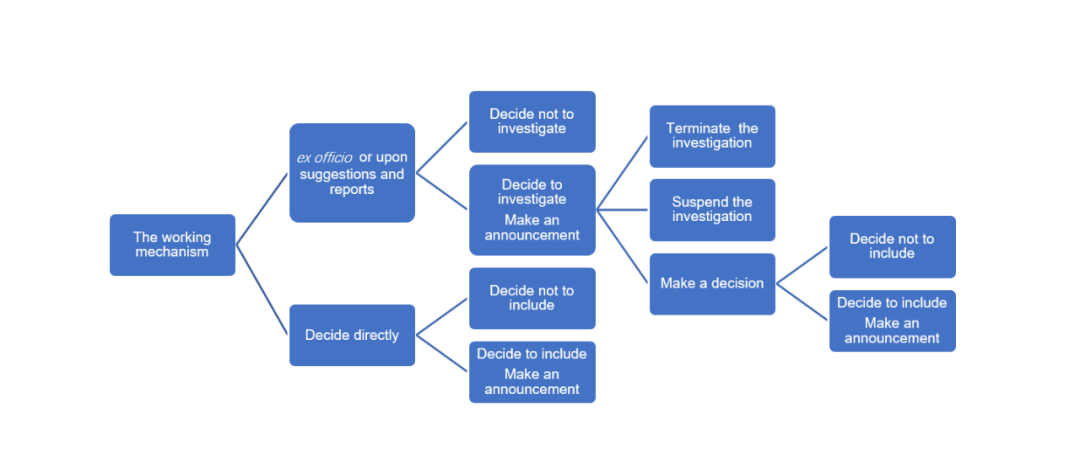
Implementing procedures of the Unreliable Entity List
Control measures will not be taken immediately upon the inclusion of an enterprise in the Unreliable Entity List. Where the time limit to make rectifications is specified in the announcement, the enterprise can make rectifications within the time limit. Where the relevant foreign entity rectifies its conducts within the time limit specified in the announcement and takes measures to eliminate the consequences of its conducts, it may be removed from the Unreliable Entity List.
【Endnote】
[1] See http://www.mofcom.gov.cn/xwfbh/20190531.shtml, last visited on September 23, 2020.
[2] According to Article 6 of the National Security Law, the country shall establish and continuously improve national security strategy, comprehensively assess international and domestic security situations, andspecify guidelines and medium and long-term goals of national security strategyand national security policies, tasks and measures in
key areas.
[3] According to Article 7 of the Foreign Trade Law, the People's Republic of China may adopt corresponding measures against any country or region which implements a discriminatory ban or restriction or other similar measures against trade with the People's Republic of China, in accordance with actual
circumstances.
[4] See http://www.mofcom.gov.cn/article/news/202009/20200903002631.shtml, last visited on September 23,
2020.
[5] See https://www.globaltimes.cn/content/1201425.shtml, last visited on September 23, 2020.
[6] Seehttp://coi.mofcom.gov.cn/article/y/gnxw/201906/20190602869699.shtml, last visited on September 23, 2020.
A Glimpse of Provisions on the Unreliable Entity List
作者:DavidPan KennethKong ShanaSha来源:通力律师

On September 19, 2020, the Ministry of Commerce of the PRC (“MOFCOM”) issued the Provisions on the U