This article discusses how foreign-invested enterprises should adapt to China’s amended Company Law.
China’s legislative body issued the amended Company Law of the People’s Republic of China (“Company Law”) on December 29, 2023, which will take effect on July 1, 2024. The amended Company Law has updated a series of regulatory measures to enhance the regulations on limited liability companies and companies limited by shares, which may impact many aspects of corporate governance.
This article focuses on the main changes of the amended Company Law with an aim to help foreign-invested enterprises (“FIEs”) in China quickly catch up with the key updates and change their corporate governance systems and documents accordingly. Additionally, given most of FIEs are incorporated in the form of limited liability companies, the term “company” or “companies” hereinafter refers to a limited liability company or limited liability companies.
I. Necessary Adjustment of Articles of Association (“AoA”)
Among all the corporate documents, the AoA is the most significant one, which is the constitutional document of a company setting out the fundamental rules relating to its establishment, corporate governance matters, rights and liabilities of the board members and shareholders, liquidation and de-registration, etc. Under the amended Company Law, the following provisions of the AoA may need to be adjusted.
II. Adjustment of Other Corporate Documents
A. Capital Contribution Certificate (“Certificate”)
A company needs to issue the Certificates to its shareholders in the form specified in the Company Law.
The amended Company Law has stipulated the following new requirements[4] for the contents and execution of the Certificates, and the company should adjust its Certificates accordingly:
(1) The updated Certificates should indicate the amount of both subscribed and paid-up capital contribution.
(2) The updated Certificates should specify the method of capital contribution.
In addition to being sealed with the company chop, the updated Certificates need to be signed by the legal representative of the company.
B. Register of Shareholders (“ROS”)
A company needs to prepare a ROS in the form as specified in the Company Law.
The amended Company Law stipulates the following new requirements[5] for the contents of the ROS, and the company should adjust its ROS accordingly:
(1) The updated ROS should specify the amount of both subscribed and paid-up contribution of each shareholder.
(2) The updated ROS should specify the method and date of capital contribution.
The updated ROS should include the date when a shareholder becomes or is no longer a shareholder.
III. New Obligations and Liabilities of Directors, Supervisors, and Senior Management Staff
The amended Company Law has significantly increased the responsibilities and potential liabilities of directors, supervisors, and senior management staff, emphasizing stricter accountability for these roles. Below is a summary of the new obligations and liabilities under the amended Company law.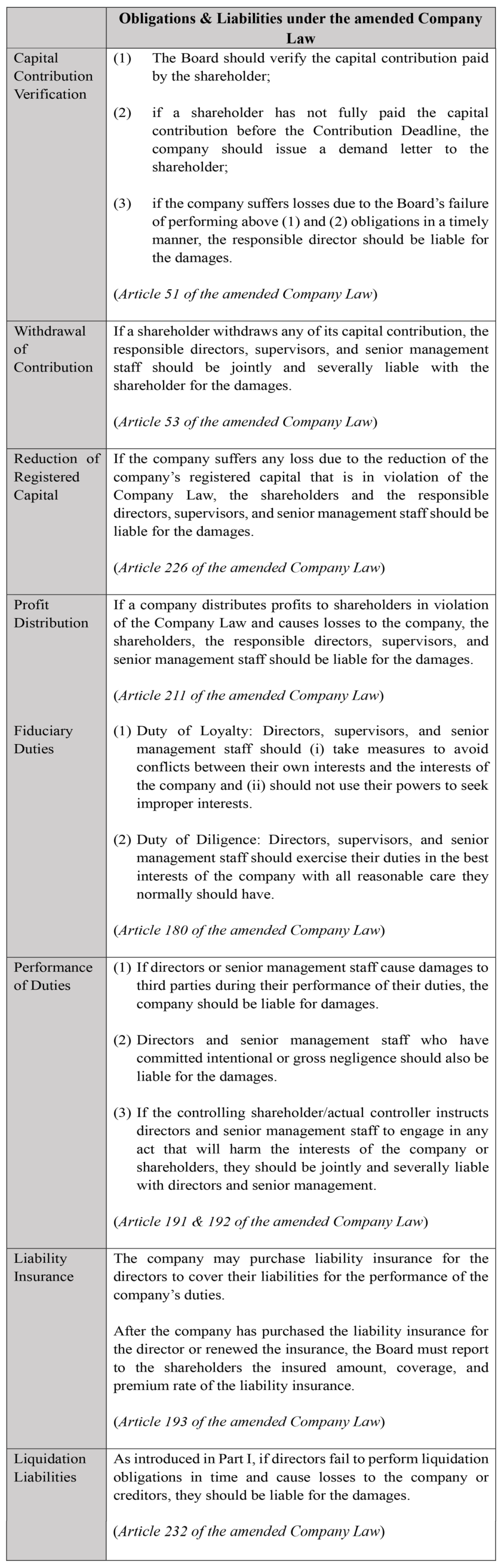
IV. Our Suggestions
The amended Company Law has changed many regulatory requirements on FIEs. Therefore, a timely update of AoA and other corporate documents is needed. In addition, some foreign shareholders often appoint foreigners as directors, supervisors, and senior management staff in FIEs to facilitate better control over operations. However, these foreign appointees, typically based overseas, may have limited knowledge of relevant Chinese laws, making it challenging for them to fulfill their duties effectively and promptly. Many serve in nominal roles without active involvement in the company’s operations in China. In some extreme instances, due to delays in filing with corporate registration authorities, certain individuals may remain registered with the company even after their departure.
To enhance the effectiveness of FIEs in complying with the amended Company Law and to safeguard their directors, supervisors, and senior management staff from potential risks, the following measures are recommended:
(1) Updating Corporate Documents: Revise the AoA and other corporate documents to align with the requirements of the amended Company Law, ensuring legal compliance and updated governance practices;
(2) Training Programs: Implement comprehensive training for directors, supervisors, and senior management staff to ensure a thorough understanding of their responsibilities, obligations, and liabilities;
(3) Active Participation: Appoint individuals who will actively engage in the company’s operations and guarantee that they fulfill their duties and obligations promptly;
(4) Timely Registration Updates: Promptly update the relevant corporate registration authorities when there are changes in directors, supervisors, or senior management staff, whether due to resignation or removal; and
(5) Liability Insurance: Acquire liability insurance for directors, supervisors, and senior management staff to cover potential compensation liabilities arising from their roles within the company.
[Note]
[1] For the company established before the effective date of the amended Company Law, it is to be further clarified the commencement date for calculating the Contribution Deadline. The amended Company Law only stipulates that, if the Contribution Deadline of such company exceeds the stipulated Contribution Deadline, such company needs to gradually adjust its Contribution Deadline to be within the stipulated Contribution Deadline.
[2] Pursuant to the Company Law, the following matters shall be approved by resolutions adopted with affirmative votes of shareholders holding 2/3 or more of the voting rights: (i) any amendment to the AoA; (ii) increasing or reducing the registered capital; (iii) the acquisition, split, dissolution of a company; and (iv) change of a company’s form. In addition to the above matters, other shareholder-resolved matters will only need to be passed with shareholders’ ordinary resolution.
[3] The manager under the Company Law typically is the “president” or “general manager” of a company.
[4] Article 55 of the amended Company Law
[5] Article 56 of the amended Company Law
[6] Under the Company Law, “senior management staff” refers to the manager, deputy manager, and financial manager of a Company and other management staff stipulated in the AoA.
Ruyi Jie also contributed to this article
How Should Foreign Investors Adapt to China’s New Company Law
作者:RonCai JaySi JieYang来源:中伦视界

This article discusses how foreign-invested enterprises should adapt to China’s amended Company Law.