In terms of relationship between patent protections and regulatory approvals for pharmaceutical products, the patent-linkage system, the patent extension rule, and the Bolar exception form a complete suite of rules balancing the interest between innovative pharmaceutical companies and generic pharmaceutical companies. The Bolar exception was introduced into the PRC Patent Law during the amendment in 2008. However, the patent-linkage system and the patent extension have not been included in the legislative pipeline until recently.
In July 2020, the Standing Committee of the People’s Congress issued the draft amendment of the PRC Patent Law (the “Patent Law Amendment”), which has become effective in October 2010. The Patent Law Amendment for the first time provides for patent extension.
On 11 September 2020, the National Medical Products Administration (“NMPA") and the State Intellectual Property Office (“SIPO") jointly issued the draft Implementation Measure for Early Resolution of Pharmaceutical Patent Disputes (Trial) (“Early Resolution Measure”) for public consultation. The Early Resolution Measure provides for a mechanism (the “Early Resolution Mechanism”) to allow owners of patents (the “Patent Owners”) in innovative drugs (the “Innovative Drugs”) and applicants (the “Generis Drug Applicants”) for regulatory approvals for generic drugs (the “Generic Drugs”) to resolve the disputes on validity and infringement of the patents (the “Applicable Patents”) concerning such generic drugs. This is the first time when an Early Resolution Mechanism has been introduced into the legislative pipeline in concrete provisions.
1. A Historical Review
For quite a few years, applicants for regulatory approvals have been required, during regulatory approval processes, to list out known patents in relation to their drugs and to declare that their drugs would not infringe these patents. However, there is no consequence if the declaration is wrong; nor is there any channel for patent owners to challenge these declarations. As a result, this declaration mechanism does not form an effective way to discover or resolve patent related disputes.
In October 2018, the General Office of China Communist Party and the General Office of the State Council jointly issued the Opinion on Further Reformation on Evaluation and Approval and on Encouragement of Innovation of Drugs and Medical Device (“Reformation Opinion”), which, among others, sets out the goal to establish a system (the “Patent Linkage System”) to link the regulatory approval process to the patent dispute resolution process so as to reduce patent related risks in relation to generic drugs. The Reformation Opinion also sets out a general principle for a Patent Linkage System, i.e., Generic Drug Applicants are to declare that their Generic Drugs do not infringe Applicable Patents and Patent Owners are to bring actions against the Generic Drug Applicants if they do not agree with the declaration.
In November 2019, the General Office of China Communist Party and the General Office of the State Council jointly issued the Opinion regarding Strengthening Intellectual Property Protections (the “Strengthening Opinion”), which for a second time, pointed out the goal to establish a Patent Linkage System in China.
In January 2020, the China government and the US government reached the Economic and Trade Agreement (the “Trade Agreement”), of which Article 1.11 specifically requires that China establish an “effective mechanism for early resolution of patent disputes,” which more or less has the same meaning as the Patent Linkage System under the prior legislations The Trade Agreement requires that the mechanism provide: (i) a notice to the Patent Owner that a regulatory approval is sought to market a Generic Drug covered by the Applicable Patents; (ii) adequate time and opportunity for the Patent Owner to seek remedies before the grant of the regulatory approval for such Generic Drug; and (iii) adequate judicial and administrative remedies for infringement of Applicable Patents.
The Patent Law Amendment adds an additional paragraph to the original Article 75. That paragraph creates two standings to sue: (i) the standing granted to Patent Owners which believe that their Applicable Patents cover Generic Drugs to initiate patent infringement suits against the Generic Drug Applicants during the regulatory approval processes and (ii) the standing granted to the Generic Drug Applicants to bring declaratory claims against the Patent Owners. However, the Patent Law Amendment does not clarify how Patent Owners will be informed of regulatory approvals for Generic Drug; nor does it provide for any clue as to how the resolutions of patent disputes will affect the regulatory approval process.
NMPA and SIPO finally issued the Early Resolution Measure with public expectations. The Early Resolution Measure was issued to achieve the goal under the Reformation Opinion and Strengthening Opinion, to satisfy the requirements under the Trade Agreement, and to implement the Patent Law Amendment.
2. Application of Early Resolution Mechanism
The Early Resolution Mechanism provides for a mechanism to resolve disputes on validity and infringement of Applicable Patents in Innovative Drugs which have already been approved to be marketed in China. It is not applicable to resolution of disputes on or in relation to Applicable Patents relating to Innovative Drugs which have not received any market authorizations or which have been approved only outside of China. This may suggest that innovative companies bring their innovative drugs to China quickly after these drugs are approved in overseas market in order to enjoy the Early Resolution Mechanism.
More specifically, the following Applicable Patents with respect to Innovative Drugs approved in China are covered by the Early Resolution Mechanism:
(1) with respect to chemical drugs: pharmaceutical ingredient (compound) patents, pharmaceutical composition patents, and pharmaceutical usage patents;
(2) with respect to biological drugs: sequence and structure patents; and
(3) with respect to herbal medicine: pharmaceutical composition patents, herbal extract patents, and pharmaceutical usage patents.
3. Procedures
The Early Resolution Measure provides for the following the procedure for the Early Resolution Mechanism:
(1) Recordal of Applicable Patents.
NMPA will establish a Recordal Platform for patents in drugs it has approved (the “Platform”). Patent Owners are required to record their Applicable Patents on the Platform (i) when applying for regulatory approvals for their Innovative Drugs; or (ii) within 30 days from the grant of Applicable Patents if the relevant Innovative Drugs have already been in the regulatory approval processes.
With respect to Innovative Drugs which have already been approved before the effectiveness of the Early Resolution Measure, the Patent Owners may be given a grace period to record their patents but the Early Resolution Measure does not provide for detail rules.
(2) Declaration by Generic Drug Applicants.
When a Generic Drug Applicant applies for the regulatory approval for its Generic Drug, it is required to review the Applicable Patents recorded on the Platform in relation to the Generic Drug and to make one of the following declarations with respect to each Applicable Patent:
- Declaration One
No Applicable Patent is recorded on the Platform in relation to the Generic Drug.
- Declaration Two
The Applicable Patents recorded on the Platform in relation to the Generic Drug are either expired or invalidated.
- Declaration Three
The Applicable Patents recorded on the Platform in relation to the Generic Drug are still valid and the Generic Drug Applicant will not market the Generic Drug until the expiration of the Applicable Patents.
- Declaration Four
The Applicable Patents recorded on the Platform in relation to the Generic Drug ought to be invalidated or the Generic Drug does not fall within the scope of protection of any of the Applicable Patents.
According to the Early Resolution Measure, Generic Drug Applicants must also submit supporting documents alongside with the declarations, which documents the Early Resolution Measure does not clarify. We believe that the supporting documents refer to copies of patent registries proving that the Applicable Patents are either expired or invalidated.
(3) Opposition by Patent Owners
A Patent Owner which does not agree with the declaration which a Generic Drug Applicant makes in relation to its Applicable Patents may initiate a judicial proceeding or bring an administrative action within 45 days from the date when the declaration is made. If the filing of such legal proceeding or administrative action is accepted, the Patent Owner must submit a copy of acceptance notice to NMPA.
If no lawsuit or administrative action is initiated, NMPA can assume that the Generic Drug Applicant’s declaration is accurate and decide whether to grant the regulatory approval for the Generic Drug according to the technical evaluation.
(4) Waiting Period (applicable only to chemical drugs).
A waiting period (the “Waiting Period”) of 9 months is available during the regulatory approval process for chemical drugs. The Waiting Period commences when the filing of the judicial proceeding or administrative action is accepted. During the Waiting Period, NMPA will not suspend the technical evaluation of the Generic Drug with respect to which the judicial proceeding or administrative action on patent validity or infringement is ongoing but will not grant a regulatory approval for it.
(5) Grant of Regulatory Approvals.
For a Generic Drug with respect to which Declaration One or Declaration Two is made, NMPA will determine whether to grant a regulatory approval for such drug according to technical evaluation.
For the Generic Drug which respect to which Declaration Three is made, NMPA will determine whether to grant a regulatory approval according to technical evaluation and, if a regulatory approval is granted, NMPA will add a remark that the Generic Drugs must not be marketed until the expiration of the Applicable Patents.
For the Generic Drug which respect to which Declaration Four is made and the Patent Owner initiates a judicial proceeding or an administrative action, NMPA will:
Chemical drugs:
- suspend the regulatory approval process until 20 days before the Applicable Patents are expired if, within the Waiting Period, the judicial proceeding or the administrative action confirms that the Applicable Patents are valid and capture the Genetic Drug; or
- continue the regulatory approval process and decide whether to grant the regulatory approvals according to the technical evaluations if, within the Waiting Period, the judicial proceeding or the administrative action confirms that the Generic Drug fall outside of the scope of protection of the Applicable Patents or that the Applicable Patents are invalid; or
- continue the regulatory approval process after the expiration of the Waiting Periods if no judicial proceeding or administrative action reaches a decision within the Waiting Period.
Biological and herbal medicines:
- if a valid judicial or administrative decision confirms that the relevant Generic Drug falls within the scope of protection of an Applicable Patent, NMPA will add a remark that the relevant Generic Drug must not be marketed until the expiration of the Applicable Patent.
A diagram about the Early Resolution Mechanism (taking chemical drugs as an example) is enclosed for reference
4. Market Exclusivity (applicable only to chemical drugs)
Under the Early Resolution Measure, NMPA grants to the first Generic Drug which successfully challenges the Applicable Patents and receives the regulatory approval, a market exclusivity period (the “Market Exclusivity Period”) (i) of twelve months from the grant of the regulatory approval, or (ii) the remaining term of the Applicable Patents which has been successfully challenged, whichever is shorter. During the market exclusivity period, NMPA will not grant regulatory approvals for subsequent generic drugs comprised of the same compound or composition (if the Applicable Patent is a compound or composition patent) or of the same usage (if the Applicable Patent is a usage patent). The inclusion of the Market Exclusivity Period in the Early Resolution Measure indicates the government’s intention to encourage the development of generic drugs.
5. Prospective Views
The Early Resolution Measure has set out a comprehensive suite of rules regarding the discovery and resolution of patent related disputes during the regulatory approval procedure. It has largely met the expectations from both innovative companies and generic companies. However, there are some gaps from the Trade Agreement and from the Patent Law Amendment
(1) Gap from Trade Agreement
The Early Resolution Measure largely reflects the requirements under the Trade Agreement. However, there are a couple of gaps:
- Paragraph 1 of Art 1.11 requires that China establish a mechanism to early resolve disputes on patents in relation to drugs which receive “prior marketing approval[s] by China or in another territory.” However, the Early Resolution Measure only applies to resolution of disputes on patents in relation drugs approved in China. In other words, if an applicant applies for a regulatory approval for a generic drug containing the same compound as the innovative drug approved only outside of China, the owner of the patents in the innovative drug will not be able to enjoy the Early Resolution Mechanism under the Early Resolution Measure.
- Paragraph 2 of Art. 1.11 requires that a cause of action be provided to patent owners to seek “civil judicial proceedings and expeditious remedies for resolution of disputes concerning the validity or infringement of an applicable patent.” However, due to Bolar exception, Patent Owners will find it difficult to have a cause of action against Generic Drug Applicants during the regulatory approval process. The Early Resolution Measure fails to clarify what cause of action is available for Patent Owners in the Early Resolution Mechanism.
(2) Gaps from Draft Patent Law Amendment
Since the Early Resolution Measure is inferior to the Patent Law, it is supposed to implement the general rules under the Patent Law and not to deviate from it. However, there are a few differences between the Early Resolution Measure and the Patent Law Amendment:
- The Patent Law Amendment requires that a Patent Owner initiate a judicial proceeding or an administrative action concerning the validity or infringement of its Applicable Patents within thirty (30) days from the public announcement of the relevant application for the relevant Generic Drug; whilst the Patent Owner has forty-five (45) days under the Early Resolution Measure.
- Under the Patent Law Amendment, if a Patent Owner does not initiate a judicial proceeding or an administrative action within said thirty (30) day period, the Generic Drug Applicant can file a judicial proceeding or an administrative action to confirm that the Generic Drug is not infringing the Applicable Patents.
6. Impact on Business
Both the Patent Law Amendment and the Early Resolution Measure are still in draft. We expect some refinery works before they are finally adopted (especially to resolve the current consistency between the Patent Law Amendment and the Early Resolution Measure).
We believe, however, the Early Resolution Mechanism benefits both Patent Owners and the Generic Drug Applicants:
(1) Patent Owners/Innovative Drug Manufacturers
Patent Owners can benefit from the Early Resolution Measure because they would be able to confirm the validity and infringement of their Applicable Patents at an early stage when relevant Generic Drugs are still in the regulatory approval processes. Otherwise, if Patent Owners initiate legal actions after the Generic Drugs are allowed to be marketed, they may not be able to effectively prevent infringement because (i) it usually takes a couple of years to conclude patent infringement cases; and (ii) interim relieves are not always available in patent infringement cases.
(2) Generic Drug Applicants/Manufacturers
The Early Resolution Measure benefits Generic Drug Applicants more because:
- They can receive greater certainty about the non-infringement of the Generic Drugs during the regulatory approval processes before investing significantly in marketing; and
- They may possibly receive market exclusivity protections if they successfully challenge Applicable Patents and receive regulatory approvals for the first Generic Drug of the same compound, composition, or usage covered by the Applicable Patents.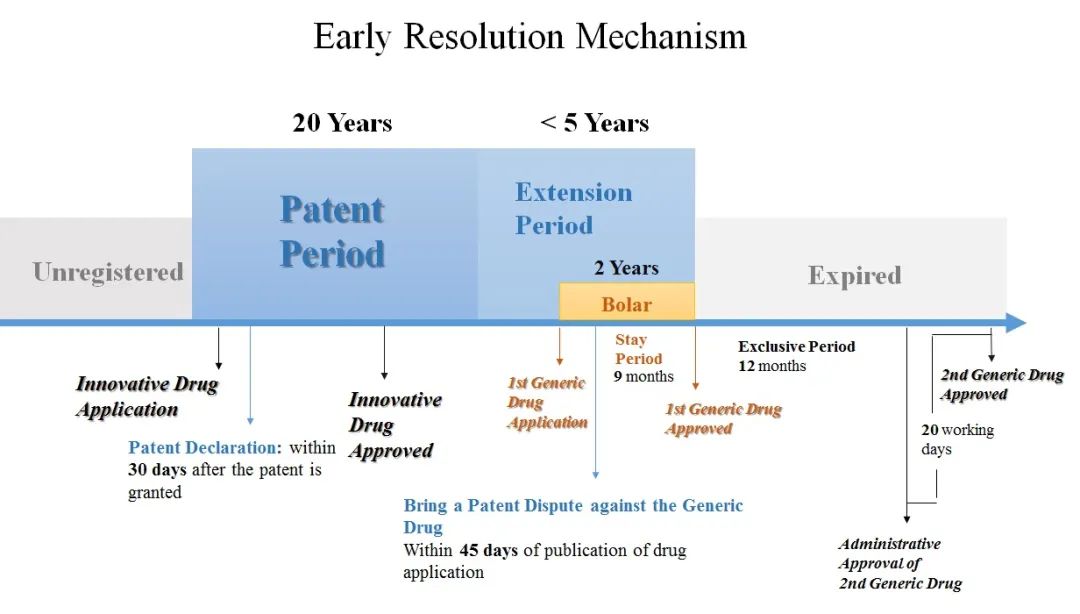
Note: Wolters Kluwer has an exclusive authorization of this article. WeChat personal users are welcome to share this article publicly, while reproduction in whole or in part without permission by any WeChat public account is prohibited.
Early Resolution of Pharmaceutical Patent Disputes
作者:XunYang VeraZhao来源:通力律师

In terms of relationship between patent protections and regulatory approvals for pharmaceutical prod