Beijing is one of China’s first QFLP pilot zones—second only to Shanghai, which announced its own QFLP pilot scheme at the end of 2010 and heralded QFLP pilot work in other cities. Beijing announced its QFLP policies as early as February 2011, making Beijing a pioneer city and providing guiding significance. In recent years, a new era of QFLP investment has arrived, owing to China’s continuous opening-up policies and expanding foreign exchange reforms, together with the increase of China assets allocation by foreign investors. Zhuhai, Suzhou, Xiamen, Hainan, and Shenzhen have each issued or updated new QFLP policies to further attract foreign investment in China. Beijing officially released the Interim Measures on the Pilot Scheme of Qualified Foreign Limited Partners in Beijing on 6th May, 2021 (hereinafter referred to as the “New QFLP Measures”), which improves Beijing’s current QFLP policies. In this article, we introduce and analyze the provisions and specific requirements of the New QFLP Measures.
Supervisory mechanism
The New QFLP Measures call for a “pilot joint review mechanism,” which means the establishment and operation of QFLPs will be jointly supervised and examined by various regulatory authorities as follows:
The members of the pilot joint review work committee include the Municipal Financial Supervision Bureau, the Market Supervision Bureau, the Operations Department of the People’s Bank of China, and the Beijing Branch of the State Administration of Foreign Exchange;
The pilot joint review office is established by the Municipal Financial Supervision Bureau;
The Municipal Financial Supervision Bureau, through the pilot joint review office, is responsible for daily affairs, and takes the lead in advancing pilot work, daily management and risk control, as well accepting application materials and other relevant documents and coordinating relevant pilot joint review committee members in reviewing application materials. The Municipal Market Supervision Bureau is responsible for coordinating and guiding the registration of pilot enterprises. The Operations Department of the People’s Bank of China and the Beijing Branch of the State Administration of Foreign Exchange are responsible for the supervision and control of foreign exchange registration, account opening, capital exchange, cross-border RMB transactions, and other matters related to the New QFLP Measures.
Requirements for pilot fund management enterprises and pilot funds
Under the New QFLP Measures, in principle, pilot fund management enterprises and pilot funds (collectively referred to as “Pilot Enterprises”) should be registered and established in Beijing. The application requirements are as follows: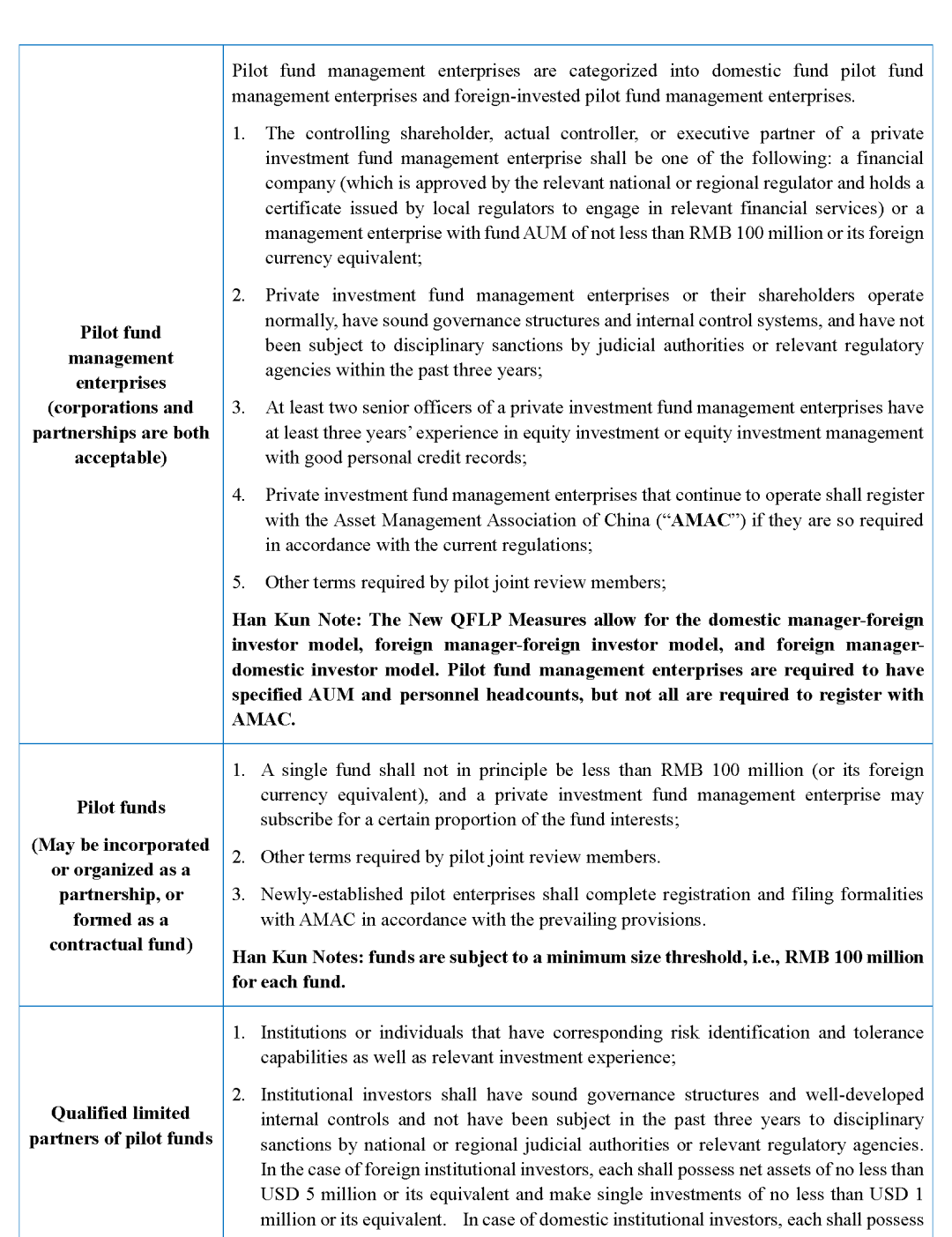
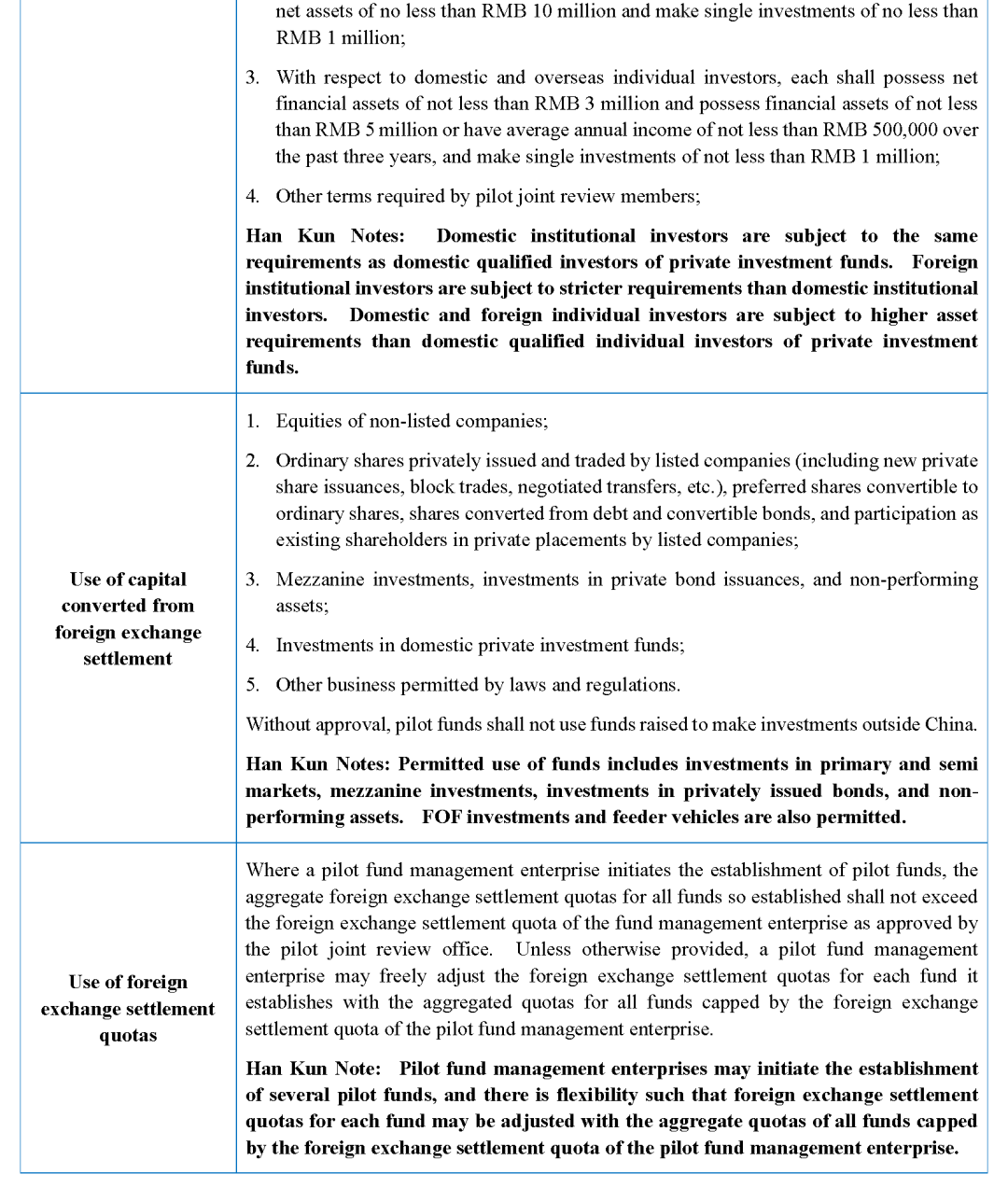
In terms of procedures, the New QFLP Measures provide that parties eligible to submit applications for pilot enterprises are private investment fund management enterprises, their controlling shareholders, actual controllers, or executive partners. Application materials are submitted to the pilot joint review office, which will then decide whether to approve the applicant’s application. If the pilot joint review office approves the application, it will issue to the applicant a review opinion with a stated pilot quota amount.
Information reporting and supervision during the term of the pilot enterprise
The New QFLP Measures stipulate rules for supervising pilot enterprises (particularly pilot funds) during their terms. The detailed rules are as follows: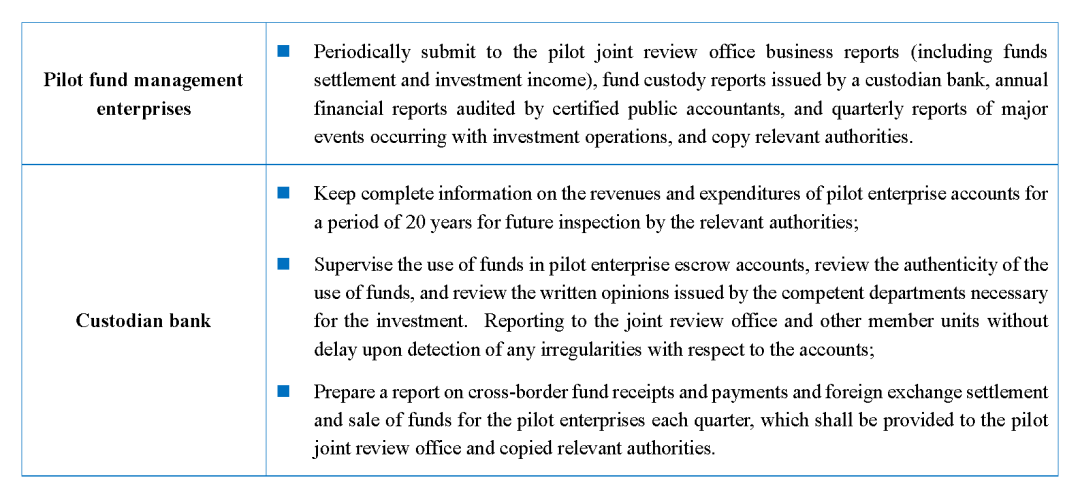
Conclusion
Beijing, among the pioneers of QFLP pilot cities, has always been a popular place for establishment of foreign equity investment enterprises. The city’s attractiveness will be further strengthened by the promulgation of the New QFLP Measures. The New QFLP Measures will create a favorable and convenient investment environment for overseas investors in Beijing by following the policy’s original regulatory logic while considering the actual needs of overseas investors and referring to QFLP policies in other regions. We will continue to watch the implementation of the New QFLP Measures and relevant implementation rules and hope it opens a path for more foreign investors to participate in the thriving Chinese private investment industry.
Analysis of Beijing’s New QFLP Scheme
作者:LuRan QingJing来源:汉坤律师事务所

Beijing is one of China’s first QFLP pilot zones—second only to Shanghai, which announced its own QF