On December 7, 2016, the National Development and Reform Commission (“NDRC”) and the Ministry of Commerce (“MOFCOM”) jointly announced the issuance of a revised draft for public comment of the Catalogue for the Guidance of Foreign Investment Industries (2015 Version) (“Revised Draft”). As the usual practice has been to issue revisions every three to four years, the speed with which the Revised Draft has been worked on demonstrates the proactive attitude of policymakers towards the negative list regulatory approach for foreign investment.
Special access administrative measures (also known as a negative list), a key supporting document to the “pre-access national treatment plus negative list,” were not issued at the time the new regulatory regime was formally introduced in October 2016. The role of the negative list has instead been delegated to the Catalogue for the Guidance of Foreign Investment Industries (2015 Version) (“2015 Catalogue”). The 2015 Catalogue, in its layout of encouraged, restricted, and prohibited categories, lacks a clear description of special access administrative measures for foreign investment. The main purpose of the current revisions is to respond to the needs of the new regulatory regime by providing a unified list of restrictions as well as to improve the clarity of the foreign investment access regime.
Overview of the Revised Draft
The Revised Draft proposes to reform the organizational structure of the 2015 Catalogue by merging the encouraged, restricted, and prohibited categories into two broad categories, “encouraged” and “special foreign investment access administrative measures” (“Negative List”). The Negative List combines those entries in the encouraged category subject to shareholding requirements with the entries in the previous restricted and prohibited categories. The Negative List is further divided into two sub-categories: restricted and prohibited. The Revised draft currently lists 344 encouraged entries and 62 Negative List entries (35 restricted entries and 27 prohibited entries).
Based on our preliminary review, the Revised Draft contains the following main adjustments to specific entries:
1. The Revised Draft presents a unified Negative List by placing encouraged entries subject to special measures into the restricted category, which results in 11 entries presented as both encouraged and Negative Listed (restricted category) (see the table below).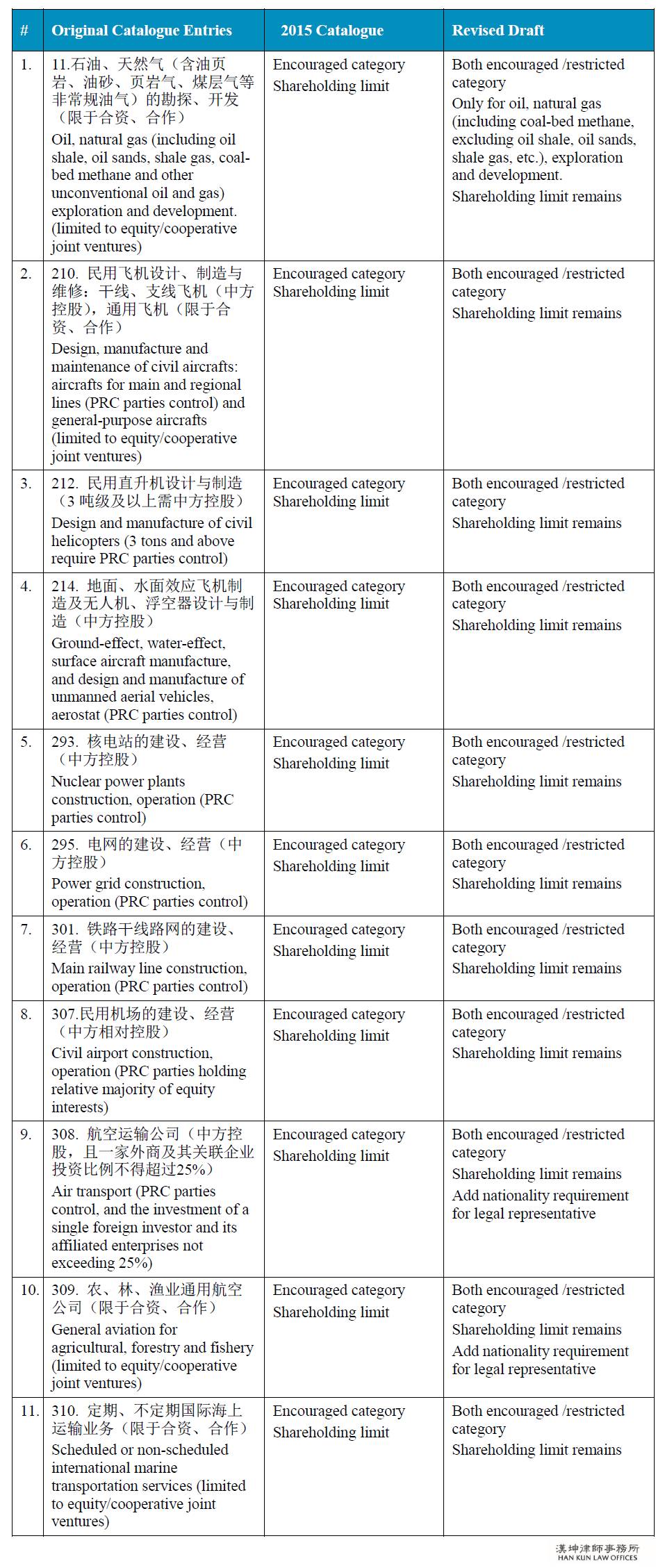
2. In accordance with the principle of consistent administration of domestic and foreign investment, the Revised Draft deletes 11 restricted entries applicable to both foreign and domestic investors, which are no longer regarded as foreign-specific access measures (see the table below).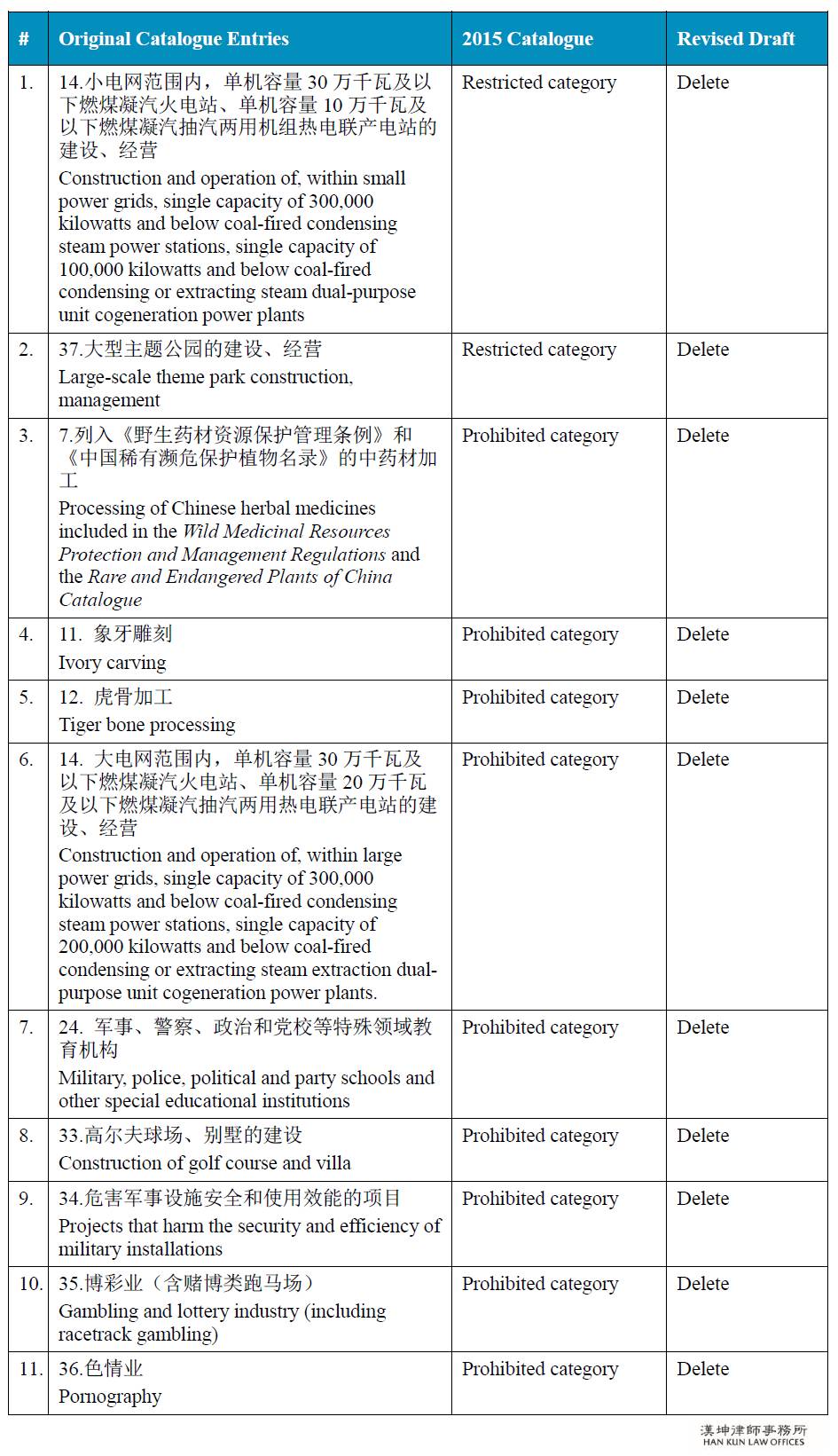
3. To further open up and improve industry structures, the Revised Draft moves 7 entries from the restricted category to the permitted category, and removes shareholding and nationality requirements for 7 encouraged entries, with some entries being moved to the permitted category (see the table below).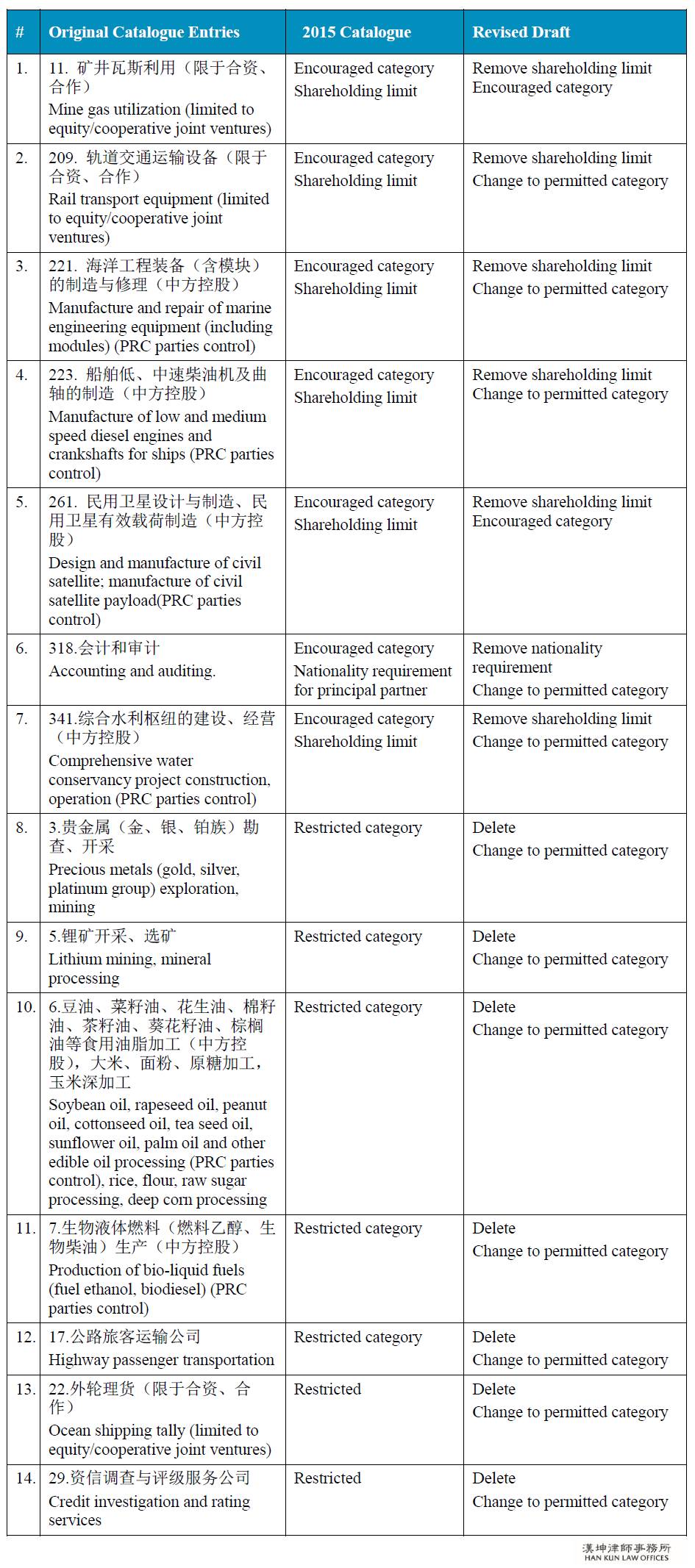
4. The Revised Draft deletes the catch-all entries in the 2015 Catalogue. Instead, in the explanatory notes to the Negative List, it is provided that where CEPA-related agreements, international agreements or treaties which China has concluded or in which it participates, or where the laws and regulations of China have provided otherwise, such provisions shall prevail. This approach could offer flexibility for Chinese government to tailor negative list on a country-specific basis without amending the Negative List.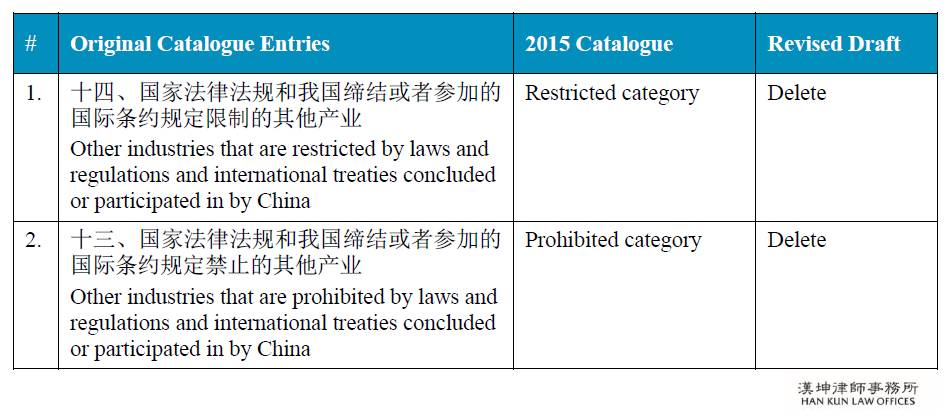
Comments
The proposed revisions to the 2015 Catalogue are of great significance for they will create a clearer, more open investment environment. However, perhaps due to time constraints, the Draft Revision does not break from the concept of a guidance catalogue, and many adjustments are more with respect to the classification and layout to satisfy the negative list form requirements. The current Negative List is still in a transitional phase, as its expressions are overly generalized, and the restrictive measures are not sufficiently specific or clear. We look forward to broader changes to the catalogue, or a new and independent negative list to be introduced.
Based on the current organizational structure, the restricted category also includes certain encouraged entries subject to shareholding limit. As listed in the table above, industries categorized as both encouraged and Negative Listed include oil and gas exploration, construction and operation of nuclear power plants, construction and operation of power grids, etc. According to the Negative List explanatory notes in the Revised Draft, entries that are listed both in the encouraged category and on the Negative List enjoy preferential treatment and, at the same time, are subject to access requirements. This indicates the continuation of incentives for encouraged industries, such as reduced tariffs for imported equipment. In this sense, the 2015 Category, after revisions, can be viewed to consist of both a “positive list” and a “negative list”. The encouraged works as a “positive list” listing sectors eligible for preferential treatments under laws and regulations, while the Negative List lists sectors offered with less-favorable national treatment.
According to the Negative List explanatory notes in the Revised Draft, the Negative List only contains restrictive measures for foreign investment. This change in administrative approach conforms to the principle of national treatment for foreign investment, and corresponds to the ongoing market access negative list reform. Under this approach, foreign investors must first comply with the foreign investment access requirements, and, after entry, follow the same administrative measures as other market players, including state-owned and private enterprises, based on their respective industries, areas, and business. The restricted and prohibited entries deleted from the Revised Draft are those applicable to both foreign and domestic investment, such as large-scale theme parks, military, police, political and party schools and other special educational institutions, golf courses, villas, activities harmful to military installations, pornography and gambling. These entries are now reflected in the Market Entry Negative List Draft (Pilot), issued by NDRC and MOFCOM on March 2, 2016.
In addition, the explanatory notes in the Revised Draft point out in particular that “where an offshore company legally established or controlled by a domestic company, enterprise, or individual acquires or merges with a domestic company affiliated with such domestic company, enterprise, or individual, the existing provisions relating to foreign projects, establishment and amendments to foreign invested enterprises shall continue to apply.” The situation to which this provision applies is similar to that of Article 11 of the Provisions on Mergers and Acquisitions of Domestic Enterprises by Foreign Investors (MOFCOM Decree No. 6 of 2009), which regulates related-party mergers and acquisitions. Per this provision, a M&A transaction involving a domestic affiliate is required to be submitted to MOFCOM for examination and approval. The purpose of this note in the Revised Draft can be understood to emphasize that related-party M&A transactions are to be approved by MOFCOM, regardless of whether they involve a Negative Listed industry. On the other hand, according to the joint announcement by NDRC and MOFCOM dated October 8, 2016, foreign investment by way of M&A transactions will continue to be subject to the existing approval system, regardless of whether it involves a Negative Listed industry. The joint announcement appears broader in scope than the Revised Draft, which only mandates that related-party M&A transactions be subject to the existing approval regime and does not mention other types of M&A. Could this mean the Revised Draft contemplates that M&A transactions by foreign investors of domestic enterprises will be subject to record-filing, rather than administrative approval, if the sector involved is not on the Negative List and the deal does not constitute a related-party transaction? Whether this “aggressive” interpretation of the note is valid is subject to further clarification by policymakers.
Foreign Investment Category under the Negative List Approach
作者:JunLi EffySun来源:汉坤律师事务所

On December 7, 2016, the National Development and Reform Commission (“NDRC”) and the Ministry of Com