On November 4, 2014, China Council for the Promotion of International Trade / China Chamber of International Commerce (hereinafter “CIETAC”) revised and adopted the CIETAC Arbitration Rules (2015)(“New CIETAC Rules”), which will come into effect as of January 1, 2015.
I Main Contents of the New CIETAC Rules
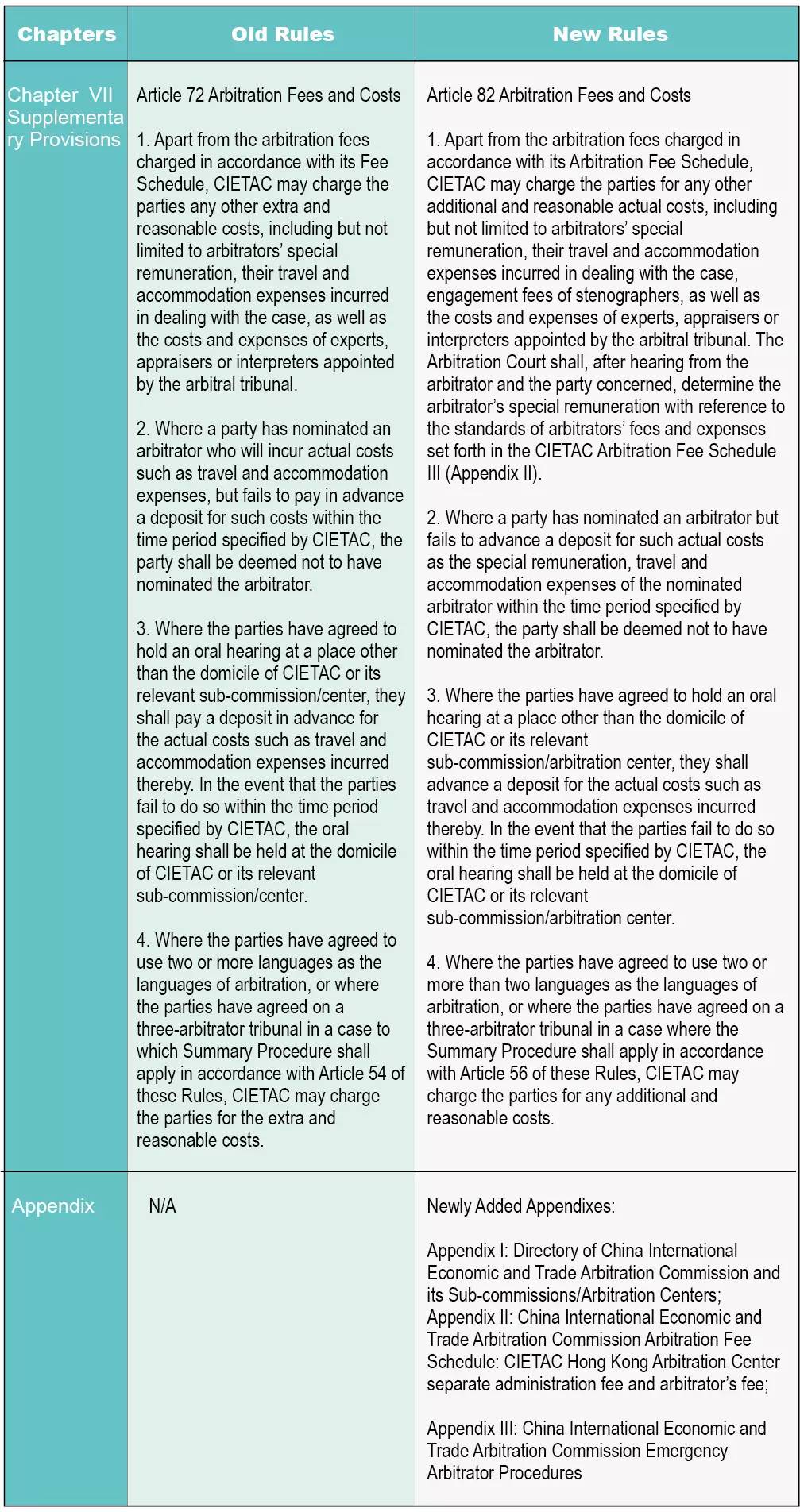
In the New CIETAC Rules, 20 articles have been revised, among which, 10 are newly added. After revision, the New CIETAC Rules contain 7 chapters, 84 articles and 3 appendixes, namely: General Provisions, Arbitral Proceedings, Arbitral Awards, Summary Procedure, Special Provisions for Domestic Arbitration, Special Provisions for Hong Kong Arbitration, and Appendixes 1-3. Details are as follows:
1. Arbitration Court as the Functional Department for the Management of Case Procedure
To achieve the purpose of reform, CIETAC has adjusted the case administration and management department in the New CIETAC Rules, adding “Arbitration Court” under the CIETAC and the CIETAC sub-commissions, which will replace the Secretariat of CIETAC and that of the CIETAC sub-commission to perform the function of case management under the New CIETAC Rules .
2. One Single Arbitration for Disputes arising from Multiple Contracts
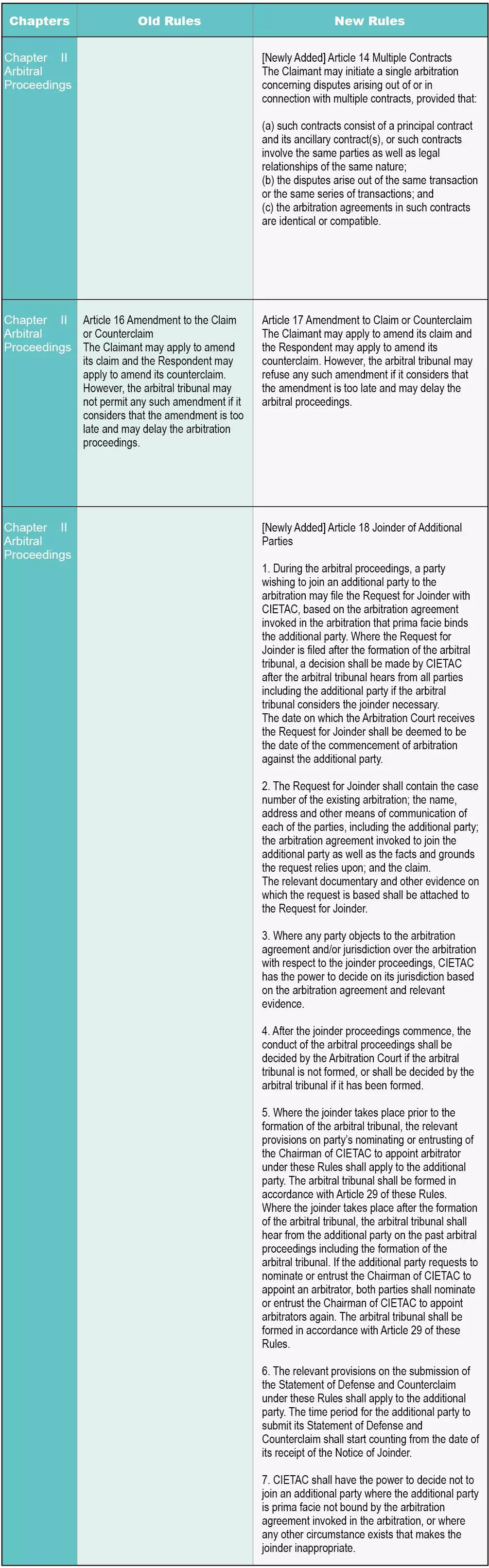
Article 14 of the New CIETAC Rules provides, the Claimant may initiate a single arbitration concerning disputes arising out of or in connection with multiple contracts, provided that the following preconditions are satisfied simultaneously: (a) such contracts consist of a principal contract and its ancillary contract(s), or such contracts involve the same parties as well as legal relationships of the same nature; (b) the disputes arise out of the same transaction or the same series of transactions; and (c) the arbitration agreements in such contracts are identical or compatible.
As to disputes on rights and obligations under multiple contracts, this new provision helps to effectively solve disputes arising from multiple contracts with multi-parties, such as serial transactions, multi-party transaction and serial transactions in one project, etc. And it also helps to save arbitration cost, facilitate the parties to participate in arbitration process, and effectively protect the legitimate rights of the parties. For instance, in an arbitration for dispute on loan mortgage contracts where the authors participated, the loan contract and mortgage contract are independent from each other. In order to enforce the claims on the collateral directly, the claimant attempted to bring two claims at the same time, namely claiming for payment, and if no payment could be made, enforcing claim on the collateral. However the old CIETAC rules did not expressly provide whether two contracts and two clauses of arbitration could be consolidated or not. The author had to inquire about this issue with the arbitration commission for several times and has made much ado to persuade the arbitration commission to accept the case consolidating the contracts. Rights and obligations under a principle contract and its ancillary contract(s) are closely related, and therefore allowing parties to bring one arbitration under both principal contract and ancillary contract simultaneously will facilitate the future enforcement of the arbitration award and better protect the legitimate interests of the parties. However, this new provision is still unclear on whether the cases could be consolidate in the circumstance where the parties are different, while legal relationships are of the same nature, disputes arising from the same transaction or same series of transactions and the arbitration agreements are identical or compatible with each other.
3. Newly-Added Procedure - Joinder of Additional Parties
Article 18 of the New CIETAC Rules newly adds the procedure of Joinder of Additional Parties. Arbitration tribunal or Arbitration Court may join additional parties to arbitration upon receipt of a Request for Joinder from the parties, which proceeds as follows: (1) the arbitration agreement invoked in the arbitration prima facie binds the additional party; (2) a Request for Joinder shall be filed, with the relevant documentary and other evidence on which the request is based attached to the Request for Joinder; (3) the additional party added to arbitration is not a third party, but added as an additional claimant or respondent; (4) the additional party shall have the same rights as the original parties to nominate or entrust the Chairman of CIETAC to appoint arbitrator; (5) the additional party also has the same rights as the original parties to object to the arbitration agreement and/or jurisdiction over the arbitration; and (6) the conduct of the arbitral proceedings prior to and after the joinder proceedings commence shall be decided by the Arbitration Court or by the arbitral tribunal, unless otherwise provided in the Rules.
The Arbitration Laws has no provision on third party procedures. Any interested third parties cannot be joined into arbitration proceedings. The newly added joinder of additional parties in the New CIETAC Rules is not addition of a third party, but it allows joinder of additional parties who are bound by the same arbitration agreement. This new procedure consolidates the actual CIETAC practice into rules, provides the certainty of arbitration procedure, and helps the arbitration tribunal to find out facts and to protect the legitimate interests of the parties.
4. Consolidation of Arbitrations
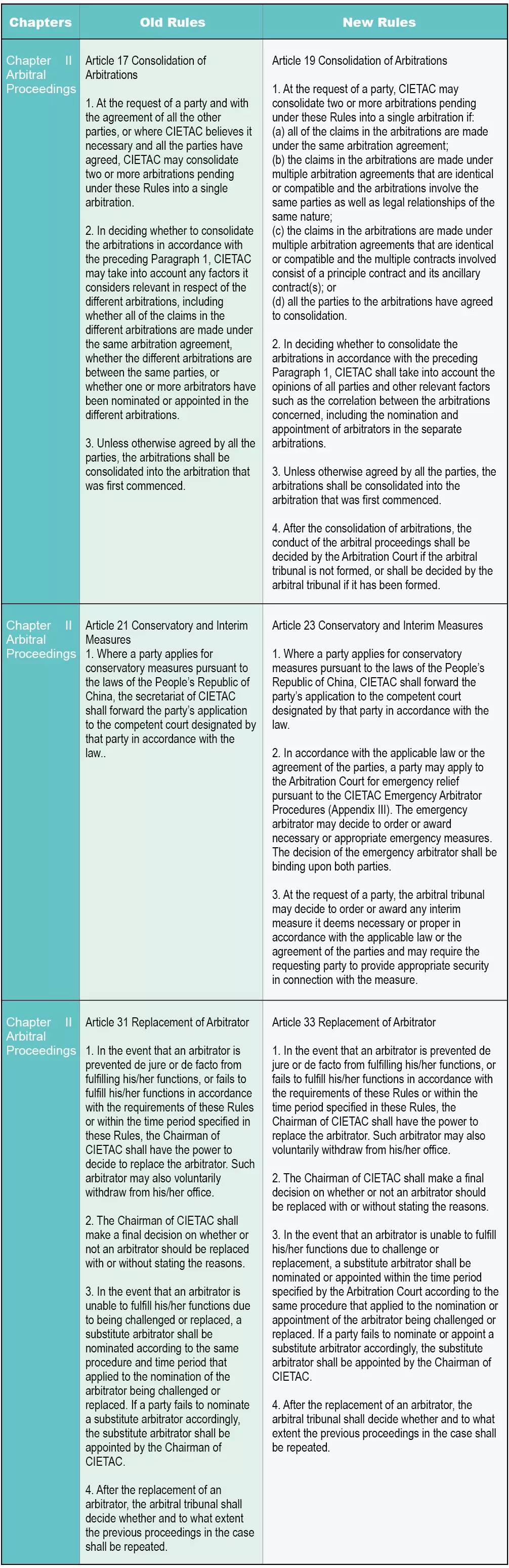
Article 19 of the New CIETAC Rules amends consolidation of arbitrations, which is, at the request of a party, CIETAC may consolidate two or more arbitrations pending under these Rules into a single arbitration. According to the old CIETAC rules, consolidation must be agreed by all the parties to the arbitrations. While the New CIETAC Rules amends this as that, at the request of a party, CIETAC may decide whether to consolidate pending arbitrations or not.
This procedure applies to cases of the following four circumstances: (1) all of the claims in the arbitrations are made under the same arbitration agreement; (2) the claims in the arbitrations are made under multiple arbitration agreements that are identical or compatible and the arbitrations involve the same parties as well as legal relationships of the same nature; (3) the claims in the arbitrations are made under multiple arbitration agreements that are identical or compatible and the multiple contracts involved consist of a principle contract and its ancillary contract(s); or (4) all the parties to the arbitrations have agreed to consolidation.
CIETAC shall make decision taking into consideration of the opinions of all parties and other relevant factors. Unless otherwise agreed by all the parties, the arbitrations shall be consolidated into the arbitration that was first commenced.
One of the most important purposes for consolidation of arbitrations is to avoid repeated hearings of the same fact or same legal issue in different proceedings, which would increase cost in solving the dispute between the parties, and may also lead to arbitration awards contradictory to each other. However, on the other hand, it also need to consider whether consolidation without agreement from all the parties intervenes the party autonomy; furthermore, after consolidation of arbitrations, the arbitral tribunal might have to be reformed, therefore the proceeding might be delayed. All of these problems remain to be solved and improved in the process of practice.
5. Increased the Dispute Amount in the Cases of Summary Procedure
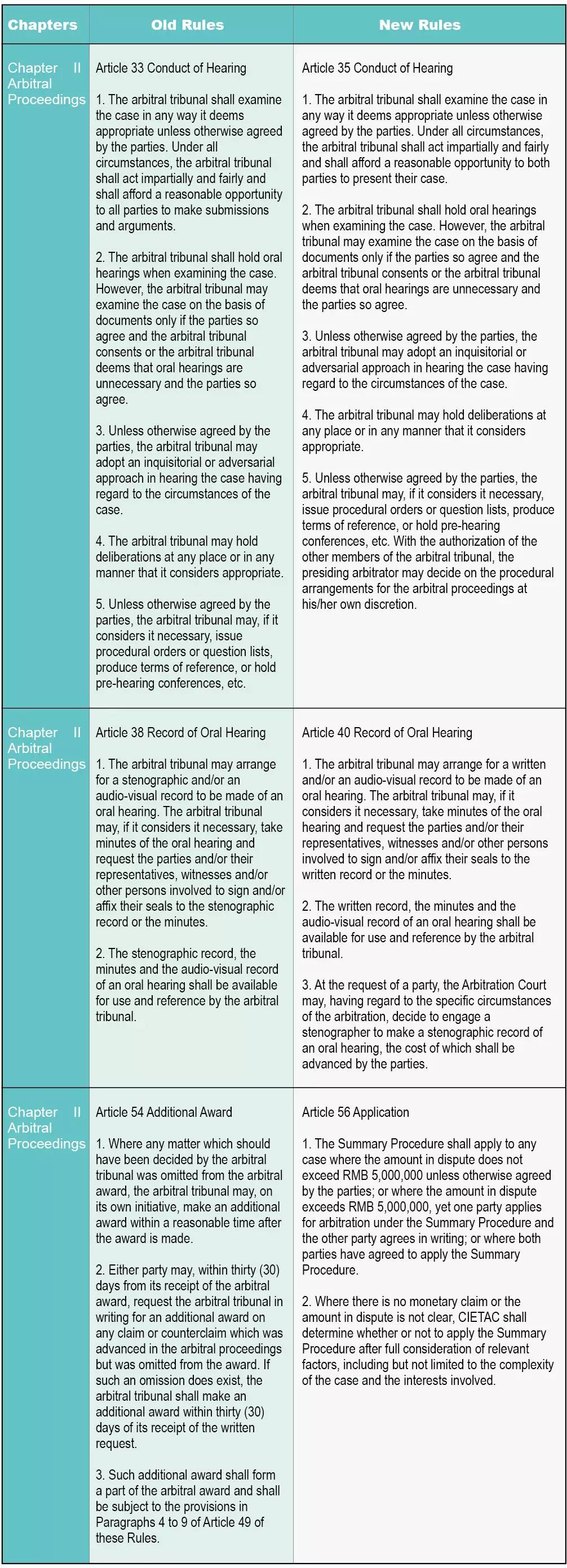
Article 56 of the New CIETAC Rules provides that the Summary Procedure shall apply to any case where the amount in dispute does not exceed RMB 5 million unless otherwise agreed by the parties.
Where the parties desire a case with the amount in dispute not exceeding RMB 5 million to be heard by a three-member tribunal but not a single member tribunal, the parties may expressly write down their choice of a three-member tribunal in the arbitration agreement. However, it is worth noticing that even if the parties select a three-member tribunal, in a case where the amount in dispute does not exceed RMB 5 million, Summary Procedure shall apply to the whole proceeding, except for the formation of tribunal.
The amendment to the amount in dispute in Summary Procedure cases is mainly because of the increase of the amount in dispute in CIETAC cases recently, and for the purpose to speed up the arbitration proceedings.
6. Emergency Relief
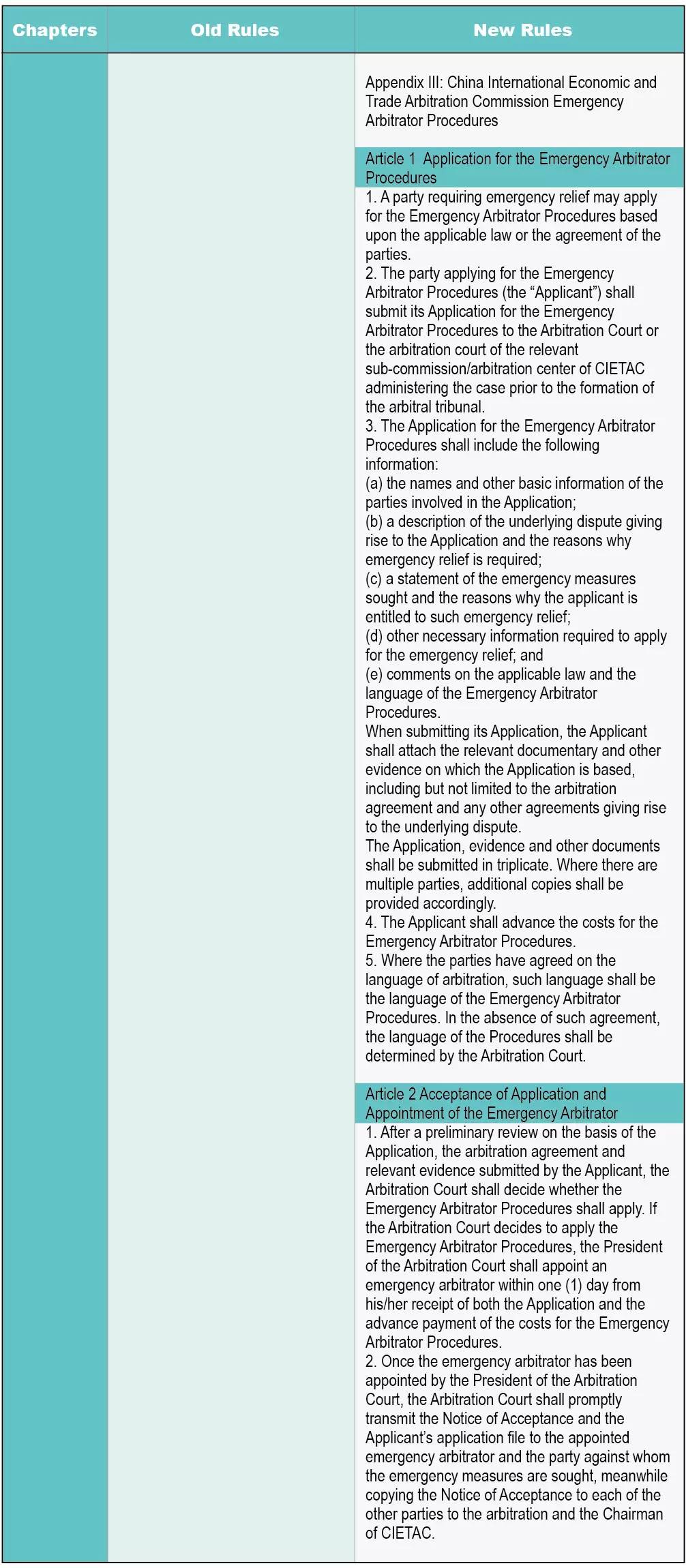
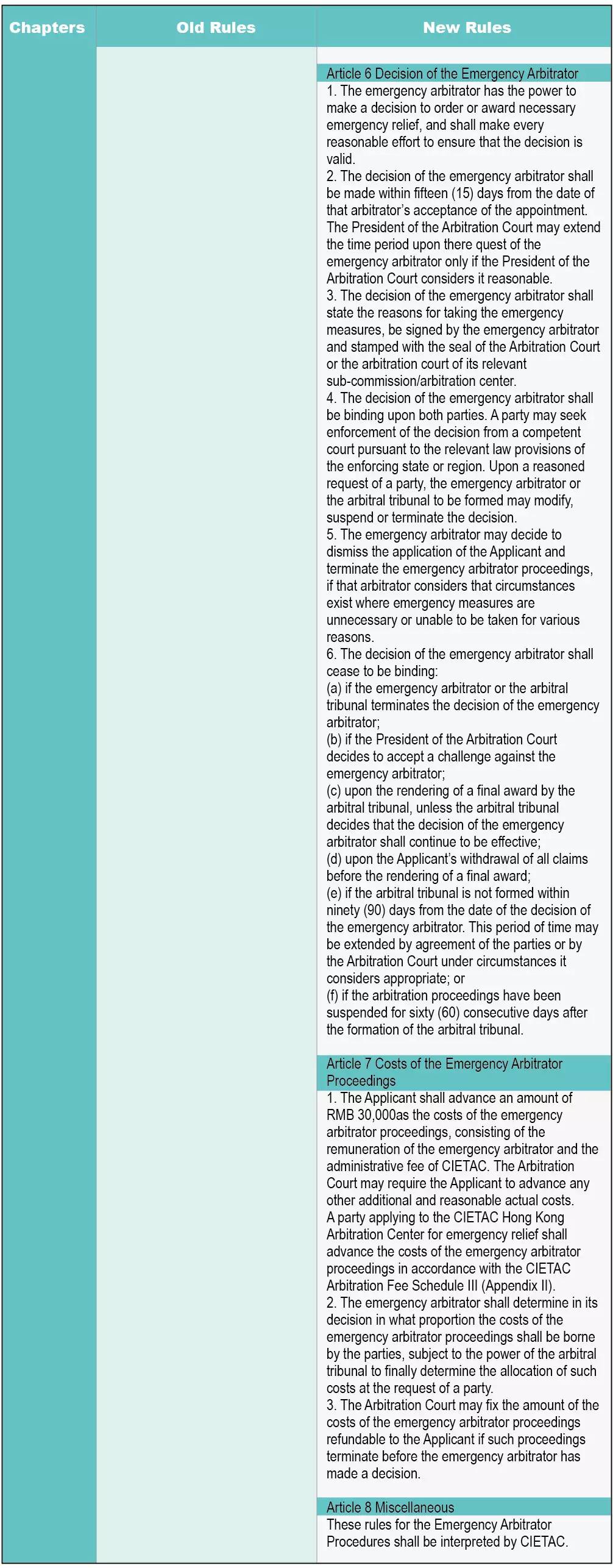
Article 23 of the New CIETAC Rules provides that in accordance with the applicable law or the agreement of the parties, a party may apply for emergency relief. The emergency arbitrator may decide to order or award necessary or appropriate emergency measures.
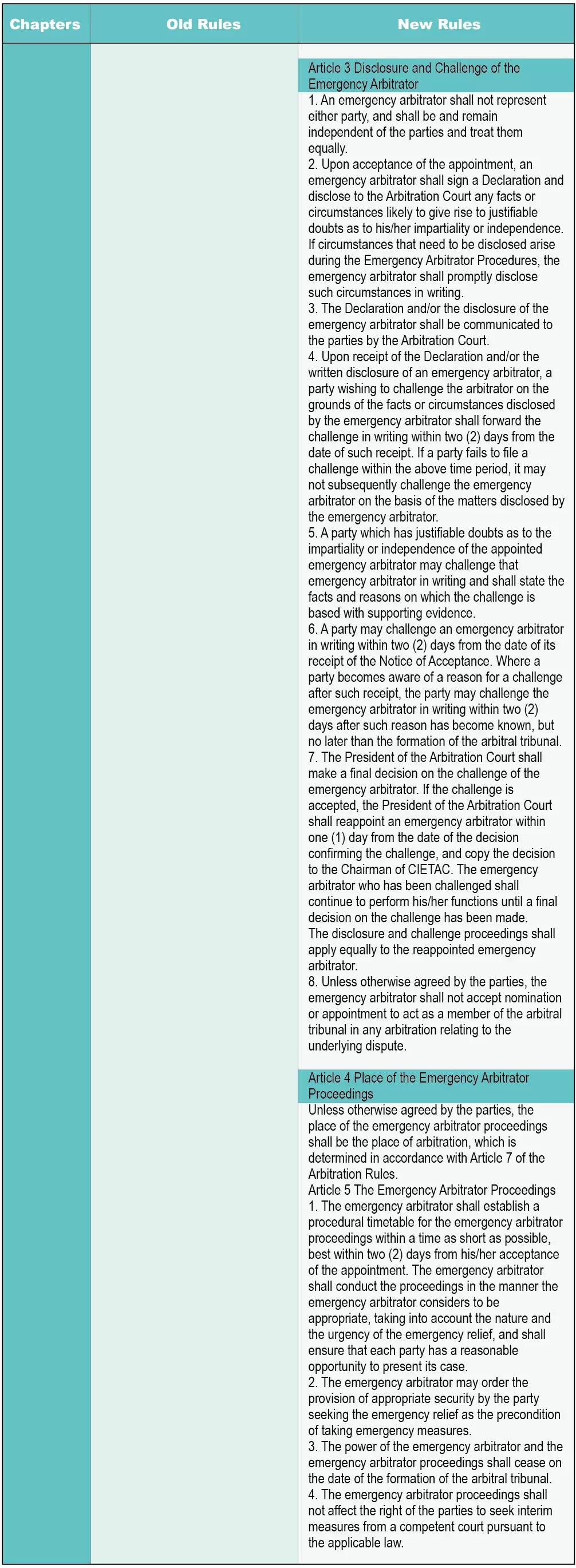
The party applying for the Emergency Arbitrator Procedures shall submit its Application prior to the formation of the arbitral tribunal. If the Arbitration Court preliminarily decides, after a preliminary review of the Application, to apply the Emergency Arbitrator Procedures, the President of the Arbitration Court shall appoint an emergency arbitrator. The power of the emergency arbitrator and the emergency arbitrator proceedings shall cease on the date of the formation of the arbitral tribunal. The emergency arbitrator may order the provision of appropriate security by the party seeking the emergency relief before rendering the decision of taking emergency measures; once the decision is rendered, a party may seek enforcement of the decision from a competent court.
As for the time limit in the Emergency Arbitrator Procedures, the President of the Arbitration Court shall appoint an emergency arbitrator within one (1) day from his/her receipt of both the Application and the advance payment of the costs for the Emergency Arbitrator Procedures; if no challenge of the emergency arbitrator is granted, the emergency arbitrator shall establish a procedural timetable for the emergency arbitrator proceedings within two (2) days from his/her acceptance of the appointment, and the decision of the emergency arbitrator shall be made within fifteen (15) days from his/her acceptance of appointment.
As for the types of emergency measures, the New CIETAC Rules have no explicit provision on it. Generally speaking, the concept of emergency relief is similar with the preservation measures in civil procedures, including: evidence preservation, property preservation, and act preservation, etc. In practice, the Emergency Arbitrator may also decide the type of emergency measures to be rendered, and the scope of the emergency relief that the parties could claim might be extended based on the above mentioned.
On another level, the emergency measures that the Emergency Arbitrator could take might go beyond the measures that the courts could take, which is a necessary supplement to the court emergency measures, benefits to instantly protect the parties’ legitimate interests and to reduce losses.
7. Hong Kong Arbitration
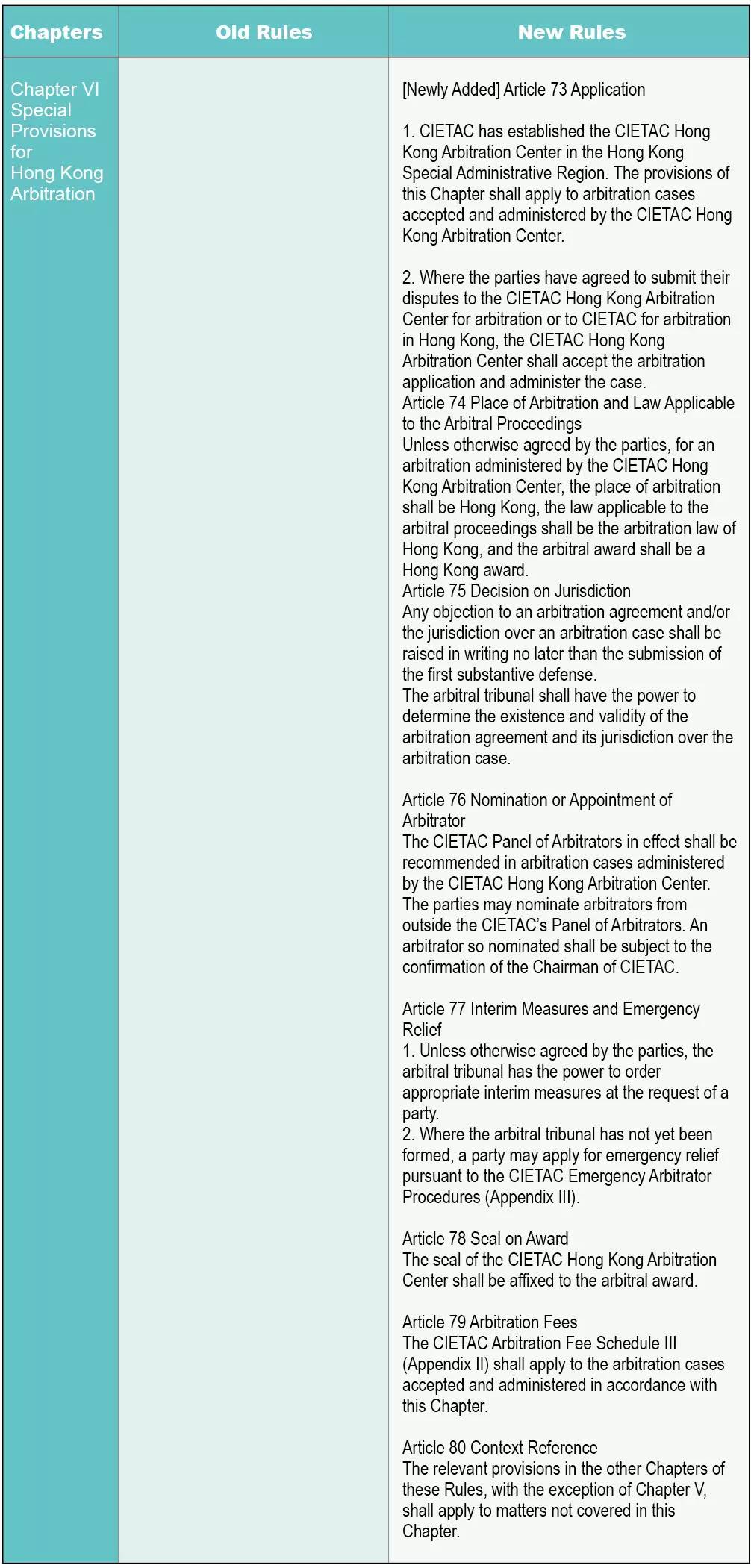
In 2012, CIETAC set up a new arbitration center in Hong Kong, and relevant provisions regarding the Hong Kong arbitration are therefore added into the New CIETAC Rules.
In practice, it is quite common that the foreign entity is reluctant to submit arbitration in mainland China, while the Chinese entity fears to resort the dispute to an unknown arbitration institution abroad, and therefore it is quite hard for both parties to reach an agreement on the choice of foreign arbitration institution. CIETAC Hong Kong Arbitration Center is a good choice on balance, and the explicit stipulations on the relevant procedures of CIETAC Hong Kong Arbitration Center provide a good protection on this choice.
For the arbitration cases administered by the CIETAC Hong Kong Arbitration Center, the law applicable to the arbitral proceedings shall be the arbitration law of Hong Kong, and the arbitral award shall be deemed as Hong Kong award. The parties may nominate arbitrators outside the list of CIETAC’s Panel of Arbitrators; as for the arbitration fees, it separates administrative fee and arbitrator’s fees in accordance with international practice. As for emergency relief, the same arbitration rules apply in CIETAC Hong Kong arbitration.
8. Other New Procedures
(1) Newly added three means of document service. Where the parties decline to receive the document or it is difficult to serve the document to the parties, three means of document service could be used, namely: service by public notary, entrustment or retention.
(2) Newly increased the power of the presiding arbitrator. The New CIETAC Rules explicitly empower the presiding arbitrator to decide on the procedural arrangements for the arbitral proceedings at his/her own discretion upon authorization of other co-arbitrators.
(3) Newly added regulations regarding arbitrator’s special remuneration. The arbitrator’s special remuneration could be determined with reference to the standards of arbitrators’ fees and expenses in CIETAC Hong Kong arbitration cases.
(4) Newly added regulations regarding stenographer. At the request of a party, the Arbitration Court may decide to engage a stenographer to make a stenographic record of oral hearing, the cost of which shall be advanced by the parties.
II Comments
1. New CIETAC Rules establish new procedural rules outside Arbitration Law
Considering the change of diversified modes in today’s business transaction, in order to accelerate dispute resolution arising from multiple contracts with multi-parties in serial transaction, multi-party transaction and series transactions in one project, etc, the New CIETAC Rules add the new provisions for “Joinder of Additional Parties” and “Multiple Contracts in a Single Arbitration”, and also amend the clause for “Consolidation of Arbitrations”. These new changes have significant meanings in accelerating the efficient proceedings and saving arbitration cost for the parties, and also demonstrate the coordination and synchronous development of CIETAC with other international arbitration institutions at the international level.
2. Implementation of the New Rules
As to the newly added rules for emergency arbitrator and emergency relief, it in fact empowers CIETAC to take preservation measures. However there are no similar rules or regulations in the Arbitration Law. Although the arbitral tribunal, in the old CIETAC rules, could also take interim measures according to the applicable law, due to the fact that no such regulations exist in the applicable Chinese laws, there is hardly any such applications for the interim measures in practice. After the enforcement of the New CIETAC Rules, if the parties apply to enforce the decision on emergency relief, how would the court deal with the application?
Besides, according to the New CIETAC Rules, the emergency arbitrator or Arbitration Court may decide to take emergency measures upon receipt of parties’ application in accordance with the applicable law or the agreement of the parties. How specifically should the parties agree on this? If the parties agree to apply the New CIETAC Rules, does it mean a party could apply for the emergency relief directly, or are the parties required to make additional specific agreement on the emergency measures?
All of the above-mentioned need to be further resolved and improved in practice.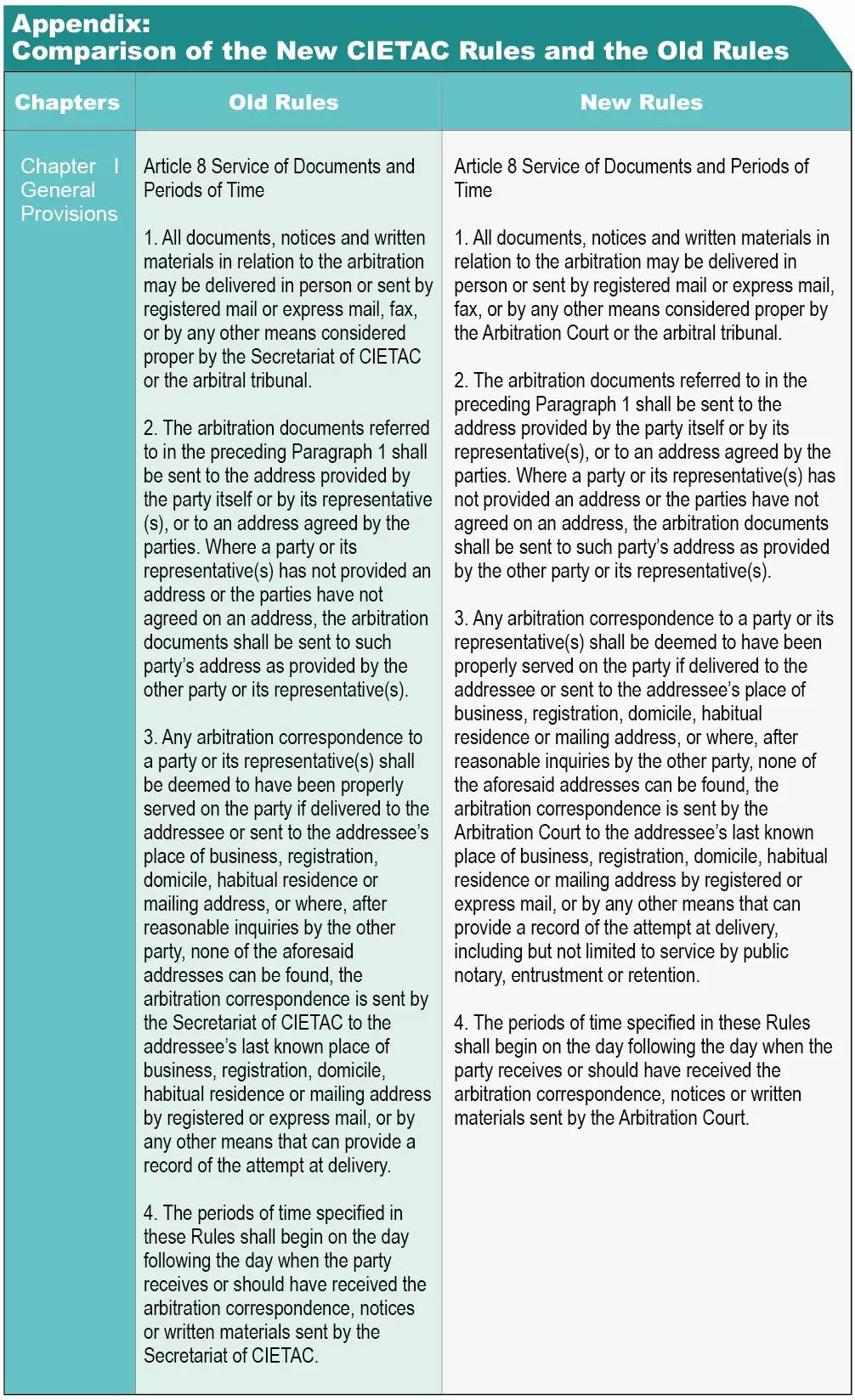
CIETAC Arbitration Rules (2015)
作者:ChristineKANG NanHU LiYE XinJIANG来源:君合律师事务所

On November 4, 2014, China Council for the Promotion of International Trade / China Chamber of Inter