
01Offshore finance business
Offshore business refers to an international financial business that utilizes funds absorbed from non-residents to meet the financial needs of other non-residents. The client is a non-resident and the currency is limited to freely convertible currencies. As a special business organization, offshore companies have played an important role in the operation of international investment, international trade, property protection, international tax planning and other field. Most offshore registration sites have the following traditional features:
1. Free currency exchange: Because there is no foreign exchange control or a dual exchange control that distinguishes between residents and non-residents, non-resident companies can be freer to engage in international trade settlement and payment.
2. Perfect bank secrecy system: good confidentiality can better protect the company's trade secrets.
3. Low tax rate: This is the significance of some offshore centers and the basis for their survival. Tax-free preferential tax policies have exclusive advantages and attract enterprises and investors that have different purposes to register company here.
4. Developed banking and communications networks: as the support of the commercial trade, it provides them with a broad and stable financial support and trading environment.
The main purpose of the establishment of special purpose companies in offshore centers, is to effectively use preferential tax systems, overseas investment policy, return investment and any other convenient conditions.
02Offshore finance center and its classifications
Different from the general finance institutions in each country, which only engage in local currency deposit and loan business, offshore financial centers refer to international financial markets with free and unregulated transactions in some countries, regions and cities. In the offshore finance center, the main foreign currency is the transaction (or deposit and loan) of the standard currency, and the non-residents are the transaction object.
The most famous offshore finance centers are the British Virgin Islands, the Cayman Islands, the Isle of Man, the Bahamas, Bermuda, London, Hong Kong, the United States, and Japan, which are specifically divided into the following four categories:
1. An internal and external hybrid offshore finance center represented by London and Hong Kong
Features: It is a mixed operation of offshore finance business and domestic finance business, which the two markets' funds and business complement each other, and allows non-residents to operate both onshore and domestic businesses, that is, residents and non-residents can engage in each the deposit and loan business of the currency, the settlement of the account. And the entry and exit of funds is not restricted. At the same time, offshore finance services are not subject to the laws, regulations and regulatory rules of their domestic finance systems.
However, the currency of offshore finance transactions is the currency outside the country where the market is located, that is, in London, it is impossible to directly operate the European currency business. In addition, residents operating onshore and domestic businesses must pay deposit reserve and related taxes. In an environment where financial regulators strictly control the issuance of “comprehensive business” licenses, the proportion of the onshore business is much smaller than offshore business.
2. Separate offshore finance centers represented by New York, Singapore and Tokyo
Features: It should keep the accounting of onshore finance business and offshore finance business apart and calculate deposit and loan business of residents and non-residents respectively. Operating offshore finance business can be exempted from deposit reserve, and enjoy deposit insurance benefits, as well as interest withholding tax and local tax exemption. The currency operated by the offshore business can be either an overseas currency or a national currency. However, offshore and traditional businesses must have separate accounts. Funds are prohibited from flowing between domestic and foreign markets and between offshore and onshore accounts.
3. Separation-based osmotic offshore financial center, represented by Jakarta, Indonesia, Bangkok, Thailand and Labuan, Malaysia
Features: Offshore business and onshore business must be separated into two major accounts. Also the deposit business of residents is separated from the non-resident deposit business. However, one-way penetration is allowed, that is, only offshore to shore loans are allowed, and onshore funds are allowed to flow offshore. This type mainly occurs in developing countries.
4. Tax-deductible port or thin-book offshore finance center, represented by BVI, Cayman, Bermuda
Features: Such markets act as intermediaries for capital flows and there is no actual offshore capital transaction. It is only the accounting business for other market transactions. Such markets have a stable political situation, preferential tax policies, and no financial controls. This is the “offshore financial center” in the usual sense. For example, the British Virgin Islands (BVI), Bermuda, Bahamas, Seychelles, Cayman Islands, etc., constitute an offshore registration or offshore center.
These countries or regions have established special laws to regulate companies, investment, taxation, banks, trusts, private funds, property, etc., and generally have a highly liberalized and international financial management system and a very favorable tax system. Therefore, these places are also known as "tax-free ports."
Generally speaking, “offshore company” refers to a limited liability company or an international commercial company that is established in an offshore jurisdiction but does not operate in a registered country or region.
03Offshore financial center and listed IPO
In recent years, the country has quietly raised a wave of offshore development. Many enterprises, especially private enterprises, have gone abroad to go to the international offshore financial center to set up offshore companies to facilitate enterprises to list overseas, offshore financing, venture capital exit and enjoy preferential policies for foreign companies in return investment. At the same time, the registration of offshore companies is easy and the cost is low, which also saves a lot of time and economic costs for the operation of the company.
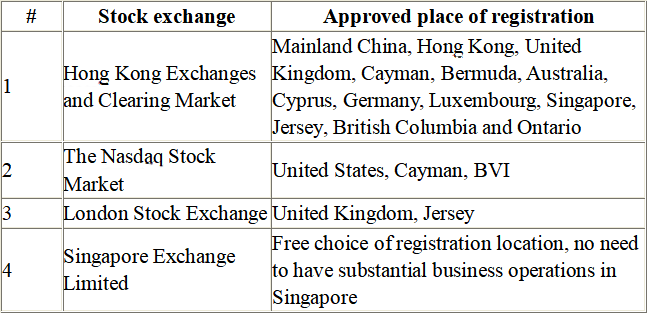
However, not all offshore companies can be recognized by overseas stock exchanges. If the company plans to list overseas in the future, it needs to make advance arrangements according to the requirements of the stock exchanges to be listed. At present, the world's major stock exchanges have the following requirements for the registration of listed companies:
In addition, China's current strict control of the foreign exchange system and complex overseas listing approval procedures limit the international financing of enterprises. By registering an offshore company to control domestic industries and conduct overseas financing and listing in the name of the company can greatly simplify the operation procedures of overseas listings. Moreover, the transfer of funds from offshore companies is not subject to any restrictions, and funds can be optimally managed through investment and financing on a global scale.
Offshore business refers to an international financial business that utilizes funds absorbed from non-residents to meet the financial needs of other non-residents. The client is a non-resident and the currency is limited to freely convertible currencies. As a special business organization, offshore companies have played an important role in the operation of international investment, international trade, property protection, international tax planning and other field. Most offshore registration sites have the following traditional features:
1. Free currency exchange: Because there is no foreign exchange control or a dual exchange control that distinguishes between residents and non-residents, non-resident companies can be freer to engage in international trade settlement and payment.
2. Perfect bank secrecy system: good confidentiality can better protect the company's trade secrets.
3. Low tax rate: This is the significance of some offshore centers and the basis for their survival. Tax-free preferential tax policies have exclusive advantages and attract enterprises and investors that have different purposes to register company here.
4. Developed banking and communications networks: as the support of the commercial trade, it provides them with a broad and stable financial support and trading environment.
The main purpose of the establishment of special purpose companies in offshore centers, is to effectively use preferential tax systems, overseas investment policy, return investment and any other convenient conditions.
02Offshore finance center and its classifications
Different from the general finance institutions in each country, which only engage in local currency deposit and loan business, offshore financial centers refer to international financial markets with free and unregulated transactions in some countries, regions and cities. In the offshore finance center, the main foreign currency is the transaction (or deposit and loan) of the standard currency, and the non-residents are the transaction object.
The most famous offshore finance centers are the British Virgin Islands, the Cayman Islands, the Isle of Man, the Bahamas, Bermuda, London, Hong Kong, the United States, and Japan, which are specifically divided into the following four categories:
1. An internal and external hybrid offshore finance center represented by London and Hong Kong
Features: It is a mixed operation of offshore finance business and domestic finance business, which the two markets' funds and business complement each other, and allows non-residents to operate both onshore and domestic businesses, that is, residents and non-residents can engage in each the deposit and loan business of the currency, the settlement of the account. And the entry and exit of funds is not restricted. At the same time, offshore finance services are not subject to the laws, regulations and regulatory rules of their domestic finance systems.
However, the currency of offshore finance transactions is the currency outside the country where the market is located, that is, in London, it is impossible to directly operate the European currency business. In addition, residents operating onshore and domestic businesses must pay deposit reserve and related taxes. In an environment where financial regulators strictly control the issuance of “comprehensive business” licenses, the proportion of the onshore business is much smaller than offshore business.
2. Separate offshore finance centers represented by New York, Singapore and Tokyo
Features: It should keep the accounting of onshore finance business and offshore finance business apart and calculate deposit and loan business of residents and non-residents respectively. Operating offshore finance business can be exempted from deposit reserve, and enjoy deposit insurance benefits, as well as interest withholding tax and local tax exemption. The currency operated by the offshore business can be either an overseas currency or a national currency. However, offshore and traditional businesses must have separate accounts. Funds are prohibited from flowing between domestic and foreign markets and between offshore and onshore accounts.
3. Separation-based osmotic offshore financial center, represented by Jakarta, Indonesia, Bangkok, Thailand and Labuan, Malaysia
Features: Offshore business and onshore business must be separated into two major accounts. Also the deposit business of residents is separated from the non-resident deposit business. However, one-way penetration is allowed, that is, only offshore to shore loans are allowed, and onshore funds are allowed to flow offshore. This type mainly occurs in developing countries.
4. Tax-deductible port or thin-book offshore finance center, represented by BVI, Cayman, Bermuda
Features: Such markets act as intermediaries for capital flows and there is no actual offshore capital transaction. It is only the accounting business for other market transactions. Such markets have a stable political situation, preferential tax policies, and no financial controls. This is the “offshore financial center” in the usual sense. For example, the British Virgin Islands (BVI), Bermuda, Bahamas, Seychelles, Cayman Islands, etc., constitute an offshore registration or offshore center.
These countries or regions have established special laws to regulate companies, investment, taxation, banks, trusts, private funds, property, etc., and generally have a highly liberalized and international financial management system and a very favorable tax system. Therefore, these places are also known as "tax-free ports."
Generally speaking, “offshore company” refers to a limited liability company or an international commercial company that is established in an offshore jurisdiction but does not operate in a registered country or region.
03Offshore financial center and listed IPO
In recent years, the country has quietly raised a wave of offshore development. Many enterprises, especially private enterprises, have gone abroad to go to the international offshore financial center to set up offshore companies to facilitate enterprises to list overseas, offshore financing, venture capital exit and enjoy preferential policies for foreign companies in return investment. At the same time, the registration of offshore companies is easy and the cost is low, which also saves a lot of time and economic costs for the operation of the company.
However, not all offshore companies can be recognized by overseas stock exchanges. If the company plans to list overseas in the future, it needs to make advance arrangements according to the requirements of the stock exchanges to be listed. At present, the world's major stock exchanges have the following requirements for the registration of listed companies:
In addition, China's current strict control of the foreign exchange system and complex overseas listing approval procedures limit the international financing of enterprises. By registering an offshore company to control domestic industries and conduct overseas financing and listing in the name of the company can greatly simplify the operation procedures of overseas listings. Moreover, the transfer of funds from offshore companies is not subject to any restrictions, and funds can be optimally managed through investment and financing on a global scale.