
A Brief Comment on the Trademark Dispute over Mark “羅斯蒙特 & LSMT & Device”
1、Background1
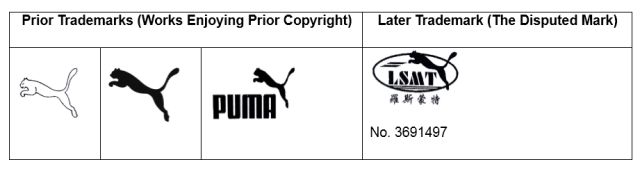
On Aug. 27, 2003, Qingdao Dekai Tyre Co., Ltd. filed an application for trademark “羅斯蒙特 & LSMT & Device” No. 3691497 on goods “automobile inner tubes; vehicle tyres; etc.” in class 12 (hereinafter referred to as “the Disputed Mark”), which was granted a validity period up to Aug. 13, 2025. In March 1, 2013, PUMA SE applied to the Trademark Review and Adjudication Board (the Appeal Board) for trademark dispute against the Disputed Mark, but the Appeal Board ruled to maintain the registration of the Mark. Dissatisfied with the ruling, PUMA SE filed a lawsuit before the Beijing First Intermediate People's Court, which rejected its claim. It then appealed to the Beijing High People’s Court, which held that the Disputed Mark infringed on the prior copyright of PUMA SE, cancelled the original verdict and also the ruling made by the Appeal Board, and ordered the Appeal Board to re-hear the case. (Here attached is the comparison table for the images of the Disputed Mark and prior marks.)
2、Key Points
Evidential materials like copyright registration certificates of trademark images, copyright contracts, registration certificates of prior international and Chinese trademarks, etc. obtained after the application date of a disputed mark can be used as preliminary evidence proving the copyright over trademark images enjoyed by the holder of prior trademarks.
3、Legal Grounds
The Beijing High People’s Court held that: PUMA SE requested to recognize its prior copyright over the art work “The Jumping Puma” based on the notarized materials including the Copyright Contract and Supplementary Agreements, the Copyright Registration Certificate, and Registration Certificates of international and Chinese trademarks. Although the Copyright Registration Certificate was obtained after the application date of the Disputed Mark, it can still be preliminarily proved that PUMA SE held prior copyright over the art work “The Jumping Puma” based on the notarized Copyright Contract and Supplementary Agreements, as well as the Registration Certificates of its prior international and Chinese trademarks. The animal image in the Disputed Mark is nearly identical to the art work “The Jumping Puma” in terms of design style and visual effect, which constitutes substantial similarity to the same. Therefore, the registration of the Disputed Mark would cause damages to the prior copyright of PUMA SE.
4、Comments
Article 32.1 of Trademark Law 2013 (Article 31.1 of Trademark Law 2001) stipulated that trademark applications shall not infringe upon others’ prior existing rights. According to judicial interpretations of the Supreme People’s Court, the adjudication guidelines of the Beijing High People’s Court, and relative law practices, such prior rights, which may be asserted to object to other’s trademarks, include the right to name and portrait, copyright, the right to trade name and patent of industrial design, etc. Where a trademark contains special figures or designs with originality, the trademark holder may file oppositions or invalidations against substantially similar upcoming trademarks in any classes based on its prior copyright as regulated in this Article. Such legal actions not only protect the image of the trademark which grants its holder with prior copyright, but also provide extended protection to the mark concerning goods and services in all the 45 classes. Some have opined that cross-class protections are only for well-known trademarks and if copyright is protected as prior right, it shall be restricted from being granted such strong protection. However, such protection is indeed an inherent requirement for protecting proprietorship of a prior copyrighted works against later marks on all goods and services. When there is conflict between a prior copyrighted works symbol and a later trademark, sufficient consideration shall be given so that the prior copyright be fully protected rather than limited.
According to general provisions in trademark laws of China and other nations, the registrant or applicant of a prior trademark has the right to prevent others from applying for registration of identical or similar marks in respect of identical or similar goods or services, so as to avoid any confusion and misrecognition. This trademark protection method shall be subject to the following two preconditions: 1) the upcoming trademark is identical with or similar to the prior trademark; 2) the designated goods or services covered by the two marks are also identical or similar. In the processes of trademark examination, opposition and opposition review, refusal review, nullification, etc., examiners and judges would first carry out examination upon the above two preconditions, then decide whether there is a likelihood of confusion, which determines their decision of approving for registration, rejecting the application or announcing invalidation.
Similarity between a prior mark and an upcoming mark can be determined by conducting a comparison and observation based on the principles established in the Trademark Review and Adjudication Standards, relevant judicial explanations and regulations; while the similarity between the goods or services of two marks can refer to the Classification Guide for Goods and Services. In the event that an upcoming trademark is filed on non-similar goods or services, and it does not constitute a preemptive registration, which applies to trademarks “acquired by fraud or any other improper means” as stipulated in Article 44 of Trademark Law, prior trademark holders can only seek protection of well-known marks in accordance with Article 13 of the Trademark Law, and must submit sufficient evidence of prior trademark use and popularity in order to prove the well-known status of the mark. But this is a heavy burden -- trademark authorities always adopt a very stringent approach in determining the well-known status of a mark, which on one hand has effectively controlled the alienation trend of pursuing the well-known recognition, and on the other hand has inevitably caused the phenomenon that some prior marks with certain popularities face difficulties in seeking protection against their use in dissimilar goods or services.
If a prior device mark or word & device mark acquires certain originalities, its holder may claim copyright protection based on provisions in Article 32 of Trademark Law, which can not only realize cross-class protection, but also spare all the troubles in recognizing well-known marks. In the subject case, the Disputed Mark’s owners applied for registration in Aug. 2003 and filed on goods “automobile inner tubes; vehicle tyres; etc.” in class 12, which are dissimilar and unrelated to “clothing” in class 25. According to the provisions of well-known marks in Article 13 of Trademark Law, PUMA SE shall submit evidential materials to prove that “The Jumping Puma” serial marks have become well-known on goods “sportswear and shoes” in class 25 in China in the year of 2003, which is of substantial difficulty. Thus, it is rightful and reasonable for PUMA SE to take prior copyright as its legal basis for protection.
In this regard, how does one prove the existence of prior copyright over the image of a prior trademark, in administrative cases concerning trademarks? According to the Adjudication Guidelines on the Administrative Cases Involving the Authorization and Determination of Trademark Rights issued by the Beijing High People’s Court, the prior trademark holder shall provide all of the following evidential materials as preliminary evidence of holding a prior copyright: manuscripts of creating the design, design commission agreement and copyright transfer contract proving the obtainment of the copyright, and copyright registration certificate before the application date of the disputed mark. For obvious reasons, a copyright registration certificate obtained after the application date of the disputed mark alone is not sufficient to prove the holding of a prior copyright.
The above-mentioned Adjudication Guidelines were of positive significance in curbing malicious and preemptive registrations of others’ prior trademarks, and were superseded by the issuance of the Regulations on Several Issues Concerning the Trial of Administrative Cases Involving the Authorization and Determination of Trademark Rights by the Supreme People's Court in 2017 (hereinafter referred to as “the Judicial Explanation”). Article 19.3 of the Judicial Explanation stipulated that: “the public announcement and registration certificate of a trademark, etc. can be used as preliminary evidence to prove that the trademark applicant is an interested party with rights to claim copyright over the image of a registered trademark.” Therefore, a party initiating an opposition or invalidation does not necessarily need to claim itself as the copyright holder to the image of a prior trademark, instead it can claim to be an interested party of prior copyright. By so doing, it can be free from the burden of submitting all the evidential materials such as the copyright registration certificate, manuscripts of creating the design, and other materials proving the prior obtainment of the copyright. By contrast, an interested party of prior copyright is only required to submit the trademark registration certificates or publication announcements. The Judicial Explanation had been applied in another case before the Beijing High People’s Court at the same period of time as the subject case. The Supreme People’s Court, in the recent retrial decision on the “Shark Device” case 3, recognized that the petitioner, DAMA S.P.A., could claim the copyright over the device based on the copyright registration certificate obtained after the application date of the mark in dispute combined with the Italian trademark registration certificates issued in the 1980s. The Court accordingly granted cross-class protection in respect of “eyeglasses” in Class 9. What needs to be particularly emphasized is that the party who initiated an opposition or invalidation claimed to be an interested party of copyright, instead of the copyright holder of a prior trademark. This difference allowed the claimant to avoid both the difficulties associated with providing the evidential materials required of a copyright holder, as well as the risk of more vulnerabilities being found in the evidential materials, which could lead to the rejection of its claim.
When participating in the market competition, businesses usually apply for various stylized word marks, device marks or word & device marks symbolizing the image of their company or products. In light of the subject case, market entities shall attach great importance to the role of copyright protection in realizing overall brand protection, including inter-class protection of the designated goods or services of such marks. On the one hand, they may need to apply for trademark registrations in core goods and services through the determination process of trademark rights; on the other hand, they may obtain evidence of copyright ownership over images of prior marks, such as manuscripts of creating the design, design commission agreement and copyright transfer contract proving the obtainment of the copyright.
In the meantime, the copyright registration certificates shall also be obtained as early as possible. Such documents or certificates are all preliminary evidence proving the holding of copyright. Foreign right holders who initiate oppositions or invalidations against Chinese trademarks, if they claim as the holder of copyright, would face many more difficulties in providing evidential materials like manuscripts of creating the design, copyright contracts, first publication proofs, copyright registration certificates before the application date of the disputed marks. If they have obtained trademark registration certificates in China and overseas, according to the Judicial Explanation of the Supreme People’s Court, foreign right holders instead may claim to be an interested party to prior copyrights, and simply use preliminary evidential materials such as prior trademark registration certificates and copyright registration certificates obtained after the application date of disputed marks, so as to be seek prior copyright protection in accordance with Article 32.1 of Trademark Law.
1、The Second Instance Judgement Numbered (2017) 785 on Lawsuit on Trademark Dispute of PUMA SE against the Trademark Review and Adjudication Board & Qingdao Dekai Tyre Co., Ltd. in Respect of Trademark “羅斯蒙特 & LSMT & Device” No. 3691497.
1、Background1
On Aug. 27, 2003, Qingdao Dekai Tyre Co., Ltd. filed an application for trademark “羅斯蒙特 & LSMT & Device” No. 3691497 on goods “automobile inner tubes; vehicle tyres; etc.” in class 12 (hereinafter referred to as “the Disputed Mark”), which was granted a validity period up to Aug. 13, 2025. In March 1, 2013, PUMA SE applied to the Trademark Review and Adjudication Board (the Appeal Board) for trademark dispute against the Disputed Mark, but the Appeal Board ruled to maintain the registration of the Mark. Dissatisfied with the ruling, PUMA SE filed a lawsuit before the Beijing First Intermediate People's Court, which rejected its claim. It then appealed to the Beijing High People’s Court, which held that the Disputed Mark infringed on the prior copyright of PUMA SE, cancelled the original verdict and also the ruling made by the Appeal Board, and ordered the Appeal Board to re-hear the case. (Here attached is the comparison table for the images of the Disputed Mark and prior marks.)
2、Key Points
Evidential materials like copyright registration certificates of trademark images, copyright contracts, registration certificates of prior international and Chinese trademarks, etc. obtained after the application date of a disputed mark can be used as preliminary evidence proving the copyright over trademark images enjoyed by the holder of prior trademarks.
3、Legal Grounds
The Beijing High People’s Court held that: PUMA SE requested to recognize its prior copyright over the art work “The Jumping Puma” based on the notarized materials including the Copyright Contract and Supplementary Agreements, the Copyright Registration Certificate, and Registration Certificates of international and Chinese trademarks. Although the Copyright Registration Certificate was obtained after the application date of the Disputed Mark, it can still be preliminarily proved that PUMA SE held prior copyright over the art work “The Jumping Puma” based on the notarized Copyright Contract and Supplementary Agreements, as well as the Registration Certificates of its prior international and Chinese trademarks. The animal image in the Disputed Mark is nearly identical to the art work “The Jumping Puma” in terms of design style and visual effect, which constitutes substantial similarity to the same. Therefore, the registration of the Disputed Mark would cause damages to the prior copyright of PUMA SE.
4、Comments
Article 32.1 of Trademark Law 2013 (Article 31.1 of Trademark Law 2001) stipulated that trademark applications shall not infringe upon others’ prior existing rights. According to judicial interpretations of the Supreme People’s Court, the adjudication guidelines of the Beijing High People’s Court, and relative law practices, such prior rights, which may be asserted to object to other’s trademarks, include the right to name and portrait, copyright, the right to trade name and patent of industrial design, etc. Where a trademark contains special figures or designs with originality, the trademark holder may file oppositions or invalidations against substantially similar upcoming trademarks in any classes based on its prior copyright as regulated in this Article. Such legal actions not only protect the image of the trademark which grants its holder with prior copyright, but also provide extended protection to the mark concerning goods and services in all the 45 classes. Some have opined that cross-class protections are only for well-known trademarks and if copyright is protected as prior right, it shall be restricted from being granted such strong protection. However, such protection is indeed an inherent requirement for protecting proprietorship of a prior copyrighted works against later marks on all goods and services. When there is conflict between a prior copyrighted works symbol and a later trademark, sufficient consideration shall be given so that the prior copyright be fully protected rather than limited.
According to general provisions in trademark laws of China and other nations, the registrant or applicant of a prior trademark has the right to prevent others from applying for registration of identical or similar marks in respect of identical or similar goods or services, so as to avoid any confusion and misrecognition. This trademark protection method shall be subject to the following two preconditions: 1) the upcoming trademark is identical with or similar to the prior trademark; 2) the designated goods or services covered by the two marks are also identical or similar. In the processes of trademark examination, opposition and opposition review, refusal review, nullification, etc., examiners and judges would first carry out examination upon the above two preconditions, then decide whether there is a likelihood of confusion, which determines their decision of approving for registration, rejecting the application or announcing invalidation.
Similarity between a prior mark and an upcoming mark can be determined by conducting a comparison and observation based on the principles established in the Trademark Review and Adjudication Standards, relevant judicial explanations and regulations; while the similarity between the goods or services of two marks can refer to the Classification Guide for Goods and Services. In the event that an upcoming trademark is filed on non-similar goods or services, and it does not constitute a preemptive registration, which applies to trademarks “acquired by fraud or any other improper means” as stipulated in Article 44 of Trademark Law, prior trademark holders can only seek protection of well-known marks in accordance with Article 13 of the Trademark Law, and must submit sufficient evidence of prior trademark use and popularity in order to prove the well-known status of the mark. But this is a heavy burden -- trademark authorities always adopt a very stringent approach in determining the well-known status of a mark, which on one hand has effectively controlled the alienation trend of pursuing the well-known recognition, and on the other hand has inevitably caused the phenomenon that some prior marks with certain popularities face difficulties in seeking protection against their use in dissimilar goods or services.
If a prior device mark or word & device mark acquires certain originalities, its holder may claim copyright protection based on provisions in Article 32 of Trademark Law, which can not only realize cross-class protection, but also spare all the troubles in recognizing well-known marks. In the subject case, the Disputed Mark’s owners applied for registration in Aug. 2003 and filed on goods “automobile inner tubes; vehicle tyres; etc.” in class 12, which are dissimilar and unrelated to “clothing” in class 25. According to the provisions of well-known marks in Article 13 of Trademark Law, PUMA SE shall submit evidential materials to prove that “The Jumping Puma” serial marks have become well-known on goods “sportswear and shoes” in class 25 in China in the year of 2003, which is of substantial difficulty. Thus, it is rightful and reasonable for PUMA SE to take prior copyright as its legal basis for protection.
In this regard, how does one prove the existence of prior copyright over the image of a prior trademark, in administrative cases concerning trademarks? According to the Adjudication Guidelines on the Administrative Cases Involving the Authorization and Determination of Trademark Rights issued by the Beijing High People’s Court, the prior trademark holder shall provide all of the following evidential materials as preliminary evidence of holding a prior copyright: manuscripts of creating the design, design commission agreement and copyright transfer contract proving the obtainment of the copyright, and copyright registration certificate before the application date of the disputed mark. For obvious reasons, a copyright registration certificate obtained after the application date of the disputed mark alone is not sufficient to prove the holding of a prior copyright.
The above-mentioned Adjudication Guidelines were of positive significance in curbing malicious and preemptive registrations of others’ prior trademarks, and were superseded by the issuance of the Regulations on Several Issues Concerning the Trial of Administrative Cases Involving the Authorization and Determination of Trademark Rights by the Supreme People's Court in 2017 (hereinafter referred to as “the Judicial Explanation”). Article 19.3 of the Judicial Explanation stipulated that: “the public announcement and registration certificate of a trademark, etc. can be used as preliminary evidence to prove that the trademark applicant is an interested party with rights to claim copyright over the image of a registered trademark.” Therefore, a party initiating an opposition or invalidation does not necessarily need to claim itself as the copyright holder to the image of a prior trademark, instead it can claim to be an interested party of prior copyright. By so doing, it can be free from the burden of submitting all the evidential materials such as the copyright registration certificate, manuscripts of creating the design, and other materials proving the prior obtainment of the copyright. By contrast, an interested party of prior copyright is only required to submit the trademark registration certificates or publication announcements. The Judicial Explanation had been applied in another case before the Beijing High People’s Court at the same period of time as the subject case. The Supreme People’s Court, in the recent retrial decision on the “Shark Device” case 3, recognized that the petitioner, DAMA S.P.A., could claim the copyright over the device based on the copyright registration certificate obtained after the application date of the mark in dispute combined with the Italian trademark registration certificates issued in the 1980s. The Court accordingly granted cross-class protection in respect of “eyeglasses” in Class 9. What needs to be particularly emphasized is that the party who initiated an opposition or invalidation claimed to be an interested party of copyright, instead of the copyright holder of a prior trademark. This difference allowed the claimant to avoid both the difficulties associated with providing the evidential materials required of a copyright holder, as well as the risk of more vulnerabilities being found in the evidential materials, which could lead to the rejection of its claim.
When participating in the market competition, businesses usually apply for various stylized word marks, device marks or word & device marks symbolizing the image of their company or products. In light of the subject case, market entities shall attach great importance to the role of copyright protection in realizing overall brand protection, including inter-class protection of the designated goods or services of such marks. On the one hand, they may need to apply for trademark registrations in core goods and services through the determination process of trademark rights; on the other hand, they may obtain evidence of copyright ownership over images of prior marks, such as manuscripts of creating the design, design commission agreement and copyright transfer contract proving the obtainment of the copyright.
In the meantime, the copyright registration certificates shall also be obtained as early as possible. Such documents or certificates are all preliminary evidence proving the holding of copyright. Foreign right holders who initiate oppositions or invalidations against Chinese trademarks, if they claim as the holder of copyright, would face many more difficulties in providing evidential materials like manuscripts of creating the design, copyright contracts, first publication proofs, copyright registration certificates before the application date of the disputed marks. If they have obtained trademark registration certificates in China and overseas, according to the Judicial Explanation of the Supreme People’s Court, foreign right holders instead may claim to be an interested party to prior copyrights, and simply use preliminary evidential materials such as prior trademark registration certificates and copyright registration certificates obtained after the application date of disputed marks, so as to be seek prior copyright protection in accordance with Article 32.1 of Trademark Law.
1、The Second Instance Judgement Numbered (2017) 785 on Lawsuit on Trademark Dispute of PUMA SE against the Trademark Review and Adjudication Board & Qingdao Dekai Tyre Co., Ltd. in Respect of Trademark “羅斯蒙特 & LSMT & Device” No. 3691497.