On March 9, 2018, approximately four months after China promised to ease or lift foreign investment restrictions in the PRC financial market during the visit by President Trump, the Administrative Measures on Foreign-invested Securities Companies (Consultation Draft) (the “Consultation Draft”) was published by the China Securities Regulatory Commission (the “CSRC”) for public comments. The Consultation Draft, once promulgated, will replace the Rules on Establishment of Foreign Equity-participated Securities Companies (the “Current Rules”) that are the major current rules dealing with the establishment of foreign invested securities companies.
In parallel with the Current Rules, Supplement Agreement 10 to Closer Economic Partnership Arrangement (CEPA 10) between the mainland, Hong Kong and Macau governments provides for certain special treatments to qualified Hong Kong and Macau investors and allows such investors to set up a limited number of foreign invested securities companies in certain designated areas and hold 51% or 49% equity interest therein. Over the past couple of years, a number of foreign invested securities companies have been established by taking advantage of these special treatments. Pursuant to the CSRC, this pilot program under CEPA 10 has accumulated experiences with respect to the opening up of the securities industry, which can now be replicated and made generally available to all foreign investors.
We have prepared the following tables which aim at assisting you to understand what changes the Consultation Draft proposes to bring about and how the Consultation Draft compares with the Current Rules and CEPA 10 requirements.
1. Foreign shareholding limit (for un-listed securities companies)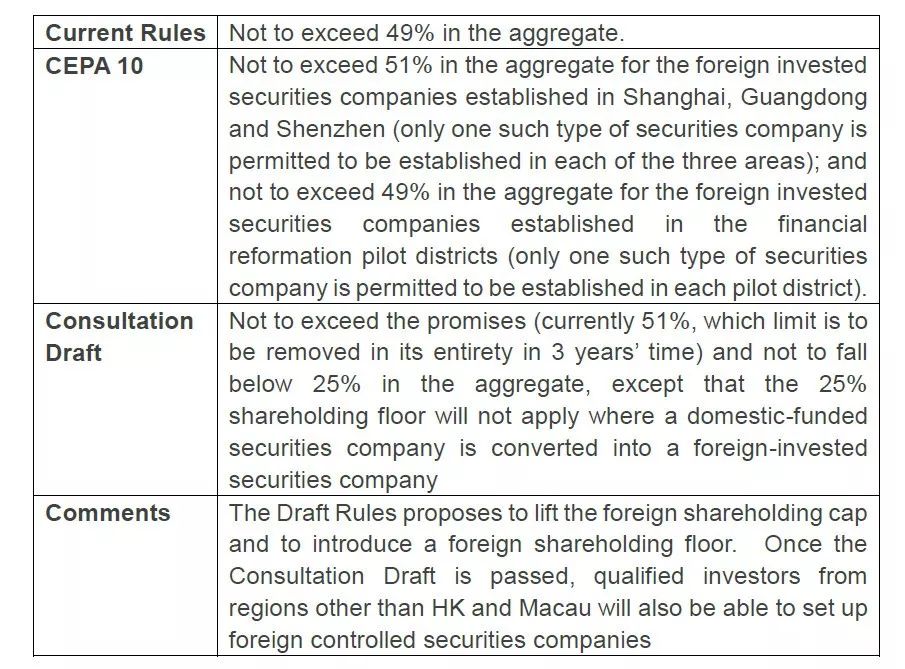
2. Foreign shareholding limit (for listed securities companies)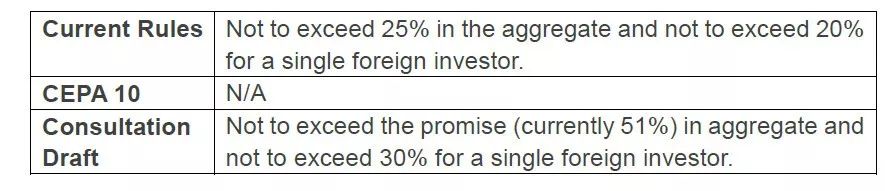
3. Business scope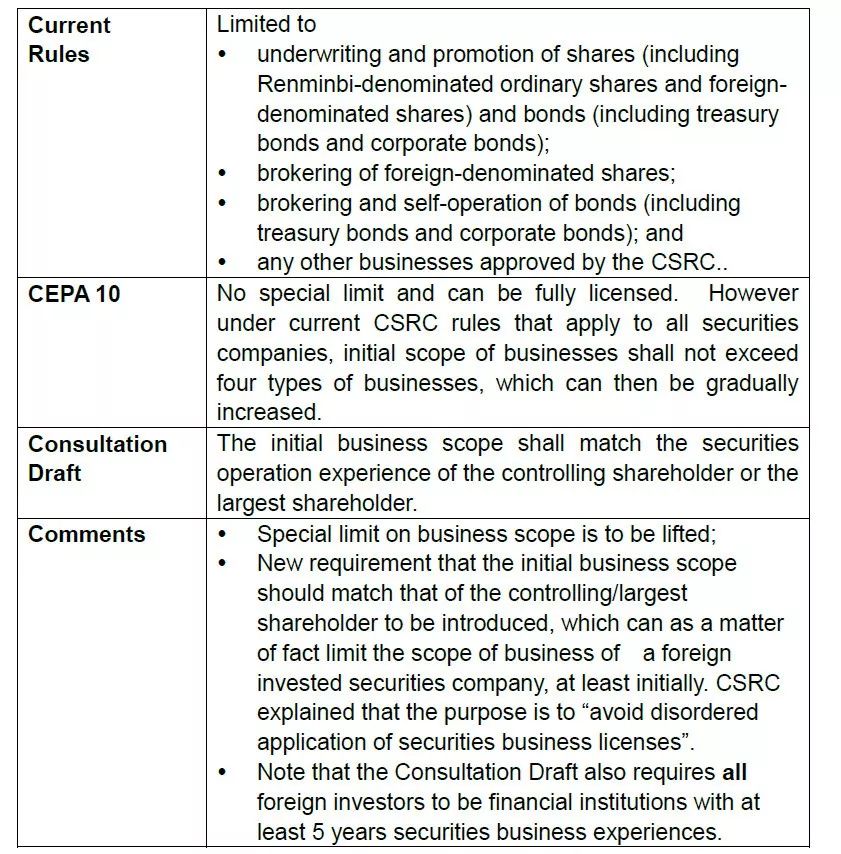
4. Foreign shareholder qualification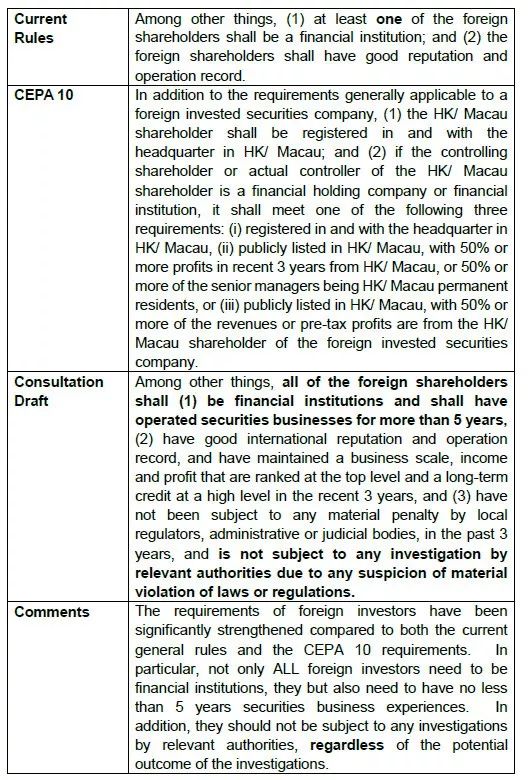
5. Domestic shareholder qualification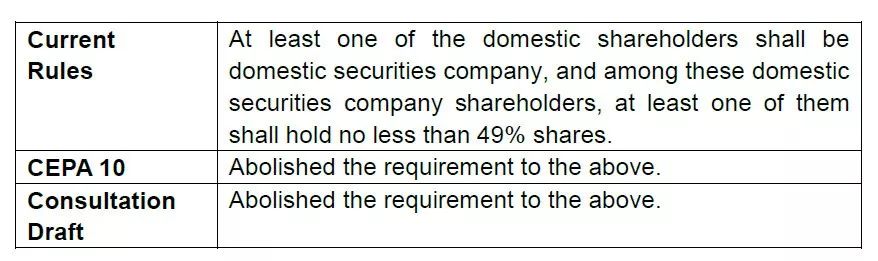
Special Notes
In addition to the comparison above, we would like to highlight the following two points to existing and potential investors in a foreign invested securities company:
The lock up:The Consultation Draft removes a requirement under the Current Rules that the foreign shareholders shall not transfer its shares in the foreign invested securities companies in three years from the date when they acquire the shares. However, foreign investors should not jump to the conclusion that they are now not subject to any lock up. As a matter of fact, longer lock up periods are provided for in the Review and Examination Guidance Number Ten on the Administrative Licensing of Securities Company – Capital Increase and Shareholding Change (“Guidance No. 10”), which as we understand, also applies to the establishment of foreign invested securities companies. According to Guidance No. 10, with respect to a securities company that has controlling shareholder or actual controller, the controlling shareholder or the shareholder controlled by the actual controller shall not transfer the shares of the securities company it holds within 60 months from the date of acquiring the shares, and other shareholders shall not transfer the shares of the securities company they hold within 36 months from the date of acquiring the shares; with respect to the securities company which has no controlling shareholder or actual controller, all of the shareholders shall not transfer the shares of the company within 48 months from the date of acquiring the shares. So unless Guidance No. 10 is also amended, the removal of the 3-year lock up from the Current Rule is probably just an effort to avoid any contradiction between different rules.
The “look-through” approach:the Consultation Draft has proposed a “look through” approach with respect to the controlling shareholder and actual controller of foreign invested securities companies in determining whether a securities company is domestic funded or foreign invested. According to Article 2 of the Consultation Draft, foreign invested securities companies include securities companies whose controlling shareholders or actual controllers have changed into foreign investors, and according to Article 14, under this circumstance, the relevant foreign investors should satisfy the qualification requirements and shareholding limit[1] for foreign shareholders, and those who do not satisfy the requirements and limit should take corrective actions within three months, which, as we understand, including transferring the shareholding to qualified domestic or foreign shareholders. As explained by the CSRC, in recent years some actual controllers of securities companies changed their citizenship and became foreign citizens, as a result of which foreign investors indirectly held shares in domestic-funded securities companies, and this proposed change is aimed at capturing such circumstances. Recent years we have seen this “look-through” approach being discussed or adopted in a number of foreign investment related areas, including in the draft Foreign Investment Act proposed by MOFCOM. However, with respect to the Consultation Draft, the most likely consequence of enforcing this requirement would be that domestic actual controllers who have immigrated to other countries will have to sell their shares, as it seems almost impossible for these actual controllers to satisfy the qualification requirements for a foreign investor.
Summary
The Consultation Draft has stayed true to the promise that China has made with respect to the gradual lifting of foreign ownership restriction in the securities industry. However the Consultation Draft has significantly strengthened the qualification requirements on foreign investors in a Chinese securities company, reflecting the regulators intention that only high quality foreign investors are encouraged to invest in this industry so that with the opening up, the Chinese securities industry can benefit from the advanced international experiences.
It is yet to be seen whether the Consultation Draft, once adopted, will also apply to the securities joint ventures established under CEPA 10. Our estimate would be yes, as the Current Rules do apply to those securities companies. If this is the case, the HK and Macau investors that intend to make use of the CEPA 10 arrangement to set up securities joint ventures will also need to satisfy the heightened qualification requirements.
[1] Article 14 however only refers to the general shareholding requirements as set forth in Article 7(ie, not to exceed the promise and not to fall below 25%), but not theindividual shareholding cap of 30% for a foreign shareholder of a listedsecurities company. This could be anoversight in the drafting.
CSRC to Revise Rules on Foreign Investments in Securities Firms
作者:蓝洁 徐禾来源:海问律师事务所

On March 9, 2018, approximately four months after China promised to ease or lift foreign investment