
Pilot Program for Chinese Circuit Courts - Brief introduction to main duties and features of newly established circuit courts in China
Following the decision to establish circuit courts at the fourth plenary session of the 18th Communist Party of China Central Committee in last October, the Supreme People’s Court (the “SPC”) issued the “Provisions of the Supreme People’s Court on Several Issues concerning Case Trials by Circuit Courts” on January 28, 2015 (the “Provisions”). On the same day, the First Circuit Court was inaugurated in Shenzhen (Guangdong Province), and three days later the Second Circuit Court was inaugurated in Shenyang (Liaoning Province).
The establishment of the circuit courts of the SPC is understood to be a major reform in China’s judicial system with a view to mitigating local influence on case trials as well as facilitating people’s participation of legal proceedings conducted by the SPC. Moreover, the allocation of some trial functions to the circuit courts may result in the SPC’s head office in Beijing becoming more focused on the formulation of judicial policies and interpretations as well as the trial of representative cases that may provide guidance for the trial of similar cases on a nationwide basis.
The aim of this article is to present the main duties and features of the newly established circuit courts in China.
1. Relationship with SPC
According to the Provisions, the circuit courts are standing trial organs of the SPC and constitute a part of the SPC. As such, any judgment or ruling made by a circuit court shall have the same legal effect as a judgment or ruling made by the SPC’s head office.
2. Judicial Circuit
The judicial circuits of the first two circuit courts are set out in the table below:
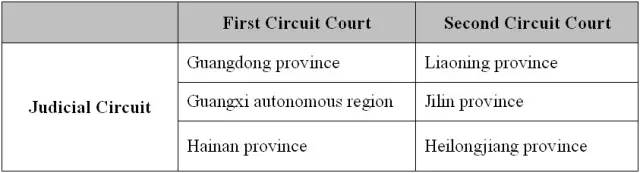
Currently the judicial circuits of the first two circuit courts only cover about 1/5 of all provinces and autonomous regions of China. The Provisions indicate that in the future the SPC may establish more circuit courts or adjust the judicial circuit of the existing circuit courts in case of need. We understand that the extension of the number or scope of the circuit courts will depend on the result of the implementation of the first two pilot circuit courts in Shenzhen and Shenyang.
3. Jurisdiction
According to the Provisions, a circuit court has the following jurisdiction:
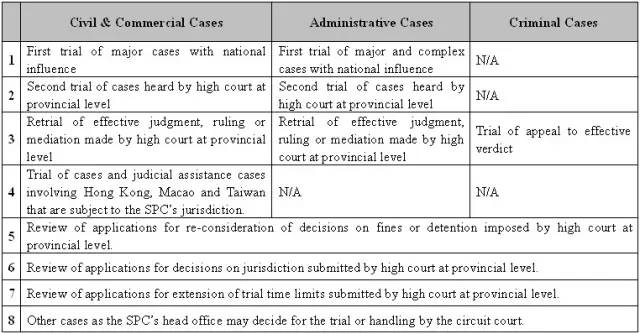
The above table shows that the circuit courts currently do not have the same jurisdiction as the SPC’s head office. In fact, the Provisions have listed the following cases which are expressly excluded from the current jurisdiction of the circuit courts:
- cases relating to intellectual property
- commercial cases involving foreign elements (excluding Hong Kong, Macao and Taiwan)
- cases involving maritime affairs
- review of death penalty
- state compensation
- enforcement cases
- protested cases lodged by the Supreme People’s Procuratorate
Despite the difference in jurisdiction between the circuit courts and the SPC’s head office, the SPC may, according to the Provisions, decide to adjust the circuit courts’ jurisdiction in light of future demand for trials.
4. Personnel
The circuit courts have no fixed “collegial panel”, which is a basic trial organization in the current court system in China and normally consists of three judges. Instead, each case heard by the circuit court will have a panel and presiding judge who takes personal responsibility for the case. This mechanism is understood to address the problem caused by the absence of personal liability for a flawed judgment or ruling made through a “collective decision” of the collegial panel.
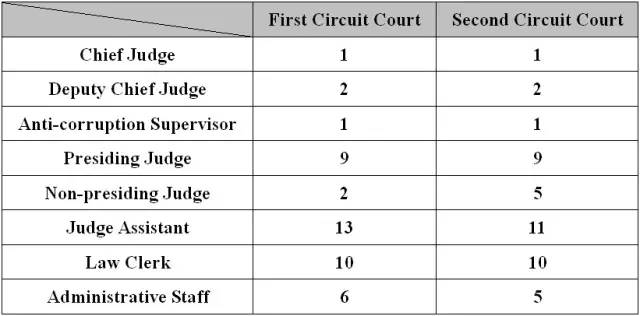
The personnel of the first two circuit courts are shown below[1]:
5. Hearing
To facilitate the concerned parties’ participation of the hearing of the cases handled by a circuit court, the hearing is not necessarily conducted at the circuit court’s office building, but can be conducted at a court of a place which is convenient for the parties and within the judicial circuit of the concerned circuit court.
This hearing procedure is understood to be cost and time efficient for parties of the cases handled by a circuit court,and should be welcome by the public.
6. Independence
To ensure the circuit courts’ independence on hearing and avoid any adverse impact on impartiality caused by local influence, the following measures are taken by the SPC:
(1) The functions of a circuit court do not rely on any local government’s support for personnel, finance or other property;
(2) Presiding judges of a circuit court will rotate every two years to avoid affection by local interests; and
(3) Each circuit court has a full-time anti-corruption supervisor who is responsible for supervising the daily work of the circuit court and establishing systems to prevent corruption and unlawful interference with the hearings.
7. Litigation services
Each circuit court is required to set up a litigation service center to provide assistance to the parties of cases that are subject to the circuit court’s jurisdiction.
As to the cases that must be handled by the SPC’s head office, if the concerned party submits the relevant application documents to the circuit court and requests the circuit court to transfer the documents to the SPC’s head office, the circuit court is obliged to accept such request and proceed with the transfer.
With this new function, a party is not obliged to go to Beijing in person to submit the relevant application documents to the SPC’s head office regardless of whether the case is within the circuit court’s jurisdiction or not.
8. Outlook
As a major step in the reform of China’s judicial system, we expect this establishment of the pilot circuit courts to bring more impartiality, convenience and other benefits to the people involved in legal proceedings in China.
That being said, it may take some time for practitioners to see whether the measures taken by the SPC can effectively ensure the independence of the circuit courts in order to meet the SPC’s original expectations.
[1]Information source: Legal Daily, January 28, 2015 (http://legal.people.com.cn/n/2015/0128/c188502-26466617.html)
Following the decision to establish circuit courts at the fourth plenary session of the 18th Communist Party of China Central Committee in last October, the Supreme People’s Court (the “SPC”) issued the “Provisions of the Supreme People’s Court on Several Issues concerning Case Trials by Circuit Courts” on January 28, 2015 (the “Provisions”). On the same day, the First Circuit Court was inaugurated in Shenzhen (Guangdong Province), and three days later the Second Circuit Court was inaugurated in Shenyang (Liaoning Province).
The establishment of the circuit courts of the SPC is understood to be a major reform in China’s judicial system with a view to mitigating local influence on case trials as well as facilitating people’s participation of legal proceedings conducted by the SPC. Moreover, the allocation of some trial functions to the circuit courts may result in the SPC’s head office in Beijing becoming more focused on the formulation of judicial policies and interpretations as well as the trial of representative cases that may provide guidance for the trial of similar cases on a nationwide basis.
The aim of this article is to present the main duties and features of the newly established circuit courts in China.
1. Relationship with SPC
According to the Provisions, the circuit courts are standing trial organs of the SPC and constitute a part of the SPC. As such, any judgment or ruling made by a circuit court shall have the same legal effect as a judgment or ruling made by the SPC’s head office.
2. Judicial Circuit
The judicial circuits of the first two circuit courts are set out in the table below:
Currently the judicial circuits of the first two circuit courts only cover about 1/5 of all provinces and autonomous regions of China. The Provisions indicate that in the future the SPC may establish more circuit courts or adjust the judicial circuit of the existing circuit courts in case of need. We understand that the extension of the number or scope of the circuit courts will depend on the result of the implementation of the first two pilot circuit courts in Shenzhen and Shenyang.
3. Jurisdiction
According to the Provisions, a circuit court has the following jurisdiction:
The above table shows that the circuit courts currently do not have the same jurisdiction as the SPC’s head office. In fact, the Provisions have listed the following cases which are expressly excluded from the current jurisdiction of the circuit courts:
- cases relating to intellectual property
- commercial cases involving foreign elements (excluding Hong Kong, Macao and Taiwan)
- cases involving maritime affairs
- review of death penalty
- state compensation
- enforcement cases
- protested cases lodged by the Supreme People’s Procuratorate
Despite the difference in jurisdiction between the circuit courts and the SPC’s head office, the SPC may, according to the Provisions, decide to adjust the circuit courts’ jurisdiction in light of future demand for trials.
4. Personnel
The circuit courts have no fixed “collegial panel”, which is a basic trial organization in the current court system in China and normally consists of three judges. Instead, each case heard by the circuit court will have a panel and presiding judge who takes personal responsibility for the case. This mechanism is understood to address the problem caused by the absence of personal liability for a flawed judgment or ruling made through a “collective decision” of the collegial panel.
The personnel of the first two circuit courts are shown below[1]:
5. Hearing
To facilitate the concerned parties’ participation of the hearing of the cases handled by a circuit court, the hearing is not necessarily conducted at the circuit court’s office building, but can be conducted at a court of a place which is convenient for the parties and within the judicial circuit of the concerned circuit court.
This hearing procedure is understood to be cost and time efficient for parties of the cases handled by a circuit court,and should be welcome by the public.
6. Independence
To ensure the circuit courts’ independence on hearing and avoid any adverse impact on impartiality caused by local influence, the following measures are taken by the SPC:
(1) The functions of a circuit court do not rely on any local government’s support for personnel, finance or other property;
(2) Presiding judges of a circuit court will rotate every two years to avoid affection by local interests; and
(3) Each circuit court has a full-time anti-corruption supervisor who is responsible for supervising the daily work of the circuit court and establishing systems to prevent corruption and unlawful interference with the hearings.
7. Litigation services
Each circuit court is required to set up a litigation service center to provide assistance to the parties of cases that are subject to the circuit court’s jurisdiction.
As to the cases that must be handled by the SPC’s head office, if the concerned party submits the relevant application documents to the circuit court and requests the circuit court to transfer the documents to the SPC’s head office, the circuit court is obliged to accept such request and proceed with the transfer.
With this new function, a party is not obliged to go to Beijing in person to submit the relevant application documents to the SPC’s head office regardless of whether the case is within the circuit court’s jurisdiction or not.
8. Outlook
As a major step in the reform of China’s judicial system, we expect this establishment of the pilot circuit courts to bring more impartiality, convenience and other benefits to the people involved in legal proceedings in China.
That being said, it may take some time for practitioners to see whether the measures taken by the SPC can effectively ensure the independence of the circuit courts in order to meet the SPC’s original expectations.
[1]Information source: Legal Daily, January 28, 2015 (http://legal.people.com.cn/n/2015/0128/c188502-26466617.html)