
01、引言Introduction
印度尼西亚,全称印度尼西亚共和国(Republic Indonesia),简称印尼。在地理位置上,印尼位于于亚洲东南部,国土面积190.45万平方千米,横跨北纬6°至南纬11°,东经95°至141°,赤道贯穿全境 全国由上万个岛屿组成,是全世界最大的群岛国家,号称“千岛之国”。疆域横跨亚洲及大洋洲,地处亚洲大陆和澳大利亚之间,地缘战略突出,扼守马六甲海峡,为太平洋、印度洋间要冲地带,是我国“一带一路”的重要支点国家。在国家文化上,印尼全国共有3个地方特区和31个省,截至2023年全国人口约2.76亿,是一个多民族国家,全境共有200多个民族,其中爪哇族占人口总数的40%,巽他族占15%,马来族占7%,马都拉族占7%,巴布亚族占6%,华人占1%,首都为雅加达,官方语言为印尼语,国教为伊斯兰教,是世界上穆斯林人口最多的国家,6.1%的人信奉基督教新教,3.6%的人信奉天主教,其余的人信奉印度教、佛教和原始拜物教等。从政治体制上,印尼的政治结构和国家制度受殖民地荷兰等西方国家影响深远,印尼是一个总统制共和国,实行三权分立的民主政治体制,总统既是国家元首,也是政府首脑,同时掌管三军。总统、副总统均由全民直选产生,总统任命内阁,内阁对总统负责。任期5年,总统可连任一次。印尼的司法机构由法院、检察院和律师协会组成。法院负责审理刑事、民事和行政案件,维护司法公正和法律权威。检察院负责执法、起诉犯罪嫌疑人,保护公民的合法权益。最高法院独立于立法和行政机构,最高法院院长由最高法院法官选举。印尼的立法机构由两个部分组成,即众议院和地方议会,众议院是印尼议会的最高机构,由全国公民直接选举产生,代表全国人民的意愿。众议院负责制定和修改法律、监督政府、批准政府预算等。地方议会由各地区的公民选举产生,代表地方居民的意愿,负责地方政治事务。
Indonesia, the full name of the Republic of Indonesia (Republic Indonesia), referred to as Indonesia. Geographically, Indonesia is located in southeastern Asia, with a land area of 1,904,500 square kilometres, spanning latitude 6°N to 11°S, longitude 95°E to 141°E, with the equator running through the whole country. The country consists of tens of thousands of islands, and is the largest archipelagic country in the world, known as the "Land of a Thousand Islands". Its territory spans across Asia and Oceania, and is located between the Asian continent and Australia, with a prominent geostrategic position, holding the Strait of Malacca, as the key zone between the Pacific Ocean and the Indian Ocean, and is an important pivot country of China's "One Belt, One Road". In terms of national culture, Indonesia has 3 local special zones and 31 provinces, with a population of about 276 million as of 2023. It is a multi-ethnic country with more than 200 ethnic groups, of which the Javanese account for 40% of the total population, the Sundanese account for 15%, the Malay account for 7%, the Madurese account for 7%, the Papuan account for 6%, and the Chinese account for 1%, with the capital city of Jakarta. The capital is Jakarta, the official language is Bahasa Indonesia, the state religion is Islam, and it is the country with the largest Muslim population in the world. 6.1 per cent of the people follow Protestant Christianity, 3.6 per cent follow Catholicism, and the rest of the people follow Hinduism, Buddhism, and primitive fetishism, among others. In terms of political system, Indonesia's political structure and state system are deeply influenced by western countries such as the colonial Netherlands. Indonesia is a presidential republic with a democratic political system of separation of powers, where the president is both the head of state and head of government, and is in charge of all three branches of the armed forces at the same time. The president and vice president are elected by universal suffrage, and the president appoints a cabinet, which is accountable to the president. The term of office is five years and the President may be re-elected once. Indonesia's judiciary consists of the courts, the Public Prosecutor's Office and the Bar Association. The courts are responsible for adjudicating criminal, civil and administrative cases and for upholding judicial impartiality and legal authority. The Public Prosecutor's Office is responsible for enforcing the law, prosecuting criminal suspects and protecting the legitimate rights and interests of citizens. The Supreme Court is independent of the legislature and the executive, and the President of the Supreme Court is elected by the judges of the Supreme Court. The Indonesian legislature consists of two parts, the House of Representatives and the local assemblies. The House of Representatives is the supreme body of the Indonesian parliament and is directly elected by the citizens of the country to represent the will of the people of the country. The House of Representatives is responsible for enacting and amending laws, supervising the government, and approving the government budget. The local councils are elected by the citizens of each region and represent the will of the local population and are responsible for local political affairs.
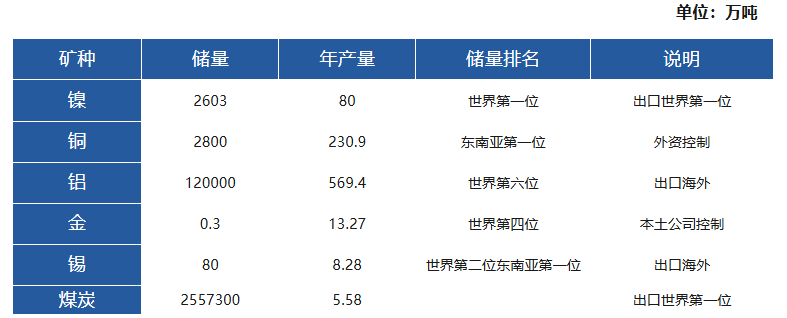
在矿产资源方面,印尼作为一个拥有丰富矿产资源的国家,一直在全球矿业领域扮演着重要角色。印尼因其幅员辽阔,国内地形多样性优势,成矿地质条件良好,煤炭、石油、天然气和锡、铝、镍、铜、金、银等矿产资源储量丰富,是全球矿产资源的重要产地之一(唐新华等,2015)。根据美国地质调查局(USGS)公布的数据显示,据统计印尼的煤炭储量高达580亿吨,以南加里曼丹和苏门答腊地区最为集中,其煤炭以低硫、低灰的特性闻名于世。在石油与天然气方面,印尼已探明的石油储量约500亿桶,天然气储量达73万亿立方米,主要深藏于苏门答腊、爪哇、加里曼丹、斯兰岛及西巴布亚地区。同时,印尼也是世界黄金和锡的主要产地之一,其中黄金储量估计为2,600吨,位于巴布亚省的格拉斯伯格的金矿,被公认为世界上最大的金矿之一(何金祥,2019);已探明的锡矿的资源储量约为146万吨,邦加勿里洞岛、井里汶岛及苏门答腊东海岸则是锡矿的重要产地,是世界第二大锡生产国。铝土矿和镍矿的储量分别约为19亿吨和13亿吨,广泛分布于邦加岛、勿里洞岛、西加里曼丹省和廖内省,以及马露古群岛、南苏拉威西省、东加里曼丹省和巴布亚岛。此外,印尼还拥有可观的铜矿资源,探明储量为4100万吨,主要集中在巴布亚岛的Grasberg矿和北苏拉威西岛的哥伦达洛省。
In terms of mineral resources, Indonesia, as a country with rich mineral resources, has been playing an important role in the global mining industry. Indonesia is one of the most important sources of mineral resources in the world due to its vast area, advantages of domestic topographic diversity, good geological conditions for mineralisation, and rich reserves of coal, oil, natural gas, and tin, aluminium, nickel, copper, gold, and silver (Tang Xinhua et al., 2015). According to the data published by the United States Geological Survey (USGS), Indonesia's coal reserves are estimated to be as high as 58 billion tonnes, with the highest concentration in the South Kalimantan and Sumatra regions, and its coal is famous for its low-sulphur and low-ash characteristics. In terms of oil and natural gas, Indonesia has proven oil reserves of about 50 billion barrels and natural gas reserves of 73 trillion cubic metres, which are mainly deep in Sumatra, Java, Kalimantan, Silan Island and West Papua. Meanwhile, Indonesia is also one of the world's major producers of gold and tin, with gold reserves estimated at 2,600 tonnes, and the gold mine in Grasberg, Papua province, which is recognised as one of the world's largest gold mines (Ho Jin-Xiang, 2019); the resource reserves of proven tin ores are about 1.46 million tonnes, and the islands of Bunga Beledom, Inle Bengal, and the east coast of Sumatra are important producers of tin, which is the world's It is the second largest tin producer in the world. Bauxite and nickel reserves of about 1.9 billion tonnes and 1.3 billion tonnes, respectively, are widely distributed in the provinces of Pangkor, Belitung, West Kalimantan and Riau, as well as in the Maluku Islands, South Sulawesi, East Kalimantan and Papua. In addition, Indonesia has considerable copper resources, with proven reserves of 41 million tonnes, concentrated in the Grasberg mine in Papua and in the province of Gorontalo in North Sulawesi.
图表1--印度尼西亚战略性矿产储量及产量图
(数据来源:印尼国家统计局2022)
尽管印尼是世界第一大镍矿生产国,第二大锡矿生产国,还是世界第一大煤炭出口国,印尼的铜矿、铝土矿和金矿产量均居世界前列,但在矿业开发上仍需面对基础设施、技术、环保和政策法规等方面的挑战(杨宇亮,2019)。为了更好地利用这些资源,印尼政府正在努力改善相关条件,并积极寻求国际合作,特别是与中国等国在矿业领域的深度协作,旨在实现矿业的可持续发展并最大化其经济效益。
Although Indonesia is the world's top nickel producer, the second largest tin producer, and the world's top coal exporter, and Indonesia's copper, bauxite, and gold production are among the highest in the world, it still needs to face challenges in infrastructure, technology, environmental protection, and policies and regulations in mining development (Yang Yuliang, 2019). In order to make better use of these resources, the Indonesian government is making efforts to improve the relevant conditions and is actively seeking international cooperation, especially in-depth collaboration with China and other countries in the field of mining, with the aim of achieving sustainable development of the mining industry and maximising its economic benefits.
02、印尼矿业投资市场分析Indonesia Mining Investment Market Analysis
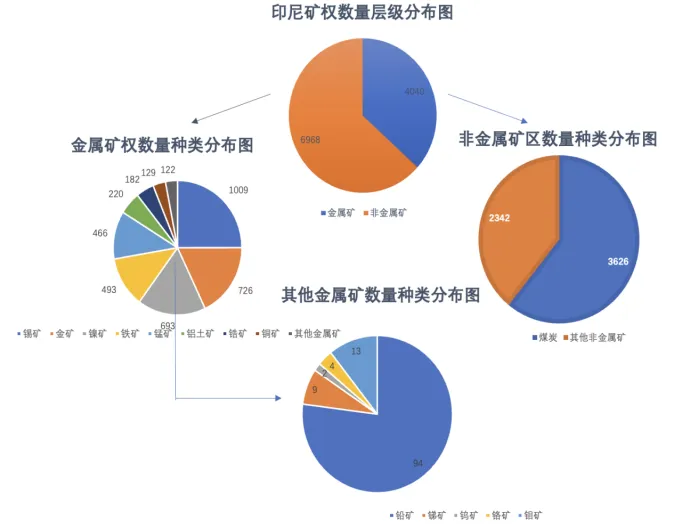
印尼矿业市场交易活跃,矿业勘探投入、固定资产投资及矿山交易均为东南亚第一位。根据印尼国家统计局2022年公布的数据显示,印尼的矿业勘探投入在东南亚地区的占比超过50%,在矿业固定资产投资的占比更是高达77%。尽管全球矿产品价格回落明显,然而新能源产业在全球范围内的发展,印尼镍矿资源的跨国投资并购火热回升,吸引世界各国矿业巨头的投资兴趣(杨宇亮,2019)。印尼境内矿业权项目共有10008个,开发交易类约4595起,处于勘探阶段为5383起,开发阶段为29起,其他项目1个。其中包含金属矿4040个,非金属矿5968个,其他金属矿94个(详情见表二)。印尼现存矿业权项目以煤炭、镍、金、锡、铁、铜、铝矿的投资勘探为主,少量处于开发阶段。截至2022年印尼全境矿业公司共有125家,包括全球矿业巨头巴西的淡水河谷公司、美国的自由港麦克莫兰,住友金属等矿业公司控制了印尼61%的镍矿34.4%的金矿;88.8%的铜矿、94.5%的铁矿11.9%的煤炭总量。印尼本土矿业公司54家,占比53%;中国的有色矿业、中国铝业、中钢集团、金川集团等27家矿业公司占比22%,在金、铁、铜领域并无控制权,仅在镍矿拥有13%、煤炭1.1%的资源控制权,其余份额有印尼本土矿业公司掌控(谢尚克等,2022)。由此可见中国矿业公司在印尼的矿产资源控制权和竞争力较小,投资发展前景巨大。
Indonesia's mining market is actively traded, with mining exploration input, fixed asset investment and mine transactions ranking first in Southeast Asia. According to the data published by Indonesia's National Statistical Office in 2022, Indonesia's mining exploration investment in Southeast Asia accounted for more than 50 per cent, and the share of fixed asset investment in the mining industry is as high as 77 per cent. Despite the obvious fall in global mineral prices, however, the new energy industry is developing globally, and the cross-border investment and mergers and acquisitions of Indonesia's nickel resources are hotly picking up, attracting the investment interest of mining giants around the world (Yang Yuliang, 2019). There are a total of 10,008 mining rights projects in Indonesia, with about 4,595 in the category of development transactions, 5,383 in the exploration stage, 29 in the development stage, and 1 other project. These contain 4,040 metallic minerals, 5,968 non-metallic minerals, and 94 other metallic minerals (see Table II for details). The existing mining rights projects in Indonesia are mainly investment exploration in coal, nickel, gold, tin, iron, copper and aluminium mines, with a small number in the development stage. As of 2022 there are a total of 125 mining companies throughout Indonesia, including global mining giants Vale of Brazil, Freeport McMoRan of the United States, Sumitomo Metals and other mining companies control 61% of Indonesia's nickel mines 34.4% of the gold mines; 88.8% of the copper mines, 94.5% of the iron mines 11.9% of the total amount of coal. Indonesia's local mining companies 54, accounting for 53%; China's non-ferrous mining, Aluminium Corporation of China, Sinosteel Group, Jinchuan Group and other 27 mining companies accounted for 22%, in the gold, iron, copper field does not have control, only in the nickel mine has 13%, coal 1.1% of the control of resources, the remaining share of the share of the local mining companies in Indonesia control (Xie Shangke et al., 2022). This shows that Chinese mining companies in Indonesia's mineral resources control and competitiveness is small, investment and development prospects are huge.
图表2—印尼矿权数量层级分布图
引用
[1]谢尚克,伊海生,杨永飞,刘书生 & 徐思维.(2022).印度尼西亚矿业开发现状研究.中国矿业(02),46-50.
[2]何金祥.(2019).印度尼西亚矿业投资环境.国土资源情报(04),27-35.
[3]唐新华 & 邱房贵.(2015).论印度尼西亚矿业投资环境及其相关法律制度——以中国企业投资为视角.东南亚纵横(03),53-58.
[4] 袁超飞,王小烈,邢佳韵,张艳飞,陈其慎 & 李莉.(2017).印度尼西亚固体矿产开发现状与前景分析.中国矿业(11),113-117.
[5]杨宇亮.(2019).印尼矿业投资的政策与法律风险分析.闽西职业技术学院学报(02),10-14.
[6]廖敏洁.(2021).印尼地方分权对外商直接投资的影响硕士(学位论文,暨南大学).硕士https://link.cnki.net/doi/10.27167/d.cnki.gjinu.2021.001362doi:10.27167/d.cnki.gjinu.2021.0013.
[7]印尼国家统计局[EB/OL]. https: ∥www.bps.go.id
[8]印尼能源和矿产资源部[EB/OL]. https: ∥www.esdm.go.id
[9]Yudi Prabangkara.(2019).印尼矿产及能源的投资现状和机遇.(eds.)2019年镍产业发展高峰论坛暨APOL年会会刊(pp.82).Coordinating Ministry For Maritime;doi:10.26914/c.cnkihy.2019.010080.
Citation
[1] Xie, Shangke, Yi, Haisheng, Yang, Yongfei, Liu, Shusheng & Xu, Si. (2022). A study on the current status of mining development in Indonesia. China Mining Industry(02),46-50.
[2] He Jinxiang. (2019). Indonesia mining investment environment. Land Resources Intelligence(04),27-35.
[3] Tang, X. X. & Qiu, F. Gui. (2015). On Indonesia's Mining Investment Environment and Its Relevant Legal System: A Perspective on Chinese Enterprises' Investment. Southeast Asia vertical and horizontal (03),53-58.
[4] Yuan Chaofei,Wang Xiaolie,Xing Jiayun,Zhang Yanfei,Chen Qishen & Li Li. (2017). Analysis of current situation and prospect of solid mineral development in Indonesia. China Mining Industry(11),113-117.
[5] Yang YL. (2019). Policy and legal risk analysis of mining investment in Indonesia. Journal of Minxi Vocational and Technical College(02),10-14.
[6] Liao, Minjie. (2021). The Impact of Local Decentralisation on Foreign Direct Investment in Indonesia Master (Dissertation, Jinan University). Master https://link.cnki.net/doi/10.27167/d.cnki.gjinu.2021.001362doi:10.27167/d.cnki.gjinu.2021.0013.
[7] National Statistical Office of Indonesia [EB/OL]. https: ∥www.bps.go.id
[8]Ministry of Energy and Mineral Resources of Indonesia[EB/OL]. https: ∥www.esdm.go.id
[9]Yudi Prabangkara.(2019). Investment Status and Opportunities in Minerals and Energy in Indonesia. (eds.) 2019 Nickel Industry Development Summit and APOL Annual Conference Proceedings (pp. 82).Coordinating Ministry For Maritime; doi:10.26914/c.cnkihy.2019.010080.
印度尼西亚,全称印度尼西亚共和国(Republic Indonesia),简称印尼。在地理位置上,印尼位于于亚洲东南部,国土面积190.45万平方千米,横跨北纬6°至南纬11°,东经95°至141°,赤道贯穿全境 全国由上万个岛屿组成,是全世界最大的群岛国家,号称“千岛之国”。疆域横跨亚洲及大洋洲,地处亚洲大陆和澳大利亚之间,地缘战略突出,扼守马六甲海峡,为太平洋、印度洋间要冲地带,是我国“一带一路”的重要支点国家。在国家文化上,印尼全国共有3个地方特区和31个省,截至2023年全国人口约2.76亿,是一个多民族国家,全境共有200多个民族,其中爪哇族占人口总数的40%,巽他族占15%,马来族占7%,马都拉族占7%,巴布亚族占6%,华人占1%,首都为雅加达,官方语言为印尼语,国教为伊斯兰教,是世界上穆斯林人口最多的国家,6.1%的人信奉基督教新教,3.6%的人信奉天主教,其余的人信奉印度教、佛教和原始拜物教等。从政治体制上,印尼的政治结构和国家制度受殖民地荷兰等西方国家影响深远,印尼是一个总统制共和国,实行三权分立的民主政治体制,总统既是国家元首,也是政府首脑,同时掌管三军。总统、副总统均由全民直选产生,总统任命内阁,内阁对总统负责。任期5年,总统可连任一次。印尼的司法机构由法院、检察院和律师协会组成。法院负责审理刑事、民事和行政案件,维护司法公正和法律权威。检察院负责执法、起诉犯罪嫌疑人,保护公民的合法权益。最高法院独立于立法和行政机构,最高法院院长由最高法院法官选举。印尼的立法机构由两个部分组成,即众议院和地方议会,众议院是印尼议会的最高机构,由全国公民直接选举产生,代表全国人民的意愿。众议院负责制定和修改法律、监督政府、批准政府预算等。地方议会由各地区的公民选举产生,代表地方居民的意愿,负责地方政治事务。
Indonesia, the full name of the Republic of Indonesia (Republic Indonesia), referred to as Indonesia. Geographically, Indonesia is located in southeastern Asia, with a land area of 1,904,500 square kilometres, spanning latitude 6°N to 11°S, longitude 95°E to 141°E, with the equator running through the whole country. The country consists of tens of thousands of islands, and is the largest archipelagic country in the world, known as the "Land of a Thousand Islands". Its territory spans across Asia and Oceania, and is located between the Asian continent and Australia, with a prominent geostrategic position, holding the Strait of Malacca, as the key zone between the Pacific Ocean and the Indian Ocean, and is an important pivot country of China's "One Belt, One Road". In terms of national culture, Indonesia has 3 local special zones and 31 provinces, with a population of about 276 million as of 2023. It is a multi-ethnic country with more than 200 ethnic groups, of which the Javanese account for 40% of the total population, the Sundanese account for 15%, the Malay account for 7%, the Madurese account for 7%, the Papuan account for 6%, and the Chinese account for 1%, with the capital city of Jakarta. The capital is Jakarta, the official language is Bahasa Indonesia, the state religion is Islam, and it is the country with the largest Muslim population in the world. 6.1 per cent of the people follow Protestant Christianity, 3.6 per cent follow Catholicism, and the rest of the people follow Hinduism, Buddhism, and primitive fetishism, among others. In terms of political system, Indonesia's political structure and state system are deeply influenced by western countries such as the colonial Netherlands. Indonesia is a presidential republic with a democratic political system of separation of powers, where the president is both the head of state and head of government, and is in charge of all three branches of the armed forces at the same time. The president and vice president are elected by universal suffrage, and the president appoints a cabinet, which is accountable to the president. The term of office is five years and the President may be re-elected once. Indonesia's judiciary consists of the courts, the Public Prosecutor's Office and the Bar Association. The courts are responsible for adjudicating criminal, civil and administrative cases and for upholding judicial impartiality and legal authority. The Public Prosecutor's Office is responsible for enforcing the law, prosecuting criminal suspects and protecting the legitimate rights and interests of citizens. The Supreme Court is independent of the legislature and the executive, and the President of the Supreme Court is elected by the judges of the Supreme Court. The Indonesian legislature consists of two parts, the House of Representatives and the local assemblies. The House of Representatives is the supreme body of the Indonesian parliament and is directly elected by the citizens of the country to represent the will of the people of the country. The House of Representatives is responsible for enacting and amending laws, supervising the government, and approving the government budget. The local councils are elected by the citizens of each region and represent the will of the local population and are responsible for local political affairs.
在矿产资源方面,印尼作为一个拥有丰富矿产资源的国家,一直在全球矿业领域扮演着重要角色。印尼因其幅员辽阔,国内地形多样性优势,成矿地质条件良好,煤炭、石油、天然气和锡、铝、镍、铜、金、银等矿产资源储量丰富,是全球矿产资源的重要产地之一(唐新华等,2015)。根据美国地质调查局(USGS)公布的数据显示,据统计印尼的煤炭储量高达580亿吨,以南加里曼丹和苏门答腊地区最为集中,其煤炭以低硫、低灰的特性闻名于世。在石油与天然气方面,印尼已探明的石油储量约500亿桶,天然气储量达73万亿立方米,主要深藏于苏门答腊、爪哇、加里曼丹、斯兰岛及西巴布亚地区。同时,印尼也是世界黄金和锡的主要产地之一,其中黄金储量估计为2,600吨,位于巴布亚省的格拉斯伯格的金矿,被公认为世界上最大的金矿之一(何金祥,2019);已探明的锡矿的资源储量约为146万吨,邦加勿里洞岛、井里汶岛及苏门答腊东海岸则是锡矿的重要产地,是世界第二大锡生产国。铝土矿和镍矿的储量分别约为19亿吨和13亿吨,广泛分布于邦加岛、勿里洞岛、西加里曼丹省和廖内省,以及马露古群岛、南苏拉威西省、东加里曼丹省和巴布亚岛。此外,印尼还拥有可观的铜矿资源,探明储量为4100万吨,主要集中在巴布亚岛的Grasberg矿和北苏拉威西岛的哥伦达洛省。
In terms of mineral resources, Indonesia, as a country with rich mineral resources, has been playing an important role in the global mining industry. Indonesia is one of the most important sources of mineral resources in the world due to its vast area, advantages of domestic topographic diversity, good geological conditions for mineralisation, and rich reserves of coal, oil, natural gas, and tin, aluminium, nickel, copper, gold, and silver (Tang Xinhua et al., 2015). According to the data published by the United States Geological Survey (USGS), Indonesia's coal reserves are estimated to be as high as 58 billion tonnes, with the highest concentration in the South Kalimantan and Sumatra regions, and its coal is famous for its low-sulphur and low-ash characteristics. In terms of oil and natural gas, Indonesia has proven oil reserves of about 50 billion barrels and natural gas reserves of 73 trillion cubic metres, which are mainly deep in Sumatra, Java, Kalimantan, Silan Island and West Papua. Meanwhile, Indonesia is also one of the world's major producers of gold and tin, with gold reserves estimated at 2,600 tonnes, and the gold mine in Grasberg, Papua province, which is recognised as one of the world's largest gold mines (Ho Jin-Xiang, 2019); the resource reserves of proven tin ores are about 1.46 million tonnes, and the islands of Bunga Beledom, Inle Bengal, and the east coast of Sumatra are important producers of tin, which is the world's It is the second largest tin producer in the world. Bauxite and nickel reserves of about 1.9 billion tonnes and 1.3 billion tonnes, respectively, are widely distributed in the provinces of Pangkor, Belitung, West Kalimantan and Riau, as well as in the Maluku Islands, South Sulawesi, East Kalimantan and Papua. In addition, Indonesia has considerable copper resources, with proven reserves of 41 million tonnes, concentrated in the Grasberg mine in Papua and in the province of Gorontalo in North Sulawesi.
图表1--印度尼西亚战略性矿产储量及产量图
(数据来源:印尼国家统计局2022)
尽管印尼是世界第一大镍矿生产国,第二大锡矿生产国,还是世界第一大煤炭出口国,印尼的铜矿、铝土矿和金矿产量均居世界前列,但在矿业开发上仍需面对基础设施、技术、环保和政策法规等方面的挑战(杨宇亮,2019)。为了更好地利用这些资源,印尼政府正在努力改善相关条件,并积极寻求国际合作,特别是与中国等国在矿业领域的深度协作,旨在实现矿业的可持续发展并最大化其经济效益。
Although Indonesia is the world's top nickel producer, the second largest tin producer, and the world's top coal exporter, and Indonesia's copper, bauxite, and gold production are among the highest in the world, it still needs to face challenges in infrastructure, technology, environmental protection, and policies and regulations in mining development (Yang Yuliang, 2019). In order to make better use of these resources, the Indonesian government is making efforts to improve the relevant conditions and is actively seeking international cooperation, especially in-depth collaboration with China and other countries in the field of mining, with the aim of achieving sustainable development of the mining industry and maximising its economic benefits.
02、印尼矿业投资市场分析Indonesia Mining Investment Market Analysis
印尼矿业市场交易活跃,矿业勘探投入、固定资产投资及矿山交易均为东南亚第一位。根据印尼国家统计局2022年公布的数据显示,印尼的矿业勘探投入在东南亚地区的占比超过50%,在矿业固定资产投资的占比更是高达77%。尽管全球矿产品价格回落明显,然而新能源产业在全球范围内的发展,印尼镍矿资源的跨国投资并购火热回升,吸引世界各国矿业巨头的投资兴趣(杨宇亮,2019)。印尼境内矿业权项目共有10008个,开发交易类约4595起,处于勘探阶段为5383起,开发阶段为29起,其他项目1个。其中包含金属矿4040个,非金属矿5968个,其他金属矿94个(详情见表二)。印尼现存矿业权项目以煤炭、镍、金、锡、铁、铜、铝矿的投资勘探为主,少量处于开发阶段。截至2022年印尼全境矿业公司共有125家,包括全球矿业巨头巴西的淡水河谷公司、美国的自由港麦克莫兰,住友金属等矿业公司控制了印尼61%的镍矿34.4%的金矿;88.8%的铜矿、94.5%的铁矿11.9%的煤炭总量。印尼本土矿业公司54家,占比53%;中国的有色矿业、中国铝业、中钢集团、金川集团等27家矿业公司占比22%,在金、铁、铜领域并无控制权,仅在镍矿拥有13%、煤炭1.1%的资源控制权,其余份额有印尼本土矿业公司掌控(谢尚克等,2022)。由此可见中国矿业公司在印尼的矿产资源控制权和竞争力较小,投资发展前景巨大。
Indonesia's mining market is actively traded, with mining exploration input, fixed asset investment and mine transactions ranking first in Southeast Asia. According to the data published by Indonesia's National Statistical Office in 2022, Indonesia's mining exploration investment in Southeast Asia accounted for more than 50 per cent, and the share of fixed asset investment in the mining industry is as high as 77 per cent. Despite the obvious fall in global mineral prices, however, the new energy industry is developing globally, and the cross-border investment and mergers and acquisitions of Indonesia's nickel resources are hotly picking up, attracting the investment interest of mining giants around the world (Yang Yuliang, 2019). There are a total of 10,008 mining rights projects in Indonesia, with about 4,595 in the category of development transactions, 5,383 in the exploration stage, 29 in the development stage, and 1 other project. These contain 4,040 metallic minerals, 5,968 non-metallic minerals, and 94 other metallic minerals (see Table II for details). The existing mining rights projects in Indonesia are mainly investment exploration in coal, nickel, gold, tin, iron, copper and aluminium mines, with a small number in the development stage. As of 2022 there are a total of 125 mining companies throughout Indonesia, including global mining giants Vale of Brazil, Freeport McMoRan of the United States, Sumitomo Metals and other mining companies control 61% of Indonesia's nickel mines 34.4% of the gold mines; 88.8% of the copper mines, 94.5% of the iron mines 11.9% of the total amount of coal. Indonesia's local mining companies 54, accounting for 53%; China's non-ferrous mining, Aluminium Corporation of China, Sinosteel Group, Jinchuan Group and other 27 mining companies accounted for 22%, in the gold, iron, copper field does not have control, only in the nickel mine has 13%, coal 1.1% of the control of resources, the remaining share of the share of the local mining companies in Indonesia control (Xie Shangke et al., 2022). This shows that Chinese mining companies in Indonesia's mineral resources control and competitiveness is small, investment and development prospects are huge.
图表2—印尼矿权数量层级分布图
引用
[1]谢尚克,伊海生,杨永飞,刘书生 & 徐思维.(2022).印度尼西亚矿业开发现状研究.中国矿业(02),46-50.
[2]何金祥.(2019).印度尼西亚矿业投资环境.国土资源情报(04),27-35.
[3]唐新华 & 邱房贵.(2015).论印度尼西亚矿业投资环境及其相关法律制度——以中国企业投资为视角.东南亚纵横(03),53-58.
[4] 袁超飞,王小烈,邢佳韵,张艳飞,陈其慎 & 李莉.(2017).印度尼西亚固体矿产开发现状与前景分析.中国矿业(11),113-117.
[5]杨宇亮.(2019).印尼矿业投资的政策与法律风险分析.闽西职业技术学院学报(02),10-14.
[6]廖敏洁.(2021).印尼地方分权对外商直接投资的影响硕士(学位论文,暨南大学).硕士https://link.cnki.net/doi/10.27167/d.cnki.gjinu.2021.001362doi:10.27167/d.cnki.gjinu.2021.0013.
[7]印尼国家统计局[EB/OL]. https: ∥www.bps.go.id
[8]印尼能源和矿产资源部[EB/OL]. https: ∥www.esdm.go.id
[9]Yudi Prabangkara.(2019).印尼矿产及能源的投资现状和机遇.(eds.)2019年镍产业发展高峰论坛暨APOL年会会刊(pp.82).Coordinating Ministry For Maritime;doi:10.26914/c.cnkihy.2019.010080.
Citation
[1] Xie, Shangke, Yi, Haisheng, Yang, Yongfei, Liu, Shusheng & Xu, Si. (2022). A study on the current status of mining development in Indonesia. China Mining Industry(02),46-50.
[2] He Jinxiang. (2019). Indonesia mining investment environment. Land Resources Intelligence(04),27-35.
[3] Tang, X. X. & Qiu, F. Gui. (2015). On Indonesia's Mining Investment Environment and Its Relevant Legal System: A Perspective on Chinese Enterprises' Investment. Southeast Asia vertical and horizontal (03),53-58.
[4] Yuan Chaofei,Wang Xiaolie,Xing Jiayun,Zhang Yanfei,Chen Qishen & Li Li. (2017). Analysis of current situation and prospect of solid mineral development in Indonesia. China Mining Industry(11),113-117.
[5] Yang YL. (2019). Policy and legal risk analysis of mining investment in Indonesia. Journal of Minxi Vocational and Technical College(02),10-14.
[6] Liao, Minjie. (2021). The Impact of Local Decentralisation on Foreign Direct Investment in Indonesia Master (Dissertation, Jinan University). Master https://link.cnki.net/doi/10.27167/d.cnki.gjinu.2021.001362doi:10.27167/d.cnki.gjinu.2021.0013.
[7] National Statistical Office of Indonesia [EB/OL]. https: ∥www.bps.go.id
[8]Ministry of Energy and Mineral Resources of Indonesia[EB/OL]. https: ∥www.esdm.go.id
[9]Yudi Prabangkara.(2019). Investment Status and Opportunities in Minerals and Energy in Indonesia. (eds.) 2019 Nickel Industry Development Summit and APOL Annual Conference Proceedings (pp. 82).Coordinating Ministry For Maritime; doi:10.26914/c.cnkihy.2019.010080.