
01、非洲矿业投资的机遇
An Introduction to Investing in Mineral Rights in Africa——The opportunities for mining investment in Africa
伴随世界范围内能源加速转型,全球供应链多元化需求上升以及地缘政治紧张等国际因素的影响,非洲关键矿产资源的战略价值在全球范围内持续凸显。非洲大陆矿产资源种类丰富,成矿地质条件良好,资源禀赋优越,且矿产分布集中度高,大型的高品质矿床较多,开发潜力巨大且易于开发,储量更是在世界矿产上占有重要的地位(朱清等,2023)。非洲作为全球最重要的矿产资源供应地区之一,其中金、铬、铂族、锰、钴、铝土矿、磷等矿产资源储量更是占居世界首位,铬和铂族占世界总储量的比例超85%,铀矿占比超70%,黄金和钻石的产量占全球总储量的50%以上(任军平等,2021),金刚石、铀等矿产储量位居世界第二位;天然气等资源储量位居世界第三位,煤、石油、铁等资源储量位居世界第四位(陈喜峰等,2022)。但由于非洲经济发展相对缓慢滞后,大多数非洲国家国内的支柱性第二和第三产业的匮乏,导致以矿业为代表的第一产业在非洲国家经济中占据重要的地位。根据亚欧系统科学研究会统计显示:非洲总体矿产储量约占世界的30%,但融资总额不到全球的5%,多数非洲矿业产值占GDP的平均比例为18%,矿业开发是大量非洲国家的经济GDP增长、解决就业、贸易出口的支柱性产业(朱清等,2023)。如下图一所示的2020非洲部分国家矿业占GDP的百分比显示,刚果(布)的占比最高可达到50%,刚果(金)占超30%,赞比亚的占比约在23%,几内亚平均占比约18%,莫桑比克的占比约在10%。以矿业为支柱的核心产业链为当地提供大量的就业岗位和税收,贡献了大部分国家出口贸易额,促进当地交通和水电等基础设施建设,是非洲经济长期发展的重要动力。然而,大部分非洲国家的采矿业处于初期阶段的下游产业链,据统计,其矿产资源的总价值占全球的23%,但产量总价值仅占全球的9%(于瑞等,2024),需要通过构建全球矿产品产业链,纵向深入参与国际市场竞争与合作,提升本国开发矿产资源的效率和利用率,完善本国基础设施建设是多数非洲国家带动了当地的经济和和社会发展的迫切需求(黄琳等,2018)。
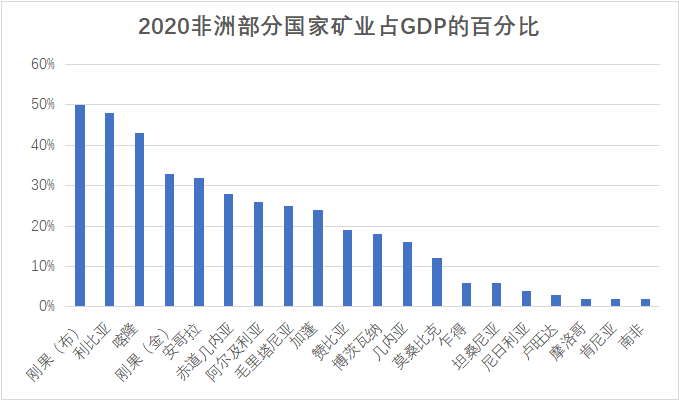
图一:(数据来源:根据朱清等,2023)
(Source: based on Zhu Qing et al., 2023)
Accompanied by the accelerated transformation of energy in the world, the rising demand for diversification of the global supply chain and geopolitical tensions and other international factors, the strategic value of Africa's key mineral resources continues to be highlighted on a global scale. The African continent is rich in mineral resources, good geological conditions for mineralisation, superior resource endowment, and high concentration of mineral distribution, more large-scale high-quality deposits, huge development potential and easy to exploit, and reserves occupy an important position in the world's minerals (Zhu Qing et al., 2023). Africa as one of the world's most important mineral resources supply region, including gold, chromium, platinum group, manganese, cobalt, bauxite, phosphorus and other mineral resources reserves is the world's first, chromium and platinum group accounted for more than 85% of the world's total reserves, uranium accounted for more than 70% of the production of gold and diamonds more than 50% of the world's total reserves (Ren Junping et al., 2021), diamonds, uranium and other minerals reserves ranked the world's The reserves of diamonds, uranium and other minerals rank second in the world; the reserves of natural gas and other resources rank third in the world, and the reserves of coal, petroleum, iron and other resources rank fourth in the world (Chen Xifeng et al., 2022). Nevertheless, due to the relatively slow and lagging economic development in Africa, the lack of pillar secondary and tertiary industries within most African countries has resulted in the primary industry represented by the mining industry occupying an important economic position in the African countries' constitutions. According to the statistics of the Asia-Europe System Science Research Society: Africa's overall mineral reserves account for about 30% of the world, but the total financing is less than 5% of the world, most African mining output value of GDP is 18% on average, mining development is a large number of African countries of economic GDP growth, solve employment, trade and export of the pillar industry (Zhu Qing et al., 2023). The percentage of mining to GDP in selected African countries in 2020, as shown in Figure 1 below, shows that the share of Congo (Brazzaville) can be as high as 50 per cent, with the DRC accounting for more than 30 per cent, Zambia's share is around 23 per cent, Guinea's average share is around 18 per cent, and Mozambique's share is around 10 per cent. The core industry chain with mining as the pillar provides a large number of local jobs and tax revenues, contributes to the export trade volume of most countries, promotes the construction of local transport and infrastructure such as water and electricity, and is an important driving force for the long-term development of the African economy. However, the mining industry of most African countries is in the early stages of the downstream industry chain, and needs to participate in international market competition and cooperation vertically and deeply through the construction of the global mineral industry chain, develop the efficiency and utilization of mineral resources, and improve the construction of the country's infrastructure is an urgent need for most African countries to drive the local economic and social development (Huang Lin et al., 2018). Accompanied by the accelerated worldwide energy transition, rising demand for global supply chain diversification and geopolitical tensions and other international factors, the strategic value of Africa's key mineral resources continues to be highlighted globally. The African continent is rich in mineral resources, with good geological conditions for mineralisation, superior resource endowment, high concentration of mineral distribution, more large-scale high-quality deposits, huge development potential and easy to develop, and reserves that occupy an important position in the world's minerals (Zhu Qing et al., 2023). Africa as one of the world's most important mineral resources supply region, including gold, chromium, platinum group, manganese, cobalt, bauxite, phosphorus and other mineral resources reserves is the world's first, chromium and platinum group accounted for more than 85% of the world's total reserves, uranium accounted for more than 70% of the production of gold and diamonds accounted for more than 50% of the world's total reserves (Ren Junping et al., 2021), diamonds, uranium and other minerals reserves ranked the world's The reserves of diamonds, uranium and other minerals rank second in the world; the reserves of natural gas and other resources rank third in the world, and the reserves of coal, petroleum, iron and other resources rank fourth in the world (Chen Xifeng et al., 2022). However, due to the relatively slow and lagging economic development in Africa, the lack of domestic pillar secondary and tertiary industries in most African countries has resulted in the primary industry represented by the mining industry occupying an important economic position in the economies of African countries. According to the statistics of the Asia-Europe System Science Research Society: Africa's overall mineral reserves account for about 30% of the world, but the total financing is less than 5% of the world, most African mining output value of GDP is 18% on average, mining development is a large number of African countries of economic GDP growth, solve employment, trade and export of the pillar industry (Zhu Qing et al., 2023). The percentage of mining to GDP in selected African countries in 2020, as shown in Figure 1 below, shows that the share of Congo (Brazzaville) can be as high as 50 per cent, with the DRC accounting for more than 30 per cent, Zambia's share is around 23 per cent, Guinea's average share is around 18 per cent, and Mozambique's share is around 10 per cent. The core industry chain with mining as the pillar provides a large number of local jobs and tax revenues, contributes to the export trade volume of most countries, promotes the construction of local transport and infrastructure such as water and electricity, and is an important driving force for the long-term development of the African economy. However, the mining industry of most African countries is in the early stages of the downstream industry chain, and needs to participate in international market competition and cooperation vertically and deeply through the construction of the global mineral industry chain, develop the efficiency and utilization of mineral resources, and improve the construction of the country's infrastructure is an urgent need for most African countries to drive the local economic and social development (Huang Lin et al., 2018).
中国国家统计局和海关总署的2022年统计数据显示(图二),我国社会对矿产资源的需求持续保持高位,进口持续保持高位增长,战略性新兴矿产需求旺盛,生产保持大幅增长。大宗矿产方面,煤炭的消费总量为30.41亿吨,同比增长4.3%,全年进口2.94亿吨;原油、天然气产量约2.05亿吨、2700.90亿立方米,消费总量分别是全年6.76亿吨和3681.3亿立方米,全年进口总量量为5.08亿吨和1522.83亿立方米。钢铁需求量萎缩,铁矿石全年进口11.1亿吨,同比减少0.9%;铜资源消费保持韧性,较2021年同比增长0.1%,进口量为2527.1亿吨,同比增长8.0%。在新兴矿产方面,碳酸锂的进口量为13.61万吨,较上年同比增长68.0%,钴和镍的进口量分别为3799.48万吨和4001.82万吨,下述图二可见,无论是中国社会经济发展和国家安全的需要,世界范围内关键矿产的稳定进口来源地的选择是至关重要的。
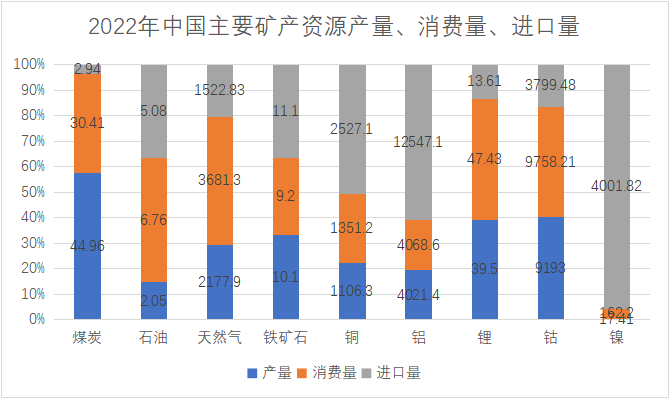
图二:(数据来源:中国国家统计局及海关总署,2022)
Figure 2 :(Source: China National Bureau of Statistics and General Administration of Customs, 2022)
The 2022 statistics from China's National Bureau of Statistics and General Administration of Customs show (Figure 2) that China's social demand for mineral resources continues to remain high, imports continue to grow at a high level, demand for strategic emerging minerals is strong, and production maintains significant growth. In terms of bulk minerals, the total consumption of coal was 3.041 billion tonnes, an increase of 4.3% year-on-year, and 294 million tonnes were imported for the year; the production of crude oil and natural gas was about 205 million tonnes and 270,090 million cubic metres, and the total consumption was 676 million tonnes and 368,133 million cubic metres, respectively, for the year, and the total volume of imports was 508 million tonnes and 152,283 million cubic metres for the year. Iron and steel demand shrinks, iron ore imports of 1.11 billion tonnes for the year, a year-on-year decrease of 0.9%; copper resources consumption remains resilient, up 0.1% year-on-year from 2021, imports of 252.71 billion tonnes, an increase of 8.0% year-on-year. In terms of emerging minerals, imports of lithium carbonate were 136,100 tonnes, up 68.0% year-on-year from the previous year, and imports of cobalt and nickel were 37,994,800 tonnes and 40,182,200 tonnes, respectively, as can be seen in Figure 2 below, both for the needs of China's socio-economic development and national security, and the selection of a stable source of imports of key minerals around the world is crucial.
Reference
[1] Zhu Qing, Gu Benjie, Zou Xiehua, et al, "Trying to Discuss the Opportunities and Challenges of China-Africa Mining Co-operation" [J]. Northwest Geology, 2023, 56(227):174-185
[2] CHEN Xifeng, YUAN Chunhua, CHEN Xiufa, et al. World Mining Situation-Africa Volume [M]. Beijing: Geological Press, 2022: 3-52.
[3] Chen Xifeng, Shi Junfa, Chen Xiufa, et al. Study on geological characteristics, metallogenic law and prospect of bauxite in Africa[J]. Geology and Exploration, 2021, 57(06): 1203-1215.
[4] CHEN Xifeng, SHI Junfa, CHEN Xiufa, et al. Geological Character- istics, Metallogenic Regularity and Prospecting Potential of Bauxite Deposits in Africa[J]. Geology and Exploration, 2021, 57(06):1203-1215.
[5] SUN Hongwei, REN Junping, WANG Jie, et al. Manganese ore mineralisation pattern and resource potential in Southern Africa [J]. Geological Bulletin, 2022, 41(01):60-71
[6] FU Chengming. Niger's Uranium Resources and Their Development Prospects[J]. Uranium Geology in Northwest China, 2006, 32(2):29-35.
[7] Huang Meibo, Tang Luping. The establishment of China-Africa economic and trade co-operation zone and the challenges it faces[J]. International Economic Cooperation, 2012,(06):48-53.
[8] Zhu Qing, Tan Wei, Zou Xiehua, Lei Yaoyi. ESG governance of mining enterprises and sustainable development of mining industry[J]. China Land Resources Economy, 2022, 35(03):16-21+72.
[9] YU Rui, ZHANG Weibo, ZHANG Fuliang, et al. Trends in the evolution of mining laws in African countries, impacts and co-operation proposals[J/OL]. China Land Resources Economy,1-15[2024-05-29].https://doi.org/10.19676/j.cnki.1672-6995.000999.
[10] Ren Junping, Hu Peng, Wang Jie, et al. Overview of mining development in Africa[J]. Journal of Geology, 2021, 95(4):945-961.
[11] HUANG Lin,SUN Wenhong,CUI Bin,et al. Analysis of the current situation and investment prospect of important metal minerals development in South Africa[J]. Geology and Exploration,2018,54(06):1122-1127.DOI:10.13712/j.cnki.dzykt.2018.06.006.
参考文献
[1] 朱清,顾本杰,邹谢华,等,《试论中非矿业合作的机遇和挑战》[J].西北地质,2023,56(227):174-185
[2]陈喜峰, 元春华, 陈秀法, 等. 《世界矿情·非洲卷》[M]. 北京: 地质出版社, 2022: 3−52.
[3]陈喜峰,施俊法,陈秀法,等. 非洲铝土矿地质特征、成矿规律与找矿前景研究[J]. 地质与勘探,2021,57(06): 1203–1215.
[4]CHEN Xifeng, SHI Junfa, CHEN Xiufa, et al. Geological Character- istics, Metallogenic Regularity and Prospecting Potential of Bauxite Deposits in Africa[J]. Geology and Exploration,2021, 57(06):1203–1215.
[5]孙宏伟,任军平,王杰,等. 南部非洲锰矿成矿规律与资源潜力 [J]. 地质通报,2022,41(01):60–71
[6]FU Chengming. Niger's Uranium Resources and Their Development Prospects[J]. Uranium Geology in Northwest China, 2006, 32(2):29–35.
[7]黄梅波,唐露萍. 中非经贸合作区的建立及其面临的挑战[J]. 国际经济合作,2012,(06):48–53.
[8]朱清,谭卫,邹谢华,雷涯邻. 矿业企业 ESG 治理与矿业可持续 发展[J]. 中国国土资源经济,2022,35(03):16–21+72.
[9] 于瑞,张伟波,张福良,等.非洲国家矿业法演进趋势、影响与合作建议[J/OL].中国国土资源经济,1-15[2024-05-29].https://doi.org/10.19676/j.cnki.1672-6995.000999.
[10]任军平,胡鹏,王杰,等. 非洲矿业发展概况[J]. 地质学报,2021, 95(4):945–961.
[11]黄琳,孙文泓,崔彬,等.南非重要金属矿产开发现状及投资前景分析[J].地质与勘探,2018,54(06):1122-1127.DOI:10.13712/j.cnki.dzykt.2018.06.006.
An Introduction to Investing in Mineral Rights in Africa——The opportunities for mining investment in Africa
伴随世界范围内能源加速转型,全球供应链多元化需求上升以及地缘政治紧张等国际因素的影响,非洲关键矿产资源的战略价值在全球范围内持续凸显。非洲大陆矿产资源种类丰富,成矿地质条件良好,资源禀赋优越,且矿产分布集中度高,大型的高品质矿床较多,开发潜力巨大且易于开发,储量更是在世界矿产上占有重要的地位(朱清等,2023)。非洲作为全球最重要的矿产资源供应地区之一,其中金、铬、铂族、锰、钴、铝土矿、磷等矿产资源储量更是占居世界首位,铬和铂族占世界总储量的比例超85%,铀矿占比超70%,黄金和钻石的产量占全球总储量的50%以上(任军平等,2021),金刚石、铀等矿产储量位居世界第二位;天然气等资源储量位居世界第三位,煤、石油、铁等资源储量位居世界第四位(陈喜峰等,2022)。但由于非洲经济发展相对缓慢滞后,大多数非洲国家国内的支柱性第二和第三产业的匮乏,导致以矿业为代表的第一产业在非洲国家经济中占据重要的地位。根据亚欧系统科学研究会统计显示:非洲总体矿产储量约占世界的30%,但融资总额不到全球的5%,多数非洲矿业产值占GDP的平均比例为18%,矿业开发是大量非洲国家的经济GDP增长、解决就业、贸易出口的支柱性产业(朱清等,2023)。如下图一所示的2020非洲部分国家矿业占GDP的百分比显示,刚果(布)的占比最高可达到50%,刚果(金)占超30%,赞比亚的占比约在23%,几内亚平均占比约18%,莫桑比克的占比约在10%。以矿业为支柱的核心产业链为当地提供大量的就业岗位和税收,贡献了大部分国家出口贸易额,促进当地交通和水电等基础设施建设,是非洲经济长期发展的重要动力。然而,大部分非洲国家的采矿业处于初期阶段的下游产业链,据统计,其矿产资源的总价值占全球的23%,但产量总价值仅占全球的9%(于瑞等,2024),需要通过构建全球矿产品产业链,纵向深入参与国际市场竞争与合作,提升本国开发矿产资源的效率和利用率,完善本国基础设施建设是多数非洲国家带动了当地的经济和和社会发展的迫切需求(黄琳等,2018)。
图一:(数据来源:根据朱清等,2023)
(Source: based on Zhu Qing et al., 2023)
Accompanied by the accelerated transformation of energy in the world, the rising demand for diversification of the global supply chain and geopolitical tensions and other international factors, the strategic value of Africa's key mineral resources continues to be highlighted on a global scale. The African continent is rich in mineral resources, good geological conditions for mineralisation, superior resource endowment, and high concentration of mineral distribution, more large-scale high-quality deposits, huge development potential and easy to exploit, and reserves occupy an important position in the world's minerals (Zhu Qing et al., 2023). Africa as one of the world's most important mineral resources supply region, including gold, chromium, platinum group, manganese, cobalt, bauxite, phosphorus and other mineral resources reserves is the world's first, chromium and platinum group accounted for more than 85% of the world's total reserves, uranium accounted for more than 70% of the production of gold and diamonds more than 50% of the world's total reserves (Ren Junping et al., 2021), diamonds, uranium and other minerals reserves ranked the world's The reserves of diamonds, uranium and other minerals rank second in the world; the reserves of natural gas and other resources rank third in the world, and the reserves of coal, petroleum, iron and other resources rank fourth in the world (Chen Xifeng et al., 2022). Nevertheless, due to the relatively slow and lagging economic development in Africa, the lack of pillar secondary and tertiary industries within most African countries has resulted in the primary industry represented by the mining industry occupying an important economic position in the African countries' constitutions. According to the statistics of the Asia-Europe System Science Research Society: Africa's overall mineral reserves account for about 30% of the world, but the total financing is less than 5% of the world, most African mining output value of GDP is 18% on average, mining development is a large number of African countries of economic GDP growth, solve employment, trade and export of the pillar industry (Zhu Qing et al., 2023). The percentage of mining to GDP in selected African countries in 2020, as shown in Figure 1 below, shows that the share of Congo (Brazzaville) can be as high as 50 per cent, with the DRC accounting for more than 30 per cent, Zambia's share is around 23 per cent, Guinea's average share is around 18 per cent, and Mozambique's share is around 10 per cent. The core industry chain with mining as the pillar provides a large number of local jobs and tax revenues, contributes to the export trade volume of most countries, promotes the construction of local transport and infrastructure such as water and electricity, and is an important driving force for the long-term development of the African economy. However, the mining industry of most African countries is in the early stages of the downstream industry chain, and needs to participate in international market competition and cooperation vertically and deeply through the construction of the global mineral industry chain, develop the efficiency and utilization of mineral resources, and improve the construction of the country's infrastructure is an urgent need for most African countries to drive the local economic and social development (Huang Lin et al., 2018). Accompanied by the accelerated worldwide energy transition, rising demand for global supply chain diversification and geopolitical tensions and other international factors, the strategic value of Africa's key mineral resources continues to be highlighted globally. The African continent is rich in mineral resources, with good geological conditions for mineralisation, superior resource endowment, high concentration of mineral distribution, more large-scale high-quality deposits, huge development potential and easy to develop, and reserves that occupy an important position in the world's minerals (Zhu Qing et al., 2023). Africa as one of the world's most important mineral resources supply region, including gold, chromium, platinum group, manganese, cobalt, bauxite, phosphorus and other mineral resources reserves is the world's first, chromium and platinum group accounted for more than 85% of the world's total reserves, uranium accounted for more than 70% of the production of gold and diamonds accounted for more than 50% of the world's total reserves (Ren Junping et al., 2021), diamonds, uranium and other minerals reserves ranked the world's The reserves of diamonds, uranium and other minerals rank second in the world; the reserves of natural gas and other resources rank third in the world, and the reserves of coal, petroleum, iron and other resources rank fourth in the world (Chen Xifeng et al., 2022). However, due to the relatively slow and lagging economic development in Africa, the lack of domestic pillar secondary and tertiary industries in most African countries has resulted in the primary industry represented by the mining industry occupying an important economic position in the economies of African countries. According to the statistics of the Asia-Europe System Science Research Society: Africa's overall mineral reserves account for about 30% of the world, but the total financing is less than 5% of the world, most African mining output value of GDP is 18% on average, mining development is a large number of African countries of economic GDP growth, solve employment, trade and export of the pillar industry (Zhu Qing et al., 2023). The percentage of mining to GDP in selected African countries in 2020, as shown in Figure 1 below, shows that the share of Congo (Brazzaville) can be as high as 50 per cent, with the DRC accounting for more than 30 per cent, Zambia's share is around 23 per cent, Guinea's average share is around 18 per cent, and Mozambique's share is around 10 per cent. The core industry chain with mining as the pillar provides a large number of local jobs and tax revenues, contributes to the export trade volume of most countries, promotes the construction of local transport and infrastructure such as water and electricity, and is an important driving force for the long-term development of the African economy. However, the mining industry of most African countries is in the early stages of the downstream industry chain, and needs to participate in international market competition and cooperation vertically and deeply through the construction of the global mineral industry chain, develop the efficiency and utilization of mineral resources, and improve the construction of the country's infrastructure is an urgent need for most African countries to drive the local economic and social development (Huang Lin et al., 2018).
中国国家统计局和海关总署的2022年统计数据显示(图二),我国社会对矿产资源的需求持续保持高位,进口持续保持高位增长,战略性新兴矿产需求旺盛,生产保持大幅增长。大宗矿产方面,煤炭的消费总量为30.41亿吨,同比增长4.3%,全年进口2.94亿吨;原油、天然气产量约2.05亿吨、2700.90亿立方米,消费总量分别是全年6.76亿吨和3681.3亿立方米,全年进口总量量为5.08亿吨和1522.83亿立方米。钢铁需求量萎缩,铁矿石全年进口11.1亿吨,同比减少0.9%;铜资源消费保持韧性,较2021年同比增长0.1%,进口量为2527.1亿吨,同比增长8.0%。在新兴矿产方面,碳酸锂的进口量为13.61万吨,较上年同比增长68.0%,钴和镍的进口量分别为3799.48万吨和4001.82万吨,下述图二可见,无论是中国社会经济发展和国家安全的需要,世界范围内关键矿产的稳定进口来源地的选择是至关重要的。
图二:(数据来源:中国国家统计局及海关总署,2022)
Figure 2 :(Source: China National Bureau of Statistics and General Administration of Customs, 2022)
The 2022 statistics from China's National Bureau of Statistics and General Administration of Customs show (Figure 2) that China's social demand for mineral resources continues to remain high, imports continue to grow at a high level, demand for strategic emerging minerals is strong, and production maintains significant growth. In terms of bulk minerals, the total consumption of coal was 3.041 billion tonnes, an increase of 4.3% year-on-year, and 294 million tonnes were imported for the year; the production of crude oil and natural gas was about 205 million tonnes and 270,090 million cubic metres, and the total consumption was 676 million tonnes and 368,133 million cubic metres, respectively, for the year, and the total volume of imports was 508 million tonnes and 152,283 million cubic metres for the year. Iron and steel demand shrinks, iron ore imports of 1.11 billion tonnes for the year, a year-on-year decrease of 0.9%; copper resources consumption remains resilient, up 0.1% year-on-year from 2021, imports of 252.71 billion tonnes, an increase of 8.0% year-on-year. In terms of emerging minerals, imports of lithium carbonate were 136,100 tonnes, up 68.0% year-on-year from the previous year, and imports of cobalt and nickel were 37,994,800 tonnes and 40,182,200 tonnes, respectively, as can be seen in Figure 2 below, both for the needs of China's socio-economic development and national security, and the selection of a stable source of imports of key minerals around the world is crucial.
Reference
[1] Zhu Qing, Gu Benjie, Zou Xiehua, et al, "Trying to Discuss the Opportunities and Challenges of China-Africa Mining Co-operation" [J]. Northwest Geology, 2023, 56(227):174-185
[2] CHEN Xifeng, YUAN Chunhua, CHEN Xiufa, et al. World Mining Situation-Africa Volume [M]. Beijing: Geological Press, 2022: 3-52.
[3] Chen Xifeng, Shi Junfa, Chen Xiufa, et al. Study on geological characteristics, metallogenic law and prospect of bauxite in Africa[J]. Geology and Exploration, 2021, 57(06): 1203-1215.
[4] CHEN Xifeng, SHI Junfa, CHEN Xiufa, et al. Geological Character- istics, Metallogenic Regularity and Prospecting Potential of Bauxite Deposits in Africa[J]. Geology and Exploration, 2021, 57(06):1203-1215.
[5] SUN Hongwei, REN Junping, WANG Jie, et al. Manganese ore mineralisation pattern and resource potential in Southern Africa [J]. Geological Bulletin, 2022, 41(01):60-71
[6] FU Chengming. Niger's Uranium Resources and Their Development Prospects[J]. Uranium Geology in Northwest China, 2006, 32(2):29-35.
[7] Huang Meibo, Tang Luping. The establishment of China-Africa economic and trade co-operation zone and the challenges it faces[J]. International Economic Cooperation, 2012,(06):48-53.
[8] Zhu Qing, Tan Wei, Zou Xiehua, Lei Yaoyi. ESG governance of mining enterprises and sustainable development of mining industry[J]. China Land Resources Economy, 2022, 35(03):16-21+72.
[9] YU Rui, ZHANG Weibo, ZHANG Fuliang, et al. Trends in the evolution of mining laws in African countries, impacts and co-operation proposals[J/OL]. China Land Resources Economy,1-15[2024-05-29].https://doi.org/10.19676/j.cnki.1672-6995.000999.
[10] Ren Junping, Hu Peng, Wang Jie, et al. Overview of mining development in Africa[J]. Journal of Geology, 2021, 95(4):945-961.
[11] HUANG Lin,SUN Wenhong,CUI Bin,et al. Analysis of the current situation and investment prospect of important metal minerals development in South Africa[J]. Geology and Exploration,2018,54(06):1122-1127.DOI:10.13712/j.cnki.dzykt.2018.06.006.
参考文献
[1] 朱清,顾本杰,邹谢华,等,《试论中非矿业合作的机遇和挑战》[J].西北地质,2023,56(227):174-185
[2]陈喜峰, 元春华, 陈秀法, 等. 《世界矿情·非洲卷》[M]. 北京: 地质出版社, 2022: 3−52.
[3]陈喜峰,施俊法,陈秀法,等. 非洲铝土矿地质特征、成矿规律与找矿前景研究[J]. 地质与勘探,2021,57(06): 1203–1215.
[4]CHEN Xifeng, SHI Junfa, CHEN Xiufa, et al. Geological Character- istics, Metallogenic Regularity and Prospecting Potential of Bauxite Deposits in Africa[J]. Geology and Exploration,2021, 57(06):1203–1215.
[5]孙宏伟,任军平,王杰,等. 南部非洲锰矿成矿规律与资源潜力 [J]. 地质通报,2022,41(01):60–71
[6]FU Chengming. Niger's Uranium Resources and Their Development Prospects[J]. Uranium Geology in Northwest China, 2006, 32(2):29–35.
[7]黄梅波,唐露萍. 中非经贸合作区的建立及其面临的挑战[J]. 国际经济合作,2012,(06):48–53.
[8]朱清,谭卫,邹谢华,雷涯邻. 矿业企业 ESG 治理与矿业可持续 发展[J]. 中国国土资源经济,2022,35(03):16–21+72.
[9] 于瑞,张伟波,张福良,等.非洲国家矿业法演进趋势、影响与合作建议[J/OL].中国国土资源经济,1-15[2024-05-29].https://doi.org/10.19676/j.cnki.1672-6995.000999.
[10]任军平,胡鹏,王杰,等. 非洲矿业发展概况[J]. 地质学报,2021, 95(4):945–961.
[11]黄琳,孙文泓,崔彬,等.南非重要金属矿产开发现状及投资前景分析[J].地质与勘探,2018,54(06):1122-1127.DOI:10.13712/j.cnki.dzykt.2018.06.006.