
1 Background
Non-PRC investors have long used total return swaps ("TRS") to gain economic exposure to the underlying shares, funds, bonds and other debt instruments (collectively, "PRC Securities") listed and traded on PRC[1] exchanges and its interbank bond market. Non-PRC investors engage in these TRS transactions for a variety of reasons, such as the following:
Access Restrictions – PRC exchanges and the PRC interbank bond market (collectively, the "PRC Capital Market") are not fully open to non-PRC investors. Currently, non-PRC investors are only permitted to trade PRC Securities (including A-shares, funds and bonds, etc.) listed on the PRC exchanges, and debt instruments (including government bonds, financial bonds, corporate bonds, commercial papers, asset-backed securities, panda bonds, etc.) traded in the PRC's interbank bond market, via certain access schemes. These include (1) the Qualified Foreign Institutional Investor program ("QFII"), (2) the Renminbi Qualified Foreign Institutional Investor program ("RQFII"), (3) the mutual market access programs between the PRC and Hong Kong, namely the Stock Connect and the Bond Connect, and (4) a direct access program for non-PRC participation in the PRC's interbank bond market (collectively, the "Permitted Access Schemes").
Each Permitted Access Scheme imposes different restrictions on eligible investors, eligible PRC Securities, investment quota/size, currency exchange, and the remittance and repatriation of funds, etc. For example, hedge funds are not qualified to apply for QFII/RQFII licenses. As a result, until the Stock Connect, Bond Connect and direct access programs, hedge funds had to use TRS to gain exposure to PRC Securities.
Fund Management – Like typical TRS structures used in non-PRC markets, from the perspective of the total return receiver, TRS referencing PRC Securities as underlying assets ("PRC Securities TRS") may optimize balance sheet management, portfolio management, hedge fund leverage and asset swap maturity manipulation. From the perspective of the total return payer, such TRS may create a hedge for both price risk and default risk.
2 Basic Structure and Essential Features
Generally, PRC Securities TRS involves a total return receiver paying a specified fixed or floating interest rate to a total return payer in exchange for a total return on a specified reference asset or index, as illustrated below:
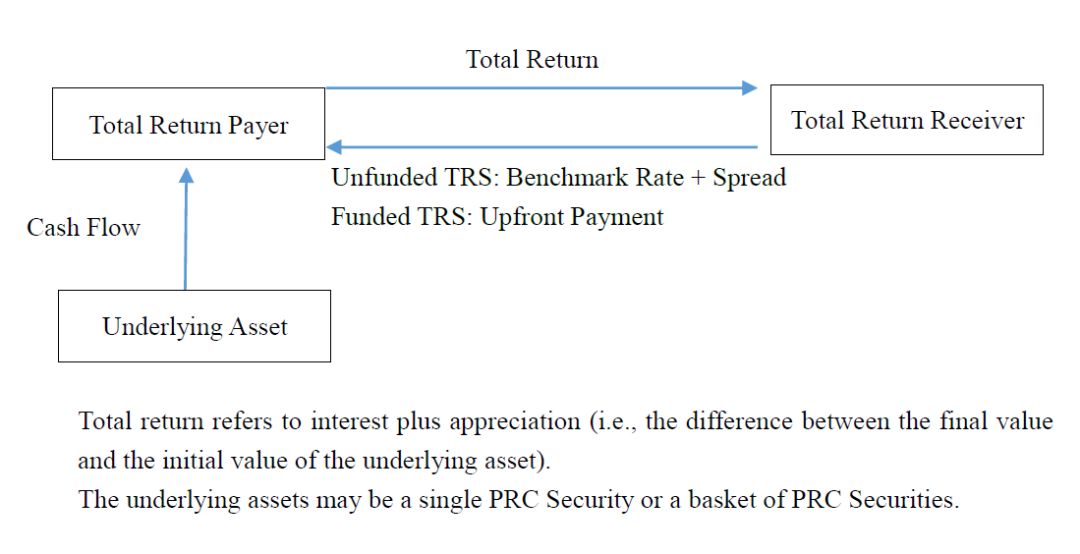
This TRS often contains the following essential features:
the total return receiver is synthetically long on the subject PRC Securities, with or without the need to fund the investment upfront, while the total return payer is synthetically short on the same PRC Securities;
the total return payer may acquire the underlying PRC Securities via one or more Permitted Access Schemes as a hedge[2] for its obligations under the terms of the TRS;
if the total return payer acquires the underlying PRC Securities, it will hold them on its balance sheet; and
during the term of the TRS, the total return receiver gains off-balance sheet exposure to the PRC Securities.
3 Legal and Regulatory Issues
PRC Securities TRS may raise legal and regulatory issues under PRC law. This note touches on some key issues but is not intended to provide an exhaustive analysis. PRC laws and regulations are rapidly changing as TRS structures evolve, so there may be additional legal and regulatory issues that arise in the future.
Legal Documentation
Non-PRC investors often use the ISDA Master Agreement and Credit Support Annex ("ISDA Documentation") to document PRC Securities TRS transactions. When negotiating early termination clauses in the ISDA Documentation, the parties may need to take into account risks associated with the total return payer's use of the Permitted Access Schemes. In some instances, total return payers may rely on the cash flow generated from its trading of underlying PRC Securities to fulfill its payment obligations under the ISDA Documentation. However, this cash flow may be disrupted due to restrictions under the relevant Permitted Access Schemes. For example, if the total return payer uses the QFII/RQFII program to hedge its obligations under the ISDA Documentation, it would have to consider the unavailability of QFII/RQFII investment quota, lock-up periods, non-PRC share aggregation limits and repatriation limitations, each of which or a combination of which may lead to an event of default or a termination event under the ISDA Documentation. Accordingly, the ISDA Documentation for PRC Securities TRS may need to be amended to account for these PRC-specific restrictions.
Legal Ownership and Beneficial Ownership
Pursuant to the terms of a non-PRC TRS, the total return payer may be deemed as the "legal owner" of underlying assets, while the total return receiver may be deemed as the "beneficial owner" of such underlying assets (on the basis that it is acquiring a total return on the reference asset). However, under PRC law, the concepts of "legal owner" and "beneficial owner" are not well established. To date, while PRC regulators have attempted to affirm the legal rights of “legal owners” and “beneficial owners” under the Stock Connect and Bond Connect programs, there is uncertainty as to whether a total return receiver can be considered a "beneficial owner" of PRC Securities. Accordingly, with respect to PRC Securities TRS, the total return receiver would face major legal hurdles in claiming "beneficial ownership" over the underlying PRC Securities in the PRC.
Non-PRC Share Aggregation Limits, Disclosure of Interests and the Short-Swing Profit Rule
Under PRC law, when trading PRC Securities through Permitted Access Schemes, non-PRC investors are subject to certain non-PRC share aggregation limits,[3] disclosure of interest rules,[4] and short-swing profit rules[5]. The level of ownership and control will determine whether TRS parties are subject to PRC regulatory jurisdiction.
(a) During the term of a PRC Securities TRS, if the total return receiver has de facto control over the voting rights of the underlying PRC Securities, the total return receiver may be subject to the above PRC regulatory obligations.
(b) If, under the terms of a PRC Securities TRS, the total return receiver becomes the legal owner of the underlying PRC Securities, whether through physical settlement or other title transfer arrangements, the total return receiver may be subject to the above PRC regulatory obligations.
(c) If the PRC Securities TRS is only settled in cash, and there is no arrangement enabling the total return receiver to control the voting rights of the underlying PRC Securities, the total return receiver may not be subject to the above PRC regulatory obligations.
(d) As long as the total return payer remains the record owner of the underlying PRC Securities, it would be subject to the above PRC regulatory obligations.
Irrespective of the level of ownership and control set forth in the terms of a PRC Securities TRS, both the total return receiver and the total return payer may also be subject to the PRC's rules in relation to inside trading or market manipulation.
Off-exchange Transfer Restrictions
Under PRC law, PRC Securities trading in the PRC Capital Market is required to be executed via designated trading facilities (with very limited exceptions for non-trade transfers). This means that non-PRC custodians or brokers are not permitted to match buy and sale orders for non-PRC investors under the Permitted Access Schemes. They are also not permitted to provide any off-exchange services relating to the transfer of PRC Securities in any other form. These restrictions may affect the legality and enforceability of physical settlement of PRC Securities TRS under PRC law. For example, if the PRC Securities TRS agreement states that on maturity of the TRS, the total return receiver has an option to purchase the PRC Securities at a market price or a pre-determined price, or otherwise may cause delivery of the PRC Securities from the total return payer to the total return receiver, the parties should carefully consider whether this delivery arrangement is permissible under PRC law.
Quota Transfers and Lending Restrictions
Certain Permitted Access Schemes (such as the QFII/RQFII program) do not permit eligible investors to transfer or lend its investment quota to non-eligible investors in non-PRC markets.
PRC Securities TRS are commonly structured as unfunded TRS, whereby the total return receiver does not make upfront payments and the total return payer uses its own funds or financing proceeds to purchase the underlying PRC Securities. If, however, the terms of the unfunded TRS permit the total return receiver to buy and sell the underlying PRC Securities at its discretion using the total return payer's investment quota, the transaction may be deemed as an unauthorized transfer or lending of investment quota. The grounds for this determination would be that the total return payer has used the PRC Securities TRS to allow a non-eligible third party (i.e. the total return receiver) to trade PRC Securities.
Where the PRC Securities TRS is structured as a funded TRS, whereby the total return payer uses upfront payments received from the total return receiver to purchase underlying PRC Securities, the transaction may be more likely to be deemed as an unauthorized transfer or lending of investment quota. The grounds for this determination would be that the total return payer has used funds provided by the total return receiver to trade PRC Securities for a non-eligible third party (i.e. the total return receiver).
Leverage Through Unfunded TRS
An unfunded PRC Securities TRS may be deemed as an indirect form of margin financing, on the grounds that a PRC Securities TRS has an equivalent economic effect, as a total return receiver has borrowed funds from a total return payer (at the rate equal to the benchmark rate plus a spread) to trade PRC Securities. Derivative products involving a high amount of leverage have gained the attention of PRC regulators since the 2015 securities market turmoil. Specifically, PRC brokerage firms have been urged to cease financing their clients' securities trading in the PRC Capital Market through TRS and other OTC derivatives. Accordingly, non-PRC investors are advised to closely monitor the business and regulatory environment of the PRC Capital Market to ensure their leverage arrangements under PRC Securities TRS do not attract additional regulatory scrutiny.
[1] "China" or the "PRC",for the purposes of this Note, excludes Hong Kong, Macau and Taiwan.
[2]Total return payers may also use existing PRC Securities and assets to hedge their exposure under a PRC Securities TRS rather than acquire PRC Securities for the purposes of covering their exposure under a specific PRC Securities TRS. A PRC Securities TRS does not require the total return payer to hedge.
[3] For example, a single non-PRC investor cannot hold more than 10% of the total shares of a listed company through the QFII/RQFII/Stock Connect programs. The sum of China A shares of a single listed company held by all non-PRC investors may not exceed 30% of such listed company's total shares.
[4] For example, if the aggregate shareholding of a non-PRC investor (together with persons acting in concert with it) in a listed company reaches 5%, it will have to disclose such interests in 3 days. Furthermore, each subsequent 5% aggregate increase or decrease in shareholding needs to be disclosed as well.
[5] If a non-PRC investor holding more than 5% of a listed company's aggregate shares sells those shares within six months after purchasing them,the proceeds arising from the sale will be owned by the listed company and will be recovered by the listed company's board of directors.
Non-PRC investors have long used total return swaps ("TRS") to gain economic exposure to the underlying shares, funds, bonds and other debt instruments (collectively, "PRC Securities") listed and traded on PRC[1] exchanges and its interbank bond market. Non-PRC investors engage in these TRS transactions for a variety of reasons, such as the following:
Access Restrictions – PRC exchanges and the PRC interbank bond market (collectively, the "PRC Capital Market") are not fully open to non-PRC investors. Currently, non-PRC investors are only permitted to trade PRC Securities (including A-shares, funds and bonds, etc.) listed on the PRC exchanges, and debt instruments (including government bonds, financial bonds, corporate bonds, commercial papers, asset-backed securities, panda bonds, etc.) traded in the PRC's interbank bond market, via certain access schemes. These include (1) the Qualified Foreign Institutional Investor program ("QFII"), (2) the Renminbi Qualified Foreign Institutional Investor program ("RQFII"), (3) the mutual market access programs between the PRC and Hong Kong, namely the Stock Connect and the Bond Connect, and (4) a direct access program for non-PRC participation in the PRC's interbank bond market (collectively, the "Permitted Access Schemes").
Each Permitted Access Scheme imposes different restrictions on eligible investors, eligible PRC Securities, investment quota/size, currency exchange, and the remittance and repatriation of funds, etc. For example, hedge funds are not qualified to apply for QFII/RQFII licenses. As a result, until the Stock Connect, Bond Connect and direct access programs, hedge funds had to use TRS to gain exposure to PRC Securities.
Fund Management – Like typical TRS structures used in non-PRC markets, from the perspective of the total return receiver, TRS referencing PRC Securities as underlying assets ("PRC Securities TRS") may optimize balance sheet management, portfolio management, hedge fund leverage and asset swap maturity manipulation. From the perspective of the total return payer, such TRS may create a hedge for both price risk and default risk.
2 Basic Structure and Essential Features
Generally, PRC Securities TRS involves a total return receiver paying a specified fixed or floating interest rate to a total return payer in exchange for a total return on a specified reference asset or index, as illustrated below:
This TRS often contains the following essential features:
the total return receiver is synthetically long on the subject PRC Securities, with or without the need to fund the investment upfront, while the total return payer is synthetically short on the same PRC Securities;
the total return payer may acquire the underlying PRC Securities via one or more Permitted Access Schemes as a hedge[2] for its obligations under the terms of the TRS;
if the total return payer acquires the underlying PRC Securities, it will hold them on its balance sheet; and
during the term of the TRS, the total return receiver gains off-balance sheet exposure to the PRC Securities.
3 Legal and Regulatory Issues
PRC Securities TRS may raise legal and regulatory issues under PRC law. This note touches on some key issues but is not intended to provide an exhaustive analysis. PRC laws and regulations are rapidly changing as TRS structures evolve, so there may be additional legal and regulatory issues that arise in the future.
Legal Documentation
Non-PRC investors often use the ISDA Master Agreement and Credit Support Annex ("ISDA Documentation") to document PRC Securities TRS transactions. When negotiating early termination clauses in the ISDA Documentation, the parties may need to take into account risks associated with the total return payer's use of the Permitted Access Schemes. In some instances, total return payers may rely on the cash flow generated from its trading of underlying PRC Securities to fulfill its payment obligations under the ISDA Documentation. However, this cash flow may be disrupted due to restrictions under the relevant Permitted Access Schemes. For example, if the total return payer uses the QFII/RQFII program to hedge its obligations under the ISDA Documentation, it would have to consider the unavailability of QFII/RQFII investment quota, lock-up periods, non-PRC share aggregation limits and repatriation limitations, each of which or a combination of which may lead to an event of default or a termination event under the ISDA Documentation. Accordingly, the ISDA Documentation for PRC Securities TRS may need to be amended to account for these PRC-specific restrictions.
Legal Ownership and Beneficial Ownership
Pursuant to the terms of a non-PRC TRS, the total return payer may be deemed as the "legal owner" of underlying assets, while the total return receiver may be deemed as the "beneficial owner" of such underlying assets (on the basis that it is acquiring a total return on the reference asset). However, under PRC law, the concepts of "legal owner" and "beneficial owner" are not well established. To date, while PRC regulators have attempted to affirm the legal rights of “legal owners” and “beneficial owners” under the Stock Connect and Bond Connect programs, there is uncertainty as to whether a total return receiver can be considered a "beneficial owner" of PRC Securities. Accordingly, with respect to PRC Securities TRS, the total return receiver would face major legal hurdles in claiming "beneficial ownership" over the underlying PRC Securities in the PRC.
Non-PRC Share Aggregation Limits, Disclosure of Interests and the Short-Swing Profit Rule
Under PRC law, when trading PRC Securities through Permitted Access Schemes, non-PRC investors are subject to certain non-PRC share aggregation limits,[3] disclosure of interest rules,[4] and short-swing profit rules[5]. The level of ownership and control will determine whether TRS parties are subject to PRC regulatory jurisdiction.
(a) During the term of a PRC Securities TRS, if the total return receiver has de facto control over the voting rights of the underlying PRC Securities, the total return receiver may be subject to the above PRC regulatory obligations.
(b) If, under the terms of a PRC Securities TRS, the total return receiver becomes the legal owner of the underlying PRC Securities, whether through physical settlement or other title transfer arrangements, the total return receiver may be subject to the above PRC regulatory obligations.
(c) If the PRC Securities TRS is only settled in cash, and there is no arrangement enabling the total return receiver to control the voting rights of the underlying PRC Securities, the total return receiver may not be subject to the above PRC regulatory obligations.
(d) As long as the total return payer remains the record owner of the underlying PRC Securities, it would be subject to the above PRC regulatory obligations.
Irrespective of the level of ownership and control set forth in the terms of a PRC Securities TRS, both the total return receiver and the total return payer may also be subject to the PRC's rules in relation to inside trading or market manipulation.
Off-exchange Transfer Restrictions
Under PRC law, PRC Securities trading in the PRC Capital Market is required to be executed via designated trading facilities (with very limited exceptions for non-trade transfers). This means that non-PRC custodians or brokers are not permitted to match buy and sale orders for non-PRC investors under the Permitted Access Schemes. They are also not permitted to provide any off-exchange services relating to the transfer of PRC Securities in any other form. These restrictions may affect the legality and enforceability of physical settlement of PRC Securities TRS under PRC law. For example, if the PRC Securities TRS agreement states that on maturity of the TRS, the total return receiver has an option to purchase the PRC Securities at a market price or a pre-determined price, or otherwise may cause delivery of the PRC Securities from the total return payer to the total return receiver, the parties should carefully consider whether this delivery arrangement is permissible under PRC law.
Quota Transfers and Lending Restrictions
Certain Permitted Access Schemes (such as the QFII/RQFII program) do not permit eligible investors to transfer or lend its investment quota to non-eligible investors in non-PRC markets.
PRC Securities TRS are commonly structured as unfunded TRS, whereby the total return receiver does not make upfront payments and the total return payer uses its own funds or financing proceeds to purchase the underlying PRC Securities. If, however, the terms of the unfunded TRS permit the total return receiver to buy and sell the underlying PRC Securities at its discretion using the total return payer's investment quota, the transaction may be deemed as an unauthorized transfer or lending of investment quota. The grounds for this determination would be that the total return payer has used the PRC Securities TRS to allow a non-eligible third party (i.e. the total return receiver) to trade PRC Securities.
Where the PRC Securities TRS is structured as a funded TRS, whereby the total return payer uses upfront payments received from the total return receiver to purchase underlying PRC Securities, the transaction may be more likely to be deemed as an unauthorized transfer or lending of investment quota. The grounds for this determination would be that the total return payer has used funds provided by the total return receiver to trade PRC Securities for a non-eligible third party (i.e. the total return receiver).
Leverage Through Unfunded TRS
An unfunded PRC Securities TRS may be deemed as an indirect form of margin financing, on the grounds that a PRC Securities TRS has an equivalent economic effect, as a total return receiver has borrowed funds from a total return payer (at the rate equal to the benchmark rate plus a spread) to trade PRC Securities. Derivative products involving a high amount of leverage have gained the attention of PRC regulators since the 2015 securities market turmoil. Specifically, PRC brokerage firms have been urged to cease financing their clients' securities trading in the PRC Capital Market through TRS and other OTC derivatives. Accordingly, non-PRC investors are advised to closely monitor the business and regulatory environment of the PRC Capital Market to ensure their leverage arrangements under PRC Securities TRS do not attract additional regulatory scrutiny.
[1] "China" or the "PRC",for the purposes of this Note, excludes Hong Kong, Macau and Taiwan.
[2]Total return payers may also use existing PRC Securities and assets to hedge their exposure under a PRC Securities TRS rather than acquire PRC Securities for the purposes of covering their exposure under a specific PRC Securities TRS. A PRC Securities TRS does not require the total return payer to hedge.
[3] For example, a single non-PRC investor cannot hold more than 10% of the total shares of a listed company through the QFII/RQFII/Stock Connect programs. The sum of China A shares of a single listed company held by all non-PRC investors may not exceed 30% of such listed company's total shares.
[4] For example, if the aggregate shareholding of a non-PRC investor (together with persons acting in concert with it) in a listed company reaches 5%, it will have to disclose such interests in 3 days. Furthermore, each subsequent 5% aggregate increase or decrease in shareholding needs to be disclosed as well.
[5] If a non-PRC investor holding more than 5% of a listed company's aggregate shares sells those shares within six months after purchasing them,the proceeds arising from the sale will be owned by the listed company and will be recovered by the listed company's board of directors.