Recently, a ‘traffic accident’ attracted wide attention. On 6 January 2018, around 20:00 local time, the Panamanian-flagged tanker Sanchi collided with the Hong Kong-flagged bulk carrier CF Crystal about 160 nautical miles off Shanghai. Shortly after the collision, the Sanchi caught fire and leant to starboard side with all crews missing, while CF CRYSTAL suffered non-critical damage and her twenty-one crews were all rescued.
It is well known that the ship collision is a kind of typical maritime cases. The attribution of liability, the calculation of the salvage reward, as well as the general average and loss recovery are all challenges for maritime lawyers.
At the end of 2017, the Maritime Maisie case (“M case” or “M”) handled by RICC & CO. finally closed after the four-years battle over salvage, general average and insurance recovery arising out of the collision between MT Maritime Maisie and another ship. Here we would like to take this case as an example to briefly introduce lawyers’ work and value in this kind of cases.
01 Overview of the case 20 days of fire and explosion crisis
On 29 December 2013, at 2:15 a.m., the car carrier Gravity Highway collided with the chemical tanker M near the port of Busan, causing the M to catch fire. The incident was so catastrophic that all the crew members abandoned the M which subsequently drifted on Busan waters with fire. In the beginning, South Korea Coast Guard tried to help M put out the fire. However, the fire was too big to be completely extinguished. Afterwards, M drifted into Japanese water and was taken over by and under the custody of Japan Coast Guard.
On 30 December 2013, the Shipowner of M entered into the LOF salvage contract with Japan Coast Guard. On 16 January, almost 20 days after the collision, the fire was finally extinguished. However, the leak of chemicals caused serious pollution and there was a potential risk in explosion. The cargo owned by our Client was in one of the cargo tank of M.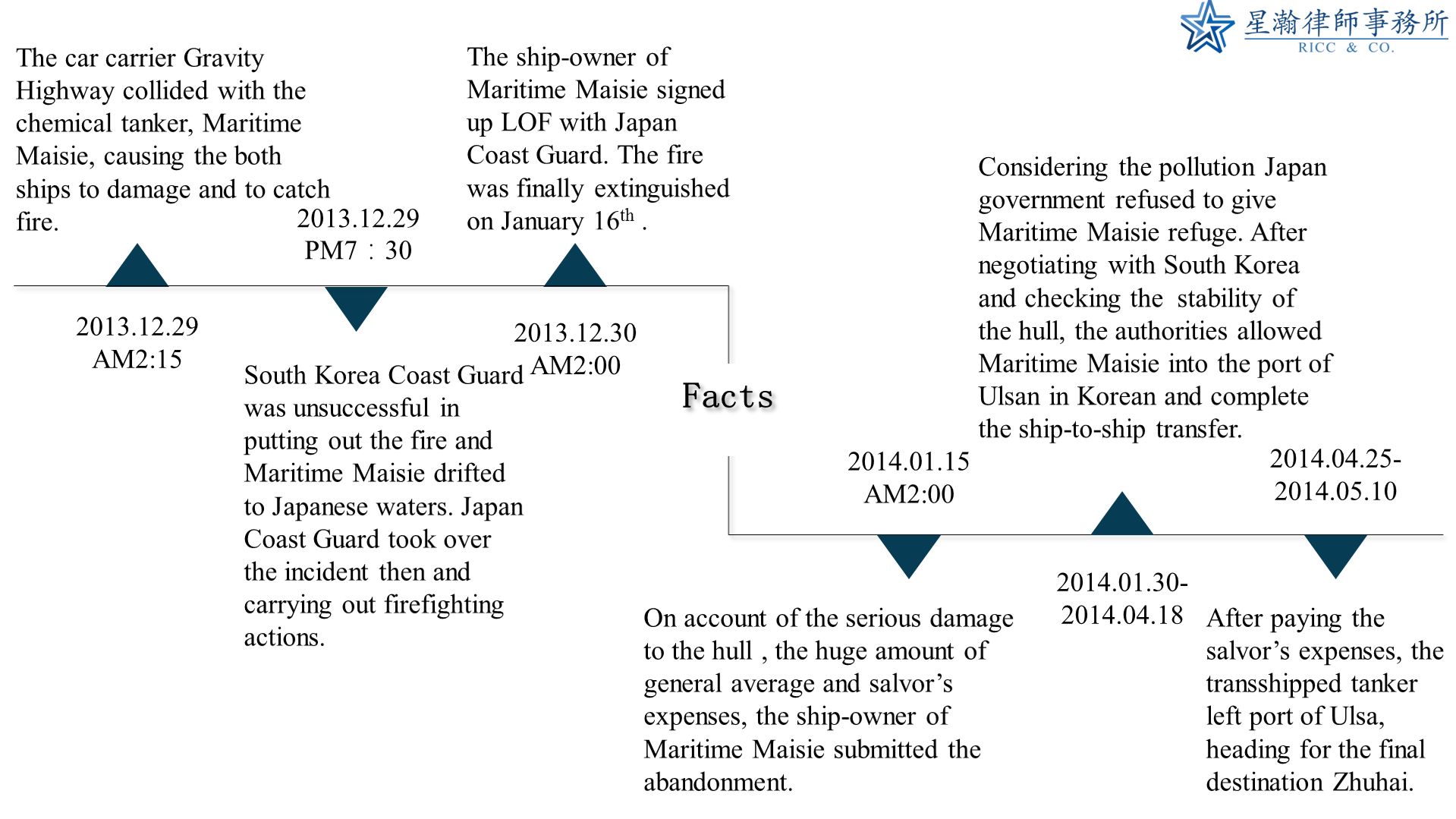
(Timeline of Maritime Maisie Case)
02 Challenges of the case: Complexity of the facts and measures taken by M
The incident occurred by the New Year of 2014 and was far overseas. Our Client, a Chinese domestic cargo-owner, knew little about the latest situation. What is more troubling is that the Shipowner of M declared general average and abandon the ship on 15 January 2014 due to the serious damage of the hull of the ship, leaving it with no port to berth.
The next port of M would have been Ningbo China after her departure from Busan. Therefore, despite that M was in Japan water and under the custody of Japan Coast Guard, Japanese government was, considering the potential risk of a subsequent incident, reluctant to grant it to berth in Japanese ports. So was the Korean Government. Thus, M Case arouse wide attention world widely—— No sovereign nations allow it to enter while there were chemicals and fuel oil on it. Once leakage occurred, it would cause catastrophic loss.
03 Lawyers’ work To maximally protect Client’s interest
After the accident, attorney Chen Lei and attorney Yan Bing went to South Korea timely for investigation in the end of January 2014.
The two attorneys firstly visited the Shipowner’s lawyer and ship’s surveyor in South Korea. Subsequently, they went to Busan to visit the lawyer of the other ship and made all the facts clear within two weeks, so as to seize the initiative in developing the solutions. Afterwards, they came back to China, reported the case to the Client, including the site situation, analysis of South Korea lawyer, our professional opinion and solutions, which won the Client’s appreciation and trust. Thus, the Client decided to give attorney Chen Lei and attorney Yan Bing the full authorities to handle the M Case.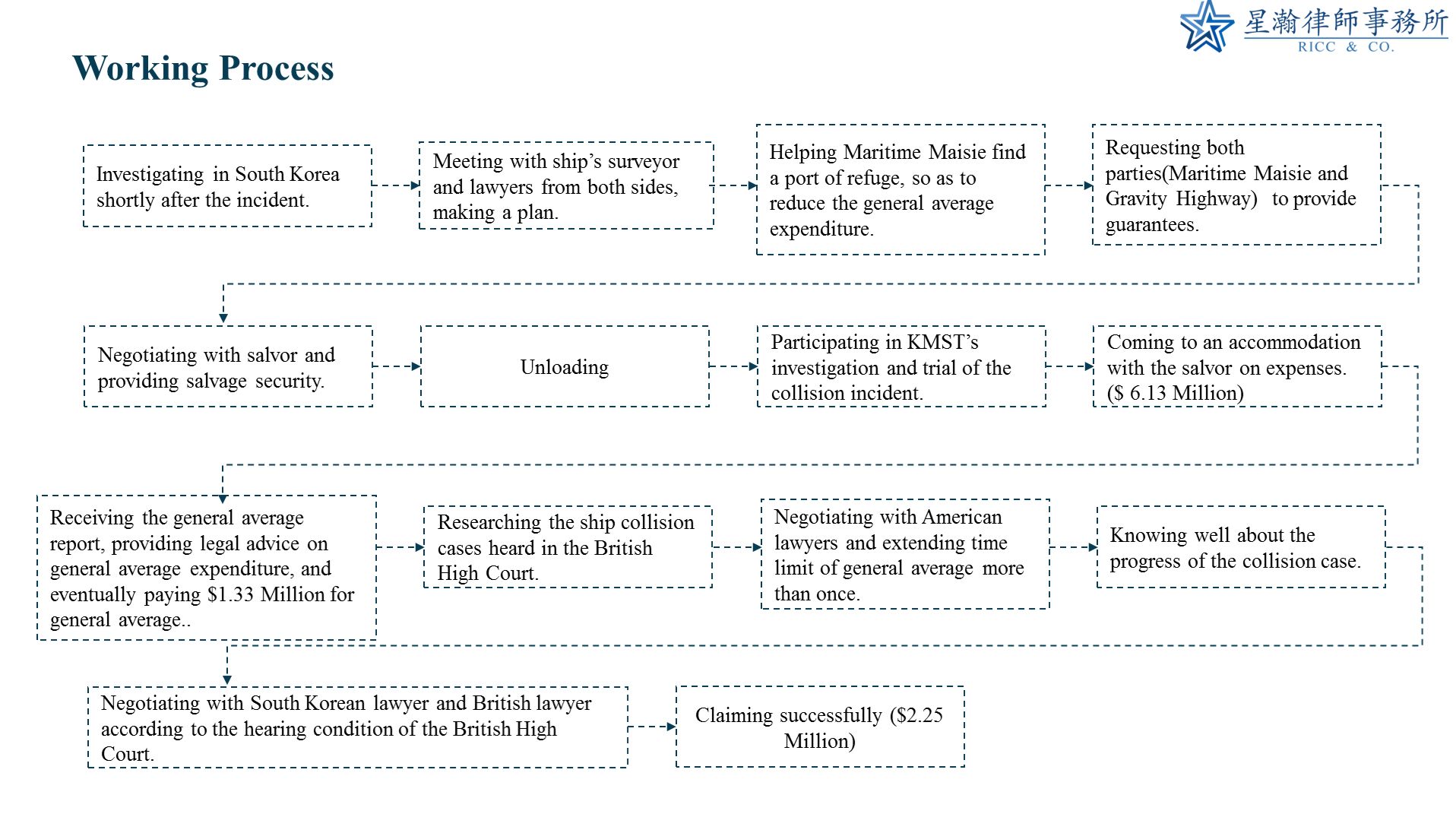
1. Find a “Port of Refuge” for M
Based on their professional analysis, attorney Chen Lei and attorney Yan Bing contacted and discussed with the Shanghai Maritime Safety Administration to make a practicable berthing plan for M as soon as possible in order to avoid the high cost of the salvage. With the cooperation of various parties, we provided the Shipowner with a preliminary berthing plan and a support scheme for subsequent operations, which made it possible for the Shipowner to arrange the M to berth in Ulsan port in Korea. Assisting M ship to find a port of refuge has reduced the subsequent costs on general average for the Client.
2. Negotiation on LOU and Jurisdiction
After solving the problem of port of refuge, it was time to solve the disputes of collision. Although the maritime law contains a concept of liability exemption in favor of the carrying ship in the collision case, for the sake of security, attorney Chen Lei and attorney Yan Bing requested the Shipowners of both ships to provide Letter of Undertaking(“LOU”). The LOU provided by the shipowners of the other ship was under the jurisdiction of Busan court in South Korean, and the LOU provided by the Shipowners of M was governed by New York state court in the US.
Given the transshipment operation has begun, the attorney team provided the salvor with salvage LOU, which was to be arbitrated by the London salvage association in London. At this point, the our team has settled all the LOUs and jurisdiction issues, and the cargo began to be discharged.
3. Participate in Investigation and Trial
After receipt of the cargo, we found that our Client is basically free of cargo damage, and the losses of the Client are mainly the costs of salvage and general average.
The first lawsuit that we participated in after discharging was initiated in South Korea, in which the hearings were held four times for analysis of the liability ratio in the collision of two ships. After the two trials in Busan and Seoul, and with the help of advanced technical procedures of handling ship collision, there was sufficient evidence to find out the facts. We found that we had little chance to challenge liability exemption of the M based on the fact found. Nevertheless, we still kept close contact with the American lawyers of the M to learn more about the development of the case.
4. Negotiations on the Salvor’s Expenses and General Average
Disputes with salvor were arbitrated by the London salvage association, and it ended with a settlement. After negotiation, the salvage cost our Client shared was about $6.13 million. As for other costs of general average other than salvage costs, such as the costs incurred by entrance of the port of refuge, after several negotiations with the adjusters, our Client finally paid about $1.33 million, and the total cost of the two items was about $7.5 million.
After the payment, the two Shipowners agreed that the high court in London shall decide on the proportion of the collision liability and the losses of both parties. In order to save cost for our Client, we had made a plan to negotiate with the Shipowners’ American lawyers. At that time, we need to know the latest progress of the London case since we concerned about whether the liability limitation fund was set up or not (in the event that the fund was set up overseas, our Client’s credit may not be able to recognized and enforced if we failed to register the same against the fund). To this end, we kept very close and frequent communication with the M’s US lawyer. Through our hard work, the full picture of the London case was available to us. As a result, the attorney fee of foreign lawyers has been greatly reduced and the whole case proceeded smoothly.
04 The Result Expertise Wins Respect
It was not until 18 April 2014 that the M ship could berth in the Ulsan port in Korea. From January, when the fire was put out, to M’s three-months drift in the sea, and finally to May 2014 when the STS (ship to ship) step completed by berthing in Ulsan port in Korea, our team closely followed the progress of the case and always put Client's interests as a priority during this four to five months.
Finally, the M case was settled out of court between two Shipowners in October 2017. Afterwards, we claimed $2.25 million against the other Shipowner who finally paid the full compensation according to the liability proportion of collision. Our Client was quite satisfied with this result.
Attorney Chen Lei, as the case handler, commented: The M case had a significant international impact, and it was one of the top ten maritime accidents of the year, with long burning time, widespread pollution and transship issues. The essential characteristic of this case is the double ships accident, the double ships accident will involve the core issues of maritime cases—collision, salvage and general average. We have not only managed to cope with the three core issues, but also achieved a good result of recovery. The compensation was almost fully recovered while the expensive foreign attorney fees were saved.
Attorney Yan Bing added: Ccomplex cases like this one, as the seats of arbitration are mostly always in London, have been monopolized by the London lawyers for a long time; But in this case, our team has done a great job by using our expertise, and coordinated with lawyers from South Korea, the United States and England, etc., which fully highlighted our comprehensive abilities to solve complicated problems.
The case is of great significance to the shipping team of RICC&CO. The team has won respect by focusing on Clients’ interests, profound professional knowledge and the ability to provide comprehensive solutions, which truly reflect the motto of our firm, be the real technical and professional lawyers!
A case study of Maritime Maisie
作者:RICC&CO.来源:星瀚微法苑

Recently, a ‘traffic accident’ attracted wide attention.