
04南非矿业投资准入的审批机构
Approval Agencies for Mining Investment Access in South Africa
4.1 矿业准入审批机构
Approval Institutions for Mining Entry
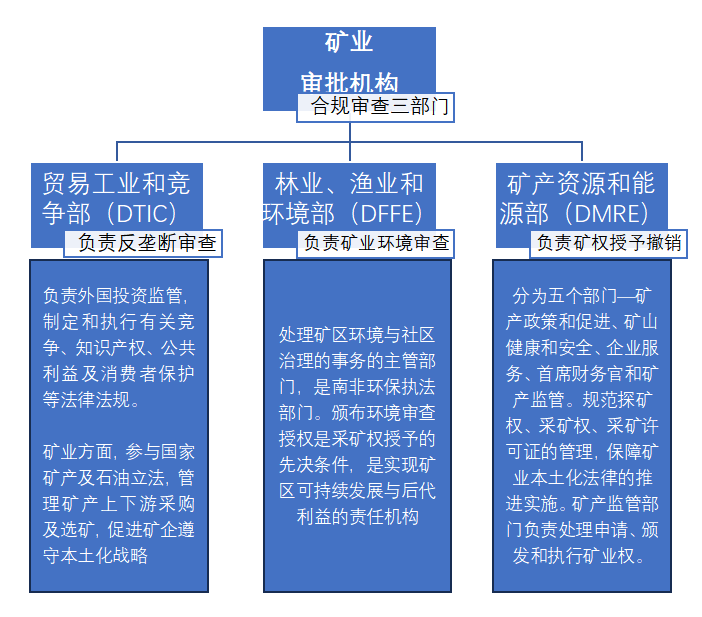
世界绝大多数发展中国家的外商投资审批大致可分为“逐项审批制度”和“选择性审批制度” (余劲松,2014)。尽管南非政府计划在未来制定统一的政策制度对国外直接投资进行评估,但目前受制于政治及经济的阶段性发展,无法形成统一的机构对外国投资进行统一的审批监管(张小虎等,2021)。本质上依旧属于“选择性审批制度”的实施。南非矿业投资准入制度是由国内各政府部门选择性逐项监管。具体而言:
The approval of foreign investment in most developing countries in the world can be broadly categorized into a “case-by-case approval system” and a “selective approval system” (Yu Jinsong, 2014). Although the South African government plans to formulate a unified policy system to assess foreign direct investment in the future, it is currently unable to form a unified organization to regulate foreign investment due to the stage of political and economic development (Zhang Xiaohu et al., 2021). In essence, it is still the implementation of “selective approval system”. South Africa's mining investment access system is regulated on a selective and case-by-case basis by various domestic government departments. Specifically:
4.2 矿业审批程序
Mining Authorization Process
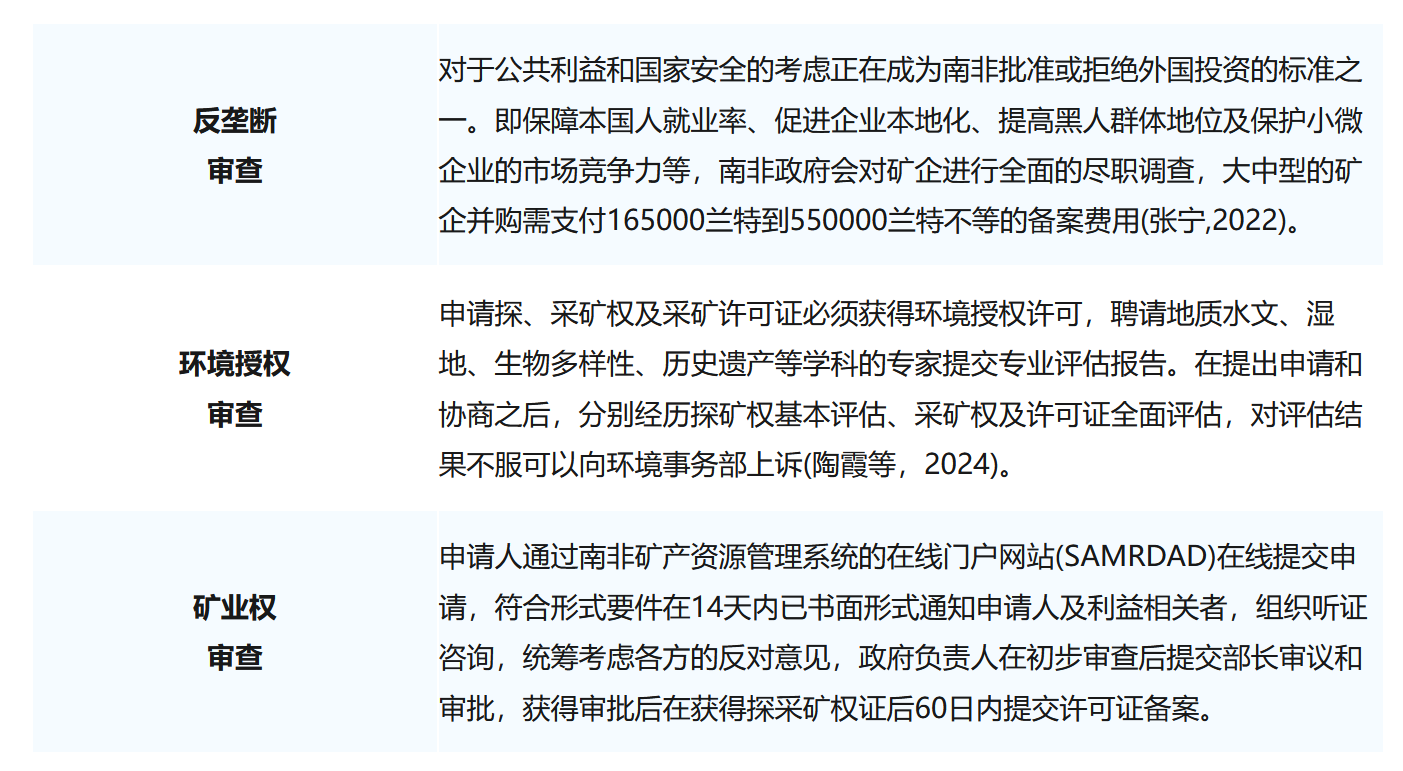
南非实行市场经济,对外国投资没有强制性审查要求,但国内的《竞争法修正案》规定通过企业并购进行的矿业投资,需首先经过上述三个部门的反垄断审查、环境授权审查及矿业权审查(詹德康,2024)。
South Africa has a market economy with no mandatory review requirements for foreign investment, but the domestic Competition Law Amendment Act requires that mining investments through corporate mergers and acquisitions are first subject to antitrust review, environmental authorization review, and mineral rights review by the three departments mentioned above (Zhan Dekang, 2024).
05总结
南非矿产国际投资的前期市场准入是一项复杂耗时的业务活动,且存在诸多不确定因素,导致沉默成本和投资风险的增加。其中最主要的原因之一就是南非矿业投资准入法律制度存在诸多缺陷。首先,准入立法体制杂乱,外国投资立法体系多层次且政策常调整,缺乏统一规划与协调机制,法律法规重复冲突,虽有基本法但领域立法分散,法律修订频繁且官网文本更新不全,增加企业查找和阅读难度,部分法律审查标准模糊,应急式立法使体制更复杂、企业成本更高(王海军,2022)。其次,准入审批机构权责不清,矿业投资受多法规制,受两个部门双重监管,企业需满足双重要求、提交双份报告,操作繁琐、成本增加,还导致立法惩罚机制空白、行政效率降低,如《广义黑人经济振兴法》和《矿业宪章》在多方面存在冲突,企业需按两套标准规划,增加额外成本和投资风险(詹德康,2024)。再者,准入审批流程繁琐,审批机构无权威性和高效性,审批效力常被否定,前置审批流程分散于多部法律,不便企业了解执行,政府要求企业承担社会责任但相关法律实施前未充分协商利益相关者,易造成采矿许可证颁发反复和法律风险,如《采矿宪章》中社区环保规定不明引发司法先例,土地补偿规定也给企业带来障碍(张小虎等,2021)。最后,准入审批标准不明,我国矿企多采用横向并购战略易引起关注,南非投资审查立法中“公共利益”和“公共安全”是原则而非具象标准,易被滥用,《竞争法修正案》相关规定未落实,增加并购审查的外部因素不确定性随之增加,风险也随之增加。
Pre-market access for international investment in South African minerals is a complex and time-consuming business activity with many uncertainties, leading to increased silent costs and investment risks. One of the main reasons for this is that the legal regime for mineral investment access in South Africa has a number of deficiencies. First of all, the access legislation system is chaotic, the foreign investment legislation system is multi-level and the policy is often adjusted, there is a lack of unified planning and coordination mechanism, laws and regulations are duplicated and conflicting, although there is a basic law, but the legislation in the field is fragmented, the law is revised frequently and the official website is not updated, which makes it difficult for enterprises to find and read, some of the laws are reviewed by vague standards, and the contingency type of legislation makes the system more complicated and the cost of enterprises is higher (Haijun Wang, 2022). ). Secondly, the authority and responsibility of access approval agencies are unclear, and mining investment is subject to multiple laws and regulations, and double supervision by two departments. Enterprises need to meet double requirements and submit double reports, which is cumbersome and costly, and also leads to the blankness of the legislative punishment mechanism and reduced administrative efficiency, for example, there are conflicts between the Act on Revitalization of the Broadly Black Economy (BEREA) and the Mining Charter in many aspects, and enterprises need to plan according to two sets of standards, which increases additional costs and investment risks (Zhan Dekang, 2024). (Zhan Dekang, 2024). Furthermore, the access approval process is cumbersome, the approval body is not authoritative and efficient, the effectiveness of the approval is often denied, the pre-approval process is scattered in multiple laws, which is inconvenient for enterprises to understand and implement, and the government requires enterprises to assume social responsibility but does not adequately consult with stakeholders prior to the implementation of the relevant laws, which is prone to repeated issuance of mining licenses and legal risks, such as judicial precedents arising from unclear community environmental protection provisions in the Mining Charter. Land compensation provisions also create obstacles for enterprises (Zhang Xiaohu et al., 2021). Finally, access approval criteria are unclear; China's mining enterprises often adopt horizontal M&A strategies that are easy to attract attention; “public interest” and “public safety” are principles rather than concrete criteria in South Africa's investment review legislation, which are easy to be abused; and the relevant provisions of the Competition Amendment Act have not been implemented, increasing the externalities of the M&A review process. The failure to implement the relevant provisions of the Competition Act Amendment Act has increased the uncertainty and risk of external factors in the merger and acquisition review.
引用
1, 余劲松:《国际投资法》,法律出版社 2014 年版,第121 页。
2, 陶霞,季营,张明慧,等.南非矿山环境管理制度研究及启示[J].煤炭技术,2024,43(09):292-295.DOI:10.13301/j.cnki.ct.2024.09.060.
3, 詹德康.(2024).中国对非洲关键矿产投资的国别风险研究(硕士学位论文,商务部国际贸易经济合作研究院).
4, 王海军.共期凿取中国-南非矿业融合发展的“红旗渠”[J].中国有色金属,2022,(09):46-47
5, 张小虎 & 赵倩.(2021).论南非矿业本土化的立法规制与风险防范.中国国土资源经济(02),49-55.doi:10.19676/j.cnki.1672-6995.000528.
6, 张宁.(2022).南非矿业投资准入法律制度研究(硕士学位论文,湘潭大学).硕士https://link.cnki.net/doi/10.27426/d.cnki.gxtdu.2022.000687doi:10.27426/d.cnki.gxtdu.2022.000687.
7, 何金祥,崔荣国,徐曙光,等.南非、赞比亚、刚果(金)和津巴布韦矿业投资环境和走势[J].国土资源情报,2021,(05):11-19.
8, 张梦婷.(2019).我国对南非投资的环保法律风险及其应对(硕士学位论文,湘潭大学).https://link.cnki.net/doi/10.27426/d.cnki.gxtdu.2019.000093doi:10.27426/d.cnki.gxtdu.2019.000093
9, 何金祥.南非矿产工业的现状、挑战和前景[J].中国矿业,2019,28(11):48-51.
Citation
1, Yu Jinsong, International Investment Law, Law Press, 2014, p. 121.
2, Tao Xia, Ji Ying, Zhang Minghui, et al. Research and inspiration of environmental management system of South African mines[J]. Coal Technology,2024,43(09):292-295.DOI:10.13301/j.cnki.ct.2024.09.060.
3, Zhan, D. K.. (2024). Country Risk Study on China's Investment in Key Minerals in Africa (Master's thesis, Institute of International Trade and Economic Cooperation, Ministry of Commerce).
4, Wang Haijun. The “Red Flag Canal” for China-South Africa Mining Integration and Development[J]. China Nonferrous Metals,2022,(09):46-47.
5, Zhang Xiaohu & Zhao Qian. 2011 The development of the Chinese non-ferrous metals industry [J]. (2021). On the Legislation and Risk Prevention of Mining Localization in South Africa. China Land Resources Economics (02), 49-55. doi:10.19676/j.cnki.1672-6995.000528.
6, Zhang, N.. (2022). Research on the legal system of mining investment access in South Africa (Master's thesis, Xiangtan University). Master's degree. https://link.cnki.net/doi/10.27426/d.cnki.gxtdu.2022.000687doi:10.27426/d.cnki.gxtdu.2022.000687.
7, He Jinxiang, Cui Rongguo, Xu Shuguang, et al. Mining Investment Environment and Trend in South Africa, Zambia, DRC and Zimbabwe[J]. Land Resources Intelligence,2021,(05):11-19.
8, Zhang, Mengting. (2019). Environmental Legal Risks of China's Investment in South Africa and Its Response (Master's Thesis, Xiangtan University).https://link.cnki.net/doi/10.27426/d.cnki.gxtdu.2019.000093doi:10.27426/d.cnki.gxtdu.2019.000093
9, He Jinxiang. Current Situation, Challenges and Prospects of South Africa's Mineral Industry[J]. China Mining Industry,2019,28(11):48-51.
Approval Agencies for Mining Investment Access in South Africa
4.1 矿业准入审批机构
Approval Institutions for Mining Entry
世界绝大多数发展中国家的外商投资审批大致可分为“逐项审批制度”和“选择性审批制度” (余劲松,2014)。尽管南非政府计划在未来制定统一的政策制度对国外直接投资进行评估,但目前受制于政治及经济的阶段性发展,无法形成统一的机构对外国投资进行统一的审批监管(张小虎等,2021)。本质上依旧属于“选择性审批制度”的实施。南非矿业投资准入制度是由国内各政府部门选择性逐项监管。具体而言:
The approval of foreign investment in most developing countries in the world can be broadly categorized into a “case-by-case approval system” and a “selective approval system” (Yu Jinsong, 2014). Although the South African government plans to formulate a unified policy system to assess foreign direct investment in the future, it is currently unable to form a unified organization to regulate foreign investment due to the stage of political and economic development (Zhang Xiaohu et al., 2021). In essence, it is still the implementation of “selective approval system”. South Africa's mining investment access system is regulated on a selective and case-by-case basis by various domestic government departments. Specifically:
4.2 矿业审批程序
Mining Authorization Process
南非实行市场经济,对外国投资没有强制性审查要求,但国内的《竞争法修正案》规定通过企业并购进行的矿业投资,需首先经过上述三个部门的反垄断审查、环境授权审查及矿业权审查(詹德康,2024)。
South Africa has a market economy with no mandatory review requirements for foreign investment, but the domestic Competition Law Amendment Act requires that mining investments through corporate mergers and acquisitions are first subject to antitrust review, environmental authorization review, and mineral rights review by the three departments mentioned above (Zhan Dekang, 2024).
05总结
南非矿产国际投资的前期市场准入是一项复杂耗时的业务活动,且存在诸多不确定因素,导致沉默成本和投资风险的增加。其中最主要的原因之一就是南非矿业投资准入法律制度存在诸多缺陷。首先,准入立法体制杂乱,外国投资立法体系多层次且政策常调整,缺乏统一规划与协调机制,法律法规重复冲突,虽有基本法但领域立法分散,法律修订频繁且官网文本更新不全,增加企业查找和阅读难度,部分法律审查标准模糊,应急式立法使体制更复杂、企业成本更高(王海军,2022)。其次,准入审批机构权责不清,矿业投资受多法规制,受两个部门双重监管,企业需满足双重要求、提交双份报告,操作繁琐、成本增加,还导致立法惩罚机制空白、行政效率降低,如《广义黑人经济振兴法》和《矿业宪章》在多方面存在冲突,企业需按两套标准规划,增加额外成本和投资风险(詹德康,2024)。再者,准入审批流程繁琐,审批机构无权威性和高效性,审批效力常被否定,前置审批流程分散于多部法律,不便企业了解执行,政府要求企业承担社会责任但相关法律实施前未充分协商利益相关者,易造成采矿许可证颁发反复和法律风险,如《采矿宪章》中社区环保规定不明引发司法先例,土地补偿规定也给企业带来障碍(张小虎等,2021)。最后,准入审批标准不明,我国矿企多采用横向并购战略易引起关注,南非投资审查立法中“公共利益”和“公共安全”是原则而非具象标准,易被滥用,《竞争法修正案》相关规定未落实,增加并购审查的外部因素不确定性随之增加,风险也随之增加。
Pre-market access for international investment in South African minerals is a complex and time-consuming business activity with many uncertainties, leading to increased silent costs and investment risks. One of the main reasons for this is that the legal regime for mineral investment access in South Africa has a number of deficiencies. First of all, the access legislation system is chaotic, the foreign investment legislation system is multi-level and the policy is often adjusted, there is a lack of unified planning and coordination mechanism, laws and regulations are duplicated and conflicting, although there is a basic law, but the legislation in the field is fragmented, the law is revised frequently and the official website is not updated, which makes it difficult for enterprises to find and read, some of the laws are reviewed by vague standards, and the contingency type of legislation makes the system more complicated and the cost of enterprises is higher (Haijun Wang, 2022). ). Secondly, the authority and responsibility of access approval agencies are unclear, and mining investment is subject to multiple laws and regulations, and double supervision by two departments. Enterprises need to meet double requirements and submit double reports, which is cumbersome and costly, and also leads to the blankness of the legislative punishment mechanism and reduced administrative efficiency, for example, there are conflicts between the Act on Revitalization of the Broadly Black Economy (BEREA) and the Mining Charter in many aspects, and enterprises need to plan according to two sets of standards, which increases additional costs and investment risks (Zhan Dekang, 2024). (Zhan Dekang, 2024). Furthermore, the access approval process is cumbersome, the approval body is not authoritative and efficient, the effectiveness of the approval is often denied, the pre-approval process is scattered in multiple laws, which is inconvenient for enterprises to understand and implement, and the government requires enterprises to assume social responsibility but does not adequately consult with stakeholders prior to the implementation of the relevant laws, which is prone to repeated issuance of mining licenses and legal risks, such as judicial precedents arising from unclear community environmental protection provisions in the Mining Charter. Land compensation provisions also create obstacles for enterprises (Zhang Xiaohu et al., 2021). Finally, access approval criteria are unclear; China's mining enterprises often adopt horizontal M&A strategies that are easy to attract attention; “public interest” and “public safety” are principles rather than concrete criteria in South Africa's investment review legislation, which are easy to be abused; and the relevant provisions of the Competition Amendment Act have not been implemented, increasing the externalities of the M&A review process. The failure to implement the relevant provisions of the Competition Act Amendment Act has increased the uncertainty and risk of external factors in the merger and acquisition review.
引用
1, 余劲松:《国际投资法》,法律出版社 2014 年版,第121 页。
2, 陶霞,季营,张明慧,等.南非矿山环境管理制度研究及启示[J].煤炭技术,2024,43(09):292-295.DOI:10.13301/j.cnki.ct.2024.09.060.
3, 詹德康.(2024).中国对非洲关键矿产投资的国别风险研究(硕士学位论文,商务部国际贸易经济合作研究院).
4, 王海军.共期凿取中国-南非矿业融合发展的“红旗渠”[J].中国有色金属,2022,(09):46-47
5, 张小虎 & 赵倩.(2021).论南非矿业本土化的立法规制与风险防范.中国国土资源经济(02),49-55.doi:10.19676/j.cnki.1672-6995.000528.
6, 张宁.(2022).南非矿业投资准入法律制度研究(硕士学位论文,湘潭大学).硕士https://link.cnki.net/doi/10.27426/d.cnki.gxtdu.2022.000687doi:10.27426/d.cnki.gxtdu.2022.000687.
7, 何金祥,崔荣国,徐曙光,等.南非、赞比亚、刚果(金)和津巴布韦矿业投资环境和走势[J].国土资源情报,2021,(05):11-19.
8, 张梦婷.(2019).我国对南非投资的环保法律风险及其应对(硕士学位论文,湘潭大学).https://link.cnki.net/doi/10.27426/d.cnki.gxtdu.2019.000093doi:10.27426/d.cnki.gxtdu.2019.000093
9, 何金祥.南非矿产工业的现状、挑战和前景[J].中国矿业,2019,28(11):48-51.
Citation
1, Yu Jinsong, International Investment Law, Law Press, 2014, p. 121.
2, Tao Xia, Ji Ying, Zhang Minghui, et al. Research and inspiration of environmental management system of South African mines[J]. Coal Technology,2024,43(09):292-295.DOI:10.13301/j.cnki.ct.2024.09.060.
3, Zhan, D. K.. (2024). Country Risk Study on China's Investment in Key Minerals in Africa (Master's thesis, Institute of International Trade and Economic Cooperation, Ministry of Commerce).
4, Wang Haijun. The “Red Flag Canal” for China-South Africa Mining Integration and Development[J]. China Nonferrous Metals,2022,(09):46-47.
5, Zhang Xiaohu & Zhao Qian. 2011 The development of the Chinese non-ferrous metals industry [J]. (2021). On the Legislation and Risk Prevention of Mining Localization in South Africa. China Land Resources Economics (02), 49-55. doi:10.19676/j.cnki.1672-6995.000528.
6, Zhang, N.. (2022). Research on the legal system of mining investment access in South Africa (Master's thesis, Xiangtan University). Master's degree. https://link.cnki.net/doi/10.27426/d.cnki.gxtdu.2022.000687doi:10.27426/d.cnki.gxtdu.2022.000687.
7, He Jinxiang, Cui Rongguo, Xu Shuguang, et al. Mining Investment Environment and Trend in South Africa, Zambia, DRC and Zimbabwe[J]. Land Resources Intelligence,2021,(05):11-19.
8, Zhang, Mengting. (2019). Environmental Legal Risks of China's Investment in South Africa and Its Response (Master's Thesis, Xiangtan University).https://link.cnki.net/doi/10.27426/d.cnki.gxtdu.2019.000093doi:10.27426/d.cnki.gxtdu.2019.000093
9, He Jinxiang. Current Situation, Challenges and Prospects of South Africa's Mineral Industry[J]. China Mining Industry,2019,28(11):48-51.