On December 23, 2018, the Foreign Investment Law of the People's Republic of China (Draft) (the "2018 Draft") was submitted for deliberation to the Seventh Session of the Thirteenth Standing Committee of the National People's Congress. The 2018 Draft[1] had been published on the official website of the National People's Congress on December 26, 2018 for public comment until February 24, 2019.
A foreign investment legal system framework based on the existing "three foreign capital laws" (the Law on Sino-Foreign Equity Joint Ventures, the Law on Sino-Foreign Contractual Joint Ventures and the Law on Foreign-Capital Enterprises) has gradually formed in China over the past 40 years since the country’s reform and opening up. The newly enacted Foreign Investment Law will replace the three foreign capital laws to become the legal foundation for foreign investment in China in the new era.
The 2018 Draft is not the first attempt to establish a unified legal system for foreign investment. As early as January 2015, the Ministry of Commerce promulgated the Foreign Investment Law of the People's Republic of China (Draft for Comment) (the "2015 Draft")[2]. Compared with the 2015 Draft, the 2018 Draft saw major changes in content and structure, by reducing 170 articles to 39 and mainly stipulating details for the promotion, protection and management of investment. What is most noteworthy, however, is not what the 2018 Draft stipulates, but what has been deleted or modified as compared with the 2015 Draft. This article will analyze the 2018 Draft mainly from the perspective of variable interest entities ("VIEs").
VIE Structures
VIE structures, also known as "agreement control" or "contractual arrangements", refers to achieving actual control and consolidation in financial statements of PRC operating entities through various contractual agreements rather than through equity ownership. A VIE structure is typically arranged as follows: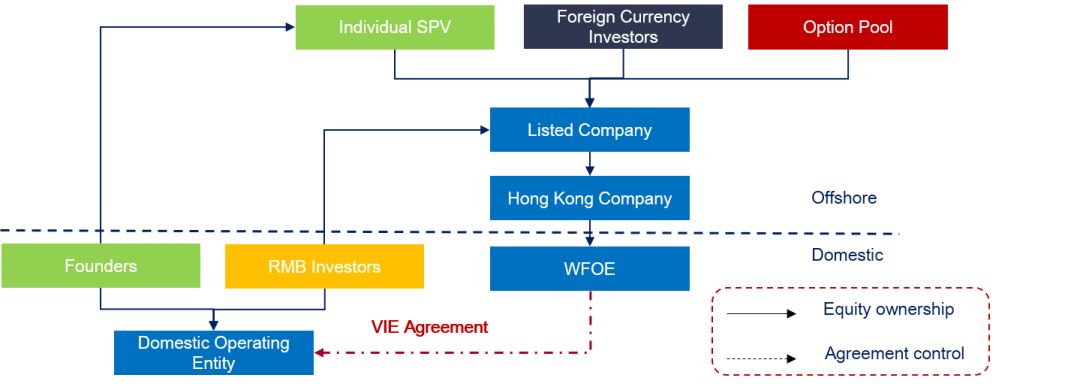
Since 2000, when Sina completed its U.S. initial public offering through adopting a VIE structure, VIE structures have been widely used by PRC enterprises that involve foreign investment restricted or prohibited industries (such as technology, media and telecommunications, private education, etc.) to create overseas red-chip structure for the purpose of financing or listing overseas.
However, currently effective PRC laws and regulations have not clearly characterized VIE structures. As a consequence, PRC companies which adopt a VIE structure have needed to provide in their prospectuses a special section on "contract arrangements" and to disclose relevant legal opinions of PRC legal counsel to complete overseas initial public offerings. Thus, relevant PRC enterprises have had to pay attention to legislative and enforcement developments with respect to the legality of VIE structures and oversight models.
Review: The 2015 Draft proposed to subject VIE structures to the supervision of the foreign investment regulatory system.
The 2015 Draft first attempted to combine the three foreign capital laws into a unified legal system for foreign investment, and clearly defined VIE structures as a form of foreign investment.
With regard to the definition of "foreign investment", Article 15 stipulated that foreign investment referred to, among others, "control" of a domestic enterprise or the holding of an interest in a domestic enterprise by foreign investors through contracts, trusts, etc., which shall be governed by investment access management provisions, security reviews, information reporting on foreign investment under the foreign investment law.
With regard to the definition of "foreign investor", Article 11 stipulated that foreign investors also included domestic enterprises that are "controlled" by non-PRC nationals, overseas registered entities and other organizations.
With regard to the definition of "control", Article 18 further clearly stipulated three means of control, specifically: (1) by acquiring more than 50% of the equity, voting rights or similar rights of the controlled enterprise; (2) in the absence of 50% equity ownership, (i) be entitled to decide the appointment of more than half of the board members of the controlled enterprise; (ii) have a significant impact on the shareholders' meeting or the board of directors of the controlled enterprise; or (3) be able to exert decisive influence on the business, finance, personnel or technology of the controlled enterprise through contracts, trusts, etc.
Based on the above definitions of "control", Article 45 further clarified that foreign investors controlled by domestic investors (including domestic natural persons or enterprises), may apply for their investments to be deemed as a domestic, rather than foreign, so as to avoid the requirements for "foreign investment".
The Explanations on the Foreign Investment Law of the People's Republic of China (Draft for Public Comments), issued by the Ministry of Commerce, failed to clearly stipulate the treatment of VIE structures, but proposed three potential solutions, i.e. a declaration system, declaration and certification system and a licensing system.
The 2015 Draft attracted widespread attention immediately upon promulgation. The Hong Kong Stock Exchange even updated its HKEX-LD43-3 listing decision document and GL77-14 guidance to recommend VIE-structured IPO applicants to consult the exchange in advance for informal and confidential guidance on novel issues, and expressly required applicants to disclose in their prospectuses the content required under the 2015 Draft and the measures (if any) that applicants would implement to reduce any potential risks upon consulting with PRC legal counsel.
At present: The 2018 Draft temporarily sets aside VIE structure-related issues
It is notable that the 2018 Draft makes no mention of VIE structures.
Compared with the definition of "foreign investment" in the 2015 Draft, the 2018 Draft in paragraph 2, Article 2 deletes from the definition of "foreign investment" the "providing financing of terms of one year or more to domestic enterprises in which [the foreign investor] holds an interest", "acquiring concessions for the exploration and development of natural resources, or obtaining concessions for the construction and operation of infrastructure within territory of China or other regions under the jurisdiction of China", "acquiring real estate rights such as domestic land-use rights and real estate ownership within the territory of China" and "controlling domestic enterprises or holding rights and interests in domestic enterprises through contracts, trusts, etc." Instead, the 2018 Draft adds a catch-all provision, "investments made by foreign investors in China through means stipulated by laws or administrative regulations or other methods prescribed by the State Council." In addition, the concept of "actual controller" and related provisions as first proposed in the 2015 Draft are deleted in their entirety. As a result, the 2018 Draft, if adopted in its current form, may again return to a gray area those issues relating to VIE structure legality and oversight models.
What was the legislative intent behind removing VIE structure-related content from the 2018 Draft? The Explanations on the Foreign Investment Law of the People's Republic of China (Draft for Comment) [3] state that the views behind the law are "based on the principle of promoting the all-round opening, highlighting the tone of expanding opening and actively utilizing foreign capital, focusing on investment promotion and investment protection, firmly sticking to the Chinese government’s unwavering commitment to promote a new round of high-level opening." The speech presented subsequently by the spokesperson of Ministry of Commerce, Feng Gao, at a regular press conference[4] of the Ministry of Commerce on December 27, 2018 also provided some clues. "We believe that the introduction of the Foreign Investment Law will soothe the minds of foreign investors and foreign-invested enterprises." He said, "we will adapt to the new situations and grasp new features, promote all-round opening up, further relax the access of foreign-investment and promote relevant departments to accelerate the opening in the fields of telecommunications, education, medical care, and culture in accordance with the deployment of the Central Economic Work Conference. Foreign shareholding restrictions will be further relaxed especially in the fields of education and medical care, to which foreign investors pay close attention and in which there is a large gap in the domestic market."
Based on above, we have reason to speculate that under the background of the 40th anniversary of reform and opening-up and Sino-U.S. economic friction and consultations, the Foreign Investment Law focuses more on solving a series of urgent issues, such as expanding opening up, clarifying to apply the pre-entry national treatment plus negative list management system to foreign investment and building a fair competition environment for domestic and foreign capital. In this sense, the current legislation temporarily sets aside issues that still remain controversial but are relatively less urgent, such as the legality of the VIE structure and the identification of foreign investors by the source of capital rather than the place of registration (i.e. the 2015 Draft), and leaves those less urgent issues to legislative authorization. This means that VIE structures may in the future still be regarded as "foreign investment" under separate laws, administrative regulations formulated by the State Council, and regulatory documents according to the catch-all provision found in paragraph 2, Article 2 of the 2018 Draft.
Outlook: Exploring regulatory views
As mentioned above, the 2018 Draft temporarily sets aside issues relating to VIE structure legality and oversight models, but allows for future rulemakings to address these issues through the inclusion of a catch-all provision. So, what will VIE-structured enterprises face in the future regarding the regulatory environment? We speculate that VIE structure regulation may be temporarily suspended in all aspects or will be implemented as a pilot program in certain sensitive industries (such as the private education industry).
We noted that, after the publication of the 2015 Draft, some separate laws and regulations promulgated in the private education industry began to adopt the concept of "agreement control" and reflected the tendency to incorporate "agreement control" into the scope of oversight, which has drawn the attention of capital markets. For example:
According to the Regulations for the Implementation of the Law of the PRC on Promotion of Privately-run Schools (Revised Draft) (Draft for Review) promulgated by the Ministry of Justice in October 2018 (the "Draft Regulations"), "enterprises with foreign investment established in China and social organizations with foreign parties as actual controllers are not allowed to sponsor, participate in the sponsoring of or actually control privately-run schools providing compulsory education; the sponsoring of other types of privately-run schools shall comply with the national provisions on foreign investment … a social organization implementing group-oriented running of schools is not allowed to control any non-profit privately-run school by means of merger and acquisition, franchise and chain operation, or by means of agreement-based control."
According to Several Opinions on Deepening the Reform and Regulating the Development of Preschool Education, promulgated by the Central Committee of the Communist Party of China and the State Council in November 2018, "social capital shall not control kindergartens and non-profit kindergartens invested with state-owned assets or collective assets through means of mergers and acquisitions, entrusted operations, franchise chains, variable interest entities, agreement control, etc."
Since the above documents were published very near to the 2018 Draft, we believe that the Draft Regulation will provide a very valuable reference for predicting future regulatory views on the treatment of VIE structures:
If issues related to VIE structures are also temporarily set aside by the State Council in the deliberation of the Draft Regulations (i.e. removing content related to "agreement control"), the VIE structure will face low risk of being subject to strict supervision in the short term.
However, if the State Council ultimately retains relevant content related to VIE structures in the deliberation of the Draft Regulation, the private education industry will likely become a pilot industry for implementing foreign investment supervision of VIE structures, and the pilot may be further expanded to other specific industries and even be incorporated into the Foreign Investment Law if the effects of implementation are basically in line with legislative expectations.
In this respect, we will continue to monitor developments in this area.
[1] http://www.npc.gov.cn/COBRS_LFYJNEW/user/Law.jsp
[2] http://tfs.mofcom.gov.cn/article/as/201501/20150100871010.shtml
[3] http://www.npc.gov.cn/COBRS_LFYJNEW/user/UserIndex.jsp?ID=13126141
[4] http://www.mofcom.gov.cn/xwfbh/20181227.shtml
Interpreting Draft Foreign Investment Law from VIE Perspectives
作者:AdrianLv HuanhaoHe来源:汉坤律师事务所

On December 23, 2018, the Foreign Investment Law of the People's Republic of China (Draft) (the "201