Businesses in China, unlike their counterparts in most of the western world, make widespread use of company chops and they play an important role when contracting with Chinese companies.
Under Chinese law, it is not mandatory that all contracts be concluded in writing. However, where a written contract is preferred or required, chop and signature issues are mostly inevitable.
Q1 What is a Chinese company chop?
In China, the use of a company chop (a.k.a. stamp, carved seal) can have the same legal effect as the signature of a company’s legal representative (statutorily representing a company) or a duly authorised officeholder.
The contracting parties may explicitly stipulate that the execution of a contract requires both the chop and signature or one of them. If no such explicit contract provision is in place, either a company chop, or a signature can legally bind the relevant contracting party.
Q2 Chop vs signature
Though historically China has the longstanding tradition of using chops, under modern Chinese law, chops carry the same legal effect as signatures especially in civil and commercial circumstances.
When a signature is involved, the signature of the legal representative (法定代表人) normally carries the highest level of authority. The legal representative acts as the “legal face” of the company and is the deemed signatory for all company operational activities.
The legal representative is identified on the company’s business licence, registered at the AMR (Administration of Market Regulation) and has the presumed authority to enter into binding obligations on behalf of the company. A company can only have one legal representative.
In addition to the legal representative, any other duly authorised person can also sign a contract on behalf of the company, even without a company chop. In such cases, cautious verification of such person’s authorisation would be a good practice to avoid legal risks to the validity of the signed document incurred by lack of authority (i.e., unauthorised representation or ultra vires representation). The most critical issue for the bona fide counterparty would be to prove that it has reasonably cautiously examined the said authorisation in the given business circumstances.
Q3 Different types of chops
In practice, it is not uncommon to see a Chinese company having several different types of chops carrying various functions for its business operation. Examples are set out below.
A company should only engrave its chops at licensed chop-makers regulated by the local public security authority and relevant filing procedures have to be complied with.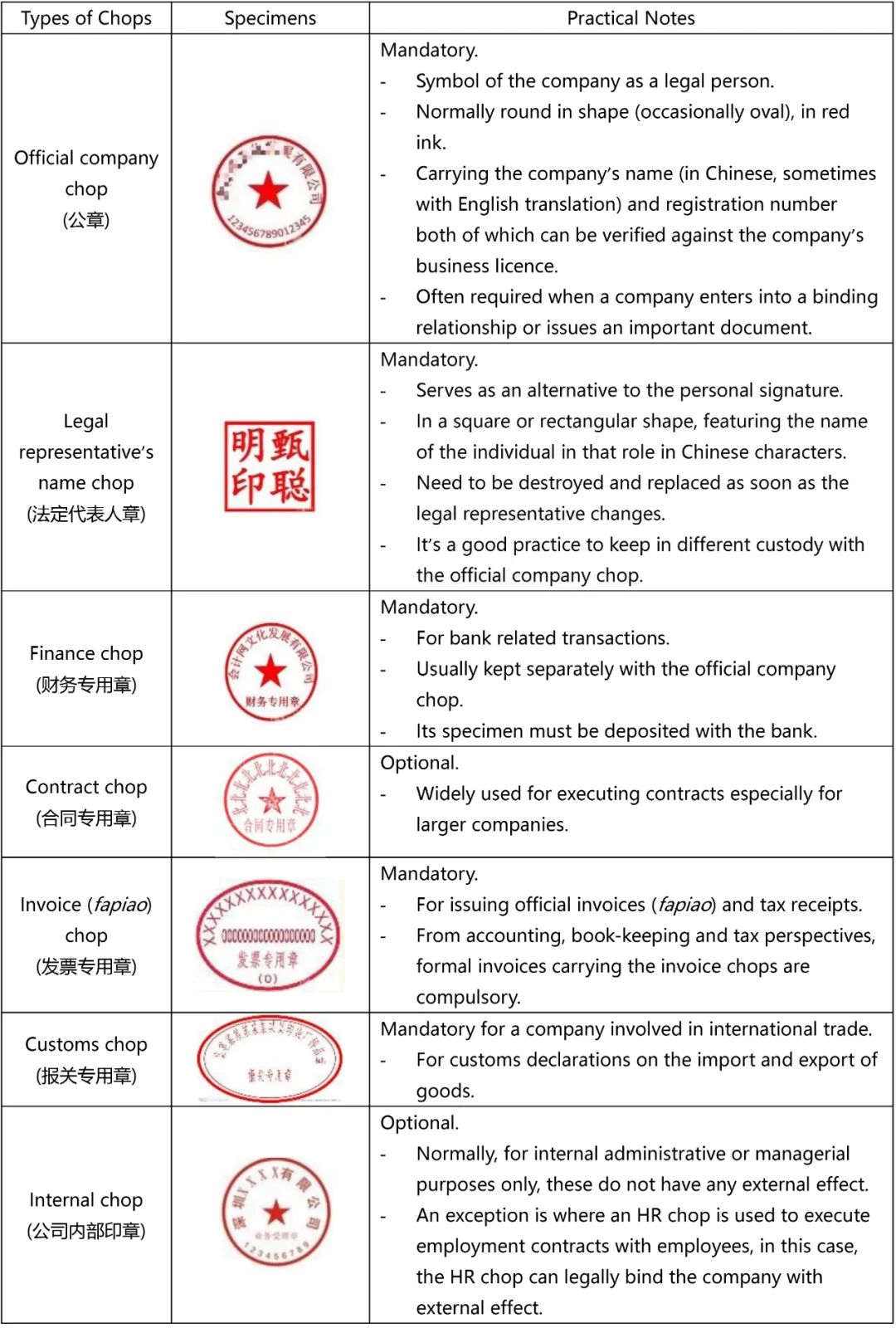
Q4 Digital chops/signatures (电子印章/签名)
A digital chop/signature is the digital equivalent of a given chop/signature used for remote execution of documents. They are usually binding as long as it’s agreed upon by the parties.
To make sure a digital chop or signature is authentic, the executing party should be in sole control and use of the chop/signature creation data. Such data should be only linked to his/her identity. This means simply cutting and pasting an existing symbol do not work. By using a qualified e-signing software or platform, any subsequent changes in the data should be detectable.
The system should integrate all the electronic and encryption information during the execution process, store them in the system and allow future downloads by authorised parties.
In China, service providers of digital chop/signature software should be licensed by relevant authorities. Unlike the widely used DocuSign and SignNow in the West, Chinese providers might be less known to the people outside China. It is advisable to check if a particular provider has been duly licensed before using them to avoid later difficulties.
Some exceptions exist, such as the signing of documents relating to marriage, adoption, inheritance, public utilities, and other documents as stipulated by law and administrative regulations.
We will discuss the authenticity and custody of company chops in the serial article II.
Practical Guidance on Chinese Company Chops: Serial Article
作者:YuhuaYang DaisyLi YangYu来源:通力律师事务所

Businesses in China, unlike their counterparts in most of the western world, make widespread use of