Following amendments to the PRC Company Law at the end of 2013, in the past two years, the Chinese government has launched a series of legislative efforts aimed at reconciling related laws and regulations to realize the full implication of the capital regime reforms. In furtherance of the reforms, on October 28, 2015, the Ministry of Commerce (“MOFCOM”) issued the Decision on Revising Certain Rules and Normative Documents (Announcement (2015) No. 2 of MOFCOM) (“Revising Decision”) to amend provisions in 29 administrative rules and normative documents related to minimum registered capital, contribution timetables, first capital contribution installments, capital verifications, and annual examinations. Provisions concerning foreign investment have been a particular area of focus.
Background on the Revising Decision: Simplification of the Registered Capital System
At the end of 2013, China adopted an amendment to the Company Law (“Company Law Amendment”) to reform the registered capital system. For most companies, except as otherwise provided under laws, administrative regulations or as directed by the State Council, the following requirements no longer exist:
◆ at least 20% of registered capital must be paid-in upon formation (for foreign invested enterprises (“FIEs”), 15% within 90 days of formation) and the remainder paid within 2 years (5 years for investment companies);
◆ minimum amount of registered capital;
◆ minimum cash capital contributions.
Shortly following the issuance of the Company Law Amendment, on February 7, 2014, the State Council issued a policy statement outlining reforms to the registration formalities directed by the Company Law Amendment, the Circular of the State Council on Circulating the Reform Plan for the Registered Capital Registration System (Guofa 2014 No. 7) (“Reform Plan”). The Reform Plan, in the form of a policy statement, calls for comprehensive reforms in the registration regime covering a variety of market participants, such as companies (including FIEs), proprietorships, partnerships, non-corporate enterprises and farmers' specialized cooperatives.
In the same manner, on February 19, 2014, the State Council issued the Decisions to Repeal and Amend Certain Administrative Regulations [Decree No. 648] (“Decree No. 648”). Decree No. 648 amends the provisions not in conformity with the Company Law Amendment and Reform Plan found in eight administrative regulations and abolishes two regulations which regulated capital contributions to FIEs.
In May 2015, the General Office of the State Council promulgated the Notice of the General Office of the State Council on Accelerating the Implementation of the Reform of Registered Capital Registration (Guo Ban Han [2015] No. 14) (“Implementing Notice”). Although the Implementing Notice has not been publicly issued, it forms the basis for the Revising Decision and promotes its formulation and issuance.
Highlights of the Revising Decision: Changes concerning Foreign Investment
One of the key focuses of the Revising Decision is to revise administrative rules and normative documents concerning foreign investment. 16 of the 29 revised rules and documents relate to foreign investment. Certain changes are industry-neutral and touch upon general aspects of foreign investment, and some relate to specific business sectors. Major revisions are summarized below: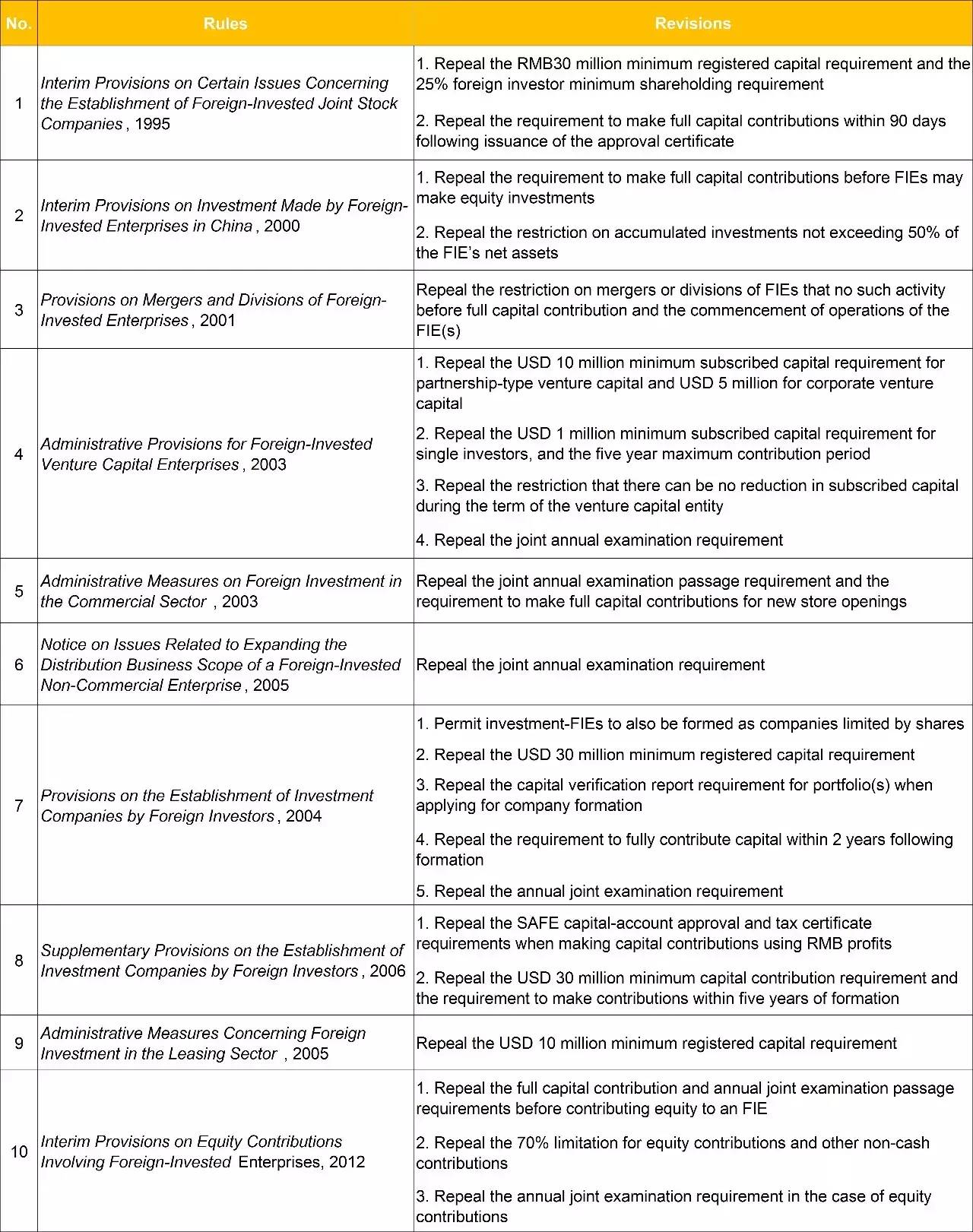
Impact on Foreign Investments: Nice Cleanup and to be Continued
The Reform Plan explicitly stipulates thatall companies are to adopt the subscribed capital regime, except for those incertain ineligible industries. Allcompanies are also to be relieved of the minimum registered capitalrequirement, except as otherwise stipulated under law, administrativeregulation, or as directed by the State Counsel. Despite these developments, however, thereforms have yet to take full effect due to various administrative regulationsand rules that have been left in place. While Decree No. 648 has abolished two administrative regulationsspecifically relating to FIE capital contributions, and has revised theimplementing regulations for FIE-related laws, provisions concerning minimumregistered capital, contribution schedules and similar provisions are stillprevalent in rules of lower force. The Revising Decision has repealed capital-related requirements and restrictions atthe administrative rule level and has cleared obstacles within the legalframework for capital reforms.
From the Company Law Amendment until the recent issuance of the Revising Decision, it is encouraging to see that the regulatory landscape in China is changing to one which is likely more familiar to foreign investors. Foreign investors are expected to enjoy greater flexibility in structuring capitalizations in ways similar to those that they are accustomed to in other jurisdictions. However, the legacy registered capital requirements still await further action. For example, under the current rule concerning M&A activities by foreign investors, foreign investors are still required to follow the statutory contribution timeline when acquiring new capital of a non-FIE company or when forming a new FIE based on assets acquired domestically. While in certain locations such as Beijing, these requirements are not enforced with the understanding of reform in this regard, other local authorities still follow the letter of the rules. We expect these requirements to be repealed in the near future.
The Revising Decision was promulgated by MOFCOM with the consent of other governmental departments, including SAIC, SAFE, CSRC, the State Administration of Taxation, etc., representing a concerted effort towards realizing the Company Law reform initiatives. However, as mentioned above, there continue to be unresolved issues related to the registered capital registration system. We expect to see legislative action soon to address these outstanding questions.
Registered Capital Regime Undergoes Administrative Fine-tuning
作者:DavidTang JunLi SerinaWei来源:汉坤律师事务所

Following amendments to the PRC Company Law at the end of 2013, in the past two years, the Chinese g