Recently, China has intensively promulgated regulations and draft guidance documents on data classification and grading system (see Chart 1). These regulations and documents purport to refine the data classification and grading system stipulated in the regulations already in effect, and provide specific guidance to government departments and organizations to implement the classification and grading system. From the angle of corporate compliance, it is also necessary for enterprise to fulfill complex data compliance obligations based on data classification and grading system. In this article, by "separating the wheat from the chaff" from a very complex legal regime, we briefly analyze three fundamental questions.
1、What is data classification and grading system?
2、Why to implement the system?
3、How to implement the system?
1、What is data classification and grading system
In addition to the important data classification system stipulated in the Data Security Law, various departments and regional governments are gradually formulating data classification rules or guidelines for different sectors to provide reference for enterprises to implement data classification and grading system.
According to Article 21 of the Data Security Law effective on September 1, 2021, the State establishes a data classification and grading protection system to protect data by category and by grade, depending on the importance of the data in economic and social development, and the damage caused to national security, public interests, or the legitimate rights and interests of individuals and organizations if the data is falsified, damaged, disclosed, illegally obtained or illegally used. The national data security coordination mechanism shall coordinate the relevant departments to formulate catalogs of important data, and strengthen the protection of important data. Data concerning national security, lifelines of the national economy, important people’s livelihood, major public interests, etc. are core data of the State, and shall be subject to a stricter management system. All regions and departments shall, under the data classification and grading protection system, determine the specific catalogue of important data for their respective regions and departments and for relevant industries and fields, and give priority to the protection of data included in the catalogue.
Data classification and grading system does not apply to important data only. The system guides enterprises to (i) classify all the data which they possess according to laws and regulations and the actual situations of the enterprises themselves, and (ii) on the basis of such classification, manage such data according to the importance and severity of "disaster consequences" of different categories of data.
Followed by the important data classification system, data classification and grading system is evolving, which includes mainly the following regulations, normative documents and policies.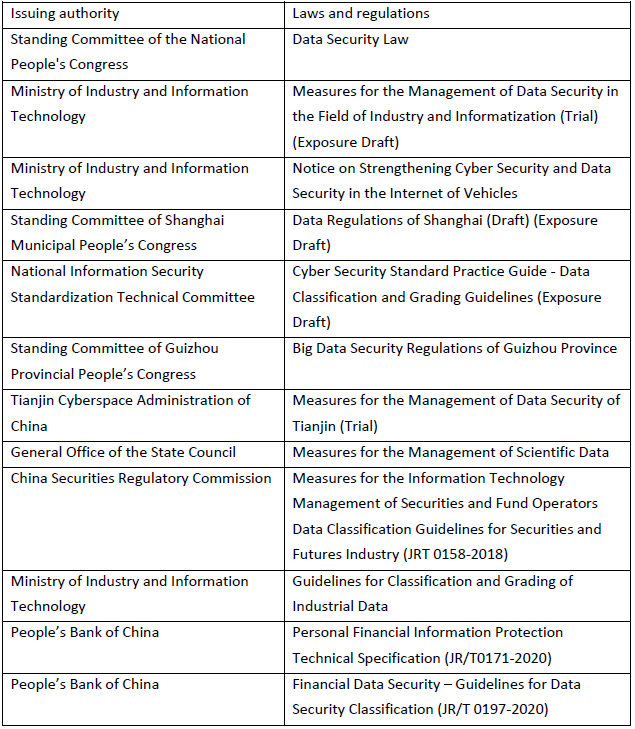
Chart 1, Major regulations and documents on data classification and grading system
2、Why to implement the system
From the perspective of regulatory supervision, it is imperative to implement data classification and grading system so as to enforce the regulatory requirements on important data and others supervised data set forth in the Cyber Security Law, the Data Security Law, the Personal Information Protection Law and other laws and regulations. At the same time, data classification and grading can also facilitate the regulator’s policy to promote the opening and sharing of data and enhance the value of data resources.
From the perspective of corporate compliance, enterprises not only face compliance obligations relating to personal information and important data, but also special categories of data applicable in their industries and fields. If an enterprise does not conduct a thorough assessment on its possessed data and manage data by category and by grade accordingly, it would be extremely difficult (if not impossible) to fulfill data compliance obligations.
As a data processor, an enterprise must fulfill its legal obligation of data classification and grading. In addition, in order to fulfill various data compliance obligations regarding personal information protection, data collection and use, data export, and important data, it is necessary for the enterprise to properly implement data classification and grading. In accordance with relevant laws and regulations, an enterprise that fails to perform data classification and grading obligations may be subject to administrative penalties such as discredit record, public exposure, confiscation of illegal income, fines, suspension of business, suspension for rectification, closure of websites, revocation of licenses and permits, or revocation of business licenses; and if a crime is constituted, criminal liability shall be investigated in accordance with the law.
For enterprises in specific industries (for example healthcare industry undertakings), certain internal business data (for example, population health information and human genetic resource information) may constitute specially regulated data. Failure to separately process and protect such data may cause a violation of special laws and regulations.
Currently, the relevant regulations and documents are still in the draft exposure stage. Enterprises naturally wonder whether they should wait until the relevant regulations and documents become effective to implement data classification and grading. Judging from legislation and law enforcement practices, we recommend that enterprises should NOT take a “wait and see” attitude. Rather, it is advisable for enterprises to proactively implement data classification and grading. First, as a new legal branch, China’s legislation on data classification and grading system has been “crossing the river by feeling the stones”, and its legislative logic has also undergone a change from “bottom-up” to “top-down” (see our previous article The Stronger Ability, the Greater Responsibility - A Review of the Data Classification and Grading System). The newly released Cyber Security Standard Practice Guide - Data Classification and Grading Guidelines (Exposure Draft) includes several specific principles of data classification and grading, one of which is the principle of "autonomy". That is, under the State’s framework of data classification and grading rules, and according to specific management needs, industries, fields, localities or organizations shall independently refine and determine the categories and grades of data under their own jurisdictions. Therefore, under the premise that the framework rules are basically completed, enterprises should start considering refinement on their own; secondly, as mentioned above, enterprises must thoroughly sort out the data which they possess, implement data classification and grading system, and take different control and protection measures for data of different importance and sensitivity levels, establish and improve the internal process of data risk management. Doing so will help enterprises fulfill other obligations regarding cyber security and data compliance.
3、How to implement the system
By referring to relevant laws and regulations and law enforcement practices, we summarize the hardcore for enterprises to implement data classification and grading.
(1) Establish a joint taskforce composed of personnel from departments of legal and compliance, IT, and business
To implement data classification and grading, it is necessary to complete tasks such as identifying data, understanding regulatory requirements, identifying objects harmed by data incidents and degree of harm, which require the joint efforts of legal and compliance, IT, and business personnel.
For example, an enterprise often possesses structured data (RDD, SQL, NOSQL, JSON, etc.), semi-structured data (log files, XML documents, Email, etc.), and unstructured data (office documents, text, pictures, HTML, reports, images, audio and video materials, etc.). Structured and semi-structured data may be "unreadable" for legal and compliance personnel and business personnel. Interpretation of these data requires the support from the enterprise’s IT department; on the other way around, IT department relies on the professional interpretation of the legal and compliance department on legal and compliance requirements. Even seemingly basic legal issues require a professional advice. For example, the identification of the scope of personal information (which is protected by law) must be performed based on laws, regulations, judicial practices and enforcement practices; analysis of the consequences of data tampering, destruction, and leakage depends on the business department’s detailed explanation on the data source, purpose, impact on upstream and downstream industries, etc.
(2) Classify data
According to relevant laws and regulations, enterprises should first classify and then grade data, classify and label data according to factors such as industry requirements, business needs, data sources and uses, formulate data classification lists and regularly update the lists.
Generally, an enterprise can classify its possessed data into three categories: public data, personal information, and enterprise data. Each category of data can be further subdivided according to laws and regulations, and enterprises’ own needs and actual conditions.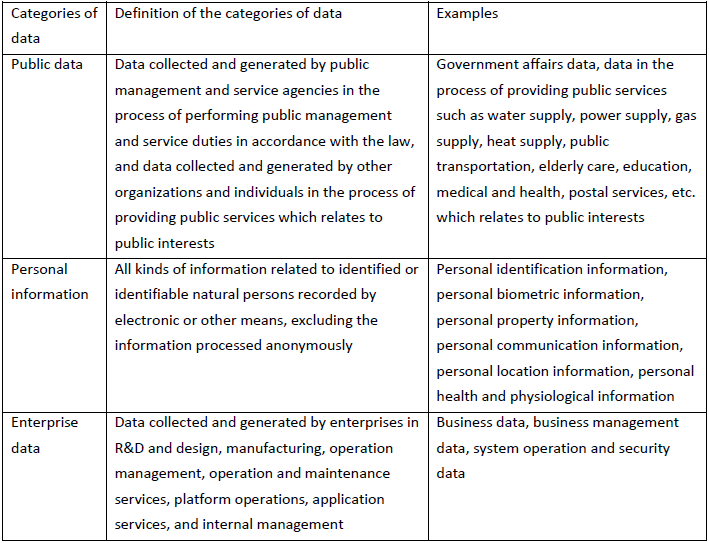
Chart 2, Categories of data
(3) Grade data
Enterprises can refer to the data grading rules set forth in the Cyber Security Standard Practice Guide - Data Classification and Grading Guidelines (Exposure Draft), classify various categories of data as ordinary data (Levels 1 to 3), important data (Level 4) and core data (Level 5). If certain data spans more than one level, then it should be graded at a highest level.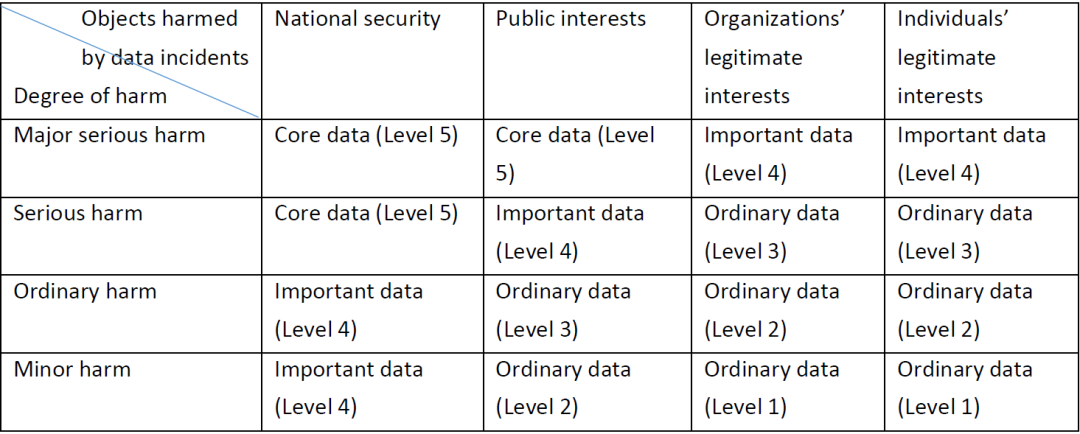
Chart 3, Data grading rules
Undoubtedly, it is important for enterprises to determine whether the data they possess belongs to core data and important data. If an enterprise possesses core data and important data, it must manage such data in accordance with laws and regulations. Taking pharmaceutical enterprises as an example, enterprises can consider the following two steps for conducting the assessment.
Step one: Whether enterprises possess any of the following data:
Related to infectious diseases, new biotechnology, laboratory biology, important national genetic resources and genetic data;
Related to emergent infectious diseases, major animal and plant epidemics, microbial resistance, and biotechnology environmental safety;
Personal privacy, patient and reporter information obtained during the reporting and monitoring of adverse drug and contraceptive reactions;
Personal privacy and related disease and epidemiological information of infectious disease patients and their families and close contacts obtained during the monitoring of public health emergencies and infectious disease epidemics;
Various types of diagnosis, treatment, and health data information such as personal electronic medical records and health files kept by medical institutions and health management service institutions;
Personal information of human organ donors, recipients and applicants for human organ transplantation in the medical service of human organ transplantation;
Personal information of sperm and egg donors and users in human assisted reproductive technology services and applicants for such services;
Personal privacy involved in the process of family planning services;
Genetic information of individuals and families;
Life registration information.
Step two: Analyze the degree of harm to national public health security and interests, the business service capabilities of enterprises and upstream and downstream industries, and individuals’ legitimate rights if such data is tampered, destroyed, leaked, or illegally obtained or used illegally, and identify the grade of data, by referring to Chart 3.
(4) Manage data by category and by grade
After data classification and grading are completed, enterprises shall perform external and internal compliance obligations in accordance with laws and regulations. Externally, enterprises shall perform filing and data security assessment obligations etc. to the regulatory authorities. Internally, enterprises shall manage data by category in accordance with the data CIA principles (i.e., confidentiality, integrity, and accessibility).
Three Fundamental Questions on Data Classification Compliance
作者:DavidPan NigelZhu SusanDeng StellaHuang来源:通力律师事务所

Recently, China has intensively promulgated regulations and draft guidance documents on data classif