
02、南非矿业投资准入审查内容
Elements of an access review for the South African mining sector
南非作为一个矿产资源极为丰富的国家,在矿业投资方面提供了广泛的机遇,涵盖黄金、钻石、铂族金属、煤炭、铁矿石、锰、铬、铜、铅、锌、钛、钒、镍等多种矿产资源。南非政府通过《矿产与石油资源开发法》(MPRDA)和《黑人经济振兴法案》(BEE)等立法,为矿业投资建立了明确的法律框架,2018 年《矿业宪章》规定,采矿公司必须遵守广义黑人经济振兴法案(Broad Based Black Economic Empowerment, B-BBEE), 采矿权持有人在拥有采矿权的 5 年内将黑人持股比例从26%提高到至少30%。同时,政府积极吸引外国直接投资,并通过设立经济特区等措施促进基础设施建设和大型项目开发(张梦婷,2019)。外国投资者可以通过设立全资子公司、合资企业或收购现有矿业公司等方式进入南非市场,但需经过严格的尽职调查,并向南非矿业和能源部申请勘探许可证或采矿权。此外,还需进行环境影响评估并获得相应的环保许可,与当地社区协商确保项目的社区接受度,并可能需要签署利益共享协议。尽管南非提供了丰富的投资机会,但也存在政策不确定性、劳工关系紧张、基础设施限制、电力供应不稳定等风险因素(詹德康,2024)。具体而言以下是南非矿业准入的重点:
As an extremely mineral-rich country, South Africa offers a wide range of opportunities for mining investment, covering a wide range of mineral resources such as gold, diamonds, platinum group metals, coal, iron ore, manganese, chromium, copper, lead, zinc, titanium, vanadium and nickel. The South African government has established a clear legal framework for mining investment through legislation such as the Mineral and Petroleum Resources Development Act (MPRDA) and the Black Economic Empowerment (BEE) Act, and the Mining Charter 2018 states that mining companies must comply with the Broad Based Black Economic Empowerment (B -The 2018 Mining Charter stipulates that mining companies must comply with the Broad Based Black Economic Empowerment (BBEE) Act, which requires holders of mining rights to increase their black shareholding from 26 percent to at least 30 percent within five years of owning the rights. Meanwhile, the government actively attracts foreign direct investment and promotes infrastructure construction and large-scale project development through measures such as the establishment of special economic zones (Zhang Mengting, 2019). Foreign investors can enter the South African market by setting up wholly-owned subsidiaries, joint ventures, or acquiring existing mining companies, but they need to undergo rigorous due diligence and apply for exploration licenses or mining rights from the South African Department of Mines and Energy. In addition, environmental impact assessments and appropriate environmental permits are required, consultations with local communities to ensure community acceptance of the project, and benefit-sharing agreements may need to be signed. While South Africa offers a wealth of investment opportunities, there are also risk factors such as policy uncertainty, labor tensions, infrastructure constraints, and unstable power supply (Zhan Dekang, 2024). Specifically the following are highlights of mining access in South Africa:
2.1. 法律保留地的勘探红线
Exploration red lines on legally reserved lands
《矿业与石油资源开发法》第48条规定,不得就以下土地颁发勘察许可、探矿权、采矿权或采矿许可证:住宅区、任何公共道路、铁路或墓地、任何用于公共或政府目的或根据任何其他法律保留的土地;或部长根据第49 条以宪报公告的方式确定的区域,例如国家公园和军事区。且在南非任何地区探矿或移除、开采、进行技术合作作业、侦测作业、勘探或开始任何附带作业,至少提前21天书面通知土地所有权人或有关土地的合法占有人(张小虎等,2021)。
Section 48 of the Mining and Petroleum Resources Development Act provides that no exploration permit, prospecting right, mining right or mining license shall be granted in respect of: a residential area, any public road, railroad or cemetery, any land used for public or governmental purposes or reserved under any other law; or an area determined by the Minister by way of a gazette notification in terms of section 49, such as national parks and military areas. And to give at least 21 days' written notice to the owner of the land or to the person in lawful possession of the land in question of prospecting or removal, mining, technical cooperation operations, reconnaissance operations, exploration or the commencement of any operations incidental thereto in any area in South Africa (Zhang Xiaohu et al., 2021).
2.2. 南非矿业投资准入形式—设新VS.并购
Mining investment access form-establishment of new vs. mergers and acquisitions
南非政府奉行市场经济政策,积极吸引外资,对国外资本秉持自由开放的态度,将外资作为推动本国经济增长、提高国际竞争力的重要手段,对与外国资本除非涉及国家安全利益,均不进行强制性入境审查。但矿业投资由于涉及对国家安全的安全较为敏感,对于外国资本对本国矿企的兼并收购设置重重监管,实务中操作难度较大(张梦婷,2019)。在南非进行矿业企业的并购(M&A)时,法律与合规性是首要考虑的因素,包括详尽的尽职调查、遵守竞争法以及确保交易符合黑人经济赋权(BEE)的要求。此外,政策环境的稳定性也需要密切注意,同时了解和利用可用的税收优惠。在社会与环境责任方面,必须遵守严格的环境保护法规,维护与当地社区的良好关系,并履行企业社会责任(CSR)。劳动关系方面,需妥善处理与工会的关系,并制定合理的员工安置方案。财务与风险管理则涉及资金筹集和建立有效的风险管理机制。市场竞争状况分析也是必不可少的,包括市场需求与供给状况的评估以及竞争对手的考量。并购后的文化融合和业务整合同样重要,需制定详细的整合计划。最后,政治风险也不容忽视,包括与政府保持良好关系以及对政策变化的准备(詹德康,2024)。
The South African government pursues market economy policy, actively attracts foreign capital, upholds a free and open attitude towards foreign capital, takes foreign capital as an important means to promote the country's economic growth and improve international competitiveness, and does not carry out mandatory entry examination of foreign capital unless it involves national security interests. However, mining investment is more sensitive because it involves national security, and the merger and acquisition of domestic mining enterprises by foreign capital is heavily regulated, and it is difficult to operate in practice (Zhang Mengting, 2019). When conducting mergers and acquisitions (M&A) of mining companies in South Africa, legal and compliance are the primary considerations, including exhaustive due diligence, adherence to competition law, and ensuring that the transaction meets the requirements of Black Economic Empowerment (BEE). In addition, the stability of the policy environment requires close attention, as well as understanding and utilizing available tax incentives. In terms of social and environmental responsibility, it is important to comply with strict environmental protection regulations, maintain good relations with the local community and fulfill corporate social responsibility (CSR). In terms of labor relations, it is necessary to properly manage the relationship with labor unions and develop a reasonable employee resettlement plan. Financial and risk management involves raising funds and establishing an effective risk management mechanism. Analysis of market competition is also essential, including assessment of market demand and supply and consideration of competitors. Post-merger cultural integration and business integration are equally important, and detailed integration plans need to be formulated. Finally, political risks should not be ignored, including maintaining a good relationship with the government and preparing for policy changes (Zhan, 2024).
相较于操作审查复杂的跨国投资并购,外国投资者通常设立私人公司和公共企业开发矿产。南非设立企业的形式可以是“法人实体”也可以“非法人实体”,矿企设立的的公司只能是独立的法人实体,且对公司的债务和税务承担独立责任(何金祥等,2021)。但是,外部公司(即在南非开展业务的外国公司)、合资企业或合伙企业也可用于在南非开展采矿业务。外国公司在南非建立采矿业务时,通常会选择成立私人公司。这是因为私人公司拥有有限责任、独立的法人资格,并且即使股权发生变更也能保持持续运营的特点。与上市公司相比,私人公司在公司治理和财务报告方面的要求较为宽松。
In contrast to cross-border investment mergers and acquisitions (M&As), where operational scrutiny is complex, foreign investors usually set up private companies and public enterprises to develop minerals. In South Africa, companies can be set up as either “legal entities” or “unincorporated entities”, and the companies set up by miners can only be independent legal entities with separate liabilities for debts and taxes (Ho et al., 2021). However, external companies (i.e. foreign companies operating in South Africa), joint ventures or partnerships can also be used to establish mining operations in South Africa. When foreign companies establish mining operations in South Africa, they usually choose to form private companies. This is due to the fact that private companies have limited liability, separate legal personality and the ability to continue operations even if there is a change in shareholding. Private companies have less stringent corporate governance and financial reporting requirements than listed companies.
03、南非海外矿业投资准入要求分析
Entry Requirements for South Africa's Overseas Mining Investments
准入要求通常指为促进东道国经济与社会发展对外国投资加以规范限制条件的总称,以促使外国投资者投资本国的过程中做出有利于当地经济发展的决定(余劲松,2014)。南非的矿业投资准入包含了一系列旨在促进当地经济发展和社会福利的地方成分要求。南非矿业投资准入的条件就是要求国外矿业投资者在践行2013年《广义黑人经济振兴法》的基础上,根据南非的黑人经济授权(BEE)政策,矿业公司需确保一定的股权由黑人企业持有,通常情况下,这包括至少26%的股份权益,其中5%必须是非转移性的。此外,还有专门针对女性持股的规定。除了股权要求外,公司还需确保员工和矿区周边社区分别持有至少5%的非转移性权益(张宁,2022)。除此之外,矿业公司还需要遵守其他地方成分要求,如优先采购本地产品和服务、优先雇佣本地劳动力、优先进行技术转让以及参与社区发展计划等。为吸引外资,南非政府还可能提供一系列激励措施,包括税收减免和其他财政支持。
Access requirements usually refers to the general term for the regulatory restrictions on foreign investment to promote the economic and social development of the host country, in order to induce foreign investors to make decisions in favor of local economic development in the process of investing in their home country (Yu Jinsong, 2014). Mining investment access in South Africa encompasses a series of local component requirements aimed at promoting local economic development and social welfare. A condition of mining investment access in South Africa is the requirement for foreign mining investors to practice the Broad-Based Black Economic Revitalization Act of 2013, and under South Africa's Black Economic Empowerment (BEE) policy, mining companies are required to ensure that a certain amount of equity is held by black-owned businesses, which typically includes at least 26% of the shareholding interest, of which 5% must be non-transferable. In addition, there are provisions specifically for female shareholdings. In addition to the equity requirements, companies need to ensure that employees and the communities surrounding the mine hold at least 5% non-transferable interest each (Ning Zhang, 2022). In addition to this, mining companies are also required to comply with other local component requirements, such as prioritizing the procurement of local products and services, prioritizing the hiring of local labor, prioritizing technology transfer, and participating in community development programs. To attract foreign investment, the South African government may also offer a range of incentives, including tax breaks and other financial support.
3.1 持股比例要求
Shareholding requirements
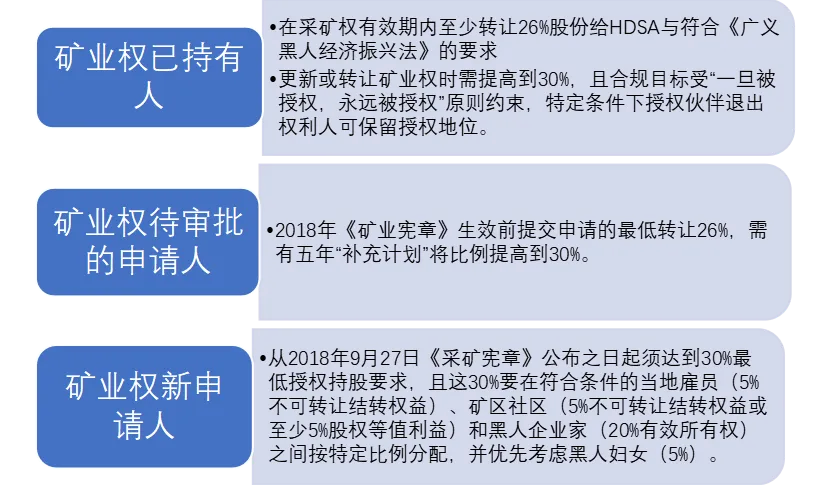
南非矿业投资准入的持股比例要求因矿业权状态不同而有差异。
The shareholding requirements for access to mining investment in South Africa vary depending on the status of the mineral rights.
3.2 当地成分要求
南非政府对矿业的采购供应商的上下游产业链提出极高的当地成分要求。这一点可以在“BEE政策”只能够可以看出。BEE规定,企业实体需要在优惠采购的25分中至少应保证40%即10分;在供应商发展的10分中至少保证40%即4分;在企业发展的5分中至少获得40%即2分。因此,一家企业为了保持B-BBEE整体地位的不下降,则应至少拥有16分的强制性当地成分要求,且这种趋势随着南非经济的发展,呈现出逐年幅度上升的趋势。
The South African government places very high local content requirements on the upstream and downstream chains of suppliers to the mining industry. This can only be seen in the BEE Policy, which states that a business entity needs to secure at least 40% of the 25 points for preferential procurement (10 points), 40% of the 10 points for supplier development (4 points), and 40% of the 5 points for business development (2 points). Therefore, in order for a company to maintain a non-declining overall B-BBEE status, then it should have at least 16 points of the mandatory local component requirement, and this trend is showing an increasing year-on-year magnitude as the South African economy grows.
根据2018年的《矿业宪章》,南非对矿业公司在矿产品和服务采购方面设定了明确的地方成分要求。在矿产品采购方面,宪章规定,矿业公司的矿产品采购总支出(包括不可控支出,)中至少70%必须用于购买所谓的“南非制造的产品”( 不包括利润加价、无形价值和间接费用)。即在南非境内组装或制造,并且当地含量至少达到60%的产品。此外,这部分支出中的70%必须按照如下方式进行分配:21%用于历史上处于不利地位的人(HDP)拥有和控制的企业;5%用于由妇女或青年拥有和控制的企业;剩余的44%则需用于符合黑人经济授权(BEE)标准的企业。在服务采购方面,《矿业宪章》同样设定了严格的地方成分要求(张宁,2022)。宪章规定,矿业公司的服务总支出(包括不可控支出)中至少80%必须用于南非本土的服务提供商。其中,50%用于由HDP拥有和控制的企业提供的服务;15%用于由妇女拥有和控制的企业提供的服务;5%用于由青年拥有和控制的企业提供的服务;以及10%用于由符合BEE标准的企业提供的服务。这些规定旨在通过促进本地采购来增强南非经济的发展,并推动历史上的社会不公现象得到纠正。值得注意的是,随着时间推移,相关规定可能会有所更新或调整,具体条款应当以南非政府发布的最新版本为准(詹德康,2024)。尽管上述严苛的当地成分要求可能违反南非在关《关税及贸易总协定-GATT》和《服务贸易总协定-GATS》项下给予“进口产品不低于本国同类产品的待遇”的国际义务,但投资者若想顺利进入南非矿业市场则必须遵守《矿业宪章》规定的“禁止从外国供应商那里获得任何超过20%的产品或服务”的强制性规定。
Under the 2018 Mining Charter, South Africa has set clear local content requirements for mining companies in terms of mineral product and service sourcing. In terms of mineral procurement, the Charter stipulates that at least 70% of a mining company's total mineral procurement expenditure (including uncontrollable expenditure) must be spent on so-called “South African-made products” (excluding profit mark-ups, intangible values and overheads). This means products that are assembled or manufactured in South Africa and have at least 60% local content. In addition, 70% of this expenditure must be allocated as follows: 21% to businesses owned and controlled by historically disadvantaged people (HDPs); 5% to businesses owned and controlled by women or youth; and the remaining 44% to businesses that meet the criteria for Black Economic Empowerment (BEE). In terms of service procurement, the Mining Charter similarly sets strict local component requirements (Zhang Ning, 2022). The Charter stipulates that at least 80% of a mining company's total expenditure on services (including uncontrollable expenditure) must be spent on South African-based service providers. Of this, 50% is to be spent on services provided by HDP-owned and controlled businesses; 15% on services provided by women-owned and controlled businesses; 5% on services provided by youth-owned and controlled businesses; and 10% on services provided by BEE-compliant businesses. These provisions are intended to enhance the development of the South African economy through the promotion of local sourcing and to facilitate the redress of historical social injustices. It is worth noting that the regulations may be updated or adjusted over time, and the specific provisions should be based on the most recent version issued by the South African government (Jandekom, 2024). While these stringent local content requirements may violate South Africa's international obligations under the General Agreement on Tariffs and Trade (GATT) and the General Agreement on Trade in Services (GATS) to treat imports no less favorably than their domestic counterparts, investors wishing to enter South Africa's mining market must comply with the Mining Charter's “prohibition on importing from foreign sources” (JDK, 2024), which prohibits the import of goods from foreign countries. However, investors wishing to enter the South African mining market must comply with the Mining Charter's mandatory requirement to “prohibit the acquisition of any product or service from a foreign supplier in excess of 20% of the value of the product or service”.
除此之外,外国矿企投资者还应符合南非当地的“社区参与和发展要求“,即矿业公司通常需要与当地社区合作,通过社区发展计划来改善当地基础设施、教育、卫生等条件,这不仅是社会责任的一部分,也是市场准入的条件之一。”就业和技能发展要求“矿业投资者需要承诺提供一定数量的工作岗位给南非公民,并且需要实施技能发展计划,以提高当地劳动力的技术水平。”环境保护要求“,矿业活动必须遵守严格的环境保护法规,包括采取必要的措施减少对环境的影响,恢复受损的土地,并确保水资源的可持续使用(陶霞等,2024)。”法律合规性要求“,即投资者需要遵守南非的所有相关法律法规,包括《矿业宪章》、《矿业法》以及其他与矿业相关的法律法规,确保其经营活动合法合规。以及”透明度和治理要求“,矿业公司需要保持高水平的透明度,并建立良好的公司治理结构,以防止腐败和促进公平竞争。
In addition, foreign mining investors should also comply with South Africa's local “community engagement and development requirements”, which means that mining companies are often required to work with local communities to improve local infrastructure, education, health and other conditions through community development programs, not only as part of their social responsibility, but also as a condition for market access. ” Employment and Skills Development Requirements “Mining investors are required to commit to providing a certain number of jobs to South African citizens and are required to implement skills development programs to improve the skill levels of the local workforce.” Environmental Protection Requirements”, mining activities must comply with strict environmental protection regulations, including taking the necessary measures to minimize environmental impacts, rehabilitate damaged land, and ensure the sustainable use of water resources (Tao Xia et al., 2024).” Legal Compliance Requirements”, i.e., investors are required to comply with all relevant laws and regulations in South Africa, including the Mining Charter, the Mining Act, and other mining-related laws and regulations, to ensure that their operations are legally compliant. As for “transparency and governance requirements”, mining companies need to maintain a high level of transparency and establish a good corporate governance structure to prevent corruption and promote fair competition.
引用
1, 余劲松:《国际投资法》,法律出版社 2014 年版,第121 页。
2, 陶霞,季营,张明慧,等.南非矿山环境管理制度研究及启示[J].煤炭技术,2024,43(09):292-295.DOI:10.13301/j.cnki.ct.2024.09.060.
3, 詹德康.(2024).中国对非洲关键矿产投资的国别风险研究(硕士学位论文,商务部国际贸易经济合作研究院).
4, 王海军.共期凿取中国-南非矿业融合发展的“红旗渠”[J].中国有色金属,2022,(09):46-47
5, 张小虎 & 赵倩.(2021).论南非矿业本土化的立法规制与风险防范.中国国土资源经济(02),49-55.doi:10.19676/j.cnki.1672-6995.000528.
6, 张宁.(2022).南非矿业投资准入法律制度研究(硕士学位论文,湘潭大学).硕士https://link.cnki.net/doi/10.27426/d.cnki.gxtdu.2022.000687doi:10.27426/d.cnki.gxtdu.2022.000687.
7, 何金祥,崔荣国,徐曙光,等.南非、赞比亚、刚果(金)和津巴布韦矿业投资环境和走势[J].国土资源情报,2021,(05):11-19.
8, 张梦婷.(2019).我国对南非投资的环保法律风险及其应对(硕士学位论文,湘潭大学).https://link.cnki.net/doi/10.27426/d.cnki.gxtdu.2019.000093doi:10.27426/d.cnki.gxtdu.2019.000093
9, 何金祥.南非矿产工业的现状、挑战和前景[J].中国矿业,2019,28(11):48-51.
Citation
1, Yu Jinsong, International Investment Law, Law Press, 2014, p. 121.
2, Tao Xia, Ji Ying, Zhang Minghui, et al. Research and inspiration of environmental management system of South African mines[J]. Coal Technology,2024,43(09):292-295.DOI:10.13301/j.cnki.ct.2024.09.060.
3, Zhan, D. K.. (2024). Country Risk Study on China's Investment in Key Minerals in Africa (Master's thesis, Institute of International Trade and Economic Cooperation, Ministry of Commerce).
4, Wang Haijun. The “Red Flag Canal” for China-South Africa Mining Integration and Development[J]. China Nonferrous Metals,2022,(09):46-47.
5, Zhang Xiaohu & Zhao Qian. 2011 The development of the Chinese non-ferrous metals industry [J]. (2021). On the Legislation and Risk Prevention of Mining Localization in South Africa. China Land Resources Economics (02), 49-55. doi:10.19676/j.cnki.1672-6995.000528.
6, Zhang, N.. (2022). Research on the legal system of mining investment access in South Africa (Master's thesis, Xiangtan University). Master's degree. https://link.cnki.net/doi/10.27426/d.cnki.gxtdu.2022.000687doi:10.27426/d.cnki.gxtdu.2022.000687.
7, He Jinxiang, Cui Rongguo, Xu Shuguang, et al. Mining Investment Environment and Trend in South Africa, Zambia, DRC and Zimbabwe[J]. Land Resources Intelligence,2021,(05):11-19.
8, Zhang, Mengting. (2019). Environmental Legal Risks of China's Investment in South Africa and Its Response (Master's Thesis, Xiangtan University).https://link.cnki.net/doi/10.27426/d.cnki.gxtdu.2019.000093doi:10.27426/d.cnki.gxtdu.2019.000093
9, He Jinxiang. Current Situation, Challenges and Prospects of South Africa's Mineral Industry[J]. China Mining Industry,2019,28(11):48-51.
Elements of an access review for the South African mining sector
南非作为一个矿产资源极为丰富的国家,在矿业投资方面提供了广泛的机遇,涵盖黄金、钻石、铂族金属、煤炭、铁矿石、锰、铬、铜、铅、锌、钛、钒、镍等多种矿产资源。南非政府通过《矿产与石油资源开发法》(MPRDA)和《黑人经济振兴法案》(BEE)等立法,为矿业投资建立了明确的法律框架,2018 年《矿业宪章》规定,采矿公司必须遵守广义黑人经济振兴法案(Broad Based Black Economic Empowerment, B-BBEE), 采矿权持有人在拥有采矿权的 5 年内将黑人持股比例从26%提高到至少30%。同时,政府积极吸引外国直接投资,并通过设立经济特区等措施促进基础设施建设和大型项目开发(张梦婷,2019)。外国投资者可以通过设立全资子公司、合资企业或收购现有矿业公司等方式进入南非市场,但需经过严格的尽职调查,并向南非矿业和能源部申请勘探许可证或采矿权。此外,还需进行环境影响评估并获得相应的环保许可,与当地社区协商确保项目的社区接受度,并可能需要签署利益共享协议。尽管南非提供了丰富的投资机会,但也存在政策不确定性、劳工关系紧张、基础设施限制、电力供应不稳定等风险因素(詹德康,2024)。具体而言以下是南非矿业准入的重点:
As an extremely mineral-rich country, South Africa offers a wide range of opportunities for mining investment, covering a wide range of mineral resources such as gold, diamonds, platinum group metals, coal, iron ore, manganese, chromium, copper, lead, zinc, titanium, vanadium and nickel. The South African government has established a clear legal framework for mining investment through legislation such as the Mineral and Petroleum Resources Development Act (MPRDA) and the Black Economic Empowerment (BEE) Act, and the Mining Charter 2018 states that mining companies must comply with the Broad Based Black Economic Empowerment (B -The 2018 Mining Charter stipulates that mining companies must comply with the Broad Based Black Economic Empowerment (BBEE) Act, which requires holders of mining rights to increase their black shareholding from 26 percent to at least 30 percent within five years of owning the rights. Meanwhile, the government actively attracts foreign direct investment and promotes infrastructure construction and large-scale project development through measures such as the establishment of special economic zones (Zhang Mengting, 2019). Foreign investors can enter the South African market by setting up wholly-owned subsidiaries, joint ventures, or acquiring existing mining companies, but they need to undergo rigorous due diligence and apply for exploration licenses or mining rights from the South African Department of Mines and Energy. In addition, environmental impact assessments and appropriate environmental permits are required, consultations with local communities to ensure community acceptance of the project, and benefit-sharing agreements may need to be signed. While South Africa offers a wealth of investment opportunities, there are also risk factors such as policy uncertainty, labor tensions, infrastructure constraints, and unstable power supply (Zhan Dekang, 2024). Specifically the following are highlights of mining access in South Africa:
2.1. 法律保留地的勘探红线
Exploration red lines on legally reserved lands
《矿业与石油资源开发法》第48条规定,不得就以下土地颁发勘察许可、探矿权、采矿权或采矿许可证:住宅区、任何公共道路、铁路或墓地、任何用于公共或政府目的或根据任何其他法律保留的土地;或部长根据第49 条以宪报公告的方式确定的区域,例如国家公园和军事区。且在南非任何地区探矿或移除、开采、进行技术合作作业、侦测作业、勘探或开始任何附带作业,至少提前21天书面通知土地所有权人或有关土地的合法占有人(张小虎等,2021)。
Section 48 of the Mining and Petroleum Resources Development Act provides that no exploration permit, prospecting right, mining right or mining license shall be granted in respect of: a residential area, any public road, railroad or cemetery, any land used for public or governmental purposes or reserved under any other law; or an area determined by the Minister by way of a gazette notification in terms of section 49, such as national parks and military areas. And to give at least 21 days' written notice to the owner of the land or to the person in lawful possession of the land in question of prospecting or removal, mining, technical cooperation operations, reconnaissance operations, exploration or the commencement of any operations incidental thereto in any area in South Africa (Zhang Xiaohu et al., 2021).
2.2. 南非矿业投资准入形式—设新VS.并购
Mining investment access form-establishment of new vs. mergers and acquisitions
南非政府奉行市场经济政策,积极吸引外资,对国外资本秉持自由开放的态度,将外资作为推动本国经济增长、提高国际竞争力的重要手段,对与外国资本除非涉及国家安全利益,均不进行强制性入境审查。但矿业投资由于涉及对国家安全的安全较为敏感,对于外国资本对本国矿企的兼并收购设置重重监管,实务中操作难度较大(张梦婷,2019)。在南非进行矿业企业的并购(M&A)时,法律与合规性是首要考虑的因素,包括详尽的尽职调查、遵守竞争法以及确保交易符合黑人经济赋权(BEE)的要求。此外,政策环境的稳定性也需要密切注意,同时了解和利用可用的税收优惠。在社会与环境责任方面,必须遵守严格的环境保护法规,维护与当地社区的良好关系,并履行企业社会责任(CSR)。劳动关系方面,需妥善处理与工会的关系,并制定合理的员工安置方案。财务与风险管理则涉及资金筹集和建立有效的风险管理机制。市场竞争状况分析也是必不可少的,包括市场需求与供给状况的评估以及竞争对手的考量。并购后的文化融合和业务整合同样重要,需制定详细的整合计划。最后,政治风险也不容忽视,包括与政府保持良好关系以及对政策变化的准备(詹德康,2024)。
The South African government pursues market economy policy, actively attracts foreign capital, upholds a free and open attitude towards foreign capital, takes foreign capital as an important means to promote the country's economic growth and improve international competitiveness, and does not carry out mandatory entry examination of foreign capital unless it involves national security interests. However, mining investment is more sensitive because it involves national security, and the merger and acquisition of domestic mining enterprises by foreign capital is heavily regulated, and it is difficult to operate in practice (Zhang Mengting, 2019). When conducting mergers and acquisitions (M&A) of mining companies in South Africa, legal and compliance are the primary considerations, including exhaustive due diligence, adherence to competition law, and ensuring that the transaction meets the requirements of Black Economic Empowerment (BEE). In addition, the stability of the policy environment requires close attention, as well as understanding and utilizing available tax incentives. In terms of social and environmental responsibility, it is important to comply with strict environmental protection regulations, maintain good relations with the local community and fulfill corporate social responsibility (CSR). In terms of labor relations, it is necessary to properly manage the relationship with labor unions and develop a reasonable employee resettlement plan. Financial and risk management involves raising funds and establishing an effective risk management mechanism. Analysis of market competition is also essential, including assessment of market demand and supply and consideration of competitors. Post-merger cultural integration and business integration are equally important, and detailed integration plans need to be formulated. Finally, political risks should not be ignored, including maintaining a good relationship with the government and preparing for policy changes (Zhan, 2024).
相较于操作审查复杂的跨国投资并购,外国投资者通常设立私人公司和公共企业开发矿产。南非设立企业的形式可以是“法人实体”也可以“非法人实体”,矿企设立的的公司只能是独立的法人实体,且对公司的债务和税务承担独立责任(何金祥等,2021)。但是,外部公司(即在南非开展业务的外国公司)、合资企业或合伙企业也可用于在南非开展采矿业务。外国公司在南非建立采矿业务时,通常会选择成立私人公司。这是因为私人公司拥有有限责任、独立的法人资格,并且即使股权发生变更也能保持持续运营的特点。与上市公司相比,私人公司在公司治理和财务报告方面的要求较为宽松。
In contrast to cross-border investment mergers and acquisitions (M&As), where operational scrutiny is complex, foreign investors usually set up private companies and public enterprises to develop minerals. In South Africa, companies can be set up as either “legal entities” or “unincorporated entities”, and the companies set up by miners can only be independent legal entities with separate liabilities for debts and taxes (Ho et al., 2021). However, external companies (i.e. foreign companies operating in South Africa), joint ventures or partnerships can also be used to establish mining operations in South Africa. When foreign companies establish mining operations in South Africa, they usually choose to form private companies. This is due to the fact that private companies have limited liability, separate legal personality and the ability to continue operations even if there is a change in shareholding. Private companies have less stringent corporate governance and financial reporting requirements than listed companies.
03、南非海外矿业投资准入要求分析
Entry Requirements for South Africa's Overseas Mining Investments
准入要求通常指为促进东道国经济与社会发展对外国投资加以规范限制条件的总称,以促使外国投资者投资本国的过程中做出有利于当地经济发展的决定(余劲松,2014)。南非的矿业投资准入包含了一系列旨在促进当地经济发展和社会福利的地方成分要求。南非矿业投资准入的条件就是要求国外矿业投资者在践行2013年《广义黑人经济振兴法》的基础上,根据南非的黑人经济授权(BEE)政策,矿业公司需确保一定的股权由黑人企业持有,通常情况下,这包括至少26%的股份权益,其中5%必须是非转移性的。此外,还有专门针对女性持股的规定。除了股权要求外,公司还需确保员工和矿区周边社区分别持有至少5%的非转移性权益(张宁,2022)。除此之外,矿业公司还需要遵守其他地方成分要求,如优先采购本地产品和服务、优先雇佣本地劳动力、优先进行技术转让以及参与社区发展计划等。为吸引外资,南非政府还可能提供一系列激励措施,包括税收减免和其他财政支持。
Access requirements usually refers to the general term for the regulatory restrictions on foreign investment to promote the economic and social development of the host country, in order to induce foreign investors to make decisions in favor of local economic development in the process of investing in their home country (Yu Jinsong, 2014). Mining investment access in South Africa encompasses a series of local component requirements aimed at promoting local economic development and social welfare. A condition of mining investment access in South Africa is the requirement for foreign mining investors to practice the Broad-Based Black Economic Revitalization Act of 2013, and under South Africa's Black Economic Empowerment (BEE) policy, mining companies are required to ensure that a certain amount of equity is held by black-owned businesses, which typically includes at least 26% of the shareholding interest, of which 5% must be non-transferable. In addition, there are provisions specifically for female shareholdings. In addition to the equity requirements, companies need to ensure that employees and the communities surrounding the mine hold at least 5% non-transferable interest each (Ning Zhang, 2022). In addition to this, mining companies are also required to comply with other local component requirements, such as prioritizing the procurement of local products and services, prioritizing the hiring of local labor, prioritizing technology transfer, and participating in community development programs. To attract foreign investment, the South African government may also offer a range of incentives, including tax breaks and other financial support.
3.1 持股比例要求
Shareholding requirements
南非矿业投资准入的持股比例要求因矿业权状态不同而有差异。
The shareholding requirements for access to mining investment in South Africa vary depending on the status of the mineral rights.
3.2 当地成分要求
南非政府对矿业的采购供应商的上下游产业链提出极高的当地成分要求。这一点可以在“BEE政策”只能够可以看出。BEE规定,企业实体需要在优惠采购的25分中至少应保证40%即10分;在供应商发展的10分中至少保证40%即4分;在企业发展的5分中至少获得40%即2分。因此,一家企业为了保持B-BBEE整体地位的不下降,则应至少拥有16分的强制性当地成分要求,且这种趋势随着南非经济的发展,呈现出逐年幅度上升的趋势。
The South African government places very high local content requirements on the upstream and downstream chains of suppliers to the mining industry. This can only be seen in the BEE Policy, which states that a business entity needs to secure at least 40% of the 25 points for preferential procurement (10 points), 40% of the 10 points for supplier development (4 points), and 40% of the 5 points for business development (2 points). Therefore, in order for a company to maintain a non-declining overall B-BBEE status, then it should have at least 16 points of the mandatory local component requirement, and this trend is showing an increasing year-on-year magnitude as the South African economy grows.
根据2018年的《矿业宪章》,南非对矿业公司在矿产品和服务采购方面设定了明确的地方成分要求。在矿产品采购方面,宪章规定,矿业公司的矿产品采购总支出(包括不可控支出,)中至少70%必须用于购买所谓的“南非制造的产品”( 不包括利润加价、无形价值和间接费用)。即在南非境内组装或制造,并且当地含量至少达到60%的产品。此外,这部分支出中的70%必须按照如下方式进行分配:21%用于历史上处于不利地位的人(HDP)拥有和控制的企业;5%用于由妇女或青年拥有和控制的企业;剩余的44%则需用于符合黑人经济授权(BEE)标准的企业。在服务采购方面,《矿业宪章》同样设定了严格的地方成分要求(张宁,2022)。宪章规定,矿业公司的服务总支出(包括不可控支出)中至少80%必须用于南非本土的服务提供商。其中,50%用于由HDP拥有和控制的企业提供的服务;15%用于由妇女拥有和控制的企业提供的服务;5%用于由青年拥有和控制的企业提供的服务;以及10%用于由符合BEE标准的企业提供的服务。这些规定旨在通过促进本地采购来增强南非经济的发展,并推动历史上的社会不公现象得到纠正。值得注意的是,随着时间推移,相关规定可能会有所更新或调整,具体条款应当以南非政府发布的最新版本为准(詹德康,2024)。尽管上述严苛的当地成分要求可能违反南非在关《关税及贸易总协定-GATT》和《服务贸易总协定-GATS》项下给予“进口产品不低于本国同类产品的待遇”的国际义务,但投资者若想顺利进入南非矿业市场则必须遵守《矿业宪章》规定的“禁止从外国供应商那里获得任何超过20%的产品或服务”的强制性规定。
Under the 2018 Mining Charter, South Africa has set clear local content requirements for mining companies in terms of mineral product and service sourcing. In terms of mineral procurement, the Charter stipulates that at least 70% of a mining company's total mineral procurement expenditure (including uncontrollable expenditure) must be spent on so-called “South African-made products” (excluding profit mark-ups, intangible values and overheads). This means products that are assembled or manufactured in South Africa and have at least 60% local content. In addition, 70% of this expenditure must be allocated as follows: 21% to businesses owned and controlled by historically disadvantaged people (HDPs); 5% to businesses owned and controlled by women or youth; and the remaining 44% to businesses that meet the criteria for Black Economic Empowerment (BEE). In terms of service procurement, the Mining Charter similarly sets strict local component requirements (Zhang Ning, 2022). The Charter stipulates that at least 80% of a mining company's total expenditure on services (including uncontrollable expenditure) must be spent on South African-based service providers. Of this, 50% is to be spent on services provided by HDP-owned and controlled businesses; 15% on services provided by women-owned and controlled businesses; 5% on services provided by youth-owned and controlled businesses; and 10% on services provided by BEE-compliant businesses. These provisions are intended to enhance the development of the South African economy through the promotion of local sourcing and to facilitate the redress of historical social injustices. It is worth noting that the regulations may be updated or adjusted over time, and the specific provisions should be based on the most recent version issued by the South African government (Jandekom, 2024). While these stringent local content requirements may violate South Africa's international obligations under the General Agreement on Tariffs and Trade (GATT) and the General Agreement on Trade in Services (GATS) to treat imports no less favorably than their domestic counterparts, investors wishing to enter South Africa's mining market must comply with the Mining Charter's “prohibition on importing from foreign sources” (JDK, 2024), which prohibits the import of goods from foreign countries. However, investors wishing to enter the South African mining market must comply with the Mining Charter's mandatory requirement to “prohibit the acquisition of any product or service from a foreign supplier in excess of 20% of the value of the product or service”.
除此之外,外国矿企投资者还应符合南非当地的“社区参与和发展要求“,即矿业公司通常需要与当地社区合作,通过社区发展计划来改善当地基础设施、教育、卫生等条件,这不仅是社会责任的一部分,也是市场准入的条件之一。”就业和技能发展要求“矿业投资者需要承诺提供一定数量的工作岗位给南非公民,并且需要实施技能发展计划,以提高当地劳动力的技术水平。”环境保护要求“,矿业活动必须遵守严格的环境保护法规,包括采取必要的措施减少对环境的影响,恢复受损的土地,并确保水资源的可持续使用(陶霞等,2024)。”法律合规性要求“,即投资者需要遵守南非的所有相关法律法规,包括《矿业宪章》、《矿业法》以及其他与矿业相关的法律法规,确保其经营活动合法合规。以及”透明度和治理要求“,矿业公司需要保持高水平的透明度,并建立良好的公司治理结构,以防止腐败和促进公平竞争。
In addition, foreign mining investors should also comply with South Africa's local “community engagement and development requirements”, which means that mining companies are often required to work with local communities to improve local infrastructure, education, health and other conditions through community development programs, not only as part of their social responsibility, but also as a condition for market access. ” Employment and Skills Development Requirements “Mining investors are required to commit to providing a certain number of jobs to South African citizens and are required to implement skills development programs to improve the skill levels of the local workforce.” Environmental Protection Requirements”, mining activities must comply with strict environmental protection regulations, including taking the necessary measures to minimize environmental impacts, rehabilitate damaged land, and ensure the sustainable use of water resources (Tao Xia et al., 2024).” Legal Compliance Requirements”, i.e., investors are required to comply with all relevant laws and regulations in South Africa, including the Mining Charter, the Mining Act, and other mining-related laws and regulations, to ensure that their operations are legally compliant. As for “transparency and governance requirements”, mining companies need to maintain a high level of transparency and establish a good corporate governance structure to prevent corruption and promote fair competition.
引用
1, 余劲松:《国际投资法》,法律出版社 2014 年版,第121 页。
2, 陶霞,季营,张明慧,等.南非矿山环境管理制度研究及启示[J].煤炭技术,2024,43(09):292-295.DOI:10.13301/j.cnki.ct.2024.09.060.
3, 詹德康.(2024).中国对非洲关键矿产投资的国别风险研究(硕士学位论文,商务部国际贸易经济合作研究院).
4, 王海军.共期凿取中国-南非矿业融合发展的“红旗渠”[J].中国有色金属,2022,(09):46-47
5, 张小虎 & 赵倩.(2021).论南非矿业本土化的立法规制与风险防范.中国国土资源经济(02),49-55.doi:10.19676/j.cnki.1672-6995.000528.
6, 张宁.(2022).南非矿业投资准入法律制度研究(硕士学位论文,湘潭大学).硕士https://link.cnki.net/doi/10.27426/d.cnki.gxtdu.2022.000687doi:10.27426/d.cnki.gxtdu.2022.000687.
7, 何金祥,崔荣国,徐曙光,等.南非、赞比亚、刚果(金)和津巴布韦矿业投资环境和走势[J].国土资源情报,2021,(05):11-19.
8, 张梦婷.(2019).我国对南非投资的环保法律风险及其应对(硕士学位论文,湘潭大学).https://link.cnki.net/doi/10.27426/d.cnki.gxtdu.2019.000093doi:10.27426/d.cnki.gxtdu.2019.000093
9, 何金祥.南非矿产工业的现状、挑战和前景[J].中国矿业,2019,28(11):48-51.
Citation
1, Yu Jinsong, International Investment Law, Law Press, 2014, p. 121.
2, Tao Xia, Ji Ying, Zhang Minghui, et al. Research and inspiration of environmental management system of South African mines[J]. Coal Technology,2024,43(09):292-295.DOI:10.13301/j.cnki.ct.2024.09.060.
3, Zhan, D. K.. (2024). Country Risk Study on China's Investment in Key Minerals in Africa (Master's thesis, Institute of International Trade and Economic Cooperation, Ministry of Commerce).
4, Wang Haijun. The “Red Flag Canal” for China-South Africa Mining Integration and Development[J]. China Nonferrous Metals,2022,(09):46-47.
5, Zhang Xiaohu & Zhao Qian. 2011 The development of the Chinese non-ferrous metals industry [J]. (2021). On the Legislation and Risk Prevention of Mining Localization in South Africa. China Land Resources Economics (02), 49-55. doi:10.19676/j.cnki.1672-6995.000528.
6, Zhang, N.. (2022). Research on the legal system of mining investment access in South Africa (Master's thesis, Xiangtan University). Master's degree. https://link.cnki.net/doi/10.27426/d.cnki.gxtdu.2022.000687doi:10.27426/d.cnki.gxtdu.2022.000687.
7, He Jinxiang, Cui Rongguo, Xu Shuguang, et al. Mining Investment Environment and Trend in South Africa, Zambia, DRC and Zimbabwe[J]. Land Resources Intelligence,2021,(05):11-19.
8, Zhang, Mengting. (2019). Environmental Legal Risks of China's Investment in South Africa and Its Response (Master's Thesis, Xiangtan University).https://link.cnki.net/doi/10.27426/d.cnki.gxtdu.2019.000093doi:10.27426/d.cnki.gxtdu.2019.000093
9, He Jinxiang. Current Situation, Challenges and Prospects of South Africa's Mineral Industry[J]. China Mining Industry,2019,28(11):48-51.