2022年1月14日,陕西省人民政府发布了《陕西省人民政府办公厅关于印发进一步加大对中小企业纾困帮扶力度若干措施的通知》,出台24条针对中小企业经营的帮助政策措施,以促进企业健康发展。其中第22条明确了支持本地企业开拓海外市场的政策精神,并强调了《区域全面经济伙伴关系协定》为中小企业参与区域性经济提供了重大国际规则的支持。
On January 14, 2022, Shaanxi People’s Government released the Notice on Measures to Further Increase Relief and Assistance for Small and Medium-sized Enterprises (SMEs), which includes 24 policies for SMEs to promote smooth development. Among others, article 22 aims to support local enterprises in exploring the overseas market, and in particular, emphasizes that the Regional Comprehensive Economic Partnership (RECP) agreement provides important international rules for SMEs to participate in the regional economy.
对于今年1月生效的《区域全面经济伙伴关系协定》的重要内容及释放的政策红利,很多企业还较为陌生。本所涉外法律服务中心将以系列文章的形式,为企业进行该《协定》的解读与梳理,帮助企业了解协定的积极意义,助力企业发展外向型经济。
The majority of enterprises, however, are still unfamiliar with the RCEP and the policy benefits provided by the agreement, which becomes effective this January. In order for enterprises to better understand the agreement in terms of its positive significance, we are going to provide a series of articles on interpretation of the RCEP, to assist enterprises in developing exporting business.
01RCEP概述
Overview of RCEP
《区域全面经济伙伴关系协定》(Regional Comprehensive Economic Partnership,“RCEP”)是2012年由东盟发起的区域性贸易协议,包含中国、韩国、日本、澳大利亚、新西兰、东盟十国共十五个国家(印度于2020年退出),并于2022年1月1日对中国、日本、新西兰、澳大利亚、文莱、柬埔寨、老挝、新加坡、泰国以及越南生效。
The Regional Comprehensive Economic Partnership (RECP) agreement is a free trade agreement initiated by the ASEAN in 2012 among 15 countries including China, Korea, Japan, Australia, New Zealand, and ASEAN 10 member states (India withdrew in 2020). The RCEP enters into force on January 1, 2022 for China, Japan, New Zealand, Australia, Brunei, Cambodia, Laos, Singapore, Thailand, and Vietnam.
在近五年前兴起的反全球化、贸易保护主义浪潮以及新冠疫情的冲击全球经济的大背景下,以逐步取消所有货物贸易的关税和非关税壁垒、服务贸易方面的限制和歧视性措施、促进区域投资为目的的RCEP生效将是对区域性经济的一大利好消息,也为我国企业参与到涉外经贸活动提供了巨大的制度性红利。
In the past five years, a growing trend of anti-globalization and trade protectionism, together with the covid pandemic, make a hard and cold time to global economy. Becoming effective against such global background, the RCEP aiming at reducing or eliminating customs duties, removing restrictive or discriminatory measures against trade in service, and promoting regional investment will inject fresh energy into the regional economy, and will also deliver significant systematic benefits to Chinese enterprises participating in international economic and trade activities.
概括而言,RCEP在货物贸易、原产地规则、海关程序与贸易便利化、卫生与植物卫生措施、标准、技术法规和合格评定程序、贸易救济、服务贸易、自然人移动、投资、知识产权、电子商务、竞争、中小企业、经济与技术合作、政府采购等二十个方面都给予缔约国较大的政策优惠,建立了较为统一的相关贸易标准。对于发展外向型经济,促进区域、全球经济的发展有着很强的推动作用,也为有关企业的商业经营、布局规划指明了方向。因此,读懂RCEP中释放的制度性红利无疑能够帮助企业更好地依托政策进行产业发展与升级。
As an overview, the RCEP offers relatively bigger policy benefits to member states in more than 20 areas covering trade in goods, rules of origin, customs procedures and trade facilitation, sanitary and phytosanitary measures, standards, technical regulations, and conformity assessment procedures, trade remedies, trade in service, temporary movement of natural persons, investment, intellectual property, e-commerce, competition, small and medium enterprises, economic and technical cooperation, and government procurement, etc. Additionally, the RCEP establishes a relatively unified trading standard, making the implementation of the agreement a tremendous boost to the open economy as well as the regional and global economy. Further, the RCEP also brings guidance to enterprises with respect to business planning and operation. In this regard, understanding the systematic benefits brought by the RCEP will help enterprises take better advantage of the new regional trading policy to for industry development and upgrading.
本系列文章将以RCEP的条款顺序为线索,对协议内的主要内容进行梳理与归纳,向企业展示出清晰易懂的区域贸易的国际制度安排。
In this series of articles on Interpretation of RCEP, we will take a look at the main terms of the agreement and provide enterprises with easy-to-understand summary of the newly effective regional trading system.
02货物贸易
Trade in Goods
货物贸易作为跨国经济活动的主要形式,也是RCEP所主要针对的核心内容之一。为实质性降低各缔约国之间货物进出口的成本,RCEP不仅从国民待遇、关税削减、加速关税承诺等方面进行了约定,还详细地列举了不同货物所适用的税率、原产地货物在不同情况下所享受的待遇、以及其他与进出口相关活动的规定。
As the primary type of international economic activity, trade in goods stands as one of the central parts of the RCEP. For the purpose of costs mitigation in goods trading among participating countries, the new deal stipulates measures on national treatment, reduction of tariffs, acceleration of tariff commitments, and also elaborates on tariff rates for different categories of goods, application of rules of origin under different circumstances, and other provisions on importation or exportation.
作为RCEP的第二章,货物贸易在部分参照GATT 1994以及《WTO协定》的基础之上,对于缔约国之间适用的关税又做了更明确及更优惠的规定,其主要内容包括以下几项:
In chapter 2 of the RCEP, the “trade in goods” section refers to GATT 1944 and WTO Agreement, and on this basis furthers more specific and preferential stipulations, including, among others:
1. 国民待遇
根据GATT 1994第三条的规定,各缔约国对从其他缔约国进口的货物在其国内进行销售、购买、运输、零售、使用时,所征收的税款或其他费用的标准应当与其国内货物相同。缔约国不得以直接或间接的方式,增加对其他缔约国进口货物的国内税费。
i. National Treatment
According to article 3 of GATT 1994, with regard to internal taxes or other internal charges, participating countries shall accord imported goods from other participating countries the equal standards in terms of domestic sale, purchase, transportation, retail and use. Participating countries shall not directly or indirectly apply internal taxes higher than those imposed on domestic products against other participating countries.
2. 关税削减或取消
ii. Reduction or Elimination of Customs Duties
(1) 一般规则。对于从其他缔约国进口的货物,RCEP的一般规则是,要求进口的缔约国根据其对不同缔约国的关税承诺进行征税。该关税承诺表格是RCEP的附件一,详细列举了不同种类的进口货物所对应的不同年份的关税,以做到有规划地逐步削减甚至取消进口货物关税。
(a) General Rule. In relation to imported goods from participating countries, the RCEP requires that RCEP members apply customs duties based on different tariff commitments of participating countries. The schedule of tariff commitments, attached as annex 1 of the RCEP, lists tariffs for different categories of imported goods in various years, for the purpose of progressively reducing or gradually eliminating customs duties.
(2) 最惠国待遇。如果根据《WTO协定》,一缔约国对原产于其他缔约国的进口货物所实施的最惠国待遇税率低于其在RCEP的关税承诺,则该货物应适用最惠国待遇。如果进口商未进行申请,则进口商有权申请退还相较于最惠国待遇所多缴纳的关税。
(b) Most Favored Nation (MFN) Treatment. The MFN rule applies if the tariff stipulated by the WTO Agreement for the imported goods originating from participating countries lowers than the tariff stipulated by the RCEP. If the RCEP state makes no request for this regard, the importer may apply for returning the amount higher than the MFN standard.
3. 加速关税承诺
iii. Acceleration of Tariff Commitments
加速关税承诺是指,鉴于RCEP中的关税承诺随着协议生效时间变长而税率降低,缔约国可以对进口货物提前适用较低关税税率。
Under acceleration of tariff commitments, considering that the committed tariff will progressively decrease as the RCEP stays effective, the member state may apply in advance the lower custom duty on the imported goods.
(1)双方或多方协商加速关税承诺。两个或两个以上缔约国经协商一致可以加速各自所承诺的关税的适用时间,但该等加速应当自动适用于其他缔约国,并应在生效前进行通知。
(a) Acceleration By Two or More Member States. Two or more RCEP states may consult and reach to accelerate the application of respective tariff commitments, provided that the said acceleration shall simultaneity apply to other member states, and the corresponding notice shall be made before the acceleration becomes effective.
(2)单方加速关税承诺。缔约国可以单方决定加速其关税承诺的适用时间,同样地该等加速应当自动适用于其他缔约国,并应在生效前进行通知。
(b) Acceleration By One Member State. The RCEP states may unilaterally decide to accelerate the application of their tariff commitments. Likewise, the said acceleration shall automatically apply to other member states and the notice shall be made before its coming into force.
(3)单方改进关税承诺。缔约国可以单方决定改进其在关税承诺中的关税税率,在提高关税的情况下,提高后的税率不能超过该年度的优惠关税水平。
(c) Modification of Tariff Commitments by One Member State. The RCEP states may unilaterally decide to modify the tariff rates scheduled in their tariff commitments; however, the modified tariff, if increased, shall not higher than the preferential tariff level of that year.
4. 关税差异
iv. Tariff Differentials
在RCEP项下的关税承诺是一缔约国对另一缔约国单独做出,对不同缔约国有着不一样的适用税率或者不同长短的过渡期。由此所产生的关税税率差异在RCEP实施的初期存在范围较大,为确保各国真正减税意图的实现,防止货物集中在低关税承诺国家出口,RCEP在关税差异条款中规定了缔约国之间出口货物如何适用承诺关税的流程。
Under the RCEP, not all tariff commitments made by one member country on other member countries have same standards. In fact, the tariff rates and the transition periods vary among different RCEP states. Thus, the resulting tariff differentials widely occur at the beginning of the implementation of the agreement. In order to ensure the genuine reduction of customs duties and prevent most goods from exporting to countries with lower tariff commitment, in tariff differentials clause stipulates the process on how to apply committed tariff among the RCEP states.
其内在逻辑为首先出口货物应为RCEP的原产地货物,这是适用承诺关税的前提条件,其认定规则在RCEP第三章;其次,该原产地货物会因出口缔约国的不同而存在关税差异;最后,原产地货物应根据RCEP的规则认定其RCEP原产国,从而确定可适用的具体承诺税率。
Firstly, the importing goods shall originate from the RCEP countries, which is the prerequisite for applying committed tariffs. Secondly, the tariffs imposed on the said goods of origin vary based on different exporting countries. Lastly, the goods of origin shall refer to the RCEP rules to determine its RCEP country of origin, and further find out the particular committed tariff.
中国海关公布了认定RCEP原产国的流程图如下: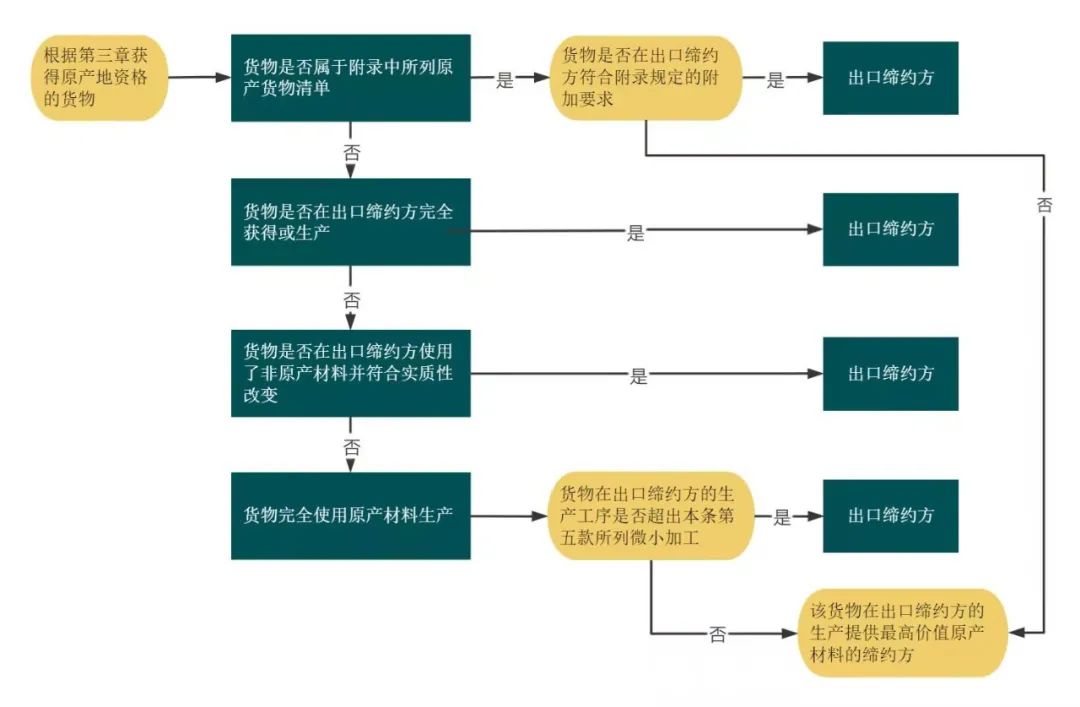
As guideline on process of determining the RCEP country of origin, below is a flowchart issued by China’s General Administration of Customs: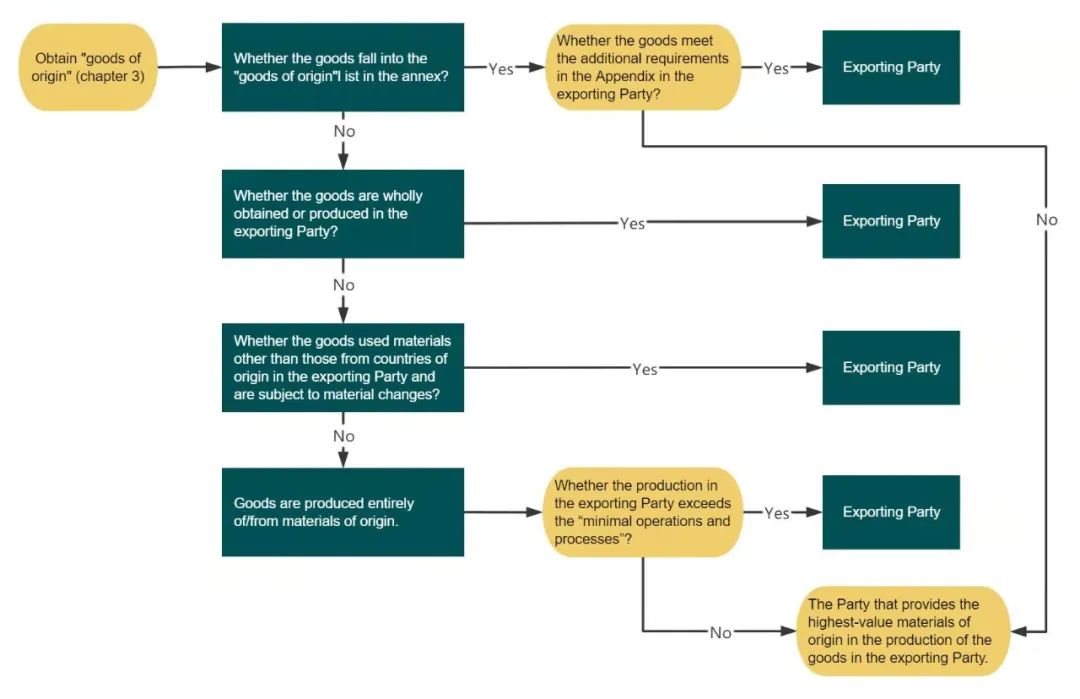
图中微小加工的情况主要包括十一种:(1)为确保货物在运输或储存期间保持良好状态而进行的保存操作;(2)为运输或销售而对货物进行的包装或展示;(3)简单加工,包括过滤、筛选、挑选、分类、磨锐、切割、纵切、研磨、弯曲、卷取或开卷;(4)在货物或其包装上粘贴或印刷标记、标签、标识或其他类似的用于区别的标志;(5)仅用水或其他物质稀释,不实质改变货物的特性;(6)将产品拆分成零件;(7)屠宰动物;(8)简单的喷漆和抛光操作;(9)简单的去皮、去核或去壳;(10)同种类或不同种类货物的简单混合;或者(11)第(一)项至第(十)项所述的两种或两种以上操作的任意组合。
The “minimal operations and processes” mainly include the following 11 situations: (1) preserving operations to ensure that the good remains in good condition for the purposes of transport or storage; (2) packaging or presenting goods for transportation or sale; (3) simple processes, consisting of sifting, screening, sorting, classifying, sharpening, cutting, slitting, grinding, bending, coiling, or uncoiling; (4) affixing or printing of marks, labels, logos, or other like distinguishing signs on goods or their packaging; (5) mere dilution with water or another substance that does not materially alter the characteristics of the good; (6) disassembly of products into parts; (7) slaughtering of animals; (8) simple painting and polishing operations; (9) simple peeling, stoning, or shelling; (10) simple mixing of goods, whether or not of different kinds; or (11) any combination of two or more operations referred to in above (1) through (10).
5. 货物的临时准入
v. Temporary Admission of Goods
在RCEP项下,对于货物的临时准入,缔约国应全部或部分免于支付进口关税和国内税,并不得对临时准入设置除了以下条件之外的额外条件:a. 货物的使用仅由另一缔约方国民、居民进行,或在其监督下进行;b. 在其领土内时不出售或租赁;c. 设置担保金,在该货物出口时可返还;d. 在进口或出口时可确认;e. 在第一项所提及的人员离境时准入货物应当出口;f. 准许的数量不得超过其预期用途的合理数量;以及g. 根据其法律法规,其他允许进入该缔约方领土的情况。
In relation to temporary admission of goods, the RCEP requires that the member states shall be totally or partially exempted from import duties and internal taxes. In general, no conditions shall be imposed on the temporary admission, with exception to require that the goods: (a) be used solely by or under the personal supervision of a national or resident of another member state in the exercise of the business activity, trade, profession, or sport of that person; (b) not be sold or leased while in its territory; (c) be accompanied by a security or guarantee in an amount no greater than the customs duties, taxes, fees, and charges that would otherwise be owed on entry or final importation, releasable on exportation of the good; (d) be capable of identification when imported and exported; (e) be exported on the departure of the person referred to in (a); (f) be admitted in no greater quantity than what is reasonable for its intended use; and (g) be otherwise admissible into the member state’s territory under its laws and regulations.
适格的临时准入货物应当满足以下三个条件:a. 为特定目的而运入其关税区;b. 计划在特定期限内复出口;以及 c. 除因其使用所造成的正常折旧和磨损外未发生任何改变。
In order for the temporary admission to be eligible, the goods need to meet the following three requirements: (a) such goods are brought into its customs territory for a specific purpose; (b) such goods are intended for re-exportation within a specific period; and (c) such goods have not undergone any change, except normal depreciation and wastage due to the usage of them.
RCEP对国际贸易海关税收的政策性优惠大幅削减了商品的进口成本,甚至在农产品领域的很多产品都采取0关税的规定。加之在税收差异章节对RCEP原产国认定的规范,对于精准帮助协议成员国扩大本国产品市场、发挥区域优势、促进区域经济融合有着巨大作用。
In sum, the RCEP offers big preferential policy on customs duties, lessening costs for importers, a typical example is that some of the agriculture products will be imposed zero tariff. Adding to the agreement's extensive preference, the “tariff differentials” chapter stipulates on how to determine the RCEP countries of origin. These policies altogether will help member states expand exporting market, utilize regional advantages, and promote regional economic integration.
本系列下一篇将解读RCEP最为关键的一章——原产地规则,它对企业如何安排上下游生产、提前规划产业链有着重要参考意义。
In the next article of this series, we will look into “rules of origin”, the most important chapter of the RCEP, to guide enterprises on how to plan their production process and supply chain.
《区域全面经济伙伴关系协定》解读系列之概述及货物贸易
作者:吴青洋 王漠来源:永嘉信律师事务所

2022年1月14日,陕西省人民政府发布了《陕西省人民政府办公厅关于印发进一步加大对中小企业纾困帮扶力度若干措施的通知》,出台24条针对中小企业经营的帮助政策措施,以促进企业健康发展。