
06.莫桑比克
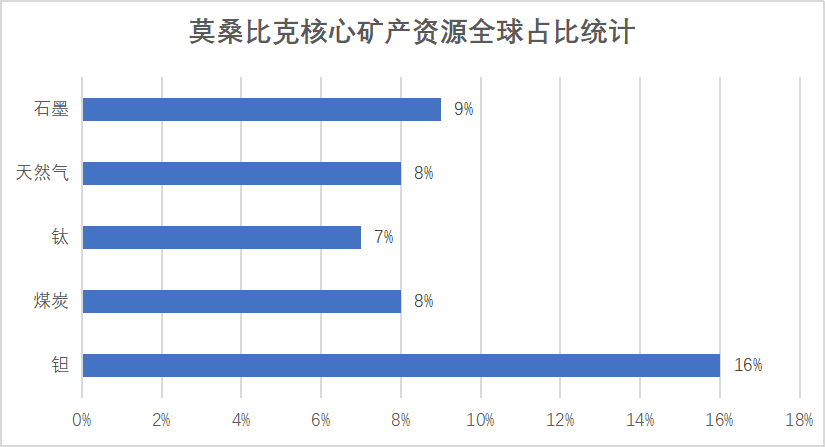
莫桑比克位于非洲东南部,拥有丰富的矿产资源,是加强“一带一路”矿业产能合作的重要国家之一。该国的矿产资源包括金、铁、铜、钽、钛、铝、金刚石、煤和天然气等多种金属和非金属矿产,大部分矿产资源属于未开发状态。其中,钛、钽等矿种被认为是极具优势的矿产资源,而铁矿、有色金属、非金属矿也存在进一步勘探的潜力。莫桑比克的煤炭资源尤其值得关注,其储量丰富,已探明的煤炭资源量达到了20亿吨以上。这些煤炭资源主要分布在莫桑比克南部地区,特别是Ruhuhu盆地,该地区的煤炭资源量超过5.85亿吨,而且这些煤炭属于优质低硫煤。此外,自2010年以来,国际石油公司在莫桑比克陆续发现了大型天然气田,特别是在该国东北部的鲁伍马盆地(黄牡丹,2021)。莫桑比克的天然气资源也非常丰富,探明的天然气储量达到了54万亿立方英尺(约1.52万亿立方米),预计总储量至少可达200万亿立方英尺,这为该国未来天然气产业的发展提供了坚实的基础。中国矿企在莫桑比克的投资活动涉及多个领域,特别是在煤炭和天然气开发方面。中国企业不仅参与了矿产资源的开采,还涉及加工和物流支持等多个环节,对莫桑比克矿产资源的投资有助于保障中国对这些重要资源的稳定供应,同时也为莫桑比克创造了就业机会,促进了当地经济的发展。例如中国国际冶金公司参与建设的莫桑比克太特省钢铁厂项目(下称“太特钢铁厂项目”)随着中莫两国合作关系的进一步加深;2023年华体国际能源以300万美元认购莫桑比克梅蒂卡尔11682项目锂矿100%权益,形成对11682号锂矿的开采、破碎、加工、运输等全流程的掌控。预计未来中国在莫桑比克的矿产资源投资将持续增长,并可能探索新的合作领域(黄牡丹,2021)。总之,莫桑比克的矿产资源为中资企业提供了广阔的投资前景,中国矿企在该国的投资不仅有助于满足中国对矿产资源的需求,也促进了当地经济的可持续发展。
Mozambique is located in the southeast of Africa and possesses abundant mineral resources. It is one of the important countries for strengthening the cooperation in mining capacity under the "Belt and Road" initiative. The country's mineral resources include various metals and non-metals such as gold, iron, copper, tantalum, titanium, aluminum, diamond, coal, and natural gas, and most of these mineral resources are undeveloped. Among them, minerals such as titanium and tantalum are considered highly advantageous, and there is also potential for further exploration of iron ore, non-ferrous metals, and non-metal minerals. The coal resources in Mozambique are particularly noteworthy, with proven reserves reaching more than 2 billion tons. These coal resources are mainly distributed in the southern region of Mozambique, especially in the Ruhuhu Basin, where the coal resources exceed 585 million tons, and this coal is of high quality and low sulfur. In addition, Mozambique also has very abundant natural gas resources, with proven reserves reaching 54 trillion cubic feet (approximately 1.52 trillion cubic meters), and the estimated total reserves can reach at least 200 trillion cubic feet, providing a solid foundation for the future development of the natural gas industry in the country. Chinese mining enterprises' investment activities in Mozambique involve multiple fields, especially in the development of coal and natural gas. Chinese enterprises not only participate in the mining of mineral resources but also involve multiple links such as processing and logistics support. China's investment in Mozambique's mineral resources helps ensure the stable supply of these important resources for China and also creates employment opportunities for Mozambique, promoting the development of the local economy. For example, with the further deepening of the cooperative relationship between China and Mozambique, the steel plant project in Tete Province, Mozambique, participated in by China International Metallurgical Corporation (hereinafter referred to as the "Tete Steel Plant Project"); in 2023, Huati International Energy subscribed for 100% equity of the Metical 11682 project lithium mine in Mozambique for 3 million US dollars, gaining full control over the entire process of mining, crushing, processing, and transportation of the No. 11682 lithium mine. It is expected that China's investment in Mozambique's mineral resources will continue to grow in the future and may explore new areas of cooperation. In short, Mozambique's mineral resources offer broad investment prospects for Chinese-funded enterprises. The investment of Chinese mining enterprises in the country not only helps meet China's demand for mineral resources but also promotes the sustainable development of the local economy.
07.加纳
加纳位于非洲西部几内亚湾北岸,是一个矿产资源丰富的国家。该国拥有世界上最大的人工湖,并以“可可之国”著称。加纳的矿产资源主要包括黄金、钻石、铝土矿、铁矿、锰矿、石油和天然气等。黄金储量估计为20亿盎司,已探明储量近2亿盎司,2015年的黄金产量为280万盎司(约合77吨)。钻石储量估计为1亿克拉,已探明储量为872.85万克拉。铝土矿储量估计为4亿吨,已探明储量为1891.19万吨。铁矿储量估计为14亿吨。锰矿储量为4900万吨。石油储量估计在20亿桶左右,天然气储量估计约8000亿立方英尺。此外,加纳还拥有石灰石、红柱石、石英砂和高岭土等非金属矿产资源。中国企业在加纳的矿产资源开发中扮演着重要角色,中国对加纳的矿产资源投资主要集中在黄金、铝土及钻石。其中中国企业在加纳的黄金开采领域占据显著地位,加纳是中国企业在非洲进行黄金开采的重要目的地之一,在加纳的矿产资源投资不仅有助于保障中国对这些重要资源的稳定供应,同时也为加纳创造了就业机会,促进了当地经济的发展(范二可,2021)。加纳的采矿业约占政府收入的16%,占国内生产总值的7.9%,目前正在推动绿色矿山建设,保障当地的社区和环境。中国矿产开采技术及清洁技术的成熟性,让(加纳)整体的矿业更具有可持续性。”随着中加两国合作关系的进一步加深,预计未来中国在加纳的矿产资源投资将持续增长,并可能探索新的合作领域。以下这些项目代表了中国企业在加纳矿业领域的重大投资,涵盖了从黄金到铝土矿等多种矿产资源。这些投资不仅有助于提升加纳的矿业开发能力,也为当地的经济和社会发展做出了贡献。
Ghana is located on the northern coast of the Gulf of Guinea in western Africa and is a country rich in mineral resources. It has the world's largest artificial lake and is known as the "Country of Cocoa". The mineral resources in Ghana mainly include gold, diamonds, bauxite, iron ore, manganese ore, oil, and natural gas. The estimated gold reserves are 2 billion ounces, and the proven reserves are nearly 200 million ounces. The gold production in 2015 was 2.8 million ounces (approximately 77 tons). The estimated diamond reserves are 100 million carats, and the proven reserves are 8.7285 million carats. The estimated bauxite reserves are 400 million tons, and the proven reserves are 18.9119 million tons. The estimated iron ore reserves are 1.4 billion tons. The manganese ore reserves are 49 million tons. The estimated oil reserves are about 2 billion barrels, and the estimated natural gas reserves are about 800 billion cubic feet. In addition, Ghana also has non-metallic mineral resources such as limestone, andalusite, quartz sand, and kaolin. Chinese enterprises play an important role in the development of mineral resources in Ghana. China's investment in Ghana's mineral resources mainly focuses on gold, bauxite, and diamonds. Chinese enterprises occupy a significant position in the gold mining sector in Ghana, and Ghana is one of the important destinations for Chinese enterprises to carry out gold mining in Africa. The investment in Ghana's mineral resources not only helps ensure the stable supply of these important resources for China but also creates employment opportunities for Ghana and promotes the local economic development. Ghana's mining industry accounts for about 16% of the government's revenue and 7.9% of the gross domestic product. Currently, it is promoting the construction of green mines to protect the local community and environment. The maturity of China's mineral mining technology and clean technology makes the overall mining industry in Ghana more sustainable. "As the cooperative relationship between China and Ghana further deepens, it is expected that China's investment in Ghana's mineral resources will continue to grow in the future and may explore new areas of cooperation. China's investment in mining projects in Ghana involves multiple different projects and companies. Here are a few specific examples: These projects represent significant investments by Chinese enterprises in the mining sector in Ghana, covering a variety of mineral resources from gold to bauxite. These investments not only help enhance Ghana's mining development capabilities but also contribute to the local economic and social development.
中国企业在加纳重点矿业开发项目2012-2022
08.刚果(布)
刚果(布)全称刚果共和国,是非洲地区同我国建交最早的国家之一,位于非洲中部,赤道横贯其中部。该国拥有丰富的矿产资源,其中包括石油、天然气、铁矿石、钾盐、磷酸盐、铜、铝、锌和金等。刚果布的石油资源尤其丰富,据刚果石油天然气部援引《BP世界能源统计年鉴》公布的数据,刚果布探明可开采石油储量约16亿桶,在撒哈拉以南非洲位列尼日利亚、安哥拉和加蓬之后。此外,刚果布还拥有丰富的矿产资源,铁矿储量约250亿吨,钾盐储量达60亿吨,磷酸盐矿储量为600万吨。刚果布的矿产资源分布广泛,特别是在滨海盆地,这里被认为是刚果布最重要的矿产资源聚集地之一,富含钾盐等矿产资源。中国企业对刚果(布)的矿产资源投资在石油和天然气领域占据显著地位,参与了海上石油开采活动以及天然气开发项目;在铁矿石开采方面进行了大规模投资,例如桑加矿业公司就得到了中国投资的支持。同时,鉴于刚果布拥有世界最大的钾盐矿之一,中国企业在钾盐资源的开发方面也有所战略布局。当然,中国企业在刚果布还参与了其他矿产资源的开发,包括铜、铝、锌和金等。2021年11月,刚果(布)议会批准了山东鲁源集团在布谷马西(Mboukoumassi)的钾盐项目,鲁源集团向刚果(布)矿业基金出资8,200万中非法郎(约合人民币91.5万),用于加强公司人员技术能力建设,也为刚果青年创造数百个工作岗位。中国企业在刚果布的矿产资源投资不仅有助于保障中国对这些重要资源的稳定供应,同时也为刚果布创造了就业机会,促进了当地经济的发展。随着中刚两国合作关系的进一步加深,预计未来中国在刚果布的矿产资源投资将持续增长,并可能探索新的合作领域。
The full name of Congo (Brazzaville) is the Republic of the Congo. It is one of the first countries in Africa to establish diplomatic relations with China, located in the central part of Africa, with the equator running through the middle of the country. The country has abundant mineral resources, including oil, natural gas, iron ore, potash salt, phosphate, copper, aluminum, zinc, and gold. Congo (Brazzaville) is particularly rich in oil resources. According to data released by the Ministry of Petroleum and Natural Gas of Congo, citing the "BP Statistical Review of World Energy," the proven recoverable oil reserves in Congo (Brazzaville) are about 1.6 billion barrels, ranking after Nigeria, Angola, and Gabon in sub-Saharan Africa. In addition, Congo (Brazzaville) also has abundant mineral resources, with iron ore reserves of about 25 billion tons, potash salt reserves of 6 billion tons, and phosphate ore reserves of 6 million tons. The mineral resources in Congo (Brazzaville) are widely distributed, especially in the coastal basin, which is considered one of the most important gathering places for mineral resources in Congo (Brazzaville), rich in mineral resources such as potash salt. Chinese enterprises' investment in the mineral resources of Congo (Brazzaville) plays a significant role in the fields of oil and natural gas, participating in offshore oil exploitation activities and natural gas development projects; they have made large-scale investments in iron ore mining, for example, the Sangha Mining Company has received support from Chinese investment. At the same time, given that Congo (Brazzaville) has one of the largest potash salt mines in the world, Chinese enterprises also have a strategic layout in the development of potash salt resources. Of course, Chinese enterprises also participate in the development of other mineral resources in Congo (Brazzaville), including copper, aluminum, zinc, and gold. In November 2021, the Parliament of Congo (Brazzaville) approved the potash salt project of Shandong Luyuan Group in Mboukoumassi. Luyuan Group contributed 82 million CFA francs (approximately 915,000 RMB) to the Congolese Mining Fund to strengthen the technical capabilities of the company's personnel and create hundreds of jobs for Congolese youth. Chinese enterprises' investment in the mineral resources of Congo (Brazzaville) not only helps ensure the stable supply of these important resources for China but also creates employment opportunities for Congo (Brazzaville) and promotes the local economic development. With the further deepening of the cooperative relationship between China and Congo (Brazzaville), it is expected that China's investment in the mineral resources of Congo (Brazzaville) will continue to grow in the future and may explore new areas of cooperation.
引用
1. 何金祥,崔荣国,徐曙光,等.南非、赞比亚、刚果(金)和津巴布韦矿业投资环境和走势[J].国土资源情报,2021,(05):11-19.
2. 黄牡丹.东非六国的矿业权制度研究[D].湘潭大学,2021.DOI:10.27426/d.cnki.gxtdu.2021.000060.
3. 唐翠魟.赞比亚矿业投资环境分析[J].中国水运(下半月),2019,19(03):56-57.g
4. 于瑞,张伟波,张福良,等.非洲国家矿业法演进趋势、影响与合作建议[J].中国国土资源经济,2024,37(07):66-76.DOI:10.19676/j.cnki.1672-6995.000999.
5. 卢宜冠,龚鹏辉,孙凯,等.刚果(金)矿产资源与矿业投资环境[J].地质通报,2022,41(01):154-166.宋崇宇,陈喜峰,李仰春,等.纳米比亚矿产资源禀赋特征、开发现状及投资前景分析[J].地质与勘探,2021,57(06):1278-1286.
6. 古阿雷,任军平,袁杨森,等.坦桑尼亚矿产资源及矿业投资环境[J].地质通报,2023,42(08):1291-1
7. 王纪昆,刘高杰,时培哲,等.几内亚矿产资源概况及矿业投资环境分析[J].矿产与地质,2023,37(01):1-10.DOI:10.19856/j.cnki.issn.1001-5663.2023.01.001.
8. 何金祥.莫桑比克矿业投资环境[J].国土资源情报,2004,(06):16-19.
9. 范二可.加纳矿业法律制度研究[D].湘潭大学,2021.DOI:10.27426/d.cnki.gxtdu.2021.000140.(范二可,2021)
10. 王聪,吴树明.津巴布韦矿业管理及投资环境分析[J].国土资源情报,2021,(07):47-51.
11. 张宁.南非矿业投资准入法律制度研究[D].湘潭大学,2022.DOI:10.27426/d.cnki.gxtdu.2022.000687.
12. 王海盟,中国南非矿业外资准入实体条件法律制度研究,2021.西南大学,MA,
thesis.doi:10.27684/d.cnki.gxndx.2021.002689.
Citation
1. He Jinxiang, Cui Rongguo, Xu Shuguang, et al. Mining Investment Environment and Trends in South Africa, Zambia, the Democratic Republic of the Congo, and Zimbabwe [J]. Land and Resources Information, 2021, (05): 11-19.
2. Huang Mudan. Research on the Mining Rights System in Six East African Countries [D]. Xiangtan University, 2021. DOI: 10.27426/d.cnki.gxtdu.2021.000060.
3. Tang Cuihong. Analysis of the Mining Investment Environment in Zambia [J]. China Water Transport (Second Half), 2019, 19(03): 56-57.
4. Yu Rui, Zhang Weibo, Zhang Fuliang, et al. Evolution Trends, Impacts, and Cooperation Suggestions of Mining Laws in African Countries [J]. China Land and Resources Economics, 2024, 37(07): 66-76. DOI: 10.19676/j.cnki.1672-6995.000999.
5. Lu Yiguan, Gong Penghui, Sun Kai, et al. Mineral Resources and Mining Investment Environment in the Democratic Republic of the Congo [J]. Geological Bulletin, 2022, 41(01): 154-166. Song Chongyu, Chen Xifeng, Li Yangchun, et al. Analysis of the Endowment Characteristics, Development Status, and Investment Prospects of Mineral Resources in Namibia [J]. Geology and Exploration, 2021, 57(06): 1278-1286.
6. Gu Alei, Ren Junping, Yuan Yangsen, et al. Mineral Resources and Mining Investment Environment in Tanzania [J]. Geological Bulletin, 2023, 42(08): 1291-1.
7. Wang Jikun, Liu Gaojie, Shi Peizhe, et al. Overview of Mineral Resources and Analysis of Mining Investment Environment in Guinea [J]. Minerals and Geology, 2023, 37(01): 1-10. DOI: 10.19856/j.cnki.issn.1001-5663.2023.01.001.
8. He Jinxiang. Mining Investment Environment in Mozambique [J]. Land and Resources Information, 2004, (06): 16-19.
9. Fan Erke. Research on the Legal System of Mining in Ghana [D]. Xiangtan University, 2021. DOI: 10.27426/d.cnki.gxtdu.2021.000140. (Fan Erke, 2021)
10. Wang Cong, Wu Shuming. Analysis of Mining Management and Investment Environment in Zimbabwe [J]. Land and Resources Information, 2021, (07): 47-51.
11. Zhang Ning. Research on the Legal System of Mining Investment Access in South Africa [D]. Xiangtan University, 2022. DOI: 10.27426/d.cnki.gxtdu.2022.000687.
12. Wang Haimeng, Research on the Legal System of Substantive Conditions for Foreign Investment Access in the Mining Industry in South Africa, 2021. Southwest University, MA, thesis. doi: 10.27684/d.cnki.gxndx.2021.002689.
莫桑比克位于非洲东南部,拥有丰富的矿产资源,是加强“一带一路”矿业产能合作的重要国家之一。该国的矿产资源包括金、铁、铜、钽、钛、铝、金刚石、煤和天然气等多种金属和非金属矿产,大部分矿产资源属于未开发状态。其中,钛、钽等矿种被认为是极具优势的矿产资源,而铁矿、有色金属、非金属矿也存在进一步勘探的潜力。莫桑比克的煤炭资源尤其值得关注,其储量丰富,已探明的煤炭资源量达到了20亿吨以上。这些煤炭资源主要分布在莫桑比克南部地区,特别是Ruhuhu盆地,该地区的煤炭资源量超过5.85亿吨,而且这些煤炭属于优质低硫煤。此外,自2010年以来,国际石油公司在莫桑比克陆续发现了大型天然气田,特别是在该国东北部的鲁伍马盆地(黄牡丹,2021)。莫桑比克的天然气资源也非常丰富,探明的天然气储量达到了54万亿立方英尺(约1.52万亿立方米),预计总储量至少可达200万亿立方英尺,这为该国未来天然气产业的发展提供了坚实的基础。中国矿企在莫桑比克的投资活动涉及多个领域,特别是在煤炭和天然气开发方面。中国企业不仅参与了矿产资源的开采,还涉及加工和物流支持等多个环节,对莫桑比克矿产资源的投资有助于保障中国对这些重要资源的稳定供应,同时也为莫桑比克创造了就业机会,促进了当地经济的发展。例如中国国际冶金公司参与建设的莫桑比克太特省钢铁厂项目(下称“太特钢铁厂项目”)随着中莫两国合作关系的进一步加深;2023年华体国际能源以300万美元认购莫桑比克梅蒂卡尔11682项目锂矿100%权益,形成对11682号锂矿的开采、破碎、加工、运输等全流程的掌控。预计未来中国在莫桑比克的矿产资源投资将持续增长,并可能探索新的合作领域(黄牡丹,2021)。总之,莫桑比克的矿产资源为中资企业提供了广阔的投资前景,中国矿企在该国的投资不仅有助于满足中国对矿产资源的需求,也促进了当地经济的可持续发展。
Mozambique is located in the southeast of Africa and possesses abundant mineral resources. It is one of the important countries for strengthening the cooperation in mining capacity under the "Belt and Road" initiative. The country's mineral resources include various metals and non-metals such as gold, iron, copper, tantalum, titanium, aluminum, diamond, coal, and natural gas, and most of these mineral resources are undeveloped. Among them, minerals such as titanium and tantalum are considered highly advantageous, and there is also potential for further exploration of iron ore, non-ferrous metals, and non-metal minerals. The coal resources in Mozambique are particularly noteworthy, with proven reserves reaching more than 2 billion tons. These coal resources are mainly distributed in the southern region of Mozambique, especially in the Ruhuhu Basin, where the coal resources exceed 585 million tons, and this coal is of high quality and low sulfur. In addition, Mozambique also has very abundant natural gas resources, with proven reserves reaching 54 trillion cubic feet (approximately 1.52 trillion cubic meters), and the estimated total reserves can reach at least 200 trillion cubic feet, providing a solid foundation for the future development of the natural gas industry in the country. Chinese mining enterprises' investment activities in Mozambique involve multiple fields, especially in the development of coal and natural gas. Chinese enterprises not only participate in the mining of mineral resources but also involve multiple links such as processing and logistics support. China's investment in Mozambique's mineral resources helps ensure the stable supply of these important resources for China and also creates employment opportunities for Mozambique, promoting the development of the local economy. For example, with the further deepening of the cooperative relationship between China and Mozambique, the steel plant project in Tete Province, Mozambique, participated in by China International Metallurgical Corporation (hereinafter referred to as the "Tete Steel Plant Project"); in 2023, Huati International Energy subscribed for 100% equity of the Metical 11682 project lithium mine in Mozambique for 3 million US dollars, gaining full control over the entire process of mining, crushing, processing, and transportation of the No. 11682 lithium mine. It is expected that China's investment in Mozambique's mineral resources will continue to grow in the future and may explore new areas of cooperation. In short, Mozambique's mineral resources offer broad investment prospects for Chinese-funded enterprises. The investment of Chinese mining enterprises in the country not only helps meet China's demand for mineral resources but also promotes the sustainable development of the local economy.
07.加纳
加纳位于非洲西部几内亚湾北岸,是一个矿产资源丰富的国家。该国拥有世界上最大的人工湖,并以“可可之国”著称。加纳的矿产资源主要包括黄金、钻石、铝土矿、铁矿、锰矿、石油和天然气等。黄金储量估计为20亿盎司,已探明储量近2亿盎司,2015年的黄金产量为280万盎司(约合77吨)。钻石储量估计为1亿克拉,已探明储量为872.85万克拉。铝土矿储量估计为4亿吨,已探明储量为1891.19万吨。铁矿储量估计为14亿吨。锰矿储量为4900万吨。石油储量估计在20亿桶左右,天然气储量估计约8000亿立方英尺。此外,加纳还拥有石灰石、红柱石、石英砂和高岭土等非金属矿产资源。中国企业在加纳的矿产资源开发中扮演着重要角色,中国对加纳的矿产资源投资主要集中在黄金、铝土及钻石。其中中国企业在加纳的黄金开采领域占据显著地位,加纳是中国企业在非洲进行黄金开采的重要目的地之一,在加纳的矿产资源投资不仅有助于保障中国对这些重要资源的稳定供应,同时也为加纳创造了就业机会,促进了当地经济的发展(范二可,2021)。加纳的采矿业约占政府收入的16%,占国内生产总值的7.9%,目前正在推动绿色矿山建设,保障当地的社区和环境。中国矿产开采技术及清洁技术的成熟性,让(加纳)整体的矿业更具有可持续性。”随着中加两国合作关系的进一步加深,预计未来中国在加纳的矿产资源投资将持续增长,并可能探索新的合作领域。以下这些项目代表了中国企业在加纳矿业领域的重大投资,涵盖了从黄金到铝土矿等多种矿产资源。这些投资不仅有助于提升加纳的矿业开发能力,也为当地的经济和社会发展做出了贡献。
Ghana is located on the northern coast of the Gulf of Guinea in western Africa and is a country rich in mineral resources. It has the world's largest artificial lake and is known as the "Country of Cocoa". The mineral resources in Ghana mainly include gold, diamonds, bauxite, iron ore, manganese ore, oil, and natural gas. The estimated gold reserves are 2 billion ounces, and the proven reserves are nearly 200 million ounces. The gold production in 2015 was 2.8 million ounces (approximately 77 tons). The estimated diamond reserves are 100 million carats, and the proven reserves are 8.7285 million carats. The estimated bauxite reserves are 400 million tons, and the proven reserves are 18.9119 million tons. The estimated iron ore reserves are 1.4 billion tons. The manganese ore reserves are 49 million tons. The estimated oil reserves are about 2 billion barrels, and the estimated natural gas reserves are about 800 billion cubic feet. In addition, Ghana also has non-metallic mineral resources such as limestone, andalusite, quartz sand, and kaolin. Chinese enterprises play an important role in the development of mineral resources in Ghana. China's investment in Ghana's mineral resources mainly focuses on gold, bauxite, and diamonds. Chinese enterprises occupy a significant position in the gold mining sector in Ghana, and Ghana is one of the important destinations for Chinese enterprises to carry out gold mining in Africa. The investment in Ghana's mineral resources not only helps ensure the stable supply of these important resources for China but also creates employment opportunities for Ghana and promotes the local economic development. Ghana's mining industry accounts for about 16% of the government's revenue and 7.9% of the gross domestic product. Currently, it is promoting the construction of green mines to protect the local community and environment. The maturity of China's mineral mining technology and clean technology makes the overall mining industry in Ghana more sustainable. "As the cooperative relationship between China and Ghana further deepens, it is expected that China's investment in Ghana's mineral resources will continue to grow in the future and may explore new areas of cooperation. China's investment in mining projects in Ghana involves multiple different projects and companies. Here are a few specific examples: These projects represent significant investments by Chinese enterprises in the mining sector in Ghana, covering a variety of mineral resources from gold to bauxite. These investments not only help enhance Ghana's mining development capabilities but also contribute to the local economic and social development.
中国企业在加纳重点矿业开发项目2012-2022
| 项目名称 | 投资方 | 投资金额 |
| 铝土矿开发项目 | 中国政府(通过国家开发银行) | 约100亿美元 |
| 山东黄金开发项目 | 山东黄金集团 | 约2.3亿加元 |
| 卡蒂诺项目 | 山东黄金集团与中国铁建国际投资 | 未具体提及 |
| 纳穆蒂尼黄金矿项目 | 山东黄金集团 | 约7.8亿美元 |
| 赤峰黄金项目 | 赤峰吉隆黄金矿业股份有限公司 | 约2.1亿美元 |
| 天成国际黄金项目 | 天成国际矿业有限公司 | 约1.2亿美元 |
| 恩德科黄金矿业项目 | 中国恩德科黄金矿业股份有限公司 | 约1.1亿美元 |
08.刚果(布)
刚果(布)全称刚果共和国,是非洲地区同我国建交最早的国家之一,位于非洲中部,赤道横贯其中部。该国拥有丰富的矿产资源,其中包括石油、天然气、铁矿石、钾盐、磷酸盐、铜、铝、锌和金等。刚果布的石油资源尤其丰富,据刚果石油天然气部援引《BP世界能源统计年鉴》公布的数据,刚果布探明可开采石油储量约16亿桶,在撒哈拉以南非洲位列尼日利亚、安哥拉和加蓬之后。此外,刚果布还拥有丰富的矿产资源,铁矿储量约250亿吨,钾盐储量达60亿吨,磷酸盐矿储量为600万吨。刚果布的矿产资源分布广泛,特别是在滨海盆地,这里被认为是刚果布最重要的矿产资源聚集地之一,富含钾盐等矿产资源。中国企业对刚果(布)的矿产资源投资在石油和天然气领域占据显著地位,参与了海上石油开采活动以及天然气开发项目;在铁矿石开采方面进行了大规模投资,例如桑加矿业公司就得到了中国投资的支持。同时,鉴于刚果布拥有世界最大的钾盐矿之一,中国企业在钾盐资源的开发方面也有所战略布局。当然,中国企业在刚果布还参与了其他矿产资源的开发,包括铜、铝、锌和金等。2021年11月,刚果(布)议会批准了山东鲁源集团在布谷马西(Mboukoumassi)的钾盐项目,鲁源集团向刚果(布)矿业基金出资8,200万中非法郎(约合人民币91.5万),用于加强公司人员技术能力建设,也为刚果青年创造数百个工作岗位。中国企业在刚果布的矿产资源投资不仅有助于保障中国对这些重要资源的稳定供应,同时也为刚果布创造了就业机会,促进了当地经济的发展。随着中刚两国合作关系的进一步加深,预计未来中国在刚果布的矿产资源投资将持续增长,并可能探索新的合作领域。
The full name of Congo (Brazzaville) is the Republic of the Congo. It is one of the first countries in Africa to establish diplomatic relations with China, located in the central part of Africa, with the equator running through the middle of the country. The country has abundant mineral resources, including oil, natural gas, iron ore, potash salt, phosphate, copper, aluminum, zinc, and gold. Congo (Brazzaville) is particularly rich in oil resources. According to data released by the Ministry of Petroleum and Natural Gas of Congo, citing the "BP Statistical Review of World Energy," the proven recoverable oil reserves in Congo (Brazzaville) are about 1.6 billion barrels, ranking after Nigeria, Angola, and Gabon in sub-Saharan Africa. In addition, Congo (Brazzaville) also has abundant mineral resources, with iron ore reserves of about 25 billion tons, potash salt reserves of 6 billion tons, and phosphate ore reserves of 6 million tons. The mineral resources in Congo (Brazzaville) are widely distributed, especially in the coastal basin, which is considered one of the most important gathering places for mineral resources in Congo (Brazzaville), rich in mineral resources such as potash salt. Chinese enterprises' investment in the mineral resources of Congo (Brazzaville) plays a significant role in the fields of oil and natural gas, participating in offshore oil exploitation activities and natural gas development projects; they have made large-scale investments in iron ore mining, for example, the Sangha Mining Company has received support from Chinese investment. At the same time, given that Congo (Brazzaville) has one of the largest potash salt mines in the world, Chinese enterprises also have a strategic layout in the development of potash salt resources. Of course, Chinese enterprises also participate in the development of other mineral resources in Congo (Brazzaville), including copper, aluminum, zinc, and gold. In November 2021, the Parliament of Congo (Brazzaville) approved the potash salt project of Shandong Luyuan Group in Mboukoumassi. Luyuan Group contributed 82 million CFA francs (approximately 915,000 RMB) to the Congolese Mining Fund to strengthen the technical capabilities of the company's personnel and create hundreds of jobs for Congolese youth. Chinese enterprises' investment in the mineral resources of Congo (Brazzaville) not only helps ensure the stable supply of these important resources for China but also creates employment opportunities for Congo (Brazzaville) and promotes the local economic development. With the further deepening of the cooperative relationship between China and Congo (Brazzaville), it is expected that China's investment in the mineral resources of Congo (Brazzaville) will continue to grow in the future and may explore new areas of cooperation.
引用
1. 何金祥,崔荣国,徐曙光,等.南非、赞比亚、刚果(金)和津巴布韦矿业投资环境和走势[J].国土资源情报,2021,(05):11-19.
2. 黄牡丹.东非六国的矿业权制度研究[D].湘潭大学,2021.DOI:10.27426/d.cnki.gxtdu.2021.000060.
3. 唐翠魟.赞比亚矿业投资环境分析[J].中国水运(下半月),2019,19(03):56-57.g
4. 于瑞,张伟波,张福良,等.非洲国家矿业法演进趋势、影响与合作建议[J].中国国土资源经济,2024,37(07):66-76.DOI:10.19676/j.cnki.1672-6995.000999.
5. 卢宜冠,龚鹏辉,孙凯,等.刚果(金)矿产资源与矿业投资环境[J].地质通报,2022,41(01):154-166.宋崇宇,陈喜峰,李仰春,等.纳米比亚矿产资源禀赋特征、开发现状及投资前景分析[J].地质与勘探,2021,57(06):1278-1286.
6. 古阿雷,任军平,袁杨森,等.坦桑尼亚矿产资源及矿业投资环境[J].地质通报,2023,42(08):1291-1
7. 王纪昆,刘高杰,时培哲,等.几内亚矿产资源概况及矿业投资环境分析[J].矿产与地质,2023,37(01):1-10.DOI:10.19856/j.cnki.issn.1001-5663.2023.01.001.
8. 何金祥.莫桑比克矿业投资环境[J].国土资源情报,2004,(06):16-19.
9. 范二可.加纳矿业法律制度研究[D].湘潭大学,2021.DOI:10.27426/d.cnki.gxtdu.2021.000140.(范二可,2021)
10. 王聪,吴树明.津巴布韦矿业管理及投资环境分析[J].国土资源情报,2021,(07):47-51.
11. 张宁.南非矿业投资准入法律制度研究[D].湘潭大学,2022.DOI:10.27426/d.cnki.gxtdu.2022.000687.
12. 王海盟,中国南非矿业外资准入实体条件法律制度研究,2021.西南大学,MA,
thesis.doi:10.27684/d.cnki.gxndx.2021.002689.
Citation
1. He Jinxiang, Cui Rongguo, Xu Shuguang, et al. Mining Investment Environment and Trends in South Africa, Zambia, the Democratic Republic of the Congo, and Zimbabwe [J]. Land and Resources Information, 2021, (05): 11-19.
2. Huang Mudan. Research on the Mining Rights System in Six East African Countries [D]. Xiangtan University, 2021. DOI: 10.27426/d.cnki.gxtdu.2021.000060.
3. Tang Cuihong. Analysis of the Mining Investment Environment in Zambia [J]. China Water Transport (Second Half), 2019, 19(03): 56-57.
4. Yu Rui, Zhang Weibo, Zhang Fuliang, et al. Evolution Trends, Impacts, and Cooperation Suggestions of Mining Laws in African Countries [J]. China Land and Resources Economics, 2024, 37(07): 66-76. DOI: 10.19676/j.cnki.1672-6995.000999.
5. Lu Yiguan, Gong Penghui, Sun Kai, et al. Mineral Resources and Mining Investment Environment in the Democratic Republic of the Congo [J]. Geological Bulletin, 2022, 41(01): 154-166. Song Chongyu, Chen Xifeng, Li Yangchun, et al. Analysis of the Endowment Characteristics, Development Status, and Investment Prospects of Mineral Resources in Namibia [J]. Geology and Exploration, 2021, 57(06): 1278-1286.
6. Gu Alei, Ren Junping, Yuan Yangsen, et al. Mineral Resources and Mining Investment Environment in Tanzania [J]. Geological Bulletin, 2023, 42(08): 1291-1.
7. Wang Jikun, Liu Gaojie, Shi Peizhe, et al. Overview of Mineral Resources and Analysis of Mining Investment Environment in Guinea [J]. Minerals and Geology, 2023, 37(01): 1-10. DOI: 10.19856/j.cnki.issn.1001-5663.2023.01.001.
8. He Jinxiang. Mining Investment Environment in Mozambique [J]. Land and Resources Information, 2004, (06): 16-19.
9. Fan Erke. Research on the Legal System of Mining in Ghana [D]. Xiangtan University, 2021. DOI: 10.27426/d.cnki.gxtdu.2021.000140. (Fan Erke, 2021)
10. Wang Cong, Wu Shuming. Analysis of Mining Management and Investment Environment in Zimbabwe [J]. Land and Resources Information, 2021, (07): 47-51.
11. Zhang Ning. Research on the Legal System of Mining Investment Access in South Africa [D]. Xiangtan University, 2022. DOI: 10.27426/d.cnki.gxtdu.2022.000687.
12. Wang Haimeng, Research on the Legal System of Substantive Conditions for Foreign Investment Access in the Mining Industry in South Africa, 2021. Southwest University, MA, thesis. doi: 10.27684/d.cnki.gxndx.2021.002689.